
VLA司机大模型

Search documents
理想汽车更新OTA8.3版本 VLA司机大模型交互全面升级
Yang Shi Wang· 2026-02-13 10:16
Core Insights - The company has introduced new features in its driver assistance system, including intersection speed and lane memory functions, allowing users to set preferences via voice commands [2] - The upgrade enhances user interaction with features like voice saving of parking spots and obstacle detection during reverse maneuvers, significantly improving convenience [4] - The company is expanding its AI capabilities with the introduction of an art frame feature for users of the 2022 and 2023 L series, enabling the generation of static or dynamic screensavers [7] - The smart cockpit upgrade focuses on enriching audio-visual entertainment, supporting local media playback and various voice commands for seamless user experience [10] - In charging services, the company has added real-time status display for supercharging stations and remote charging preconditioning features in its app to enhance charging efficiency [11] - The company emphasizes continuous evolution based on user needs, integrating safety, comfort, and emotional engagement into its technological innovations [13]


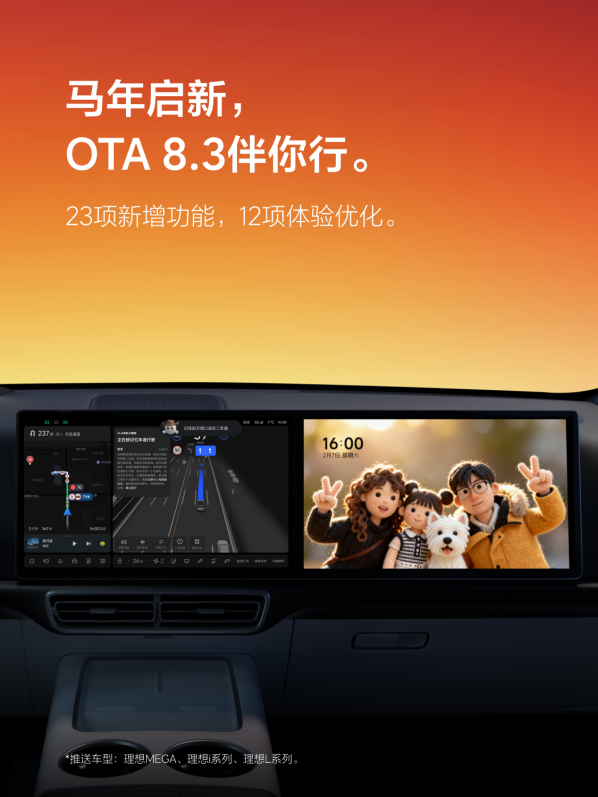
理想汽车OTA 8.3升级 新增超充站状态展示等23项功能
Zhong Guo Zhi Liang Xin Wen Wang· 2026-02-10 04:24
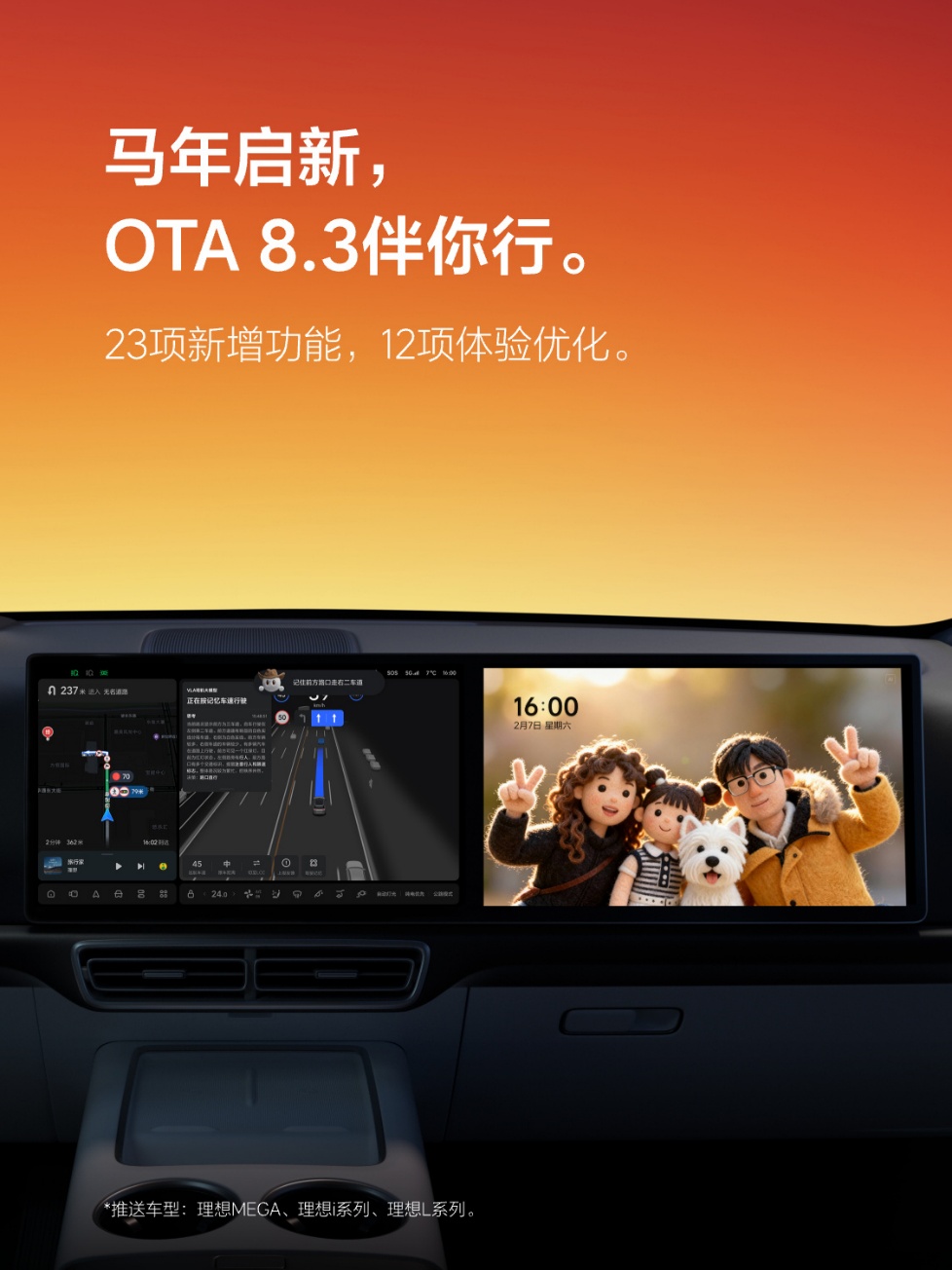
Core Insights - Li Auto has released the OTA 8.3 version, introducing 23 new features and 12 experience optimizations across various dimensions including smart driving, charging, vehicle interaction, and entertainment, applicable to models such as Li MEGA, Li L series, and Li i series [1] Group 1: Charging and User Experience - The upgrade includes a real-time display feature for Li Supercharging station status, helping users check charging station conditions during peak times to avoid long queues [3] - Electric vehicle users can now remotely activate charging preheating or precooling via the Li Auto App to enhance charging speed and experience [3] Group 2: Smart Driving Enhancements - The VLA driver model has received algorithm upgrades for lane change decision-making accuracy and now includes intersection speed and lane memory capabilities, allowing vehicles to learn drivers' habits at specific intersections to improve commuting efficiency [6] - For closed park scenarios, the AD Max model has added a parking fee reminder feature when exiting, in collaboration with Alipay, to optimize the exit experience [6] Group 3: Entertainment and Personalization Features - The Li L series and Li MEGA have introduced an art frame feature, allowing users to upload images and use AI technology to create personalized static or dynamic screensavers, with some templates adapting to the vehicle's color [9] - New alert sounds have been unlocked for the Li L series and Li MEGA, suitable for various notification scenarios [9] - The OTA update has added local audio and video playback capabilities, supporting direct reading of mainstream audio and video formats from USB drives, and introduced a Unity game virtual controller feature, enabling passengers to connect their phones to the vehicle's system as controllers without needing to purchase physical ones [9]
李想:all in AI是为了更好造车
Jing Ji Guan Cha Wang· 2026-02-05 09:44
Core Viewpoint - The chairman and CEO of Li Auto, Li Xiang, emphasized that the company's commitment to "all in AI" is not a deviation from its core automotive business, but rather a strategy to enhance vehicle quality and move closer to the ultimate form of "robotic" vehicles [1] Group 1: Technological Development - Li Auto has focused on the development of various technologies over the past decade, including perception systems, operating systems, central domain controllers, chips, and large models, with the aim of improving overall vehicle capabilities rather than just showcasing individual technologies [1] - The company has successfully developed and mass-produced technologies such as end-to-end autonomous driving large models, Star Ring OS, and VLA driver large models [1] Group 2: Commitment to Automotive Excellence - In response to concerns about whether the focus on AI neglects the automotive aspect, Li Xiang stated that embodied intelligence must be integrated into a well-designed vehicle, and 70% of his time is still dedicated to the automotive core [1] - The upcoming new Li Auto L9 will further implement the concept of "vehicle as an intelligent entity," leveraging a complete technology stack for proactive perception, understanding, and service [1] Group 3: Future Outlook - Looking ahead to 2026, Li Auto plans to enter its second decade, continuing to leverage AI capabilities to enhance vehicle product evolution [1]
理想的VLA,不只是辅助驾驶
Jin Rong Jie· 2026-01-22 09:22
Core Insights - The introduction of the VLA (Visual-Language-Action) driver model by Li Auto in 2025 marks a significant leap in AI's understanding of the physical world, moving beyond traditional assisted driving to a more advanced form of intelligent interaction [1][9][14] Group 1: Evolution of Assisted Driving - Li Auto's evolution in assisted driving reflects the technological advancements and cognitive deepening within China's smart automotive industry, transitioning from rule-based systems to AI-driven models [3][6] - The shift from "imitation" to "thinking" in driving models highlights the limitations of earlier systems, which relied heavily on human-engineered rules and lacked deep reasoning capabilities [3][6] - The introduction of the VLA model aims to overcome the communication barriers and slow reasoning speeds that hindered previous models, enhancing the overall performance of assisted driving [6][10] Group 2: VLA Technology and Its Implications - The VLA model is positioned as a foundational technology for the next generation of AI systems, transforming vehicles from passive tools into proactive service robots [9][12] - Li Auto's commitment to the VLA model is supported by a vast dataset from over 1.5 million vehicles, enabling a data loop that enhances the model's training and performance [6][10] - The VLA model's ability to exhibit "human-like" behaviors signifies a shift towards a more intuitive interaction between humans and vehicles, allowing for voice commands and complex decision-making [7][10] Group 3: Future of the Automotive Industry - The ongoing development of the VLA model is expected to lead to the emergence of "automobile robots," capable of achieving higher levels of automation and intelligence [12][14] - Li Auto's exploration of VLA technology is influencing other leading companies in the industry, indicating a broader trend towards integrating large-scale data and advanced algorithms into automotive systems [12][14] - The ultimate goal of the assisted driving industry may evolve from merely achieving "autonomous driving" to creating mature embodied intelligent products, marking a new era in the automotive and AI sectors [12][14]
加码智能化投入,理想正式成立美国研发中心|36氪独家
3 6 Ke· 2025-12-18 07:02
Core Insights - Li Auto is establishing an AI R&D center in Silicon Valley to enhance its smart technology development, focusing on advanced driver assistance systems and recruiting high-end algorithm talent [1][2] - The expansion of Li Auto's R&D capabilities aligns with its global strategy, which includes existing centers in Germany and China, bringing the total to four R&D centers worldwide [1] - The competition in the smart driving sector is intensifying, with major players like Huawei and Xiaopeng Motors also investing heavily in autonomous driving technologies [3][6] Group 1: Li Auto's Strategic Moves - Li Auto's new Silicon Valley center aims to upgrade its previous small R&D team to a full-fledged center, emphasizing the importance of proximity to cutting-edge AI talent [1] - The company has already established R&D centers in Germany and has two domestic centers in Beijing and Shanghai, focusing on core technology breakthroughs and vehicle development [1] - The establishment of the AI center is part of Li Auto's broader strategy to evolve into an "AI company" over the next decade, with a focus on integrating AI into all business operations [6] Group 2: Competitive Landscape - The establishment of R&D centers in Silicon Valley by Chinese EV companies like Li Auto, NIO, and Xiaopeng Motors indicates a significant escalation in the competition for smart vehicle technology [2][6] - Xiaopeng Motors has a well-established North American team that plays a crucial role in developing its autonomous driving technology, highlighting the importance of sustained investment in R&D [4][5] - The race for advanced driver assistance systems is marked by significant technological advancements, with companies like Huawei and Xiaopeng Motors already deploying L3-level autonomous driving solutions [3][6]
加码AI投入,理想正式成立美国研发中心
3 6 Ke· 2025-12-18 02:08
Group 1 - Li Auto is establishing an AI R&D center in Silicon Valley to enhance its smart technology development, with recruitment already underway [1][2] - The new center will focus on advanced driver assistance systems and aims to attract high-end talent with cutting-edge AI backgrounds [1][2] - Li Auto's global strategy includes establishing R&D centers in key international markets, with existing centers in Germany and China [2] Group 2 - The competition in automotive intelligent driving is intensifying, with Huawei and Li Auto both advancing their autonomous driving technologies [3] - Li Auto's VLA driver model, which integrates visual-language-action modeling, aims to improve the vehicle's understanding of complex scenarios [3][6] - The shortage of AI talent, particularly those with expertise in both AI models and autonomous driving, makes Silicon Valley a critical location for talent acquisition [3][6] Group 3 - Xpeng Motors has a well-established North American R&D team that plays a significant role in developing its autonomous driving technology [4] - Xpeng's Foundation Model, with a parameter count of 72 billion, is being developed to enhance its AI capabilities, contrasting with Li Auto's VLA model at 4 billion parameters [5] - Li Auto is shifting its strategic focus towards becoming an AI company, establishing an AI technology committee to integrate AI into all business operations [5][6] Group 4 - The establishment of the Silicon Valley R&D center represents Li Auto's commitment to advancing its AI capabilities and staying competitive in the rapidly evolving automotive industry [6] - The competition among Chinese automakers is shifting from traditional sales battles to a race for AI innovation and talent acquisition [6]
理想汽车推出首款“穿戴机器人” 三个维度推进“具身智能”建设
Zhong Guo Jin Rong Xin Xi Wang· 2025-12-17 10:26
Core Viewpoint - Li Auto has launched AI glasses Livis, marking a significant step towards the vision of becoming an embodied intelligence company, integrating advanced capabilities into existing machinery [1][2] Product Dimension - Li Auto does not position itself as an electric vehicle manufacturer or a smart terminal producer, but rather as an "embodied intelligence" enterprise, aiming to avoid unnecessary competition based on parameters and configurations [1][2] Technology Dimension - The company emphasizes deep self-research to build an AI system that includes perception, models, operating systems, computing power, and the physical body [2][3] - The 3D ViT technology aims to enhance perception capabilities, potentially increasing effective distance by 2-3 times compared to human vision, addressing over 50% of common issues in assisted driving [2][3] - The self-developed M100 chip is designed to tackle various challenges faced by embodied intelligence [3] Organizational Dimension - Li Auto has reverted to a startup management model to enhance agility and efficiency, moving away from a professional manager governance system that was adopted as the company scaled [4][5] VLA Model Capabilities - The VLA (Vision-Language-Action) model presents five core capabilities: spatial understanding, reasoning, communication and memory, behavior, and iteration, enhancing user experience through safety, comfort, and natural interaction [6][7][8] - The model's reasoning ability allows for real-time decision-making at a frame rate exceeding 10Hz, improving driving decisions [6][7] - The VLA model is positioned as a pathway to higher levels of autonomous driving, with rapid iteration expected due to foundational capabilities in algorithms, computing power, and data [8]

理想汽车:L4级自动驾驶实现,将是行业的“iPhone 4时刻”
Mei Ri Jing Ji Xin Wen· 2025-12-11 12:43
Core Insights - The global automotive industry is undergoing a profound transformation driven by artificial intelligence (AI) technology, reshaping every aspect from product forms to user experiences and business models [1][2]. Group 1: AI's Impact on the Automotive Industry - In the next 5 to 10 years, AI will fundamentally reshape the automotive industry, transitioning vehicles from traditional transportation tools to "space robots" in the AI era [2]. - The core of competition will shift from hardware manufacturing to software and AI technology, necessitating a comprehensive capability that includes models, computing power, operating systems, and hardware [2]. Group 2: User Experience Changes - AI will elevate the user experience from being an "assistive tool" to a "productive tool," allowing users to be completely liberated from driving tasks [3]. - Natural human-machine interaction will enable users to communicate with vehicles using natural language, making complex commands easily executable [3]. - AI aims to provide a safer and more comfortable experience than human drivers by aligning with human driving habits and values [3]. Group 3: Levels of Autonomous Driving - Level 3 (L3) autonomous driving is viewed as a necessary transitional phase towards Level 4 (L4) and is not considered a "pseudo-proposition" [3]. - Achieving L4 autonomy requires breakthroughs in core technologies, substantial investment in computing resources, and a large-scale data collection for continuous model training [4]. Group 4: Future Vehicle Design - The company plans to launch its first L4-level autonomous vehicle by around 2028, which will fundamentally change vehicle design by eliminating traditional driving components [6]. - This shift will transform cars from "driving machines" into pure "living" or "working spaces" [7]. Group 5: Challenges and Opportunities - Significant technical challenges remain for L4-level autonomous driving, including reliability, safety, redundancy design, and cybersecurity [8]. - Market acceptance, legal regulations, and insurance liability are critical factors that will influence the commercialization of fully autonomous vehicles [8]. Group 6: AI Model Generalization - The key to overcoming the limitations of point-to-point AI models lies in developing a universal AI foundational model that can be applied across various scenarios [9]. - The company is focused on developing a VLA foundational model to create a "world model" that can be applied in manufacturing and supply chain management [9]. Group 7: Talent and Organizational Structure - To adapt to the demands of the AI era, the company has restructured its human resources department to align talent strategy with overall business strategy [13]. - The organization is transitioning from a traditional functional structure to a more agile matrix structure to enhance collaboration and innovation [13].
硅基革命重构竞争格局:中国智驾的攻与守
Mei Ri Jing Ji Xin Wen· 2025-12-02 09:00
Group 1 - The global automotive industry is facing unprecedented challenges, with over 55,000 jobs lost in the past two years in Germany alone, and more than 100,000 layoffs reported worldwide in the last year [1][2] - In contrast, China's automotive sector is thriving, with significant advancements in smart electric vehicles and a robust supply chain, positioning itself as a global leader in the industry [1][3] Group 2 - 2025 is seen as a critical year for automotive manufacturers, with a focus on survival in the face of electrification and the need for innovation in smart technologies [2][10] - China's automotive industry has rapidly evolved, achieving over 30 million annual vehicle sales and over 50% penetration of new energy vehicles, showcasing its ability to catch up and lead in the electric transformation [3][10] Group 3 - Major automotive companies are balancing tradition and innovation, with firms like Mercedes-Benz adapting to local markets while maintaining high safety and quality standards [4][5] - The innovation paths of foreign and Chinese companies are converging, with a blend of cautious planning and agile execution becoming the norm in the industry [5][6] Group 4 - A significant debate is ongoing regarding the technical routes for intelligent driving, with different approaches such as Tesla's vision-based system and Huawei's lidar-based system highlighting diverse innovation strategies [6][7] - The introduction of mandatory safety standards for L2-level driving assistance in China marks a shift towards a more regulated and safety-focused industry [8][9] Group 5 - The Chinese government is facilitating the development of L3-level autonomous driving, with expectations for standards to be established soon, indicating a strong push towards advanced automated driving technologies [10][11] - The competitive landscape in China's smart driving sector is characterized by a diverse ecosystem of companies, fostering innovation and adaptability across various scenarios [10][11]



左手AI,右手生态
Zhong Guo Qi Che Bao Wang· 2025-12-01 01:44
Core Insights - The automotive industry is transitioning from traditional hardware competition to a new era driven by AI, which is deeply integrated into vehicle control and intelligent driving, transforming cars into essential "smart partners" and "ecological hubs" in daily life [2][12] AI Empowerment and Breakthroughs - AI technology has penetrated various aspects of the automotive sector, including intelligent driving and smart cockpits, showcasing significant advancements in both technical depth and application breadth [3] - The shift towards software-defined intelligent platforms is evident, with companies like Li Auto and Xiaomi showcasing advanced driver assistance systems that enhance user experience and mimic human decision-making [3][4] Market Accessibility and Cost Reduction - The price range of 120,000 to 150,000 yuan has emerged as a new battleground for intelligent driving, with companies like GAC Toyota and Dongfeng Nissan introducing advanced features at lower price points due to a significant drop in core component costs [4] - The cost of automotive-grade lidar has decreased from approximately 8,000 yuan in 2023 to below 3,000 yuan, indicating a trend towards more affordable intelligent driving technologies [4] Intelligent Cockpit Innovations - AI models are transforming traditional vehicles into emotionally aware travel companions, as seen in the Roewe M7 DMH's AI cockpit system, which offers advanced interaction capabilities and personalized user experiences [5] - The system can understand complex commands and remember user preferences, enhancing the overall driving experience [5] New Automotive Ecosystem - AI serves as a core hub connecting various elements of a vast automotive ecosystem, integrating travel services, energy networks, hardware, software applications, and urban infrastructure [7] - This integration breaks down the traditional isolation of vehicles, creating a more interconnected and efficient transportation network [7] Integrated Smart Mobility - AI is the foundational technology for building an integrated "vehicle-road-cloud" smart mobility ecosystem, enhancing collaborative driving and optimizing traffic network efficiency [8] - In the energy sector, AI is transforming vehicles into active participants in smart energy networks, improving battery management and charging efficiency [8] Comprehensive User Experience - AI is becoming the central engine for connecting "people-vehicles-home" ecosystems, evolving cars from mere transportation tools to personal mobility control centers [9] - The shift in human-machine interaction is moving towards an AI-centric model, where AI understands user intentions and provides tailored services [9] Industry Transformation - The dual drive of AI and ecosystem integration is reshaping the global automotive industry's competitive landscape, requiring participants to reassess their roles and value [11] - The focus of competition has shifted from mechanical performance to intelligence and ecosystem integration, with new business models emerging that emphasize lifecycle value rather than one-time hardware sales [11] Future Outlook - The automotive industry is moving from a horsepower competition to one focused on computing power and collaboration, with AI as the driving force behind this transformation [12] - Companies must understand these trends and build comprehensive capabilities to thrive in the evolving automotive landscape [12]
