
量化指增

Search documents
当“稳健”遇上“算法”:险资入“量”生态链调查
Zhong Guo Zheng Quan Bao· 2026-02-04 15:52
Core Viewpoint - Insurance funds are facing allocation pressure due to low interest rates and asset mismatch, leading some small and medium-sized insurance institutions to explore quantitative private equity through professional asset management channels [1][3] Group 1: Insurance Funds and Quantitative Private Equity - Insurance funds are primarily driven by a rigid liability cost of 3% to 4%, focusing on "safe returns above cost coverage" rather than high-volatility returns [3] - There is a cautious attitude among large insurance asset management institutions towards investing in quantitative private equity due to perceived high risks, although some smaller institutions have begun to experiment [3][4] - Leading quantitative private equity firms are adapting their strategies to meet the stringent risk control requirements of insurance funds, including limiting stock selection to those that can be hedged with index futures [4] Group 2: MOM Model as a Compliance Bridge - The MOM (Manager of Managers) model has emerged as a mainstream compliance bridge, allowing insurance funds to invest in a single asset management plan managed by a broker, which then hires multiple quantitative private equity firms as investment advisors [6] - The MOM model is valued for its high level of professionalization, flexibility in strategy customization, and enhanced compliance by isolating insurance funds from private equity [6] - Challenges within the MOM model include operational delays in order execution and restrictions on certain stocks, which can complicate the investment process [6][7] Group 3: Future Expectations and Regulatory Clarity - There is a growing consensus among market participants that collaboration between insurance funds and quantitative private equity is a strategic optimization in a low-interest and asset mismatch environment [9] - Industry insiders are calling for clearer and unified regulatory rules for insurance fund investments in quantitative products to create a sustainable ecosystem [9][10] - Recommendations include ensuring compliance through partnerships with licensed institutions and establishing dynamic evaluation mechanisms for private equity managers [10]
百亿量化超额胜率榜揭晓!明汯、顽岩、蒙玺等领衔!宽德、衍复、天演等上榜!
私募排排网· 2026-01-30 03:35
Core Viewpoint - Quantitative investment products have become a significant choice for investors seeking excess returns amid market fluctuations, particularly among large private equity firms with mature strategies and technical capabilities [3] Group 1: Performance Metrics - The average excess return for quantitative products under large private equity firms (over 10 billion) is 13.90% for 2025, with an excess win rate of 61.01% [4] - The average return for quantitative products across different asset sizes shows that those over 100 billion have the highest average return of 38.60% [4] - The overall average excess return across all private equity products is 11.33%, with an average excess win rate of 56.20% [4] Group 2: Top Performers in Different Indices - In the CSI 300 index enhancement category, Mingxuan Investment leads with an excess win rate of 66.25% and an average return of 30.05% for 2025 [5] - The top products in the CSI 500 index enhancement category include Wanyan Asset with a leading excess win rate of 66.12% and an average return of 50.84% [8] - For the CSI 1000 index enhancement, Micron Bo Yi leads with an impressive excess win rate of 72.71% and an average return of 55.96% [11] Group 3: Notable Companies and Strategies - Mingxuan Investment, established in 2014, has a strong team with backgrounds from top universities and has successfully applied AI technology in financial markets [7] - Wanyan Asset, founded in 2015, focuses on high liquidity assets and has made significant investments in AI to enhance market prediction accuracy [10] - Micron Bo Yi, also established in 2015, utilizes a data-driven approach and has a team of experts from prestigious institutions, focusing on extracting effective information from vast data [13] Group 4: Other Noteworthy Products - In the category of other index enhancements, Montrose Investment leads with a high excess win rate of 65.83% and an average return of 46.44% [14] - Square and Investment's product in the CSI 2000 index enhancement category has shown a strong performance with an excess win rate of 43 out of 53 weeks in 2025 [16]


都是做量化指增,公募和私募谁更牛?
雪球· 2026-01-27 08:57
Core Viewpoint - The article discusses the performance differences between private equity and public equity funds, highlighting that 2025 is expected to be a significant year for quantitative index enhancement, with both private and public funds showing impressive results [2]. Group 1: Performance Comparison - Public equity funds, represented by the CSI 1000 index, achieved an average return of 39% last year, with minimal performance variation among funds [5]. - Private equity funds outperformed public funds, averaging a return of 56%, but exhibited significant performance dispersion, with top products yielding up to 70% [6][7]. Group 2: Investment Strategy Differences - The core difference lies in the approach: public funds prioritize "discipline," while private funds focus on "efficiency" throughout the investment process [9]. - Public funds are heavily regulated, requiring at least 80% of their capital to be invested in index constituent stocks, ensuring safety and stability [11]. - Private funds have greater flexibility, theoretically able to select from over 4,000 stocks, although many still impose self-restrictions on constituent stock proportions to manage investor expectations and product volatility [13][15]. Group 3: Operational Focus - In the operational phase, public funds have limited deviation from their set parameters, focusing on fine-tuning within established guidelines [18]. - Private funds, benefiting from higher pre-investment flexibility, often monitor industry and market capitalization deviations to manage risk and seek excess returns [20][22]. - An example illustrates that if a private fund's consumer stock allocation exceeds its self-imposed limit, it will adjust its holdings to remain within the defined range [24]. Group 4: Post-Investment Review - Public funds emphasize annualized tracking error to ensure net asset value fluctuations align closely with index movements [27]. - Private funds prioritize excess returns and are more tolerant of tracking error, reflecting their different operational philosophies [29]. Group 5: Resource Allocation - Private funds invest heavily in algorithms, hardware, and data to gain speed and information advantages, while public funds have more limited resources due to diverse product lines [36][38]. - The compensation structure for private fund research personnel is closely tied to product performance, attracting top quantitative talent [40]. - Public funds have less flexibility in strategy implementation, lacking the ability to utilize intraday trading or derivatives to enhance returns [42]. Group 6: Investment Preference - For investors seeking "stable enhancement" with modest returns above the index, public equity funds are a more straightforward choice [44]. - Conversely, for those willing to accept higher volatility and performance variability in pursuit of greater excess returns, private equity funds are more advantageous [44].

2025年公募混合类理财榜单出炉!12只产品收益率超20%
2 1 Shi Ji Jing Ji Bao Dao· 2026-01-16 09:12
Market Performance - The A-share market showed strong overall performance in 2025, with major indices all closing higher. The ChiNext Index led with a 49.57% increase, followed by the Shenzhen Component Index at 29.87%, the Shanghai Composite Index at 18.41%, and the CSI 300 Index at 17.66% [2] - The STAR 200 Index surged by 59.31%, and the ChiNext 50 Index rose by 57.45% [2] - The Hong Kong stock market also performed well, with the Hang Seng Index rising by 27.77%, marking its largest annual increase since 2017. The Hang Seng Tech Index increased by 23.45%, and the Hang Seng China Enterprises Index rose by 22.27% [2] - In contrast, the bond market faced challenges, with the 10-year government bond yield rising above 1.9%, ending a two-year bull market [2] Mixed Public Fund Performance - As of December 31, 2025, there were 895 mixed public funds in existence, with an average net value growth rate of 4.52% for the year [3] - Over 70% of the products had a net value growth rate between 1% and 5%. Twelve products exceeded a 20% growth rate, while 38 products had growth rates between 10% and 20%. Two products experienced negative growth [3] - Ningyin Wealth Management and Huihua Wealth Management led in average returns, both exceeding 10% for the year [3] - The top ten performing products came from six different wealth management companies, with Ningyin Wealth Management having four products on the list [3] Product Analysis - The "Fuli Xingyi Intelligent Quantitative Index Growth 3-Month Minimum Holding Period No. 1 Mixed Wealth Management Product A" from Xingyin Wealth Management is classified as a medium-high risk product, with 43.06% in equity holdings and 53.21% in cash and bank deposits as of Q3 2025 [4] - The product is expected to focus on high-grade credit bonds and technology growth sectors in the equity market [4] - The "CITIC Wealth Management Zhi Rui Win Progress No. 1 Net Value Type RMB Wealth Management Product" from Xinyin Wealth Management is also a medium-high risk product, with 47.73% of its investments in public funds and 25.78% in equity investments as of Q3 2025 [4] - This product includes gold stock ETFs in its top ten assets, which may benefit from a strong performance in the gold sector [4]
这些主动量化基金,给了我2025年的惊喜~
Sou Hu Cai Jing· 2025-12-23 08:21
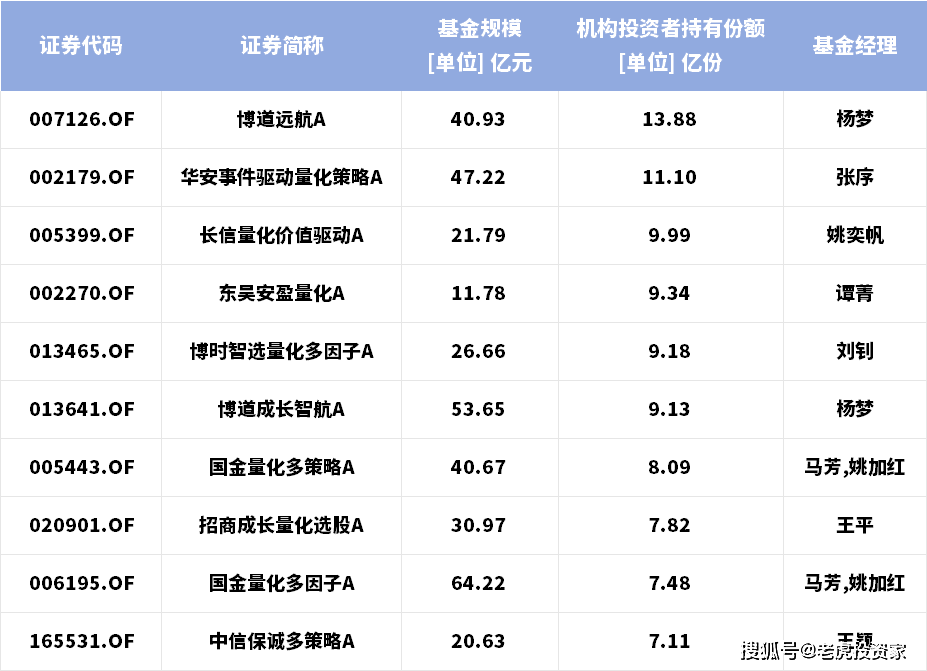
Core Viewpoint - The explosive growth of AI has significantly boosted the popularity of actively managed quantitative funds, which have shown the ability to outperform the market while reducing volatility risk [2][3]. Group 1: Market Trends - The total share of actively managed quantitative funds reached 80.5 billion units by the end of Q3 2025, marking a 27% increase from the previous year [2]. - Institutional investors hold 46.5 billion units of these funds, accounting for over 70% of the total shares [3]. Group 2: Fund Performance - The "Huaan Event-Driven Quantitative Strategy A" fund has outperformed the CSI 300 index for six consecutive years, with a significant lead in 2025 [6]. - In 2025, the fund achieved a return of 35.77%, compared to 14.04% for its benchmark and 17.20% for the CSI 300 [8]. - The fund's risk-return profile is strong, with annualized returns of 33.02% and a maximum drawdown of -9.96%, outperforming peers in all six key metrics [10]. Group 3: Fund Management - The success of the "Huaan Event-Driven" fund is attributed to its manager, Zhang Xu, who employs a multi-faceted strategy that includes industry rotation and event-driven factors [13][18]. - The "Guojin Quantitative Multi-Factor A" fund, managed by Ma Fang, has also shown resilience, achieving positive returns in 2022 and 2023 despite market downturns [26][29]. Group 4: Investment Strategies - Actively managed quantitative funds are increasingly favored for their ability to adapt to market conditions, utilizing diverse strategies to capture excess returns [18][29]. - The focus on risk-adjusted returns and the ability to navigate different market environments are key factors driving institutional interest in these funds [22][23].
量化指增,占据下一个C位?
21世纪经济报道· 2025-12-18 11:11
Core Viewpoint - The article emphasizes the rapid growth and potential of index-enhanced funds in the public fund industry, driven by regulatory support and technological advancements, particularly in AI, which enhances the ability to achieve stable excess returns [1][2][3]. Industry Overview - The public fund industry is undergoing transformation due to ongoing high-quality development, with new regulations impacting the landscape of bond funds and active equity funds [1]. - As of November, 160 new index-enhanced funds were established in 2023, with a total issuance scale nearing 900 billion [2]. - The total scale of index-enhanced funds reached 2,622 billion by the end of September, marking a 23.34% increase from the previous year [2]. Technological and Regulatory Support - The growth of index-enhanced funds is attributed to both market factors and dual support from technology and regulation, with AI enabling better performance and regulatory emphasis on performance benchmarks [2]. - Index-enhanced funds are characterized by strict stock composition ratios and tracking error limits, aligning well with regulatory policies [2]. Company Performance - Tianhong Fund has significantly expanded its index-enhanced product line, with a 44.85% increase in share and a 70.21% increase in scale compared to the previous year [3]. - Over 90% of investors holding Tianhong's index-enhanced products for more than six months have outperformed the corresponding performance benchmarks [3]. Product Matrix - Tianhong Fund has established a comprehensive product matrix, including both broad-based and industry-specific index-enhanced funds, covering major indices and sectors [4][8]. - The company has launched two product lines: Classic Index Enhancement (pursuing long-term excess returns) and Stable Index Enhancement (focusing on high win rates) [8]. Performance Metrics - Tianhong's index-enhanced funds have shown consistent excess returns, with the Tianhong CSI 1000 Index Enhanced Fund achieving a 33.80% excess return over its benchmark in the past three years [11][12]. - The performance of Tianhong's industry-specific index-enhanced funds has also exceeded that of average active funds in the same sectors [13]. AI Integration - Tianhong's quantitative team has integrated AI technologies into their investment processes, enhancing the ability to identify and utilize excess return factors [18][19]. - The use of AI has led to the development of a comprehensive factor network, with over 70% of excess return factors derived from AI learning [18]. Investor Engagement - As of June, Tianhong's index-enhanced funds had 910,000 users, ranking fifth in the industry, with over 96% of the holdings being from individual investors [26]. - The average holding period for Tianhong's index-enhanced products exceeds seven months, significantly longer than the typical one-month holding period for standard index funds [26].

量化指增,占据下一个C位?
远川投资评论· 2025-12-18 07:04
Core Viewpoint - The article emphasizes the rapid growth and potential of index-enhanced funds in the public fund industry, driven by regulatory support and technological advancements, particularly in AI, which enhances the ability to achieve stable excess returns [1][2]. Industry Overview - The public fund industry is undergoing transformation due to ongoing high-quality development, with new regulations impacting the landscape of bond funds and active equity funds [1]. - As of November, 160 new index-enhanced funds have been established in 2023, with a total issuance scale nearing 90 billion, reflecting a 23.34% increase compared to the end of the previous year [2]. Company Performance - Tianhong Fund has significantly expanded its index-enhanced business, with a 44.85% increase in market share and a 70.21% increase in scale compared to the end of last year [3]. - Over 90% of investors holding Tianhong's index-enhanced products for more than six months have outperformed the corresponding fund performance benchmarks [3][12]. Product Line and Strategy - Tianhong Fund has developed a comprehensive product line in index enhancement, including both broad-based and industry-specific funds, with a total of 18 quant index-enhanced funds managing over 12 billion [3][5]. - The company has launched two product lines: one focusing on long-term excess returns and the other on stable excess returns with a higher success rate [5][6]. Performance Metrics - Tianhong's index-enhanced products have shown consistent excess returns, with the Tianhong CSI 1000 Index Enhanced Fund achieving a 33.80% excess return compared to its benchmark over three years [8][11]. - The performance of Tianhong's broad-based index-enhanced products has been notably consistent, attributed to a unified quantitative management framework [10]. Technological Integration - Tianhong Fund has integrated AI technology into its quantitative investment strategies, with over 70% of excess factors derived from AI learning [14][19]. - The company employs a diverse and systematic approach to its quantitative research, utilizing advanced algorithms and a comprehensive factor network to enhance investment decision-making [15][20]. Market Position - Tianhong Fund ranks fifth in the industry for the number of users in index-enhanced funds, with over 910,000 users as of June, and maintains a leading position in terms of individual investor holdings [21].

量化指增,占据下一个C位?
阿尔法工场研究院· 2025-12-18 00:06
Core Viewpoint - The continuous promotion of high-quality development in public funds is reshaping the industry, with new regulations indicating profound changes in the product structure and management models of actively managed equity funds [1][2]. Group 1: Industry Trends - The number of index-enhanced funds has accelerated in 2023, with 160 new funds established by the end of November, totaling nearly 90 billion yuan in issuance [2]. - The total scale of index-enhanced funds reached 262.2 billion yuan by the end of September, marking a 23.34% increase compared to the end of the previous year, outpacing the growth rate of actively managed equity funds [2]. - The rapid development of index-enhanced funds is supported by both market factors and favorable regulatory conditions, emphasizing the importance of performance benchmarks [2]. Group 2: Company Performance - Tianhong Fund has significantly expanded its index-enhanced business, with a 44.85% increase in market share and a 70.21% increase in scale compared to the end of the previous year [3]. - Over 90% of investors holding Tianhong's index-enhanced products for more than six months have outperformed the corresponding fund performance benchmarks [3][16]. - By the end of the third quarter of 2025, Tianhong Fund's quant index-enhanced funds reached 18, with a total management scale exceeding 12 billion yuan [5]. Group 3: Product Offerings - Tianhong Fund has established a comprehensive product line in the index-enhanced sector, covering major indices and offering both classic and quantitative strategies [8][9]. - The company has launched two product lines: the classic index-enhanced line focusing on long-term excess returns and a second line targeting high win rates with stable excess returns [8]. - Tianhong's industry-specific index-enhanced products focus on key sectors such as technology, consumption, medicine, high-end manufacturing, and new energy, providing tools for capturing structural excess opportunities [9]. Group 4: Performance Metrics - Tianhong's index-enhanced products have demonstrated consistent excess returns, with the Tianhong CSI 1000 Index Enhanced Fund achieving a 33.80% excess return compared to its benchmark over three years [10][11]. - The performance of Tianhong's index-enhanced funds has shown high consistency across different market styles and capitalizations, indicating a robust systematic investment capability [13]. - The company has successfully replicated its systematic investment approach in industry-specific index-enhanced products, with excess returns ranging from 5% to 29% since inception [13]. Group 5: Technological Integration - Tianhong Fund has integrated AI technology into its quantitative investment processes, enhancing its ability to capture excess returns through advanced data analysis and machine learning [18][19]. - The quant team has developed a comprehensive factor network and employs various AI models to improve investment decision-making and risk management [19][22]. - The use of AI in quantitative index-enhanced products is seen as a potential competitive advantage in a market increasingly focused on passive investment strategies [24].
透视北证50投资风口|中加基金持续掘金“专精特新”核心资产
中国基金报· 2025-11-13 03:04
Core Insights - The article emphasizes the significant role of the Beijing Stock Exchange (BSE) in empowering innovative small and medium-sized enterprises (SMEs) amidst a backdrop of policy benefits and accelerated innovation [1] - The BSE has become a core window for observing the growth of Chinese SMEs and the deepening of capital market reforms, with nearly 950,000 qualified investors and various institutional funds creating a diverse ecosystem [1] Investment Opportunities - The BSE 50 Index, consisting of 50 representative stocks, is highlighted as a key investment direction, providing precise coverage of innovative SMEs and including many "hidden champions" in niche markets [1][4] - As of mid-2025, 40% of the BSE 50 constituents are specialized and innovative enterprises, and 88% are high-tech companies, indicating a strong focus on growth potential [1] Performance Metrics - The BSE 50 Index has shown a nearly 50% increase in 2025, outperforming major A-share indices and attracting significant investor attention [4][6] - The trading volume of the BSE 50 Index reached 44 times that of its initial establishment in 2022, indicating a substantial increase in liquidity [3][11] Policy Support - Continuous policy support is identified as a core driving force behind the BSE 50 Index's strength, with various reforms aimed at enhancing market ecology and efficiency [7] - The introduction of a new ETF for the BSE 50 is expected to inject over 20 billion yuan into the market, boosting investor confidence [7] Sector Focus - The BSE 50 Index primarily invests in strategic emerging industries such as power equipment, machinery, and electronics, which are crucial for traditional industry transformation and economic growth [8] - The focus on "hard tech" sectors like AI and renewable energy is expected to unlock growth potential in response to policy and market demand [8] Institutional Participation - Institutional funds have accelerated their investment in the BSE, with public funds holding over 10 billion yuan in BSE market capitalization by the end of Q3 2025, reflecting a significant year-on-year increase [9] - The diverse ecosystem formed by nearly 950,000 qualified investors and institutional funds has significantly enhanced market liquidity [9] Investment Strategies - The article discusses the introduction of the Zhongjia BSE 50 Enhanced Index Fund, which aims to balance risk and return through a dual strategy of passive tracking and active enhancement [17] - The fund employs a quantitative model that combines human expertise and AI to optimize stock selection and reduce volatility, catering to both conservative and aggressive investors [18][20]

量化指增多头保护策略悄然走红
Zhong Guo Zheng Quan Bao· 2025-09-21 20:17
Core Insights - The A-share market has seen active performance in technology growth and small-cap stocks, highlighting the high volatility and potential risks associated with high returns [1] - A new quantitative strategy focusing on "quantitative enhancement with downside protection" has gained popularity among private equity firms, utilizing stock selection and derivatives for risk management [1][2] Strategy Innovation - The increasing market volatility and demand for stable returns have led to the innovation of quantitative long protection strategies, differentiating from traditional quantitative neutral strategies [1][2] - Various private equity firms are employing different methods for options hedging and risk exposure management, leading to the evolution of these strategies [1][3] Competitive Landscape - FOF institutions and quantitative private equity firms are competing in the quantitative long protection strategy space, each exploring unique implementation paths based on their strengths [3][4] - Mainstream approaches include using off-market options for lower-cost protection and subjective timing for on-market options to hedge risks [3][4] Market Demand - There has been a noticeable increase in inquiries for quantitative long protection strategy products, particularly from high-net-worth clients seeking to balance market participation with risk control [4][6] - The introduction of new strategies reflects an upgrade in management capabilities, transitioning from pure alpha chasing to a comprehensive management approach [5][6] Future Outlook - The development of quantitative long protection strategies is seen as having significant value and potential, aligning with the trend of providing absolute returns to investors [6] - The strategies are expected to gain further traction as more index options become available and market activity increases, optimizing hedging costs [6]