
铝价支撑

Search documents
铝:美国加征关税后的市场变化
Wu Kuang Qi Huo· 2025-11-27 01:17
Report Summary 1) Report Industry Investment Rating The provided content does not mention the industry investment rating. 2) Core Viewpoints of the Report - After the implementation of US aluminum tariffs in 2025, the import volumes of primary aluminum, aluminum products, and aluminum derivatives in the US decreased. The tariffs not only suppressed US demand but also led to the consumption of the country's aluminum inventory. The change in trade flow caused by the tariffs did not result in inventory accumulation outside the US due to the increased demand in non - US countries [2][4]. - Currently and for some time in the future, the rising spot premium caused by the consumption of primary aluminum inventory in the US makes exporting to the US more advantageous again. Primary aluminum from Canada and non - US countries and regions is expected to flow more to the US, reversing the trade flow from April to August. Considering the sustained consumption growth and limited new production capacity, the supply - demand relationship of primary aluminum outside the US will remain temporarily tight, and global aluminum prices will still be strongly supported [2][22]. 3) Summary According to Related Contents Impact of US Aluminum Tariffs on Domestic Trade - In 2025, the US gradually increased aluminum tariffs. On March 12, the tariff on imported aluminum products was raised to 25%, and on June 4, it was further increased to 50%. On August 15, the scope of aluminum tariffs was expanded [4]. - In August 2025, the US primary aluminum import volume was 74,000 tons, 83,000 tons less than the same period last year. From January to August, the cumulative import volume was 1.221 million tons, 244,000 tons less than the same period last year. The import demand decreased significantly after the tariff implementation. For aluminum alloy, the import volume from January to August was 146,000 tons, with a slight increase month - on - month, and the cumulative import volume decreased only slightly compared with the same period in 2024 [4]. - For aluminum products, from April to August, the average monthly net import volume was 202,000 tons, 28,000 tons less than that from January to March and 56,000 tons less than the average monthly net import volume in 2024. For scrap aluminum, since it was not included in the tariff list, the US import demand was stimulated. From January to August, the net import volume increased by about 72,000 tons. Overall, from January to August, the reduction of imported aluminum element supply in the US was in the range of 400,000 - 500,000 tons, and the US increased the consumption of its own inventory [5]. Impact on International Trade and Market - After the implementation of US aluminum tariffs, Canada's exports to the US decreased significantly. In 2024, Canada exported about 1.828 million tons of primary aluminum to the US and only about 34,000 tons to non - US countries. From January to August 2025, Canada's total primary aluminum export volume decreased by 277,000 tons compared with the same period in 2024, with a decrease of about 432,000 tons in exports to the US and an increase of about 152,000 tons in exports to non - US countries [14]. - From early April to the end of August 2025, the overseas visible inventory of aluminum ingots decreased from about 1.14 million tons to about 1.06 million tons, indicating that the consumption in non - US countries increased and offset the decrease in US import demand [16].
铝锭库存处于低位 沪铝下方支撑较强
Qi Huo Ri Bao· 2025-10-15 23:38
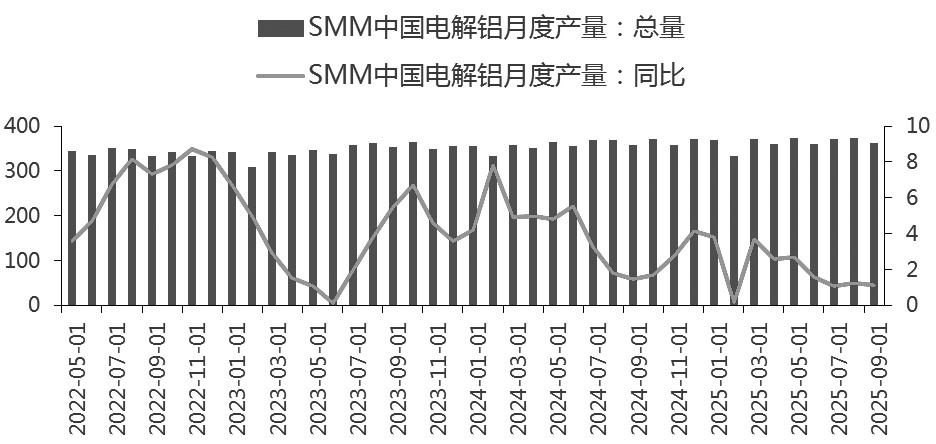
Core Viewpoint - The aluminum market is experiencing a strong support due to low inventory levels and seasonal demand, with expectations of a fluctuating but generally strong trend in aluminum prices moving forward [1][6]. Group 1: Aluminum Price Trends - The main contract for Shanghai aluminum futures reached a peak of 21,205 yuan/ton on October 10, marking a nearly 11-month high, but quickly retreated due to insufficient driving forces [1]. - The aluminum price is expected to maintain a fluctuating upward trend, with resistance at 21,130 yuan/ton and support at 20,650 yuan/ton [6]. Group 2: Production and Inventory - In September, China's electrolytic aluminum production was 3.6148 million tons, a year-on-year increase of 1.14% but a month-on-month decrease of 3.18% [3]. - The aluminum water ratio increased by 1.2 percentage points to 76.3%, leading to a decrease in cast ingot production by 8.67% to 857,000 tons [3]. - As of October 13, the electrolytic aluminum inventory in major markets was 642,000 tons, a slight increase from October 9 but down 4,000 tons year-on-year [4]. Group 3: Cost Dynamics - The average fully loaded cost of domestic electrolytic aluminum in September was 16,488 yuan/ton, down 1.37% month-on-month and 6.58% year-on-year [4]. - The total cost of electrolytic aluminum is expected to decline in October, with an estimated range of 15,800 to 16,200 yuan/ton [5]. Group 4: Automotive Industry Impact - The automotive market showed positive trends in September, with production and sales reaching 3.276 million and 3.226 million units, respectively, marking month-on-month increases of 16.4% and 12.9% [5]. - New energy vehicle sales accounted for 49.7% of total new car sales in September, indicating strong growth in this segment [5]. - The automotive sector is expected to continue growing, supported by favorable policies and increased supply of new products, despite external uncertainties [6].

花旗:上调中国宏桥目标价至25.2港元
Zheng Quan Shi Bao Wang· 2025-07-30 04:32
Group 1 - The core viewpoint of the report is that despite concerns about aluminum demand in the second half of the year, strong capacity utilization in China, limited new supply, and low inventory will support robust aluminum prices [1] - Citigroup has raised the target price for China Hongqiao from HKD 21 to HKD 25.2, maintaining a "Buy" rating [1] - The report has also increased earnings forecasts for 2025 to 2027, reflecting higher alumina prices and lower cost projections [1]