
汽车行业景气度

Search documents
2026年汽车行业景气度展望
2025-11-16 15:36
Summary of the Automotive Industry Conference Call Industry Overview - The automotive industry in China is projected to experience a decline in retail sales by 1% in 2026, with sales expected to drop from 24.54 million units in 2025 to 24.31 million units due to overconsumption in 2025 and reduced vehicle purchase tax incentives [1][2][3] - Market demand is anticipated to shift towards mid to low-priced models, particularly in the 50,000 to 100,000 yuan price range, which is expected to grow by 4% [1][2][3] Key Policy Changes - Significant policy changes are expected in 2026, particularly regarding the scrappage and trade-in subsidies, with 21 cities suspending trade-in subsidies and 16 provinces halting scrappage subsidies [2][4] - Recommendations include maintaining the trade-in and scrappage policies but controlling the subsidy budget between 140 billion to 150 billion yuan, while keeping the vehicle purchase tax reduction at 5% to stabilize the market [5][6] Market Dynamics - The automotive sales structure is expected to adjust, with a longer pre-festival sales period due to the late Spring Festival, typically resulting in 40% higher sales compared to post-festival [3] - The export of Chinese automobiles continues to grow, with passenger car exports accounting for 20% of total exports, despite a decline in the Russian market [3][14] Price Segment Performance - In 2025, the 50,000 to 100,000 yuan and 100,000 to 150,000 yuan price segments performed well, with the former growing from 16% to 20% [6][7] - The market for vehicles priced below 400,000 yuan is experiencing a downward trend, with the segment below 400,000 yuan declining by 3 percentage points [7][8] New Energy Vehicles (NEVs) - NEVs are becoming increasingly competitive in the 100,000 to 150,000 yuan market, with penetration rates rising [9][20] - The high-end electric vehicle segment faces challenges due to new energy consumption standards and tax pressures, while high-end fuel vehicles are seeing significant declines in sales [9][10] Regional Sales Trends - Northern and central-western regions are experiencing faster sales growth, with the northeastern region achieving a 15% growth rate [11][12] - Automotive manufacturers are focusing on lower-tier cities for expansion, as first-tier cities show slower growth [12] Export and International Strategy - Chinese automotive exports are expected to continue growing, with a projected increase of 30-40% in NEV exports [20][21] - Companies are adopting diverse strategies for overseas markets, including establishing CKD factories to mitigate trade barriers [15] Competitive Landscape - The competitive landscape is shifting, with leading private enterprises like BYD gaining strength, while traditional state-owned enterprises are expected to play a significant role in mergers and acquisitions [17][18] - New entrants and established brands are expected to intensify competition, particularly in the NEV sector, with companies like Xiaomi and Huawei increasing their market presence [24][25] Future Outlook - The automotive industry is expected to face challenges from policy changes, market dynamics, and competitive pressures, but opportunities for growth remain, particularly in the NEV segment and lower-tier markets [22][23]

铝锭库存处于低位 沪铝下方支撑较强
Qi Huo Ri Bao· 2025-10-15 23:38
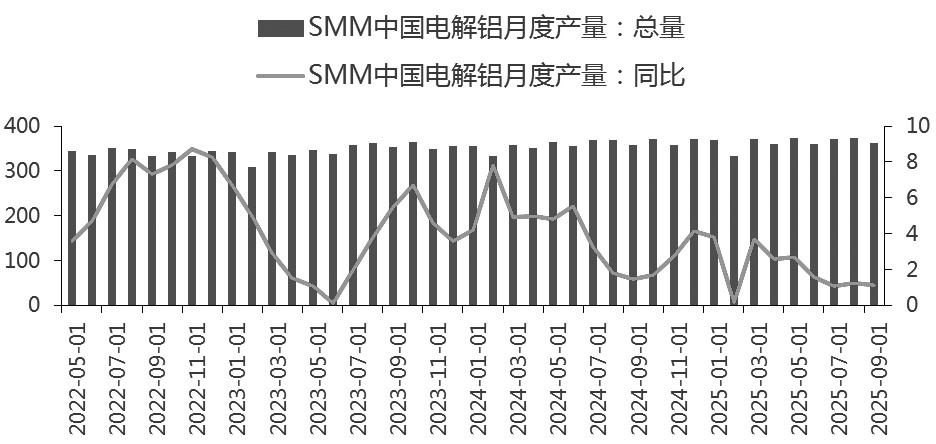
Core Viewpoint - The aluminum market is experiencing a strong support due to low inventory levels and seasonal demand, with expectations of a fluctuating but generally strong trend in aluminum prices moving forward [1][6]. Group 1: Aluminum Price Trends - The main contract for Shanghai aluminum futures reached a peak of 21,205 yuan/ton on October 10, marking a nearly 11-month high, but quickly retreated due to insufficient driving forces [1]. - The aluminum price is expected to maintain a fluctuating upward trend, with resistance at 21,130 yuan/ton and support at 20,650 yuan/ton [6]. Group 2: Production and Inventory - In September, China's electrolytic aluminum production was 3.6148 million tons, a year-on-year increase of 1.14% but a month-on-month decrease of 3.18% [3]. - The aluminum water ratio increased by 1.2 percentage points to 76.3%, leading to a decrease in cast ingot production by 8.67% to 857,000 tons [3]. - As of October 13, the electrolytic aluminum inventory in major markets was 642,000 tons, a slight increase from October 9 but down 4,000 tons year-on-year [4]. Group 3: Cost Dynamics - The average fully loaded cost of domestic electrolytic aluminum in September was 16,488 yuan/ton, down 1.37% month-on-month and 6.58% year-on-year [4]. - The total cost of electrolytic aluminum is expected to decline in October, with an estimated range of 15,800 to 16,200 yuan/ton [5]. Group 4: Automotive Industry Impact - The automotive market showed positive trends in September, with production and sales reaching 3.276 million and 3.226 million units, respectively, marking month-on-month increases of 16.4% and 12.9% [5]. - New energy vehicle sales accounted for 49.7% of total new car sales in September, indicating strong growth in this segment [5]. - The automotive sector is expected to continue growing, supported by favorable policies and increased supply of new products, despite external uncertainties [6].

【环球财经】德国汽车行业景气度连续回升 但对美出口仍承压
Xin Hua Cai Jing· 2025-09-03 08:56
Core Insights - The German automotive industry sentiment index showed a significant recovery in August, rising to -15.5 points from -23.0 points in July, although it remains in negative territory [1] - The positive development in the electric vehicle market contrasts with challenges in trade relations with the U.S. [1] Industry Performance - The assessment of current business conditions improved markedly, with the relevant indicator rising from -26.8 points in July to -16.9 points in August [1] - Demand for electric vehicles in Germany reached a record high in the first half of the year, continuing into August, leading to increased satisfaction with order levels among companies [1] Future Expectations - Business expectations for the coming months improved, with the indicator rising to -14.1 points in August from -19.2 points in July [1] - A significant increase in orders from the Eurozone, accounting for nearly one-third of the total exports of the German automotive industry, is a key reason for the improved expectations [1] Export Challenges - Uncertainty in the U.S. market continues to exert pressure on the industry, with a 15% tariff level still burdening German automakers and suppliers despite a tariff agreement reached in late July [1] - The export expectations index fell to -8.8 points in August, down from -5.1 points in July [1]
前4月汽车产销首超千万辆,新能源车增势与价格区间碾压燃油车
Bei Ke Cai Jing· 2025-05-13 01:20
Core Insights - In the first four months of this year, China's automobile production and sales both exceeded 10 million units for the first time in history [1][2][3] Production and Sales Data - Automobile production reached 10.175 million units, a year-on-year increase of 12.9%, while sales totaled 10.06 million units, up 10.8%. The growth rates for production and sales narrowed by 1.6 and 0.4 percentage points respectively compared to January-March [2] - In April, automobile production and sales were 2.619 million and 2.59 million units respectively, representing year-on-year growth of 8.9% and 9.8% [4] Market Trends - The market for passenger vehicles showed a strong performance, with production and sales of 8.765 million and 8.641 million units in the first four months, reflecting year-on-year increases of 14.5% and 12.4% [4] - The market share of domestic passenger vehicle brands rose to 68.7%, an increase of 8.1 percentage points year-on-year, with total sales of 5.94 million units, up 27.4% [5] Electric Vehicle Performance - In April, the production and sales of new energy vehicles (NEVs) were 1.251 million and 1.226 million units, showing year-on-year growth of 43.8% and 44.2%, with a market share of 47.3% [8] - For the first four months, NEV production reached 4.429 million units, a 48.3% increase, while sales were 4.3 million units, up 46.2% [8] Export Trends - Overall, automobile exports in April reached 517,000 units, a month-on-month increase of 2% and a year-on-year increase of 2.6%. For the first four months, exports totaled 1.937 million units, reflecting a year-on-year growth of 6% [8] Future Outlook - According to Huatai Securities, the automotive industry is expected to see a rebound in the second quarter due to the synergy of trade-in policies and the peak sales season [9]