
防御股

Search documents
经济火热“吓退”降息预期之际科技股“带飞”标普500指数豪取四连阳
Zhi Tong Cai Jing· 2025-12-23 23:56
Group 1 - The S&P 500 index rose 0.5% to 6909.79 points, marking a historical closing high, driven by gains in major tech stocks like Nvidia, Broadcom, and Google, despite weakness in healthcare and consumer staples sectors [1] - The U.S. GDP growth for Q3 2025 was reported at an annualized rate of 4.3%, surpassing the previous quarter's 3.8% and market expectations of 3.3%, primarily due to increased consumer spending, exports, and government spending [1][2] - Non-residential fixed investment grew only 2.8% in Q3, significantly lower than the previous quarter's 7.3%, indicating a slowdown in business investment [1] Group 2 - Market concerns about the Federal Reserve delaying interest rate cuts increased after the GDP data exceeded expectations, with traders slightly raising bets that the Fed will maintain rates in upcoming meetings [2] - Analysts predict that cyclical stocks may outperform in 2026, with firms like JPMorgan, Caterpillar, and various retailers expected to perform well due to improving economic conditions [4][5] - The performance of cyclical stocks has already surpassed defensive stocks, with a recent strategy yielding a 10% return by going long on non-commodity cyclical stocks and shorting defensive stocks [6] Group 3 - Investment strategies are shifting towards increasing exposure to cyclical stocks without selling tech stocks, as cyclical sectors are anticipated to benefit from economic growth in 2026 [7] - Financial and industrial sectors are expected to lead earnings growth in 2026, with a forecasted GDP growth of 2.5% driven by retail sales and a decrease in core PCE inflation [6][7] - The outlook for cyclical stocks is seen as sustainable over the long term, with a focus on banks and retail stocks, while caution is advised regarding potential economic overheating and its impact on interest rate expectations [7]

科技股之后,谁将接棒领跑2026美股?华尔街答案:周期股
Zhi Tong Cai Jing· 2025-12-23 12:25
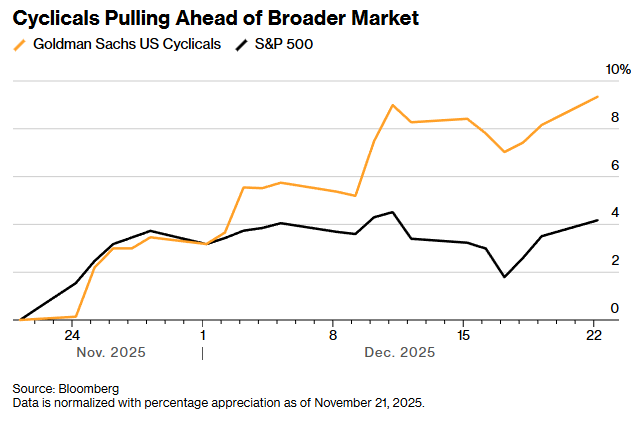
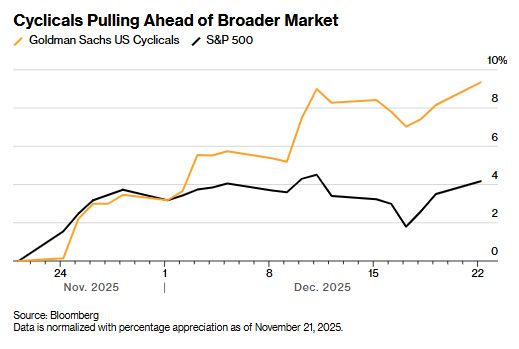
Group 1 - The article highlights that the decline in oil prices and the cooling inflation in the U.S. economy are creating a favorable environment for cyclical stocks, with expectations for strong performance from companies like JPMorgan Chase, Caterpillar, Gap, and Dollar Tree by 2026 [1] - Analysts predict that sectors such as financials, industrials, and discretionary consumer goods will lead the U.S. stock market in the upcoming year, with an average GDP growth forecast of 2% for 2024 [1] - The market is showing signs of a style shift, with cyclical stocks outperforming defensive stocks, as evidenced by a 9.3% increase in cyclical stock performance compared to a 4.2% rise in the S&P 500 index over the past month [1][4] Group 2 - The influx of capital into non-tech cyclical stocks reflects market optimism about economic expansion, with a projected 2.5% growth in U.S. GDP for 2026, driven by a 4.1% increase in retail sales and a decrease in the core PCE price index to 2.4% [4] - Analysts believe that the strong performance of cyclical stocks will be sustained over the long term, with strategies focusing on long positions in banks and retail stocks while shorting consumer staples [4] - The Dow Jones Transportation Average has risen by 10% in the past month, indicating a strengthening investment logic for cyclical stocks, with expectations for continued growth in the industrial and materials sectors [5] Group 3 - The acceleration of U.S. economic growth is expected to significantly benefit cyclical companies, as their earnings are closely tied to economic activity levels [6] - There are expectations for two interest rate cuts by the Federal Reserve in 2026, with GDP growth projections being revised upward from 1.8% to 2.3% [5]




多资产系列报告(二):降准降息利好哪些权益资产?
Soochow Securities· 2025-10-17 05:12
Group 1: Monetary Policy Impact - From January 2020 to September 2025, the central bank conducted a total of 39 monetary policy easing operations[19] - During the 12 "bear steep" phases, the proportion of A-shares outperforming the 10-year government bond yield reached 53.8%[28] - In the 5 "bear flat" phases, this proportion increased to 66.2%[28] Group 2: Stock Performance by Style - Defensive stocks benefited significantly from monetary easing, with an average outperformance ratio of 50.4%[32] - Growth stocks, on the other hand, showed a more ambiguous benefit, with an average outperformance ratio of 48.3%[32] - The average outperformance ratios for defensive, semi-defensive, semi-cyclical, and cyclical stocks were 50.4%, 49.6%, 48.2%, and 47.6%, respectively, indicating a decreasing trend[32] Group 3: Economic Conditions and Expectations - If monetary easing coincides with improved expectations for corporate profits and economic recovery, equity markets may perform better despite a bear bond market[27] - The performance of growth stocks in response to monetary easing is conditional, while defensive stocks, which are less sensitive to economic cycles, show clearer benefits[27] - If the equity market lacks clear expectations for fundamental improvements, defensive stocks may still underperform relative to bonds during monetary easing periods[27]