韩元走强

Search documents
每日机构分析:12月26日
Zhong Guo Jin Rong Xin Xi Wang· 2025-12-26 10:38
Group 1: Asset Environment and Economic Outlook - CITIC Securities predicts that the asset environment in 2026 may exhibit characteristics of marginal liquidity easing and moderate economic recovery, with the 10-year China bond yield expected to fluctuate between 1.5% and 1.8% and the 10-year US Treasury yield maintaining a range of 3.9% to 4.3% [1] - The report anticipates that Brent crude oil will oscillate between $58 and $70 per barrel, while gold prices may continue to be strong, potentially reaching $5,000 per ounce, supported by liquidity easing and geopolitical risks [1] - Copper prices are expected to rise to an average of $12,000 per ton due to supply constraints and electricity demand [1] Group 2: Currency and Foreign Investment - Huatai Securities indicates that the current appreciation of the RMB is likely to enhance foreign investors' interest in RMB-denominated assets, creating a positive cycle for capital inflows and easing financial conditions [2] - The report notes that despite seasonal declines in capital flows and risk appetite towards the end of the year, the strengthening of the RMB will continue to boost the valuation of both onshore and offshore RMB assets [2] Group 3: Silver Market Dynamics - Silver prices have surged nearly 150% this year, driven by strong industrial demand, low global inventories, and its inclusion in key mineral lists [2] - Analysts suggest that silver is breaking away from its traditional role as a "by-product" of gold, with its independent investment logic being re-evaluated by the market [2] - Predictions indicate that silver prices could reach $100 per ounce by 2026, especially if monetary instability increases [2] Group 4: Japanese Economic Indicators - Tokyo's inflation rate has shown a greater-than-expected decline, with the CPI rising 2.3% year-on-year in December, down from 2.8% the previous month, primarily due to easing food price increases and lower energy costs [3] - Despite the slowdown, inflation remains above the Bank of Japan's 2% target, suggesting continued tightening of monetary policy [3] - The Japanese economy is expected to rebound from a contraction in Q3, with forecasts indicating production growth of 1.2% and 1.8% in December and January 2026, respectively [3] Group 5: Japanese Government Bond Issuance - The Japanese Finance Ministry plans to reduce the issuance of ultra-long government bonds to the lowest level in 17 years, cutting nearly 20% from the previous fiscal year to approximately 17.4 trillion yen [4] - The total issuance of Japanese government bonds for the next fiscal year is projected to be 180.7 trillion yen, a decrease of nearly 5% from the current fiscal year [4] Group 6: South Korean Currency Intervention - The South Korean won has strengthened against the US dollar due to verbal interventions and measures from authorities, with the government expressing a firm commitment to alleviate pressure on the currency [4] - Recent measures may lead to a dollar sell-off of up to $23 billion, although there are risks that the outcomes may not meet expectations [4]
一则大消息!刚刚,直线拉升!
Zhong Guo Ji Jin Bao· 2025-12-10 01:18
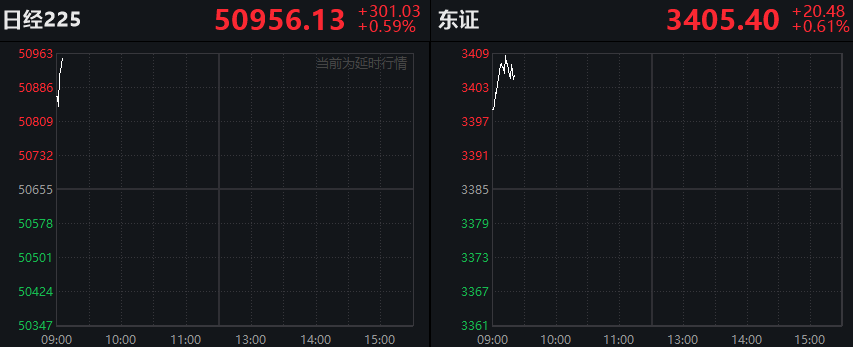
Group 1: Market Overview - The South Korean stock market opened higher, with the KOSPI index rising by 0.48% to 4163.50 points [2] - The Japanese stock market also opened positively, with the TOPIX index increasing by 0.6% to 3405.4 points, marking a new historical high [4] Group 2: SK Hynix Developments - SK Hynix's stock surged over 4% at the opening, with a current market capitalization of 427.34 trillion KRW [3] - The company is considering issuing American Depositary Receipts (ADRs) based on its treasury stock to reassess its valuation fundamentally [3] - SK Hynix is reviewing various measures to enhance corporate value, including the potential use of treasury stock for a U.S. listing [3] Group 3: Economic Indicators in South Korea - In November, South Korea added 225,000 jobs, an increase from 193,000 in October, with a seasonally adjusted unemployment rate of 2.7% compared to 2.6% in October [3] - The Bank of Korea's governor warned that the potential growth rate of the South Korean economy could drop to around 0% by 2040 due to low birth rates and rapid aging of the population [3] Group 4: Japanese Economic Indicators - Japan's producer prices increased by 0.3% month-on-month and 2.7% year-on-year in November, aligning with market expectations [6] - The Bank of Japan's governor indicated that the central bank is closer to achieving its inflation target, suggesting a possible interest rate hike in the upcoming policy meeting [6]

一则大消息!刚刚,直线拉升!
中国基金报· 2025-12-10 01:12
Group 1 - The South Korean stock market opened higher, with the KOSPI index rising by 0.48% to 4163.50 points on December 10 [4] - SK Hynix saw a significant increase in its stock price, rising over 4% at one point, with a current market capitalization of 427.34 trillion KRW [5][6] - The company is considering issuing American Depositary Receipts (ADRs) based on its treasury shares to reassess its valuation [6] Group 2 - In November, South Korea added 225,000 jobs, an increase from 193,000 in October, with a seasonally adjusted unemployment rate of 2.7% [7] - The Bank of Korea's governor warned that the potential growth rate of the South Korean economy could drop to around 0% by 2040 due to low birth rates and rapid aging [7] - Morgan Stanley analysts predict that the Korean won is expected to strengthen next year, supported by improving economic fundamentals [7] Group 3 - The Japanese stock market opened strong, with the TOPIX index increasing by 0.6% to a new historical high of 3405.4 points [9] - The Nikkei 225 index rose by 0.59% to 50956.13 points [9] - Japan's producer prices increased by 0.3% month-on-month and 2.7% year-on-year, aligning with market expectations [11] - The Bank of Japan's governor indicated that the central bank is closer to achieving its inflation target, suggesting a potential interest rate hike in the upcoming policy meeting [11]

第一个承认”海湖庄园协议“的国家出现了?韩国确认与美国讨论了外汇政策
Hua Er Jie Jian Wen· 2025-05-14 12:16
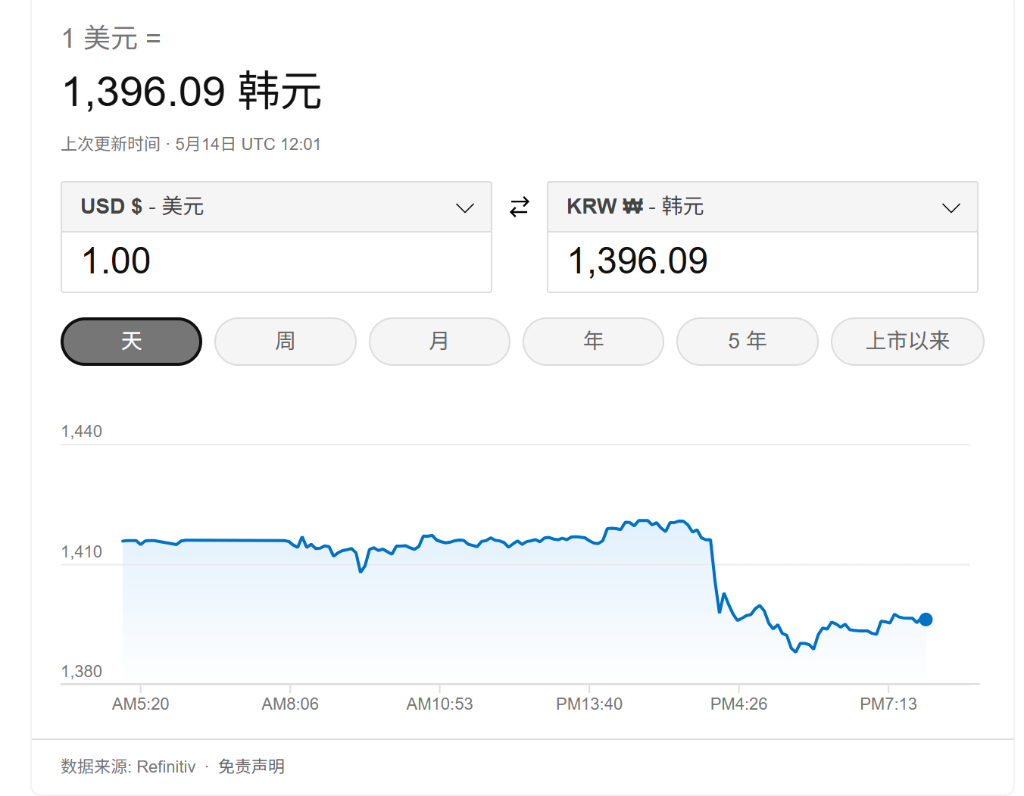
Core Viewpoint - The discussions between South Korea and the U.S. regarding the USD/KRW exchange rate have raised market speculation about potential U.S. policies favoring a weaker dollar, impacting trade negotiations and currency valuations [2][4]. Group 1: Meeting Details - South Korean Deputy Finance Minister Choi Ji-young met with U.S. Assistant Secretary of the Treasury for International Finance Robert Kaproth on May 5 during the 58th Asian Development Bank annual meeting in Milan [1]. - The meeting focused on the USD/KRW market, indicating a collaborative approach to address currency issues [1]. Group 2: Market Reactions - Following the news of the meeting, the dollar fell, with the USD/KRW exchange rate dropping 1.92% to 1396.77, marking a one-week low [2]. - The Korean won has appreciated approximately 5% against the dollar this year amid a generally weak dollar environment [2]. Group 3: Implications of U.S. Policy - Analysts suggest that the discussions may signal a shift in U.S. policy focus from trade to currency, potentially leading to a weaker dollar as a strategy to address perceived economic imbalances [5]. - Concerns have been raised that the Trump administration may encourage countries to sell dollars to mitigate the effects of a strong currency on trade competitiveness [5]. Group 4: Broader Economic Context - The meeting aligns with previous comments from the Bank of Korea Governor Lee Chang-yong, who indicated that the rise of Asian currencies, including the won, is partly due to U.S. pressure for currency appreciation [6]. - The discussions may act as a catalyst for further dollar selling, as they could integrate currency policy into bilateral trade negotiations between the U.S. and other economies [5].