预制菜行业规范发展

Search documents
食品饮料行业双周报(2026、01、30-2026、02、12):预制菜国标公开征求意见,关注春节需求表现-20260213
Dongguan Securities· 2026-02-13 07:33
Investment Rating - The industry investment rating is "Overweight," indicating that the industry index is expected to outperform the market index by more than 10% in the next six months [56]. Core Insights - The report highlights the public consultation on the national standard for prepared dishes, emphasizing the importance of monitoring demand during the Spring Festival [5][52]. - The liquor sector is experiencing short-term fluctuations in market sentiment due to factors such as real estate policies and sales performance of premium liquor brands like Moutai, which has exceeded market expectations [5][52]. - The report suggests focusing on key stocks such as Guizhou Moutai (600519) and Shanxi Fenjiu (600809) in the liquor sector, as well as companies in the mass consumer goods sector that are benefiting from Spring Festival stocking [5][54]. Summary by Sections Market Review - From January 30 to February 12, the SW Food and Beverage Industry Index fell by 0.95%, underperforming the CSI 300 Index by approximately 0.23 percentage points [12]. - Most sub-sectors underperformed the CSI 300 Index, with the seasoning sector showing the highest increase of 0.64%, while other liquor sectors saw the largest decline of 6.40% [13][14]. Industry Data Tracking - In the liquor sector, the price of Moutai increased to 1,670 RMB per bottle, up by 90 RMB from January 29, while the prices of other premium liquors remained stable [23]. - The report notes that approximately 21% of stocks in the food and beverage sector recorded positive returns during the review period, with notable gainers including Huangtai Liquor (+10.43%) and Maiqu'er (+9.23%) [16]. Important News - The report mentions the formal establishment of five national standards for liquor, which are currently under revision [44]. - The national standard for prepared dishes was released for public consultation, marking a new phase of regulated development in the industry [45]. Key Recommendations - The report recommends focusing on stocks such as Hai Tian Wei Ye (603288), Qingdao Beer (600600), Yili (600887), and Dongpeng Beverage (605499) due to their potential benefits from the upcoming Spring Festival demand [53][54].

“国标”推动行业规范发展
Xin Lang Cai Jing· 2026-02-06 21:59
Core Viewpoint - The recent focus on the prepared food industry reflects consumer demands for improved product and service quality, transparency, and the need for regulatory standards to ensure the industry's healthy development [1][2]. Group 1: Industry Standards and Regulations - The prepared food industry in China is at a critical juncture for establishing unified national standards, which will provide clear guidelines for businesses and support long-term healthy development [2]. - Safety is a non-negotiable baseline for prepared foods, with regulations prohibiting preservatives and emphasizing the necessity of safe, traceable raw materials [2]. - Two national standards are being proposed: one focusing on food safety and nutrition, and the other providing definitions and classifications for prepared food, which will enhance scientific regulation and consumer trust [2]. Group 2: Consumer Rights and Transparency - There is a strong consumer demand for restaurants to disclose whether they use prepared foods, prompting regulatory bodies to seek opinions on promoting transparency in food preparation methods [2]. - This initiative respects consumer rights to know and choose, while also fostering a fair competitive environment for businesses, addressing trust issues stemming from a lack of transparency [2]. Group 3: Collaborative Development - The sustainable development of the prepared food industry relies on scientific decision-making based on thorough research and public input, ensuring that consumer rights are upheld [3]. - The dynamic market demands require collaboration among consumers, industry players, and government entities to ensure food safety and promote high-quality industry growth [3]. - Effective policies and measures that incorporate diverse perspectives will lead to a beneficial cycle of improving public welfare and industry development [3].
人民日报评论:厘清“西贝事件” 给预制菜一个明明白白的未来
Ren Min Ri Bao· 2026-01-22 11:56
Core Viewpoint - The Chinese government is actively working on establishing national standards for pre-prepared dishes, following public discussions and incidents related to food safety, particularly the recent controversy surrounding the restaurant chain Xibei [1][2]. Group 1: Definition and Standards - Pre-prepared dishes are defined as pre-packaged meals that require heating or cooking before consumption, differing from the public's broader perception that any non-freshly made food qualifies as pre-prepared [2]. - The government is drafting standards to clarify the definition and ensure that food safety regulations are met, particularly for dishes produced in central kitchens [2]. Group 2: Consumer Awareness and Transparency - Consumer awareness regarding the preparation methods of pre-prepared dishes is crucial, and there is a need for clear labeling to protect consumer rights and allow informed choices [3]. - The process of establishing clear guidelines for labeling involves extensive public consultation to gather consumer feedback, ensuring that the regulations are comprehensive and effective [3]. Group 3: Safety and Quality Assurance - The existing supply chain management for pre-prepared dishes includes stringent food safety requirements, indicating that these products can be safe and nutritious if properly regulated [4]. - The term "pre-prepared dish" should not be associated solely with low quality; instead, it can represent safe and healthy options when produced under strict compliance with safety standards [4]. Group 4: Industry Responsibility and Collaboration - The responsibility for food quality and safety lies primarily with the restaurant industry, which is encouraged to adopt transparent practices, such as disclosing ingredient sourcing [5]. - Collaborative efforts among regulatory bodies, food businesses, and consumers are essential to establish clear standards and ensure the sustainable development of the pre-prepared dish industry [5].


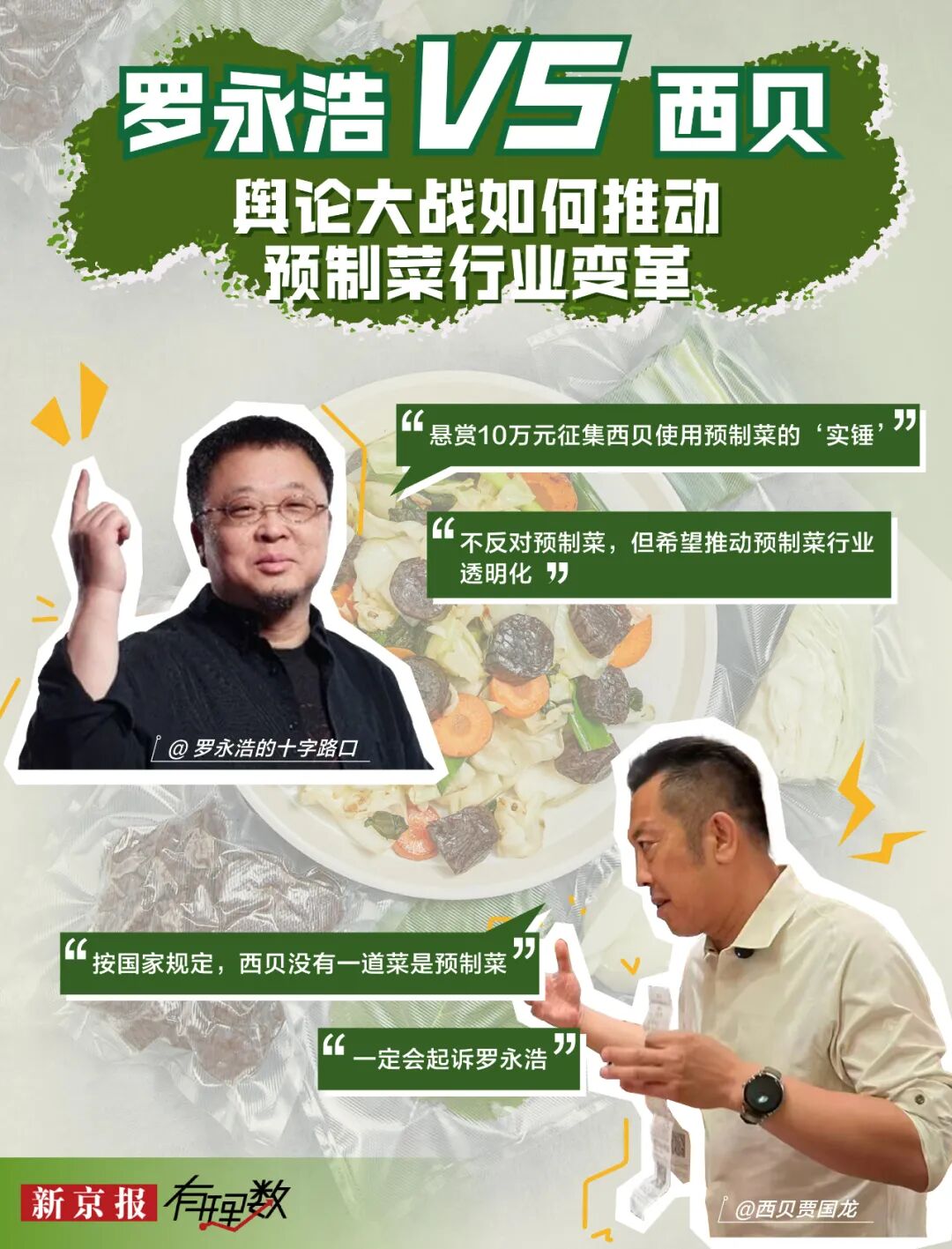
罗永浩和西贝的这场架,没白吵
Xin Jing Bao· 2025-09-14 04:30
Core Viewpoint - The debate surrounding the use of pre-prepared dishes in restaurants, sparked by a public criticism from a prominent figure, has highlighted significant consumer concerns regarding food safety, transparency, and pricing in the pre-prepared food industry [5][7][32]. Group 1: Industry Background - The pre-prepared food market in China has evolved from early forms like frozen dumplings to a significant industry, especially during the pandemic when convenience became paramount [10]. - The market is projected to exceed 1,072 billion yuan by 2026, although growth rates are expected to decline from 35% in 2024 to 18.3% by 2026 [10][17]. - The primary consumers of pre-prepared foods are B-end enterprises like group catering and chain restaurants, with household consumption remaining a small percentage [10]. Group 2: Consumer Sentiment - A significant portion of consumers express dissatisfaction with high prices for pre-prepared dishes, with many believing that restaurants should disclose the use of such items to avoid misleading customers [7][21]. - Research indicates that consumer acceptance of pre-prepared foods varies by dining context, with over 50% acceptance in fast-food settings but only 8.8% in high-end restaurants [19]. - Concerns about food safety are prevalent, with 68.55% of consumers worried about illegal additives and 61.29% about the quality of ingredients used in pre-prepared dishes [29][24]. Group 3: Regulatory and Market Dynamics - The lack of a unified national standard for defining pre-prepared foods has led to confusion among consumers and businesses alike [36]. - Recent discussions have prompted regulatory bodies to consider establishing clearer guidelines for pre-prepared foods, which may include mandatory disclosure of their use in restaurants [36][35]. - The ongoing debate reflects a critical moment for the industry, pushing for a transition from unregulated growth to a more structured and consumer-friendly approach [36][32].