
高原经济高质量发展

Search documents
统筹:冯骥 制作:晋巴次成 赵江丰 王雅慧 责任编辑:益西旺堆
Xin Lang Cai Jing· 2026-01-31 05:02
Core Viewpoint - The article highlights the significant achievements and future goals of economic and social development in Tibet, emphasizing stability, high-quality growth, and ecological safety as key priorities. Group 1: Achievements in Recent Years - The year marked the 60th anniversary of the establishment of the autonomous region, celebrated with grand activities [2] - Major engineering projects commenced successfully, indicating progress in infrastructure development [2] - Significant victories were achieved in post-earthquake recovery and reconstruction efforts [2] Group 2: Five-Year Review - The past five years have seen the comprehensive implementation of the Party's strategies in Tibet, leading to notable changes and improvements [5] - There has been a deepening awareness of the shared identity among the Chinese nation [5] - The development in Tibet has been characterized as the best and most transformative in recent history [5] - The security framework has become more robust, ensuring safety for all ethnic groups [5] - The benefits received by various communities have increased significantly [5] Group 3: Key Requirements for Future Development - The focus will remain on maintaining stability as the primary task [7] - High-quality economic development tailored to local conditions will be a central theme [7] - Strengthening the national ecological security barrier will be a fundamental requirement [7] - Accelerating modernization in border areas will be an important mission [7] Group 4: Economic and Social Development Goals for 2026 - The GDP is expected to grow by over 7% [8] - Fixed asset investment is projected to increase by around 15% [8] - Retail sales of consumer goods are anticipated to grow by 7% [8] - Per capita disposable income for urban and rural residents is expected to rise by approximately 7% and 8%, respectively [8] - The urban unemployment rate is targeted to be kept below 5% [8] - Consumer prices are expected to rise reasonably [8] Group 5: Key Focus Areas for 2026 - Building a higher level of safety in Tibet, focusing on long-term stability [8] - Expanding domestic demand to enhance economic quality and efficiency [8] - Developing highland characteristic industries based on local advantages [8]


一张图,带你了解政府工作报告!
Xin Lang Cai Jing· 2026-01-31 05:01
Core Viewpoint - The article emphasizes the importance of stability and harmony in economic and social development, particularly in the context of Tibet's growth and modernization efforts during the "14th Five-Year Plan" period and the upcoming "15th Five-Year Plan" [4][5]. Group 1: Economic Growth and Development Goals - The GDP is projected to grow by over 7% in 2026, with fixed asset investment expected to increase by around 15% [8]. - Retail sales of consumer goods are anticipated to rise by approximately 7%, while per capita disposable income for urban and rural residents is expected to grow by around 7% and 8%, respectively [8]. - The urban survey unemployment rate is targeted to be controlled within 5%, with a reasonable rebound in consumer prices [8]. Group 2: Key Development Strategies - The focus will be on maintaining stability as the primary task, promoting high-quality economic development tailored to local conditions, and reinforcing the national ecological security barrier [7]. - There will be an emphasis on modernizing border areas and enhancing the livelihoods of border residents [7]. - The strategies include strengthening supply chains, promoting new urbanization, and ensuring comprehensive rural revitalization [9]. Group 3: Social and Ecological Considerations - The development plan aims to enhance the well-being of various ethnic groups and foster a sense of community among them [9]. - There is a commitment to green development, striving to create a high standard of ecological civilization [9].
西藏两会时间到
Zhong Guo Jing Ji Wang· 2026-01-30 06:28
Group 1 - The Tibet Autonomous Region is set to hold its 12th People's Congress Fourth Session and the 12th CPPCC Fourth Session, starting on January 31 and January 30 respectively, each lasting four days [1] - During the previous session, a total of 367 proposals were submitted by representatives, covering areas such as economy, ecology, livelihood, and education, all of which have been addressed and responded to [1] - The Tibet Autonomous Region's Standing Committee has shifted its focus from merely responding to proposals to ensuring their implementation, enhancing the effectiveness of representative suggestions [1] Group 2 - The Tibet Autonomous Region's CPPCC has played a significant role in providing specialized consultation, focusing on high-quality economic development and ecological civilization, with over 80 policy suggestions made to assist government decision-making [2] - Since the 14th Five-Year Plan, the CPPCC has conducted 269 research projects and held 290 consultation sessions, resulting in 226 reports and 1,951 proposals aimed at promoting high-quality economic and social development in Tibet [2]
西藏自治区“十五五”规划建议全文公布
Bei Jing Ri Bao Ke Hu Duan· 2025-12-13 03:16
Core Viewpoint - The "14th Five-Year Plan" period has seen significant progress in building a modern socialist Tibet, with a focus on stability, development, ecology, and border security, leading to historical achievements in economic and social development [1]. Group 1: Economic and Social Development Achievements - The "14th Five-Year Plan" has led to comprehensive advancements in Tibet, with improvements in economic quality, infrastructure, and the development of characteristic industries [1]. - The region has made historical progress in ethnic unity, social stability, and the promotion of Tibetan Buddhism's integration into Chinese culture [1]. - Economic development has been characterized by enhanced quality and efficiency, with significant infrastructure construction and the flourishing of advantageous industries [1]. Group 2: Challenges and Opportunities - Tibet faces challenges such as a complex anti-secession struggle, unbalanced development, and ecological sensitivity, which require strategic focus and action [3][4]. - Opportunities arise from the central government's emphasis on Tibet's development, with major projects like the Yarlung Tsangpo River hydropower project and the Sichuan-Tibet Railway enhancing growth potential [2]. Group 3: Development Goals and Requirements - The guiding ideology for the "15th Five-Year Plan" emphasizes Marxism, socialism with Chinese characteristics, and the importance of high-quality development [5]. - Key requirements include maintaining the Party's leadership, promoting high-quality development, and ensuring that all development efforts contribute to ethnic unity and social stability [6][7]. Group 4: Major Development Targets - The construction of a strong sense of the Chinese national community and the promotion of high-quality economic development are primary targets for the "15th Five-Year Plan" [8]. - Significant improvements in living standards, ecological construction, and national security are also outlined as essential goals [9]. Group 5: Infrastructure and Industry Development - The plan includes the construction of a modern transportation system, logistics hubs, and new energy infrastructure to support economic growth [16][17][18]. - Emphasis is placed on developing pillar industries such as clean energy, cultural tourism, and modern agriculture to drive economic expansion [12][14][15]. Group 6: Social Welfare and Employment - The plan aims to enhance employment quality and promote a fair income distribution system to support common prosperity [30][32]. - Education and healthcare improvements are prioritized to ensure a well-rounded development of the population [31][33]. Group 7: Ecological and Environmental Protection - The strategy includes strict ecological protection measures and the promotion of green development to safeguard Tibet's unique environment [34][35]. - Efforts will focus on enhancing biodiversity and implementing sustainable practices to maintain ecological balance [34].
中国银行西藏自治区分行千亿元贷款注实体 一抹“中行红”映雪域
Zheng Quan Ri Bao· 2025-08-30 08:49
Group 1 - The core mission of the Bank of China Tibet Branch is to support the economic development of Tibet by providing financial services and products tailored to local needs [1][2] - The bank has launched various inclusive financial products such as "Cang Oil Loan," "Cang Medicine Loan," and "Tianlu Loan" to address funding challenges faced by local enterprises [2] - In the first seven months of this year, the Bank of China Tibet Branch has issued over 23 billion yuan in new corporate loans, all directed towards the real economy [1] Group 2 - The bank is committed to supporting the green and digital transformation of the traditional mining industry in Tibet, providing full lifecycle support for related enterprises [2] - The establishment of the first "carbon neutral" outlet in the region and the investment of over 30 million yuan in the afforestation project demonstrate the bank's commitment to ecological sustainability [2] - The bank aims to continuously innovate financial service tools and expand financial resource input to contribute to the modernization of Tibet [3]

用好政策高地、抬升价值洼地、挖掘资源宝地——金融活水润泽西藏特色经济“格桑花”
Zheng Quan Shi Bao Wang· 2025-08-25 01:25
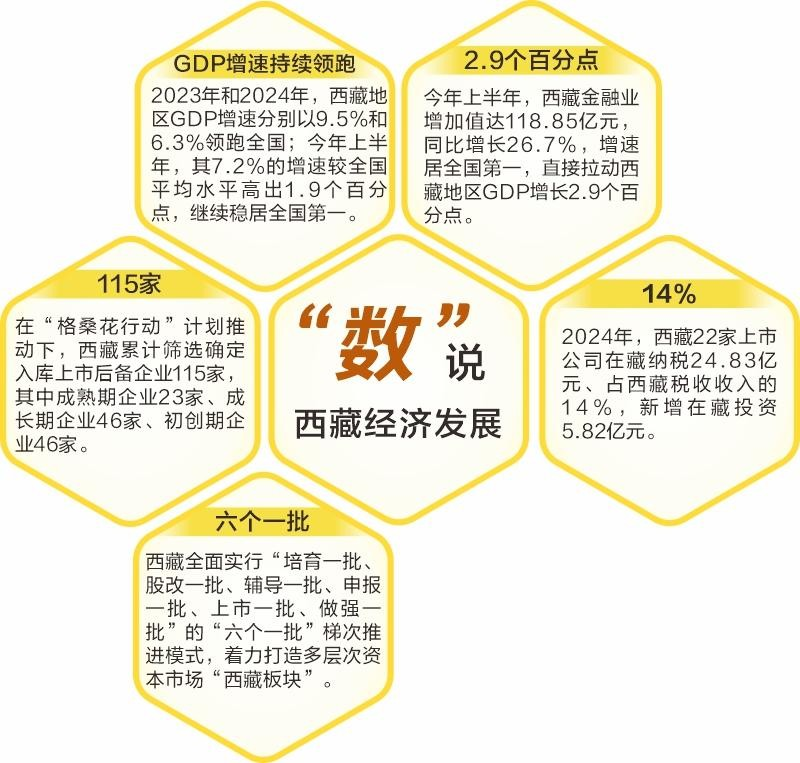
Economic Growth - Tibet's GDP growth rates for 2023 and 2024 are projected at 9.5% and 6.3%, respectively, leading the nation [2][11] - In the first half of 2023, Tibet's GDP growth rate of 7.2% exceeded the national average by 1.9 percentage points, maintaining the top position in the country [11] Financial Sector Performance - The financial sector's added value in Tibet reached 11.885 billion yuan in the first half of 2023, with a year-on-year growth of 26.7%, the highest in the nation [3][17] - The financial sector contributed 2.9 percentage points to Tibet's GDP growth [3] Policy Initiatives - The "Galsang Flower Action" plan has identified 115 potential listed companies in Tibet, including 23 mature, 46 growth-stage, and 46 startup enterprises [4][14] - In 2024, 22 listed companies in Tibet contributed 2.483 billion yuan in taxes, accounting for 14% of the region's tax revenue, and attracted 582 million yuan in new investments [6][13] Capital Market Development - Tibet is implementing a "six batches" model to promote capital market development, focusing on nurturing, restructuring, and strengthening companies [7][14] - The China Securities Regulatory Commission has provided favorable IPO policies for Tibetan enterprises since 2016, facilitating their market entry [13] Resource Utilization - Tibet's unique ecological resources, including clean energy and mineral resources, are being leveraged for industrial investment [19][22] - The total investment of approximately 1.2 trillion yuan in the Yarlung Tsangpo River hydropower project aims to enhance China's energy structure [19] Tourism and Cultural Integration - Tibet's tourism sector is capitalizing on its unique ecological environment, promoting new tourism products and experiences [20][21] - The region's tourism strategy includes integrating health, sports, and cultural experiences to cater to diverse consumer needs [20] Industry Examples - Ganlu Tibetan Medicine Co. is actively pursuing international markets and aims to establish a comprehensive ecosystem for Tibetan medicine [16][21] - Tibet Mining Co. is focusing on high-value resource development, particularly in lithium carbonate projects [22]

金融活水润泽西藏特色经济“格桑花”丨证券时报、西藏日报联合调研报道
Zheng Quan Shi Bao Wang· 2025-08-25 00:10
Economic Growth and Development - Tibet is leading the nation in economic growth with GDP growth rates of 9.5% and 6.3% for 2023 and 2024 respectively, and a 7.2% growth rate in the first half of 2023, surpassing the national average by 1.9 percentage points [1][3] - The region aims for a GDP growth of over 7% by 2025, with aspirations to reach 8% [1] Policy Support and Capital Market Development - The "Galsang Flower Action" plan was introduced to promote enterprise listings, marking a significant step in Tibet's capital market development [5] - Since 2016, the China Securities Regulatory Commission has implemented favorable IPO policies for Tibetan enterprises, allowing for immediate review and approval [6] - In 2024, 22 listed companies in Tibet contributed 24.83 billion yuan in taxes, accounting for 14% of the region's tax revenue [6] Financial Sector Growth - Tibet has the lowest loan interest rates in the country, with an average of 1.46% as of the second quarter of 2023, benefiting small and medium enterprises [7] - The financial sector is projected to achieve a value-added of 266.82 billion yuan in 2024, with a year-on-year growth of 15.9% [10] Resource Utilization and Industry Development - Tibet's unique ecological resources are being leveraged for industrial investment, particularly in clean energy and mineral resources [12][15] - The Yarlung Tsangpo River hydropower project, with an investment of approximately 1.2 trillion yuan, aims to generate 60 million kilowatts of installed capacity [12] Tourism and Cultural Integration - The tourism sector is capitalizing on Tibet's unique ecological environment, with new product launches aimed at enhancing visitor experiences [13] - The region is promoting a blend of tourism with health and wellness, as well as cultural experiences to cater to diverse consumer needs [13] Industry Case Studies - Ganlu Tibetan Medicine Co., a leading Tibetan medicine enterprise, is actively pursuing international markets and aims for a revenue of over 300 million yuan this year [9][10] - Natural堂 has established a research center in Tibet, utilizing local resources for cosmetic products, demonstrating the potential for value addition through local resource utilization [14]
金融活水润泽西藏特色经济“格桑花”丨证券时报、西藏日报联合调研报道
证券时报· 2025-08-24 23:42
Core Viewpoint - Tibet is emerging as a leader in economic growth, with GDP growth rates of 9.5% and 6.3% projected for 2023 and 2024 respectively, significantly outpacing national averages [2][4]. Group 1: Economic Growth and Development Plans - Tibet's GDP growth in the first half of 2023 was 7.2%, exceeding the national average by 1.9 percentage points, maintaining the top position in the country [2]. - The region aims for a GDP growth rate of over 7% by 2025, with aspirations to reach 8% [2]. - The "Galsang Flower Action" plan was introduced to promote enterprise listings, marking a significant step in Tibet's capital market development [14][15]. Group 2: Policy Support and Financial Environment - Central government policies, including financial and tax incentives, are fostering economic vitality in Tibet [14]. - The average loan interest rate in Tibet is 1.46%, with small and medium enterprises benefiting from an even lower rate of 1.15% [16]. - In 2024, 22 listed companies in Tibet contributed 24.83 billion yuan in taxes, accounting for 14% of the region's tax revenue [15][33]. Group 3: Resource Utilization and Industry Development - Tibet's unique ecological resources, including clean energy and mineral resources, are becoming attractive for industrial investment [24][29]. - The total investment of approximately 1.2 trillion yuan in the Yarlung Tsangpo River hydropower project aims to generate 60 million kilowatts of installed capacity [24]. - The development of the Zabuye Salt Lake project is focused on high-value resource extraction, positioning Tibet as a strategic reserve for national resources [29][30]. Group 4: Sectoral Highlights and Innovations - Companies like Gansu Tibetan Medicine are leveraging local resources to expand into international markets, with plans to achieve revenues exceeding 300 million yuan this year [21]. - The establishment of the Himalayan Research Center by a beauty giant in Tibet exemplifies the successful integration of local resources into product development [26]. - The financial sector in Tibet is rapidly growing, with a 15.9% increase in financial value added, contributing nearly a quarter to the region's economic growth [22][33].


为推进社会主义现代化新西藏建设提供有力金融支撑 李云泽赴西藏调研
Jin Rong Shi Bao· 2025-08-08 07:56
Core Insights - The Financial Regulatory Bureau is focusing on enhancing financial support for the high-quality development of Tibet, emphasizing collaboration with local governments and effective risk management [1][2] - The bureau aims to optimize financial services and support major engineering projects, while also promoting the development of characteristic industries in Tibet [1] - There is a commitment to implement the "Four New" project to improve the effectiveness of financial regulation and support for local staff [2] Group 1 - The Financial Regulatory Bureau's leadership visited Tibet to discuss financial support for major projects and regulatory collaboration with local authorities [1] - The bureau expressed gratitude for the support received from the local government in financial regulatory work [1] - The focus is on the "Four Major Issues" and "Four Creations" to enhance financial services and risk management [1] Group 2 - The leadership visited local financial regulatory offices to understand the implementation of grassroots party building and regulatory work [2] - There is an emphasis on adhering to the central government's regulations and improving the working environment for staff [2] - The bureau is committed to increasing care for staff and addressing their practical difficulties in work and life [2]
金融监管总局党委书记、局长李云泽赴西藏调研
news flash· 2025-07-30 14:28
Core Viewpoint - The Financial Regulatory Bureau aims to enhance financial services and risk management to support the high-quality development of Tibet and its major projects [1] Group 1: Financial Support and Development - The Financial Regulatory Bureau will continue to optimize financial services to effectively prevent financial risks [1] - The focus is on providing strong financial support for the construction of a modern socialist Tibet [1] Group 2: On-site Investigations - Li Yunzhe conducted on-site investigations of key projects such as the Sichuan-Tibet Railway and the construction of the Tsaina National Modern Agriculture Demonstration Zone [1] - The investigation included understanding the operational status of companies like Ganlu Tibetan Medicine and High-speed Technology [1] Group 3: Banking and Insurance Sector Initiatives - Banks and insurance institutions are encouraged to tailor their services to the specific needs of Tibet, enhancing service quality and financial supply [1] - There is a call for full support of major engineering projects and the development of characteristic advantageous industries [1]