
高股息防御资产

Search documents
避险情绪升温,百亿银行ETF华宝(512800)向上突破,营收净利双增,工商银行涨超2%
Sou Hu Cai Jing· 2026-03-30 11:25
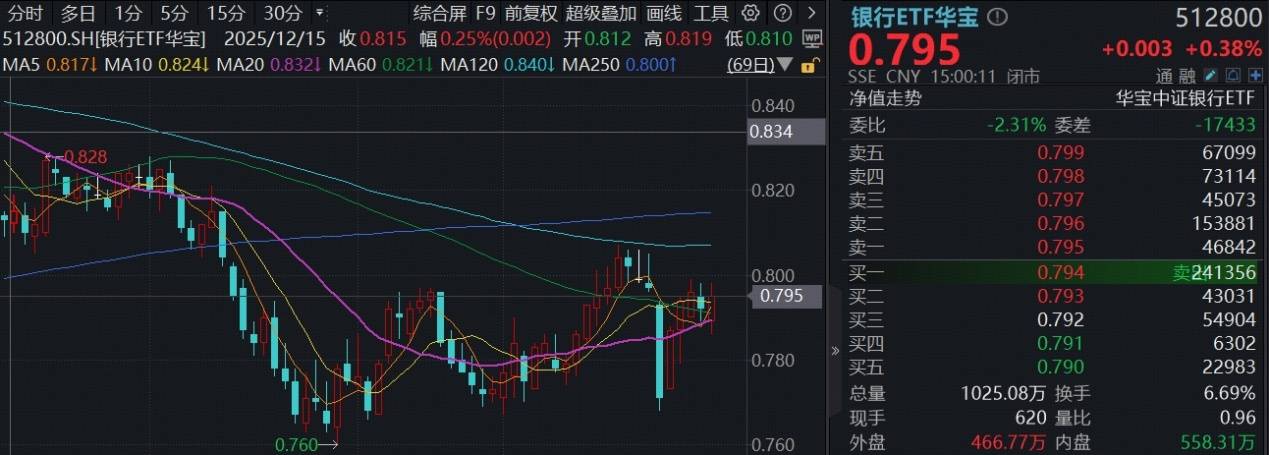
Core Viewpoint - The banking sector shows resilience amid geopolitical tensions, with a focus on high-dividend defensive assets attracting investor interest [3] Group 1: Market Performance - On March 30, the Shanghai Composite Index rose by 0.24% after initially dropping over 1%, while the ChiNext and Shenzhen Composite Indices fell [1] - The banking sector demonstrated defensive characteristics, with most individual stocks closing higher; Xiamen Bank led with a nearly 4% increase, and major banks like ICBC and Bank of China also saw gains [1] Group 2: Banking Sector Insights - Major state-owned banks, including ICBC, CCB, BOC, and PSBC, reported annual results showing steady asset growth and increases in both revenue and net profit [3] - Despite challenges such as narrowing net interest margins, bank management expressed optimism about stabilizing margins, which received positive market feedback [3] - According to CITIC Securities, the disclosed bank performance aligns with expectations, and future disclosures are likely to show minimal deviations from forecasts [3] Group 3: Investment Opportunities - With rising risk aversion, the banking sector is expected to benefit from increased allocation due to its defensive characteristics and potential for fundamental improvements [3] - The banking ETF (512800) has a significant scale of over 12 billion, making it the largest and most liquid among A-share banking ETFs, with an average daily trading volume exceeding 800 million since 2025 [4]



国企红利ETF(159515)盘中涨0.26%,政策与资金聚焦高股息防御资产
Sou Hu Cai Jing· 2025-12-25 05:46
Core Insights - The China Securities State-Owned Enterprises Dividend Index has shown a slight increase of 0.08% as of December 25, 2025, with notable gains in constituent stocks such as Xiamen International Trade (up 4.44%) and Luxi Chemical (up 3.30%) [1] - The National State-Owned Enterprises Dividend ETF (159515) has also increased by 0.26%, reflecting a growing interest in dividend-paying assets amid a favorable monetary policy environment [1][2] Market Performance - The trading volume for the National State-Owned Enterprises Dividend ETF reached 2.91% turnover with a transaction value of 1.489 million yuan, and the average daily trading volume over the past week was 4.2193 million yuan [1] - The latest scale of the National State-Owned Enterprises Dividend ETF stands at 51.0433 million yuan, with a total of 44.7866 million shares [1] Policy and Economic Environment - The People's Bank of China has reiterated its commitment to maintaining a moderately loose monetary policy, which is expected to positively influence market sentiment [1] - The decline in the risk-free interest rate is expected to enhance the attractiveness of dividend assets, supported by ongoing policy improvements aimed at strengthening the quality and market capitalization management of listed companies [2] Investment Outlook - According to Kaiyuan Securities, the performance of dividend stocks is anticipated to outperform in 2026 compared to 2025, driven by improved relative valuations, easing pressure on cyclical earnings, and a shift in funding preferences towards high-dividend assets [2] - The National State-Owned Enterprises Dividend Index reflects the overall performance of high-dividend securities selected from state-owned enterprises, focusing on those with stable dividends and significant liquidity [2][3]




中泰国际每日晨讯-20250604
ZHONGTAI INTERNATIONAL SECURITIES· 2025-06-04 03:27
Market Overview - The Hong Kong stock market rebounded on June 3, with the Hang Seng Index rising by 1.5% to close at 23,512 and the Hang Seng Tech Index increasing by 1.1% to 5,189, indicating a significant recovery in market sentiment [1] - The trading volume reached HKD 203.7 billion, showing a notable increase compared to previous days, although the net inflow from the Stock Connect was only HKD 3.9 billion [1] - Major financial stocks, including CITIC Bank, Industrial and Commercial Bank of China, and Agricultural Bank of China, hit historical highs, reflecting continued investment in high-dividend defensive assets [1] Industry Dynamics - The automotive sector saw a rebound, with Xiaomi's automotive business losses decreasing and expectations for profitability in Q3 or Q4 of this year, driven by the upcoming launch of the YU7 model [3] - The healthcare sector also performed well, with the Hang Seng Healthcare Index rising by 2.5%. Notable gains were seen in companies reporting positive clinical data at the American Society of Clinical Oncology (ASCO) [3] - The renewable energy and utilities sectors experienced widespread gains, with Goldwind Technology rising by 13.3% due to share buyback plans and the establishment of an AI-related subsidiary [4] Company-Specific Insights - The report on CSPC Pharmaceutical Group indicated a 21.9% year-on-year decline in total revenue for Q1 2025, amounting to RMB 7.01 billion, primarily due to a slowdown in the sales of its core products [5] - The company expects a gradual recovery in product sales starting from Q2 2025, as the impact of centralized procurement has already been reflected in Q1 results [6] - CSPC has secured multiple overseas licensing agreements, with expected upfront payments totaling approximately RMB 1 billion and potential milestone payments exceeding RMB 25.6 billion, indicating strong future revenue prospects [7][8] Real Estate Sector Analysis - The report on the Chinese real estate market highlighted a 12.0% year-on-year decline in new home transaction volume across 30 major cities, with first-tier cities showing resilience [9] - First-tier cities like Shanghai and Shenzhen reported increases in cumulative transaction volumes, with Shanghai up by 9.5% and Shenzhen by 45.8% year-on-year [10] - The land transaction volume in 100 major cities fell by 46.9% year-on-year, indicating ongoing challenges in the real estate sector [12]