
鸡娃

Search documents
消费降级,毕业即失业?最开始鸡娃的80后,现在已经撑不住了
Sou Hu Cai Jing· 2026-01-29 18:51
Core Viewpoint - The article discusses the shift in mindset among the 80s generation parents regarding their children's education and success, moving from a competitive "tiger parenting" approach to a more relaxed and accepting attitude towards their children's individual paths in life [1][12]. Group 1: Changing Attitudes - The 80s generation, once fervently focused on academic achievements and competitive success for their children, is now expressing relief at simple accomplishments like completing homework [1][12]. - This generation initially believed in a linear path to success, where hard work in education would guarantee a prosperous future, but they are now questioning the validity of this belief as the job market has changed dramatically [3][7]. Group 2: Realizations and Reflections - The disillusionment with the "myth of education" has led to a realization that the opportunities available to their children are not as plentiful as they were for themselves, with many graduates struggling to find suitable employment [7][9]. - The 80s generation is experiencing significant life pressures, balancing responsibilities towards aging parents and their own children, while also facing job market challenges and financial burdens [9][12]. Group 3: Acceptance of Ordinary Life - There is a growing acceptance among 80s parents that achieving a "successful" life may not necessarily mean following a traditional path of high achievement, but rather finding contentment in a balanced and healthy lifestyle [18][20]. - The shift from viewing children as extensions of their own ambitions to recognizing them as independent individuals is a significant change in perspective, promoting exploration and personal happiness over mere achievement [20][22].

“母语口罩”,中国家长又卷出了新型鸡娃神器
3 6 Ke· 2025-11-06 01:59
Core Viewpoint - The emergence of a translation mask product aims to create an English-speaking environment for families with limited English proficiency, addressing the educational anxiety of parents who cannot afford international kindergartens or lack the knowledge to teach their children English [18][34]. Group 1: Product Overview - The translation mask allows users to speak Chinese while the device translates their words into English, primarily designed for children to practice speaking [2][5]. - The device incorporates sound-dampening technology and a translation feature that captures speech in real-time, even supporting various Chinese dialects [8][12]. - Despite its innovative concept, the product faces challenges in facilitating effective communication due to translation delays and potential misunderstandings [13][14]. Group 2: Educational Context - Parents are increasingly anxious about their children's English education, leading to a rise in demand for products that can simulate an English-speaking environment at home [18][34]. - The educational landscape includes various types of kindergartens, with public and private options differing significantly in terms of curriculum and costs, influencing parents' choices [21][26]. - The trend of sending children abroad for early education is gaining popularity, as families seek affordable, high-quality English immersion experiences [28][31]. Group 3: Parental Perspectives - English has become a common obsession among Chinese families, viewed as a critical factor for academic and career opportunities, reinforcing the belief that "learning English equals opportunity" [35][39]. - The perceived return on investment for English education is high, as parents believe that early exposure will lead to long-term advantages for their children [39][40]. - The anxiety surrounding children's education drives parents to seek immediate solutions, such as translation devices, to ensure their children are competitive in an increasingly uncertain future [42].

一个暴论:普通人最大的AI杠杆,可能是多生孩子
Tai Mei Ti A P P· 2025-09-21 07:37
Group 1 - The core argument is that in the AI era, having more children may serve as a significant leverage point for ordinary people, despite contradicting contemporary values [1] - AI is expected to greatly increase the total wealth of society but will also exacerbate inequality, as those who can utilize AI will significantly enhance their productivity compared to those who cannot [2] - The ability to inherit advantageous traits such as intelligence and emotional intelligence remains uncertain, as current technology does not allow for targeted optimization of the human brain [2][3] Group 2 - AI has lowered the barriers to acquiring knowledge and skills, making it easier for individuals to learn important subjects, with AI providing more effective assistance than traditional methods [3][5] - The availability of AI tools means that families can now afford to provide their children with competitive advantages that were previously only accessible to wealthier families [4][5] - If everyone engages in educational enhancement for their children, the competition will shift to a more talent-based arena, where genetic endowment becomes the primary factor [8][9] Group 3 - The discussion emphasizes that personal ability will become increasingly important in wealth distribution, and this ability cannot be passed down genetically but must be acquired through active learning [9] - AI has made learning more accessible, thus making innate talent a key determinant of individual capability [9]

润到日本也要“鸡娃”
Hu Xiu· 2025-08-18 03:02
Group 1 - The article discusses the trend of Japanese parents encouraging their children to pursue a more relaxed educational system, referred to as "yutori education," as a means to escape the pressures of intense competition in academics [1][2] - Japan's nine years of compulsory education focuses on play and extracurricular activities, but the reality of university entrance exams remains highly competitive and challenging [3][4] - The shortage of IT talent in Japan is attributed to low salaries rather than a lack of computer education, leading to a push for mandatory computer knowledge in high school [4][5] Group 2 - The private tutoring industry, known as "juku," plays a significant role in preparing students for entrance exams, with many parents investing heavily in their children's education from a young age [9][10][16] - The financial burden of private education can be substantial, with annual costs for a child attending private school and juku easily reaching 2 million yen (approximately 100,000 RMB) [16] - The article highlights a personal perspective on the effectiveness of one-on-one tutoring versus traditional juku, suggesting that tailored education may yield better results [26][27]
时代变了,鸡娃即将崩溃?意外的事接连发生
3 6 Ke· 2025-06-26 03:27
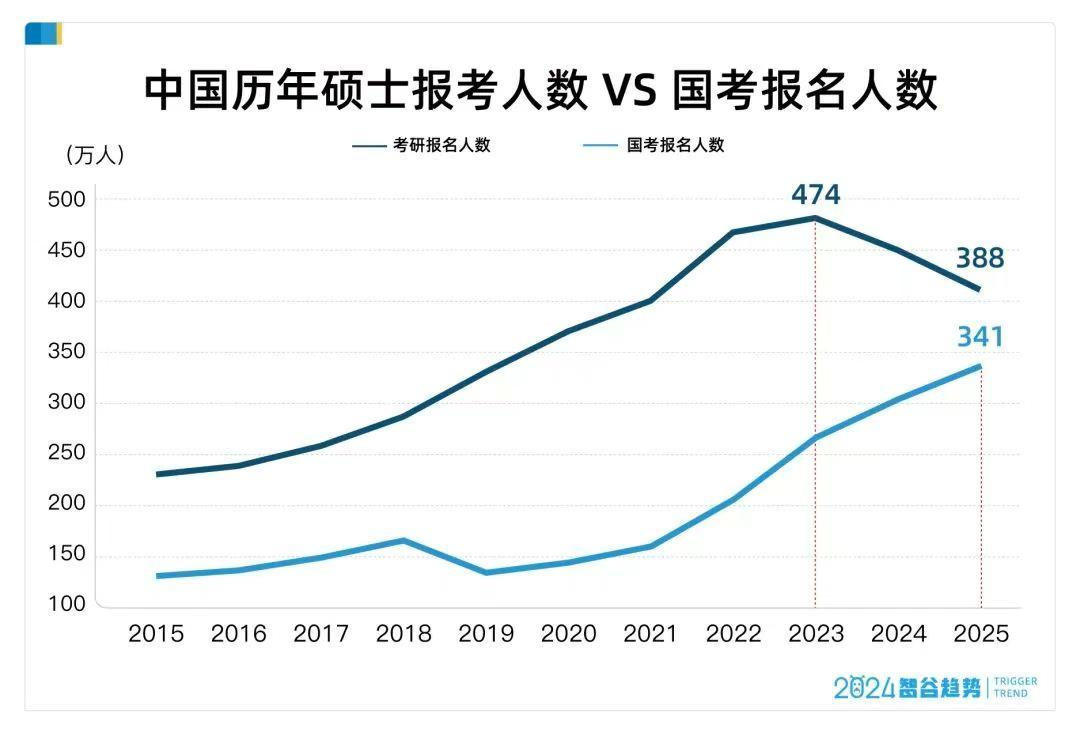
Group 1 - The number of candidates for the national college entrance examination (Gaokao) has decreased for the first time in eight years, with a total of 13.35 million applicants, down by 70,000 from last year [1] - Despite an increase in the birth population, the number of students opting out of the Gaokao has risen significantly, estimated to be around 500,000 [1] - The number of candidates for the postgraduate entrance examination (Kaoyan) is projected to drop by 500,000 in 2025, marking an 11.4% decline [1] Group 2 - The traditional paths of education and career, such as Gaokao, Kaoyan, and studying abroad, are showing signs of a turning point, indicating a potential collapse of the "chicken baby" phenomenon [3] - The marginal returns of pursuing elite education are decreasing, with many graduates facing employment difficulties despite high educational qualifications [6][10] - The employment rate for vocational college graduates is higher than that of master's and doctoral graduates, highlighting a shift in the job market dynamics [6][9] Group 3 - The cost of studying abroad is rising, while the salaries for returnees are declining, leading families to reconsider the value of overseas education [11][13] - The trend of "chicken baby" education is expected to decline as the number of college admissions increases and the competition for higher education eases [16][18] - Historical references to Japan's educational trends illustrate the potential for a similar shift in China, where the intense competition for university admission has led to diminishing returns [19][20]
不和天赋较劲,反而获得自由
Hu Xiu· 2025-04-22 00:07
Core Insights - The article discusses the influence of genetics on individual behavior and destiny, suggesting that genetic factors may play a more significant role than commonly perceived [11][19][28] - It emphasizes the limitations of education in altering one's inherent capabilities, arguing that education serves more as a catalyst rather than a fundamental change agent [25][26][27] Group 1: Genetic Influence - Genetics can determine various aspects of an individual's life, including personality traits, emotional responses, and lifestyle choices [21][22][24] - The case of the author Osamu Dazai illustrates how genetic predispositions can lead to struggles in life, despite a seemingly advantageous background [4][5][7][10] - Research on familial natural short sleepers indicates that genetic factors can dictate sleep needs, challenging the notion that everyone requires the same amount of sleep [13][15] Group 2: Education and Development - Education is portrayed as a means to activate and enhance genetic potential rather than a tool to fundamentally change one's abilities [25][26] - The article critiques the concept of "tiger parenting" or excessive pressure on children, arguing that it may overlook the inherent differences in children's capabilities [21][23] - It suggests that recognizing genetic limitations can lead to a more fulfilling life, as individuals can focus on their strengths rather than conforming to societal expectations [28][30][31]