黄金技术性回调

Search documents
张津镭:冲高回落模式警示风险 黄金高位可做空
Xin Lang Cai Jing· 2026-01-15 09:05
Core Viewpoint - The gold market experienced significant volatility, with prices fluctuating around key psychological levels, indicating a mix of bullish and bearish sentiments driven by risk aversion and liquidity [1][6]. Market Dynamics - On January 15, gold prices initially rose to around $4640 but faced selling pressure, dropping below the critical $4600 mark before rebounding to a high of $4642, ultimately closing at $4626, reflecting a small gain on the day [1][5]. - The market is characterized by a "high-high-low" pattern, where new price peaks are followed by profit-taking, making it difficult for gold to maintain a stable position at elevated levels [6][7]. Technical Analysis - Technical indicators such as MACD and RSI show signs of divergence, suggesting a weakening momentum despite the price being in an upward channel [2][6]. - The market may be due for a technical correction, with potential support levels identified at $4520-$4500 and even lower at $4460-$4450, indicating a strategic point for long-term positioning [2][7]. Trading Recommendations - A trading strategy is suggested to short gold between $4610 and $4512, with a stop loss at $4620 and targets set at $4520-$4500 [3][8]. Economic Data and Events - Key economic data to watch includes U.S. initial jobless claims, New York Fed manufacturing index, Philadelphia Fed manufacturing index, and import price index, all scheduled for January 15 [4][9].
黄金ETF持仓量报告解读(2025-10-29)金价遭大幅抛售跌破3900
Sou Hu Cai Jing· 2025-10-29 04:33
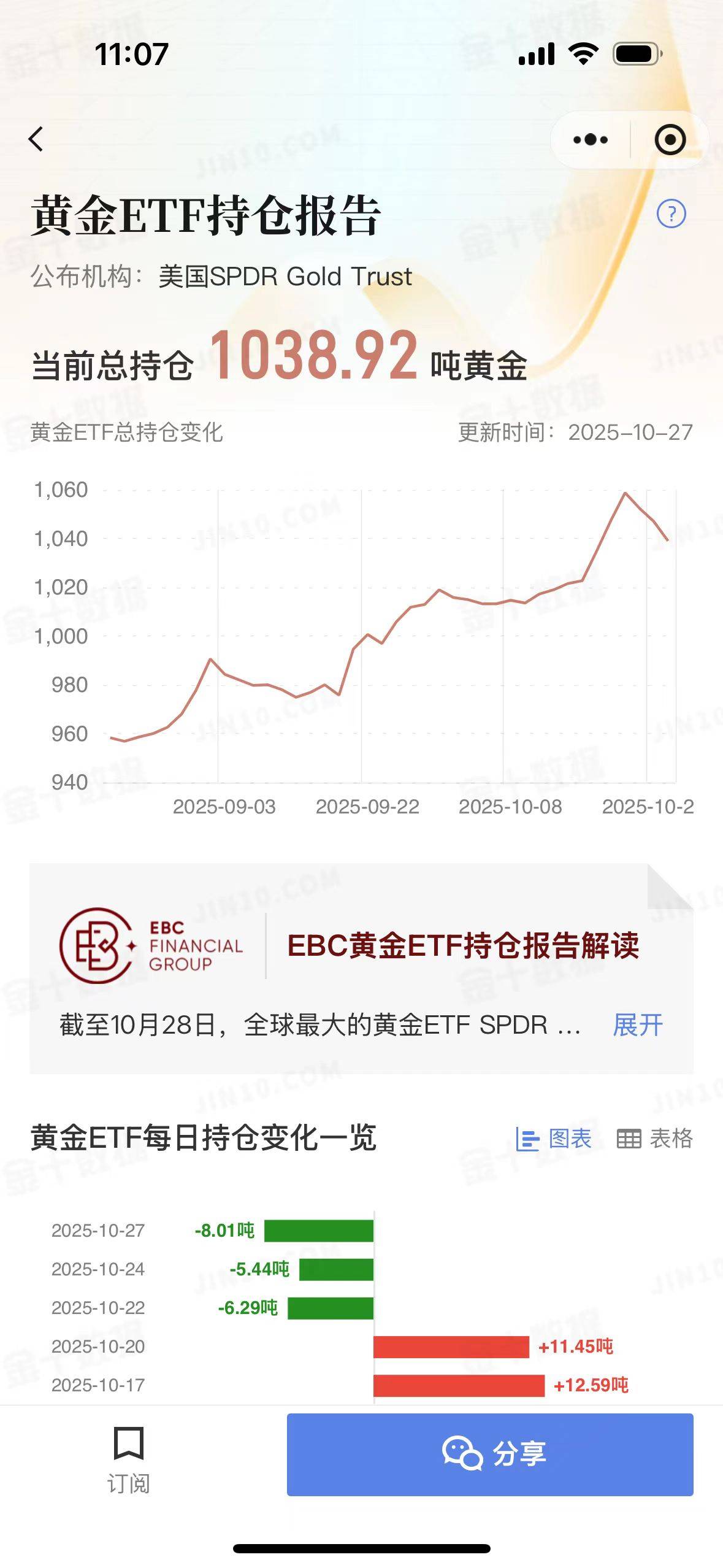
Core Insights - The total holdings of the world's largest gold ETF, SPDR Gold Trust, remain unchanged at 1,038.92 tons as of October 28, 2025, despite fluctuations in gold prices [5] - Gold prices have experienced a downward trend, dropping to a low of $3,886.80 per ounce, the lowest level since October 6, 2025, with a closing price of $3,952.54 per ounce, reflecting a decrease of $28.56 or 0.72% [5] - The signing of a rare earth supply agreement between the U.S. and Japan has injected optimism into the market, reducing gold's appeal as a safe-haven asset [5] Market Trends - The market is closely watching the Federal Reserve's decision, with expectations of a 25 basis point rate cut, marking the second cut since September and the first since December 2024 [6] - The focus will shift to Jerome Powell's speech, where dovish comments could boost gold prices, while hawkish tones may limit upward momentum [6] - Central banks, including the Bank of Korea, are considering increasing gold reserves, which could provide additional support for gold prices [6] Technical Analysis - Gold has seen a correction after a more than 30% increase since late August, with potential for further downside [7] - Key support levels are identified between $3,900 and $3,890, with a decisive break below this range opening up further declines towards $3,800 [7] - Initial resistance is near $4,000, with stronger resistance between $4,050 and $4,150, where multiple moving averages converge [7]

黄金行情“急转直下” 有色金属或面临价值重估
Zhong Guo Zheng Quan Bao· 2025-10-26 21:06
Core Viewpoint - The recent surge in gold prices has faced a significant technical correction, leading to substantial declines in gold ETFs and related stocks, while other metals like copper and rare earths are undergoing a revaluation process [1][4]. Summary of Gold ETFs and Stocks - Following a record high on October 20, gold prices plummeted on October 21, with London spot gold dropping 5.31% to $4,124.36 per ounce, marking the largest single-day decline since April 2013 [1]. - Gold stock ETFs experienced notable declines, with the Guotai CSI Hong Kong-Shenzhen Gold Industry Stock ETF falling 7.60%, leading the market, while several others saw declines exceeding 6% [1][2]. - Year-to-date performance shows significant gains for various gold ETFs, with some increasing over 80%, while others rose more than 50% [2]. Cautious Approach to Gold Volatility - Analysts indicate that gold price fluctuations reflect market confidence in the global monetary system, with gold often becoming a key asset during shifts in central bank policies [3]. - The recent downturn is attributed to an overheated market following rapid price increases, necessitating a technical correction [3][4]. Revaluation of Non-Gold Metals - The precious metals market is experiencing volatility, with copper maintaining strong performance despite concerns over supply and demand [4]. - The investment landscape for non-gold metals is categorized into three segments: precious metals, industrial metals, and rare metals, each influenced by different factors such as geopolitical risks and supply-demand dynamics [4][5]. Investment Outlook for Various Metals - The recent correction in gold is linked to easing geopolitical tensions and profit-taking, yet it retains long-term asset allocation value [5]. - Silver's future remains uncertain, closely tied to geopolitical developments and Federal Reserve actions [5]. - Copper faces a "double weakness" scenario in supply and demand, while rare earths are expected to maintain a positive outlook due to their strategic importance [5][6].
【UNforex财经事件】全球资产大幅下挫,美元美债走强,欧元承压
Sou Hu Cai Jing· 2025-10-14 12:25
Group 1 - Gold prices have experienced a rapid decline after reaching historical highs, with spot gold dropping approximately $60 from $4179.47 to around $4125, as market demand for safe-haven assets recedes and expectations for Federal Reserve rate cuts are already priced in [1] - The relative strength index (RSI) indicates that gold may need to undergo a consolidation period, and if it breaks below the support zone of $4060-$4055, it could further decline to the psychological level of $4000 [1] - The demand for the US dollar as a safe-haven asset continues to increase amid rising global uncertainty, with the dollar index stabilizing around 99.00 and US interest rates remaining relatively high, reinforcing the dollar's safe-haven appeal [1] Group 2 - The euro is under pressure due to heightened global risk sentiment and has failed to break through the 1.1600 level, with strong bearish sentiment prevailing [2] - Political instability in the Eurozone, particularly in France, where President Macron's cabinet reshuffle faces strong opposition, adds to the uncertainty surrounding fiscal reforms and increases downward pressure on the euro [1][2] - The short-term outlook for the euro against the dollar remains weak, with technical and fundamental pressures making it difficult to break the 1.1600 resistance level [2]
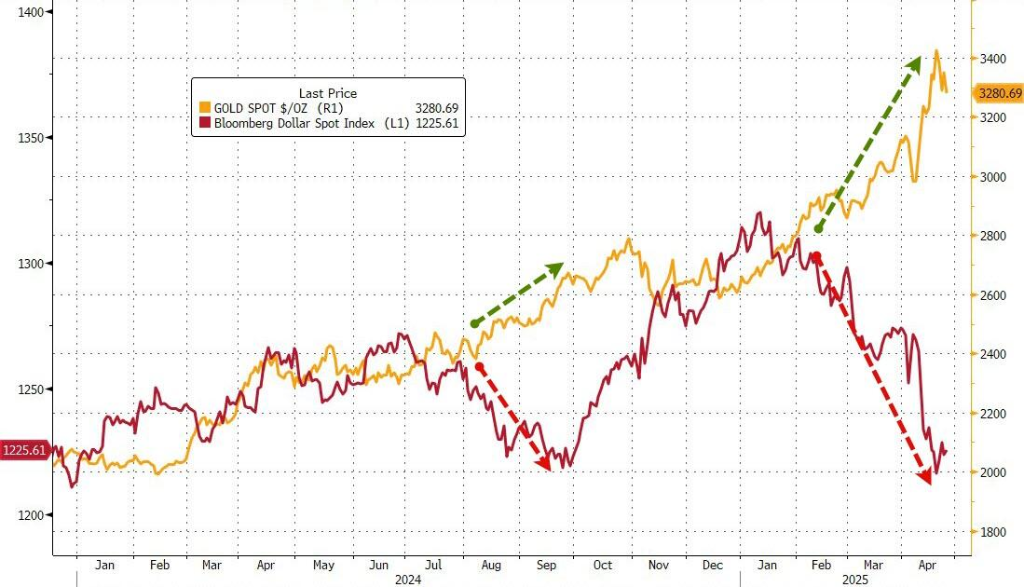
黄金“技术性回调”的理由:三大指标都指向“调整”,甚至“幅度不小”?
Hua Er Jie Jian Wen· 2025-04-26 04:19
Group 1 - Recent surge in gold prices has reached a historical high of over $3,500, attracting global investor attention [1] - The Composite Regional Fed Planned Capex Index has recently dropped below -4, indicating potential economic slowdown [3][6] - Historical data shows that when this index falls significantly into negative territory, actual core capital goods orders tend to decline sharply, reflecting the impact of tariff policies on the real economy [4] Group 2 - Nomura's report indicates that three key indicators are signaling a potential "technical correction" in the gold market, with the adjustment possibly being substantial [7] - The report highlights that when the Composite Regional Fed Planned Capex Index drops below -4, gold performance tends to be poor in the following two months [8] Group 3 - A significant anomaly in fund flows has been observed, with GLD experiencing over 95% historical levels of inflow followed by a similar level of outflow, indicating potential panic selling among late investors [10][11] - Historical patterns suggest that such "big in, big out" scenarios have preceded gold price corrections, typically within the next two months [11] Group 4 - Technical analysis shows that gold prices are currently more than 25% above the 200-day moving average, a level described as "pretty absurd," indicating a need for market correction [14][15] - Historical data indicates that significant deviations from the 200-day moving average often lead to noticeable corrections in gold prices within the subsequent two months [15] Group 5 - Recent data indicates that investors withdrew $1.27 billion from the SPDR Gold ETF, marking the largest single-day outflow since 2011, coinciding with gold prices reaching historical highs [13] - The 2011 outflow was associated with the peak of the last super cycle in gold, leading to a prolonged consolidation period until 2020, providing a historical reference for current market conditions [13]