黄金牛市回调

Search documents
国际黄金多头梦碎4000! 降息预期遭鹰派阻击
Jin Tou Wang· 2025-11-03 03:12
Core Viewpoint - The international gold market is experiencing a short-term oscillation, with prices fluctuating around $3996.90 per ounce, reflecting a slight decline of 0.11% [1] Group 1: Federal Reserve and Economic Indicators - On October 29, the Federal Reserve announced a 25 basis point interest rate cut, but Chairman Powell indicated that a further cut in December is not guaranteed, leading to a decrease in market expectations for another rate cut from 85% to 71%-74.7% [2] - The prolonged U.S. government shutdown has delayed key economic data releases, creating uncertainty for the Federal Reserve's decision-making process [2] Group 2: Market Sentiment and Trade Relations - Positive signals from U.S.-China trade negotiations, including a reduction in tariffs from 57% to 47%, have bolstered bilateral relations and reduced gold's appeal as a safe-haven asset [2] - The potential for peace in the Russia-Ukraine conflict has also diminished the attractiveness of gold, prompting investors to shift towards higher-risk assets [2] - Recent data shows that gold ETFs (SPDR) have seen a cumulative reduction of 19.74 tons, indicating a shift in market sentiment [2] Group 3: Technical Analysis and Price Projections - The gold market has shown a downward trend, with prices hovering around the $4000 mark, and further declines are anticipated, potentially testing support levels between $3850 and $3800 per ounce [3] - Key resistance levels for gold are identified at $4050-$4070, with a stronger resistance at $4120, which must be breached for a potential recovery in prices [3] - Historical patterns suggest that gold typically experiences a pullback of 15%-20% during bull markets, and the current 11% decline remains within a reasonable range [3] - Investors are advised to exercise patience and await clear signals of a market bottom before making any significant moves [3]
金价破4000美元后的警钟:历史暗示牛市中途总有一盆冰水
Sou Hu Cai Jing· 2025-10-10 14:40
Core Viewpoint - The recent volatility in the gold market, highlighted by a rapid price drop from a historical high, signals potential risks and a shift in investor sentiment [1][3]. Group 1: Market Dynamics - On October 9, gold prices reached a record high of $4059.31 per ounce, but fell below $4000 within 24 hours, hitting a low of $3945.03 [1]. - The drop in gold prices is linked to the easing of geopolitical tensions following a ceasefire agreement in Gaza, which reduced the demand for gold as a safe-haven asset [3]. - Technical indicators suggest that the current upward trend in gold prices is losing momentum, with the Relative Strength Index (RSI) at 83.41 indicating an overbought condition [3]. Group 2: Historical Context - Historical patterns show that significant price increases in gold are often followed by corrections, with past bull markets experiencing notable declines [4]. - The current bull market in gold is driven by a combination of trend-following capital, safe-haven demand, and supply-demand changes, influenced by monetary policy and geopolitical factors [4]. Group 3: Investor Behavior - Different types of investors are reacting differently to the volatility; central banks are maintaining their gold purchases, with emerging market central banks increasing their gold holdings [5]. - Long-term institutional investors remain calm amid the fluctuations, while leveraged traders may face significant risks due to the volatility [5]. - Predictions for future gold prices vary widely, with Bank of America warning of a potential drop to $3525 in Q4, while Goldman Sachs forecasts a rise to $4900 by the end of 2026 [5].


全球黄金ETF 5个月来首次净流出,除了欧洲都在卖!
Hua Er Jie Jian Wen· 2025-06-13 12:19
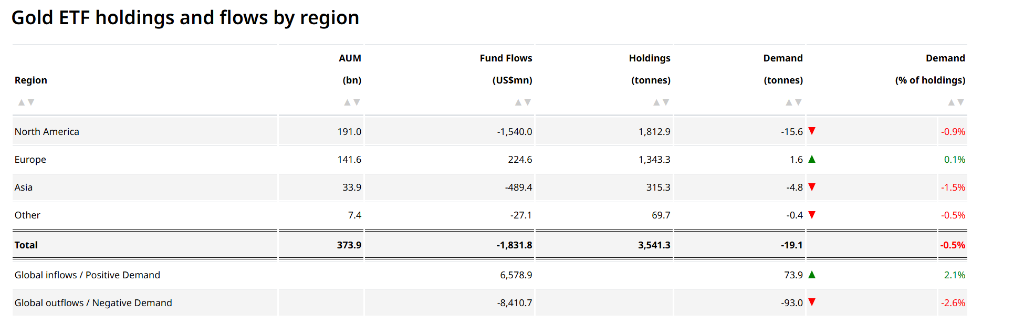
Core Insights - Global gold ETFs experienced a net outflow of $1.8 billion in May, ending a five-month streak of inflows, marking the first monthly outflow since November 2024 [1][3] - The total assets under management (AUM) for global gold ETFs decreased by 1% to $374 billion, with holdings dropping by 19 tons to 3,541 tons [1][2] Group 1: Regional Performance - North America led the outflows with a net withdrawal of $1.54 billion, reflecting a shift in investor sentiment due to a temporary easing of trade tensions and a strong stock market rebound, which reduced the demand for gold as a safe haven [2][3] - Asia saw a net outflow of $489.4 million, primarily driven by Chinese investors, as the easing of trade tensions and stock market recovery diminished the need for gold [4] - Europe was the only region to record inflows, with a modest increase of $225 million, largely attributed to stable inflows from France amid concerns over economic growth and political instability [5] Group 2: Market Dynamics - The Federal Reserve's decision to maintain interest rates in May, coupled with cautious remarks regarding inflation and labor market risks, has led to expectations of sustained high rates, increasing the opportunity cost of holding gold [3] - Despite the outflows, global gold ETF inflows for 2025 remain positive at $30 billion, with total holdings increasing by 322 tons since the beginning of the year [2]