滞胀担忧

Search documents
建信期货股指日评-20260331
Jian Xin Qi Huo· 2026-03-31 02:05
Group 1: Report Information - Report type: Stock index daily review [1] - Date: March 31, 2026 [2] - Researchers: Nie Jiayi, He Zhuoqiao, Huang Wenxin [3] Group 2: Market Review - On March 30, the Wind All - A index rose slightly with increased trading volume, opening with a decline, then rebounding and moving sideways in the afternoon, closing up 0.05% with over 50% of stocks rising. The CSI 300 and SSE 50 closed down 0.24% and 0.14% respectively, while the CSI 500 and CSI 1000 closed up 0.21% and 0.28% respectively. In the futures market, the IF, IH, and IM main contracts fell 0.30%, 0.07%, and 0.19% respectively, and the IC main contract rose 0.02% [6] Group 3: Market Outlook - The current major contradiction is the US - Iran conflict. High oil prices have led to concerns about re - inflation, suppressing risk assets. Geopolitical risks in the Middle East have a reduced impact on the market. In China, economic data from January - February showed better - than - expected exports, retail sales, and industrial added value. The trading volume in the two markets has been stable at around 2 trillion, and the margin trading balance remains high. In the short term, due to geopolitical uncertainties, oil price - induced stagflation concerns, and cautious market sentiment during the earnings disclosure period, a rapid V - shaped reversal is unlikely, and the index will remain range - bound. In the long term, liquidity concerns are expected to improve after the conflict eases. China's supply - chain competitive advantage makes it more resilient. As the macro - economic fundamentals and corporate earnings turn around, the main driving force of A - shares may shift from liquidity to substantial performance improvement. Also, after the IC and IM main contracts switched to the far - month contracts, there was a deep discount again. Considering the long - term optimistic outlook for the index, the roll - down strategy can be tried to obtain excess returns [8][9] Group 4: Industry News - On March 12, at a regular press conference, in response to the US government's new trade investigations on 16 major trading partners including China, the Chinese Foreign Ministry spokesperson stated that China opposes all forms of unilateral tariff measures, and that the so - called "over - capacity" is a false proposition and opposes political manipulation under this pretext [31]
2026年春季有色金属行业投资策略:波动中前进
Shenwan Hongyuan Securities· 2026-03-18 13:03
Group 1: Precious Metals - The financial attributes of precious metals, particularly gold, are expected to continue to shine, driven by ongoing central bank purchases and a shift in global credit dynamics, with gold prices projected to rise significantly [4][13][36] - Central banks' gold purchases are anticipated to increase from 5% to 21% of global gold demand from 2020 to 2024, with a peak of 23% in 2022, indicating a strong demand for gold as a safe asset [13][19] - Gold prices are projected to exceed $6,000 per ounce by 2026, supported by central bank buying and a decline in real interest rates [33][36][46] Group 2: Industrial Metals - The demand for industrial metals, particularly aluminum and copper, is expected to remain robust, with aluminum nearing production capacity limits domestically and limited supply growth internationally [4][54] - The copper market is facing significant supply disruptions, with major mines experiencing production cuts due to various operational challenges, leading to a tight supply outlook [53][54] - The overall copper production is projected to grow modestly, with a year-on-year increase of 2.5% in 2024 and 1.2% in 2025, but supply constraints may limit growth potential [54][72] Group 3: Minor Metals - Strategic minor metals such as lithium, cobalt, and tungsten are experiencing a revaluation due to increasing demand from energy storage and electric vehicle sectors [5][48] - The lithium industry is expected to see a reversal in its cycle earlier than anticipated, driven by high demand for energy storage solutions [5] - Cobalt supply is tightening significantly, leading to a notable price increase, while nickel prices are supported by clear cost structures and increasing supply disruptions [5][48]



2026年3月16日申万期货品种策略日报-黄金白银-20260316
Shen Yin Wan Guo Qi Huo· 2026-03-16 02:59
1. Report Industry Investment Rating - Not provided in the given content 2. Core View of the Report - In the short term, the ongoing stalemate in the US - Iran conflict, high - volatility international crude oil prices, and the resulting rise in global inflation expectations have led to a significant cooling of market expectations for the Fed to cut interest rates, along with higher US dollar index and US Treasury yields, which continue to suppress the performance of precious metals. In the long run, the price center of precious metals will continue to move up. The long - term upward trend of gold remains unchanged due to multiple factors such as geopolitical risks, anti - inflation needs, de - dollarization, and central bank gold purchases. Silver, platinum, and palladium follow the overall sector trend with greater volatility [6]. 3. Summary by Relevant Catalogs 3.1 Futures Market - **Prices and Changes**: For gold futures, the closing prices of沪金2606 and沪金2604 on the previous day were 1135.90 and 1133.00 respectively, down 15.62 and 15.10 from the day before, with declines of 1.36% and 1.32%. For silver futures, the closing prices of沪银2606 and沪银2604 on the previous day were 20923 and 21103 respectively, down 1139 and 1122 from the day before, with declines of 5.16% and 5.05% [2]. - **Positions and Volumes**: The positions of沪金2606 and沪金2604 were 140959 and 102674, and the trading volumes were 86582 and 178365 respectively. The positions of沪银2606 and沪银2604 were 212096 and 83802, and the trading volumes were 519958 and 93889 respectively [2]. - **Spot Premiums**: The spot premiums of沪金2606 and沪金2604 were - 4.65 and - 1.75, and those of沪银2606 and沪银2604 were - 36 and - 216 respectively [2]. 3.2 Spot Market - **Prices and Changes**: The closing prices of Shanghai Gold T + D and London Gold on the previous day were 1131.25 and 5018.10 respectively, down 15.01 and 59.84 from the day before, with declines of 1.31% and 1.18%. The closing prices of Shanghai Silver T + D and London Silver on the previous day were 20887 and 80.54 respectively, down 964 and 3.24 from the day before, with declines of 4.41% and 3.87% [2]. - **Price Ratios**: The current values of沪金2606 - 沪金2604,沪银2606 - 沪银2604, gold/silver (spot), Shanghai Gold/London Gold, and Shanghai Silver/London Silver were 2.90, - 180.00, 54.16, 1.02, and 1.17 respectively, with corresponding previous values of 3.42, - 163.00, 52.46, 1.02, and 1.17 [2]. 3.3 Inventory - **Changes**: The current inventories of Shanghai Futures Exchange gold, Shanghai Futures Exchange silver, COMEX gold, and COMEX silver were 105417 kg, 326566 kg, 32551562 troy ounces, and 341723209 troy ounces respectively, with changes of - 3 kg, + 16592 kg, - 104844 troy ounces, and - 2601615 troy ounces compared to the previous values [2]. 3.4 Related Markets - **Indices and Yields**: The current values of the US dollar index, S&P 500 index, 10 - year US Treasury yield, Brent crude oil, and US dollar/Chinese yuan were 100.50, 6632.19, 4.28%, 103.89, and 6.9030 respectively, with changes of + 0.76, - 40.43, + 0.01%, + 2.14, and + 0.0278 compared to the previous values [2]. 3.5 Derivatives - **ETF and Net Positions**: The current positions of SPDR Gold ETF and SLV Silver ETF were 1072 tons and 15460 tons respectively, with changes of - 4 tons and - 79 tons compared to the previous values. The current net positions of CFTC speculators in gold and silver were 163132 and 24578 respectively, with increases of 2987 and 1240 compared to the previous values [2]. 3.6 Macro News - **US - Iran Relations**: Trump said the US is in dialogue with Iran but thinks they are not ready. He warned NATO that if allies don't help reopen the Strait of Hormuz, NATO will face a "very bad" future. He also hinted at a new strike on Iran's oil export hub and infrastructure [3]. - **US Treasury Market**: Rising oil prices have led to concerns about stagflation, erasing the US Treasury market's gains this year. Yields have risen, and Wall Street has lowered expectations for US interest rate cuts [4]. - **Multinational Convoy**: The Trump administration plans to announce a multinational alliance to escort ships through the Strait of Hormuz as early as this week, but discussions on the timing of such actions are ongoing [4]. - **IEA Oil Release**: The IEA will immediately release record - reserve crude oil to the Asian market, while oil for Europe and the Americas will be released by the end of March. About 72% of the committed oil volume is crude oil, and 28% is petroleum products [5].
黄金周报:油价飙升推升通胀预期,金价冲高回落-20260310
Dong Fang Jin Cheng· 2026-03-10 09:02
Report Summary 1. Report Industry Investment Rating No relevant content provided. 2. Core View of the Report - International crude oil price surge pushed up market inflation expectations, causing the gold price to rise first and then fall. Last week, gold prices fluctuated and adjusted. After a sharp rise on Monday due to the escalation of the geopolitical situation in the Middle East and risk - aversion sentiment, the gold price oscillated downward from Tuesday. This was due to the panic in the energy supply chain, the rise in the US inflation expectation, the increase in the US dollar index, and the concern about liquidity in the global stock market [2]. - This week (the week of March 9), the gold price will oscillate and rise. The US government's measures to ease oil price pressure are expected to cause oil prices to fall from their high levels, and the previous suppression of gold prices by soaring oil prices will be significantly alleviated. However, due to high geopolitical risks and uncertain US inflation trends, the expectation of interest rate cuts remains low, which will limit the increase in the gold price [2]. 3. Summary by Directory I. Last Week's Market Review - **Gold Spot and Futures Price Trends**: Last Friday (March 6), the Shanghai gold futures price closed at 1,140.80 yuan/gram, down 7.10 yuan/gram from the previous Friday; the COMEX gold futures price closed at $5,181.30 per ounce, down $115.10 per ounce. The spot gold T + D price closed at 1,138.46 yuan/gram, down 4.02 yuan/gram; the London gold spot price closed at $5,168.01 per ounce, down $110.25 per ounce [3]. - **Gold Basis**: Last Friday, the international gold basis (spot - futures) was -$9.95 per ounce, up $47.75 per ounce from the previous Friday; the Shanghai gold basis was -2.22 yuan/gram, up 2.02 yuan/gram from the previous Friday [6]. - **Gold Domestic - Foreign Price Difference**: Last week, the international crude oil price rose significantly, reducing the market's expectation of a Fed interest rate cut. The decline of the foreign - market gold price was greater than that of the domestic market. The domestic - foreign price difference of gold on Friday was -74.05 yuan/gram, up significantly from -89.78 yuan/gram the previous Friday. The gold - oil ratio decreased significantly, the gold - silver ratio increased significantly, and the gold - copper ratio increased slightly [9]. - **Position Analysis**: In terms of spot positions, the gold ETF holdings decreased significantly last week. As of last Friday, the holdings of the world's largest SPRD gold ETF fund were 1,073.32 tons, a decrease of 28.01 tons from the previous week. The cumulative trading volume of domestic gold T + D increased significantly. In terms of futures positions, as of February 24, the long and short positions of gold CFTC asset management institutions both decreased, but the decline of short positions was larger, resulting in a slight increase in the net long positions. In terms of inventory, the COMEX gold futures inventory continued to decrease, and the Shanghai Futures Exchange gold inventory decreased by 27 kilograms to 105,033 kilograms [14]. II. Macroeconomic Fundamentals - **Important Economic Data** - US manufacturing PMI in February continued to expand for two consecutive months, and the price index soared to a nearly four - year high. The ISM manufacturing activity index in February slightly declined to 52.4, and the S&P manufacturing PMI dropped from 52.4 to 51.6, hitting a nearly seven - month low [19]. - The US ADP employment in February increased by 63,000, the highest level in three months. However, the January data was significantly revised downward, and the breadth of employment creation was insufficient [20]. - The US ISM services PMI in February rose, and the order backlog index increased significantly. The service industry index rose to 56.1, and the new order sub - index climbed to 58.6, hitting a nearly one - year high [21]. - The soaring oil price impacted the interest rate cut expectation, and the expectation of US bond traders that the Fed would not cut interest rates this year increased. As of March 5, the probability that the Fed would maintain the current interest rate range by December was 25%, higher than 17% the previous week [22]. - The US non - farm payrolls in February were disappointing, with a net decrease of 92,000 employed people and the unemployment rate rising to 4.4%. However, the wage data strengthened, increasing the complexity of the Fed's policy judgment [24]. - The US retail sales in January decreased by 0.2% month - on - month, the first negative growth since October last year. After excluding some items, the "control group" sales increased by 0.3% month - on - month, indicating a relatively stable consumer end [25]. - **Fed Policy Tracking** - On March 6, Fed Governor Waller said that the Iran war would not have a continuous impact on inflation and reiterated his preference for a 25 - basis - point interest rate cut [29]. - San Francisco Fed President Daly said that the weak non - farm employment data in February deepened her concerns about the labor market, but policymakers should not over - interpret single - month data, and the Fed should not cut interest rates immediately due to "bilateral risks" [30]. - Chicago Fed President Goolsbee hopes that the Fed can resume interest rate cuts by the end of this year [31]. - **US Dollar Index Trend**: Last week, the US dollar index rose significantly. Due to the blockade of the Strait of Hormuz and the sharp rise in oil prices, and international crude oil being priced in US dollars, the US dollar index rose by 1.34% to 98.96 as of last Friday [31]. - **US TIPS Yield Trend**: Last week, the US 10 - year TIPS yield rose significantly. The continued expansion of the US manufacturing PMI in February and the sharp rise in international crude oil prices increased market concerns about inflation rebound, causing the 10 - year TIPS yield to rise by 8 basis points to 1.80% as of Friday [32]. - **International Important Event Tracking**: The US - Iran conflict continued to expand. Last week, the US, Israel, and Iran continued to launch attacks. Trump demanded that Iran surrender unconditionally, but Iran vowed not to surrender, and the Islamic Revolutionary Guard Corps said it was ready for a full - scale war lasting at least six months. Tehran elected Mojtaba Khamenei as the supreme leader [37].
股指短期承压,国债或震荡运行
Chang Jiang Qi Huo· 2026-03-09 05:55
1. Report Industry Investment Rating - No relevant information provided 2. Core Views of the Report - The conflict between the US and Iran has intensified, causing external markets to generally decline, and stock index futures may face pressure. The bond market may benefit indirectly in the short term if external inflation expectations suppress risk assets, but it could pose a concern in the medium term if inflation becomes a reality. [11][12] 3. Summary by Directory Financial Futures Strategy Recommendations Stock Index Strategy Recommendations - Stock index trend review: Most stocks rose, with nearly 4,300 stocks in the Shanghai, Shenzhen, and Beijing stock markets closing higher. [11] - Core view: Geopolitical events such as the change of leadership in Iran, the Israel-Iran conflict, and the "production halt wave" in the Middle East, along with concerns about stagflation in the US, have led to external market declines, and the stock index may face pressure. [11] - Technical analysis: The MACD indicator shows that the market index may fluctuate. [11] - Strategy outlook: Range-bound fluctuations. [11] Treasury Bond Strategy Recommendations - Treasury bond trend review: The 30-year main contract rose 0.03%, the 10-year main contract remained flat, the 5-year main contract remained flat, and the 2-year main contract fell 0.01%. [12] - Core view: The market has entered a sideways and low-volatility state, and institutional buying willingness remains. The bond yield is unlikely to rebound significantly. The market will focus on quarter-end institutional behavior and overseas developments. External inflation expectations may indirectly benefit the bond market in the short term but pose a concern in the medium term. [12] - Technical analysis: The MACD indicator shows that the T main contract may fluctuate. [12] - Strategy outlook: Fluctuating operation. [12] Key Data Tracking PMI - On March 4, 2026, the National Bureau of Statistics announced that the manufacturing PMI in February fell to 49.0%. The decline was in line with seasonal patterns, but structural changes need attention, including a significant decline in external demand and an increasing risk of imported inflation. [18] CPI - Seasonal factors and the low base effect are expected to push up the CPI. Four factors will drive the year-on-year central level of CPI to rise in 2026: the low base, the narrowing decline of pork prices, the impact of gold prices, and the expansion of service consumption. [21] Imports and Exports - In December 2025, the year-on-year growth rate of exports unexpectedly rebounded to 6.6%, higher than the market expectation. The month-on-month growth rate was 8.3%, higher than the average of the past ten years. The two-year compound growth rate also rebounded. The overestimation of trade friction and the underestimation of the upward power of the global manufacturing cycle led to the unexpected growth of exports in 2025. The "One Belt, One Road" investment driving foreign trade may continue in 2026. [24] Fixed Asset Investment - In 2025, the growth rate of fixed asset investment was -3.8%, a significant decline from 2024 and turning negative. The estimated growth rate in December was -16.0%, with the decline continuing to widen. Among them, the growth rates of private investment and public investment in December were -17.2% and -14.3% respectively, both with expanding declines. The growth rate of construction and installation projects in December dropped to -28.0%, while the growth rates of equipment and tool purchases and other expenses rebounded to 8.7% and 0.3% respectively. [27] Social Retail - In 2025, the year-on-year growth rates of social retail, social retail excluding automobiles, and above-limit retail were 3.7%, 4.4%, and 3.3% respectively, all slightly rebounding from 2024. In December, the growth rate of social retail fell to 0.9%, while the decline of above-limit retail narrowed to -1.9%. The performance difference was mainly due to the general weakness of consumption channels and the weakening drag of durable goods. [30] Social Financing - On February 13, 2026, the central bank announced that in January 2026, the new social financing was 7.2 trillion yuan, and the new RMB loans were 4.7 trillion yuan. At the end of January, the year-on-year growth rate of the social financing scale stock was 8.2%, and the year-on-year growth rate of M2 was 9.0%. The year-on-year increase in social financing was mainly supported by government bonds, undiscounted bills, and foreign currency loans. The year-on-year increases of long-term loans for residents and enterprises were both less, while the year-on-year increases of short-term loans for residents and enterprises were more. The year-on-year growth rates of M1 and M2 both rebounded, and non-bank deposits continued to increase. The coordination of monetary and fiscal policies maintained sufficient liquidity. [33]
铜:现实端偏弱,价格承压
Guo Tai Jun An Qi Huo· 2026-03-09 02:48
1. Report Industry Investment Rating - No information provided 2. Core View of the Report - The copper market is weak in the real - world, and prices are under pressure [1] 3. Summary by Relevant Catalogs 3.1 Copper Fundamental Data - **Futures Prices**: The closing price of the Shanghai copper main contract was 101,050 with a daily decrease of 0.03%, and the night - session closing price was 100,250 with a decrease of 0.79%. The closing price of the LME copper 3M electronic disk was 12,869 with a daily increase of 0.08% [1] - **Trading Volume and Open Interest**: The trading volume of the Shanghai copper index was 251,394, a decrease of 19,260 from the previous day, and the open interest was 579,868, a decrease of 5,580. The trading volume of the LME copper 3M electronic disk was 24,172, a decrease of 3,685, and the open interest was 308,000, an increase of 2,377 [1] - **Futures Inventory**: The Shanghai copper inventory was 315,488, an increase of 11,856 from the previous day, and the LME copper inventory was 284,325, an increase of 2,125. The LME copper注销仓单 ratio was 4.04%, a decrease of 1.16% [1] - **Price Spreads**: The LME copper spread decreased by 0.30 from the previous day. The Shanghai copper spot - to - futures near - month spread increased by 35, and the near - month contract to the first - continuous contract spread decreased by 90 [1] - **Other Spreads and Profits**: The Shanghai copper spot - to - LME cash spread increased by 238, the Shanghai copper continuous - three contract to LME 3M spread increased by 155, the Shanghai copper spot - to - Shanghai 1 recycled copper spread decreased by 305, and the recycled copper import profit increased by 139 [1] 3.2 Macro and Industry News - **Macro News**: US non - farm employment has cooled sharply, and the Middle East conflict has caused oil prices to soar, increasing market concerns about stagflation. Concerns about the private credit industry have also pushed down US stocks. In 2026, China's fiscal policy will adhere to a more proactive tone, with a fiscal arrangement in the tens of billions to boost domestic demand [1] - **Industry News**: Japan's January imports of copper and copper alloys after customs clearance were 9,895 tons, a year - on - year increase of 13.51% and a month - on - month decrease of 12.75%. Chile's copper production in January decreased by 3% year - on - year to 413,712 tons. Revere Copper Products is increasing investment in the US due to increased revenues from tariffs and data center demand. The US has made some progress in obtaining strategic minerals in the Democratic Republic of the Congo, but regional conflicts, controversial licenses, and compliance requirements have slowed down US companies' entry [1][3] 3.3 Trend Intensity - The copper trend intensity is 0, indicating a neutral outlook [3]
国泰君安期货·君研海外:境外权益(港美股)周度策略报告-20260308
Guo Tai Jun An Qi Huo· 2026-03-08 12:10
Report Title - Overseas Equity (Hong Kong and US Stocks) Weekly Strategy Report [1] Report Date - March 8, 2026 [2] Analyst Information - Analyst: Dai Lu (Z0021475), Contact: Yang Teng (F03151619) [2] US Stocks Market Performance - This week, the "geopolitical situation" remained unresolved, and the US stock market continued its defensive and wait - and - see stance. The energy sector led the gains, while the three major US stock indexes declined. The rise in oil and gas prices reignited stagflation concerns, causing the consumer sector to perform weakly [3][5] - The VIX index soared to its highest level since April last year [4] Investment Strategy - Short - term: Maintain a certain defensive position (military/energy) and appropriately reduce the overall risk appetite of the portfolio. Wait for the situation to become clearer and then enter the market at low levels. Also, pay attention to the potential fluctuations brought by Oracle's earnings report and February CPI data next week [5][9] - Medium - to - long - term: US stock investment will return to fundamental endogenous factors. Hardware + HALO assets are favored [9] Key Events to Watch - Oracle will release its latest earnings report on March 11th. Last December, Oracle's earnings report with higher - than - expected CAPEX and lower - than - expected revenue triggered a pulse adjustment in the US stock market [6] Chinese - funded Stocks Market Performance - This week, the A - share and Hong Kong stock markets oscillated and closed lower. The trading theme was centered around "geopolitical games", with sectors such as petroleum and petrochemicals, shipping, and dividends leading the gains [10][11] Investment Strategy - Short - term: Maintain a balanced allocation of defensive sectors and wait for the situation to become clearer before buying at low levels [11] - Medium - term: A - shares are considered better than Hong Kong stocks. Adopt a balanced allocation strategy of technology + physical cycle, with a focus on the contraction of the technology circle (upstream infrastructure (domestic and foreign demand chains) > mid - stream cloud computing > downstream application software) [16] Hong Kong Stocks Market Performance - On Friday, the Hang Seng Technology Index rebounded strongly. This was due to JD.com signaling a reduction in takeaway investment. JD.com's Q4 conference call announced that the investment scale of its takeaway business in 2026 would be lower than the previous year, triggering a large - scale short - covering in the Hang Seng Technology Index [13][16] Investment Strategy - Short - term: Keep a certain defensive position (energy, military, and dividends) to hedge risks and wait for the situation to become clearer before buying at low levels [16] - Medium - term: A - shares are preferred over Hong Kong stocks. Hong Kong stocks face potential headwinds, such as VAT rumors, the threat of software business models being disrupted by large - scale models, and weak liquidity. HALO assets are more concentrated in A - shares [16]
地缘央行双擎沪金内强外弱
Jin Tou Wang· 2025-10-31 03:05
Core Viewpoint - The recent interest rate cut by the Federal Reserve and the ongoing geopolitical tensions have created a complex environment for gold prices, with domestic markets showing stronger performance compared to international counterparts due to local demand and currency stability [3][4]. Group 1: Market Dynamics - The Federal Reserve cut interest rates by 25 basis points and announced a halt to balance sheet reduction, which theoretically benefits non-yielding assets like gold [3]. - The mixed signals from Fed Chair Powell regarding future rate cuts have led to fluctuating market expectations, creating both upward and downward pressures on gold prices [3]. - The U.S. dollar index slightly decreased by 0.01% to 99.5328, providing some support for gold prices, although the dollar remains in a range-bound pattern [3]. Group 2: Domestic vs. International Markets - Domestic gold prices have shown significant gains, with Shanghai gold futures rising to 919.86 CNY per gram, a 1.05% increase, driven by stable RMB exchange rates and local demand [1][3]. - In contrast, international gold markets are experiencing a more subdued performance due to the lack of a clear downward trend in the dollar and ongoing uncertainty in economic indicators [3]. Group 3: Investment Trends - Global gold investment demand surged by 47% year-on-year in Q3, as reported by the World Gold Council, providing strong support for gold prices amid rising geopolitical risks [3]. - Despite a five-day outflow of funds from global gold ETFs, domestic investors are taking advantage of market volatility to enter positions [3]. Group 4: Technical Analysis - Key resistance levels for Shanghai gold futures are identified between 951 CNY and 1000 CNY per gram, while support levels are between 894 CNY and 950 CNY [4]. - The core trading range for Shanghai gold is expected to be between 910 CNY and 925 CNY, with a critical support level at 915 CNY [4].
黄金、白银期货价格持续走高 机构提示长假持仓风险
Zheng Quan Shi Bao· 2025-09-25 02:34
Group 1 - The core viewpoint is that gold and silver prices are experiencing a sustained increase due to rising geopolitical risks and expectations of interest rate cuts by the Federal Reserve, with gold reaching a historical high of 860 CNY per gram and silver at 10,397 CNY per kilogram [1] - The Federal Reserve's anticipated interest rate cuts are seen as a primary driver for gold and silver prices, alongside ongoing geopolitical tensions, particularly in the Middle East, which are elevating global risk aversion [1][2] - Central banks globally continue to maintain a net buying stance on gold, with a net increase of 10 tons in official gold reserves, and China's central bank increasing its reserves by 1.7 tons, marking ten consecutive months of growth [2] Group 2 - The market sentiment remains optimistic for precious metals in the medium to long term, although there are indications of potential technical corrections due to recent price surges [1][3] - Investors are advised to adopt a cautious approach during the upcoming National Day holiday, with recommendations to hold a small number of gold positions while liquidating silver holdings [1][3] - The recent inflow of 5.5 billion USD into global physical gold ETFs indicates a renewed interest from investors in North America and Europe, despite a negative shift in demand from Asia [2]
彻底爆了!金价再破纪录,有人一出手就折现超240万元!
Sou Hu Cai Jing· 2025-09-13 04:44
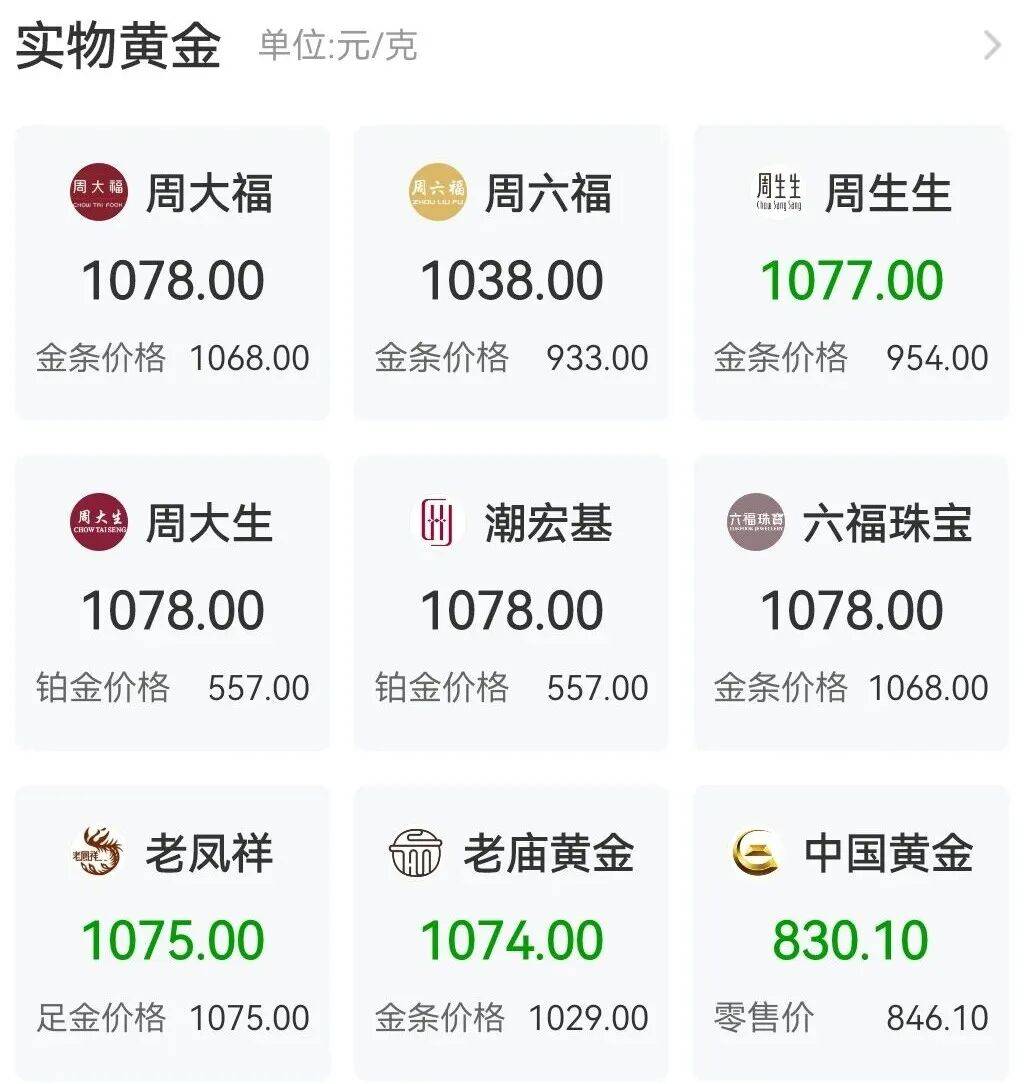
Core Insights - Gold prices reached a historic high of $3,674.27 per ounce, surpassing the previous peak of $850 per ounce from January 21, 1980, adjusted for inflation [1] - The price of gold has increased approximately 5% this month and nearly 40% year-to-date, reinforcing its status as a safe-haven asset amid macroeconomic uncertainties [1] - Domestic gold jewelry brands have seen prices exceed 1,070 yuan per gram, approaching 1,080 yuan per gram [1] Market Dynamics - A significant increase in gold prices has led investors to capitalize on the opportunity, with one investor selling 3 kilograms of gold for 2.43 million yuan [2] - Economic data releases, including a rise in initial jobless claims to 263,000, have contributed to the volatility in gold prices, which rebounded after initial declines [2] - Analysts suggest that despite some short-term buyer fatigue, the outlook for gold remains constructive with limited room for significant pullbacks [2] Economic Indicators - Recent economic data indicates a cooling U.S. economy, with the Consumer Price Index (CPI) rising 2.9% year-over-year, the largest increase in seven months, and a decline in the Producer Price Index (PPI) [3] - Non-farm payrolls added only 22,000 jobs in August, with the unemployment rate rising to 4.3%, highlighting weaknesses in the labor market alongside persistent inflation [3] - Market expectations for a potential 25 basis point rate cut by the Federal Reserve have increased, reflecting concerns over stagflation [3] Factors Driving Gold Prices - Multiple factors, including U.S. tax and tariff policies and challenges to the independence of the Federal Reserve, have diminished the attractiveness of the dollar and U.S. Treasury bonds, driving funds into gold [5] - Historical perspectives on gold as a hedge against inflation and currency devaluation are being reinforced amid current economic uncertainties [5] - The volatility of gold prices in this cycle is lower compared to the sharp spikes seen in 1980, attributed to enhanced market liquidity and the accessibility of gold through ETFs [5] Central Bank Trends - Central banks are diversifying their foreign reserves, with gold's share in reserves increasing since the Russia-Ukraine conflict, now surpassing the euro as the second-largest reserve asset globally [6] - Future gold price movements are expected to be influenced by Federal Reserve policy and global risk events, with historical trends indicating that rate-cutting cycles enhance gold's appeal [6] - The ongoing relationship dynamics between the White House and the Federal Reserve are viewed as significant variables influencing gold prices [6]