
国际黄金

Search documents
地缘局势阶段性缓和 国际黄金高位宽幅震荡
Jin Tou Wang· 2026-02-27 03:55
Core Viewpoint - The international gold price is experiencing slight fluctuations, currently around $5183.29 per ounce, with a marginal decline of 0.01%. Geopolitical tensions, particularly between the U.S. and Iran, are influencing market dynamics, leading to expectations of continued high volatility around the $5000 per ounce mark [1][2]. Geopolitical Developments - Oman reported progress in negotiations between the U.S. and Iran regarding Tehran's nuclear program, although the talks did not yield a breakthrough, maintaining regional tensions. The potential for U.S. military action remains a concern amidst the ongoing discussions [2][3]. - The U.S. and Iran plan to resume negotiations after consultations in their respective capitals, with technical discussions scheduled for next week in Vienna. A substantive agreement could reduce the likelihood of military action by the U.S. against Iran [2]. Technical Analysis - The daily structure of international gold prices indicates a strong consolidation above $5100, with the moving average system still in a bullish arrangement, although the upward momentum is slowing. Key support levels are identified at $5150 and $5100, while resistance is noted at $5220 [4]. - The four-hour chart shows gold prices operating within an ascending channel, with short-term support at $5170 and resistance between $5215 and $5220. A breakout triggered by PPI data could lead to significant price movements [4].
美国中央司令详报军事行动 金价试探高位“屡屡失败”
Jin Tou Wang· 2026-02-27 03:10
Group 1 - The international gold price reached $5192.31 per ounce, reflecting an increase of $8.27 or 0.16% from the previous trading day, indicating a rebound trend [1] - The opening price for gold was $5179.90 per ounce, with a daily high of $5199.39 and a low of $5165.79 [1] Group 2 - U.S. Central Command Chief Admiral Brad Cooper reported various potential military action options against Iran to President Trump, coinciding with indirect nuclear talks in Geneva [2] - The talks focused on Iran's nuclear program and ballistic missile project, but no public agreement was reached, although progress was acknowledged by the Iranian Foreign Minister [2] - The possibility of U.S.-Israel joint military actions remains on the table, with significant naval and air force deployments in the region, showcasing strong deterrence capabilities [2] Group 3 - The gold market opened at $5165.3, initially rising to $5206.2 before a strong pullback, with a daily low of $5129.9 and a closing price of $5184.6, forming a spinning top candlestick pattern [3] - The market outlook remains bullish, with suggested buy positions at lower levels and targets set at various price points including $5170, $5180, $5192, $5200, and $5230 [3]
金价遇阻获利了结、利好仍在回撤仍可看涨
Sou Hu Cai Jing· 2026-02-25 03:28
Group 1 - The core viewpoint of the article indicates that international gold prices have faced resistance and declined due to a stronger dollar and profit-taking, alongside warnings from multiple Federal Reserve officials about persistently high inflation, which has significantly cooled interest rate cut expectations [1][2] - The geopolitical tensions in the Middle East have become a significant driving force for the gold market, despite the recent price fluctuations showing a pattern of oscillating upward [1][2] - The outlook for interest rate cuts remains, suggesting that the recent price pullback could present a buying opportunity at support levels [1] Group 2 - On the specific price movements, gold opened at $5227.26 per ounce, reached a daily high of $5249.43, then fell over $100 before stabilizing in the $5160-$5186 range, eventually closing at $5143.70, marking a daily decline of $83.56 or 1.6% [3] - The market is currently supported by moving averages, with the dollar index's early rebound losing momentum, providing some support for gold prices [3] - Federal Reserve officials have expressed caution regarding interest rate cuts, with indications that rates may be maintained for some time, which has pressured gold prices, although the potential for future cuts remains due to the administration's preference for low-rate policies [3]


张尧浠:金价遇阻获利了结、利好仍在回撤仍可看涨
Sou Hu Cai Jing· 2026-02-25 01:35
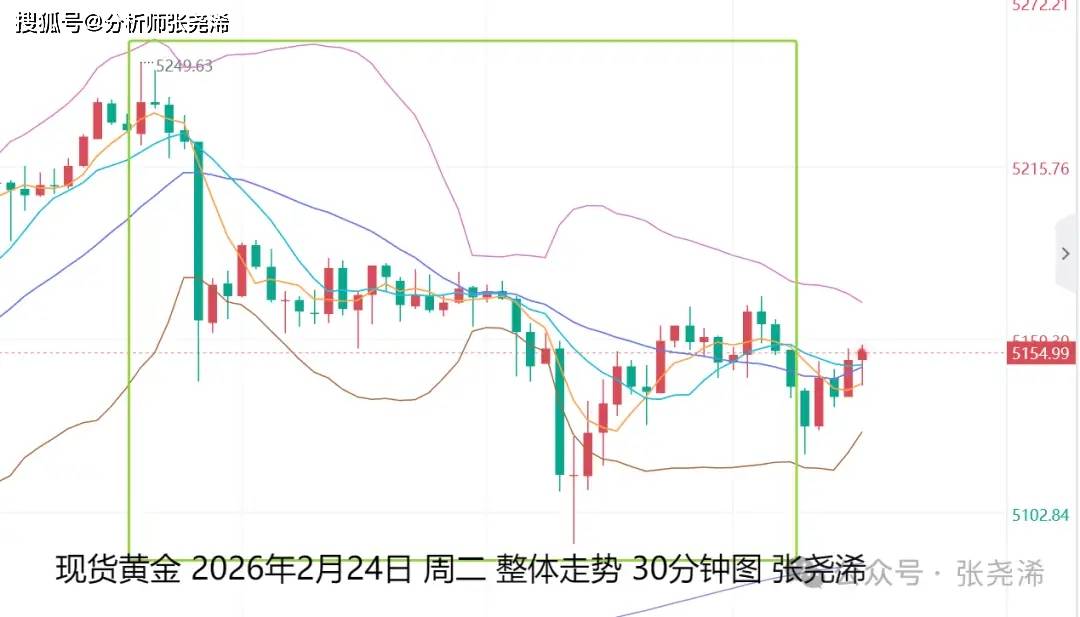
Core Viewpoint - The recent decline in gold prices is attributed to a stronger US dollar and profit-taking, but the long-term outlook remains bullish due to ongoing geopolitical tensions and potential interest rate cuts later in the year [1][5]. Market Performance - On February 24, gold opened at $5,227.26 per ounce, reached a high of $5,249.43, and then fell over $100 before stabilizing in the $5,160-$5,186 range. The lowest point was $5,094.07, closing at $5,143.70, marking a daily drop of $83.56 or 1.6% [3]. - The trading range indicates a volatile market, with a daily fluctuation of $155.36 [3]. Technical Analysis - The monthly chart shows that after a dip in February, gold prices rebounded after hitting a support level, indicating a continuation of the new bull market [6]. - The daily chart suggests that while there was a bearish reversal pattern, gold remains above the upward trend channel, indicating limited downside potential [7]. Geopolitical Factors - Geopolitical tensions have been a long-term driver for the gold market, with fluctuations in these tensions contributing to gold's upward trajectory [5]. - The combination of geopolitical concerns and central bank buying is expected to provide solid support for gold prices in the near term [5]. Future Outlook - The expectation of interest rate cuts later in the year, alongside ongoing geopolitical uncertainties, suggests that gold will maintain a bullish trend, with potential for new highs [5][6]. - Key support levels for gold are identified at $5,130 and $5,060, while resistance levels are at $5,230 and $5,300 [8].
张尧浠:关税担忧加剧避险情绪、金价转强维持看涨上行
Sou Hu Cai Jing· 2026-02-24 00:32
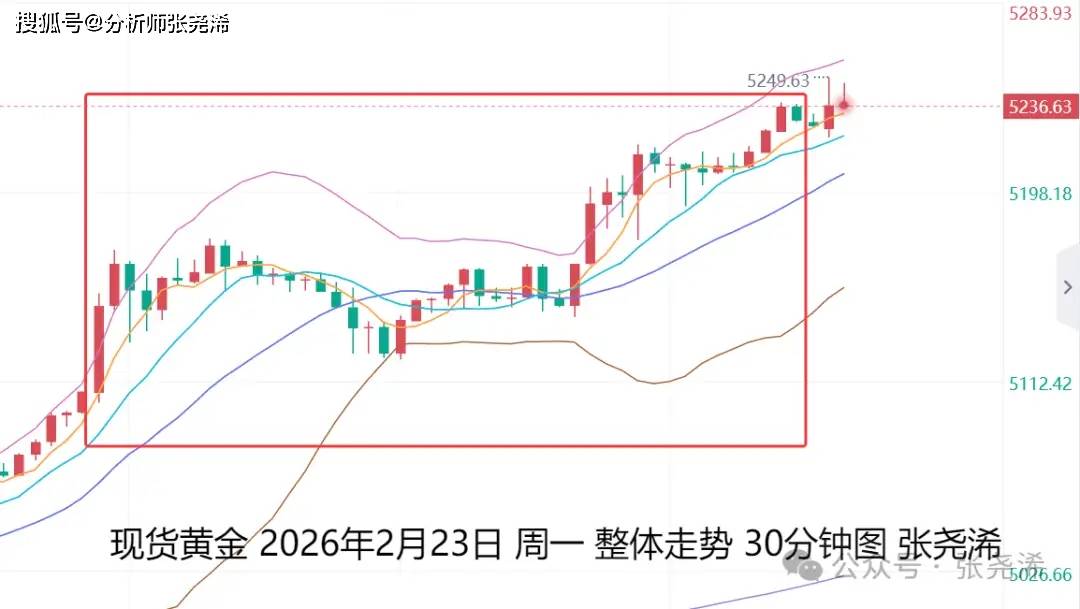
Core Viewpoint - The article discusses the strengthening of gold prices driven by increased risk aversion due to tariff concerns and geopolitical tensions, suggesting a bullish outlook for gold in the near term [1][5]. Market Performance - On February 23, gold opened at $5106.96 per ounce, reached a low of $5102.18, and then rebounded to a high of $5237.65, closing at $5227.40, marking a daily increase of $120.44 or 2.36% [3]. - The volatility for the day was $135.47 [3]. Geopolitical Factors - Trump's announcement of a temporary tariff increase to 15% has heightened risk aversion, leading to increased demand for gold [1][5]. - Despite signals of easing tensions between the U.S. and Iran, warnings from U.S. military leaders about the risks of conflict suggest that geopolitical risks will continue to support gold prices [3][5]. Economic Policy - The article notes that recent U.S. economic data has not significantly impacted interest rate cut expectations, with the Federal Reserve's leadership likely to favor low interest rates, which could support gold prices in the medium to long term [6]. - The potential for new national security tariffs on six industries by the Trump administration is expected to further increase market uncertainty and drive investment into gold [5]. Technical Analysis - Monthly and weekly charts indicate that gold prices are maintaining an upward trend, with support levels at the 5-week and 10-week moving averages [10]. - The article suggests that if gold prices experience a pullback, key support levels to watch are at $5190 or $5120 [11]. Future Outlook - The overall sentiment is bullish for gold, with expectations of continued upward movement and potential new highs throughout the year, driven by geopolitical tensions, tariff policies, and interest rate outlooks [6][8].
地缘局势风险难稳、金价震荡调整仍待走强
Sou Hu Cai Jing· 2026-02-20 13:36
Group 1 - International gold prices experienced fluctuations and closed higher on February 19, driven by ongoing tensions between the U.S. and Iran, which provided rebound momentum [1] - The strengthening U.S. dollar index and better-than-expected initial jobless claims data limited bullish sentiment, preventing gold from returning above the mid-range [1] - The outlook suggests a tendency for gold prices to rise, supported by the 30-day and 60-day moving averages, indicating a buying opportunity on dips [1] Group 2 - Gold prices opened at $4977.09 per ounce, hitting an intraday low of $4959.36 before fluctuating, reaching a high of $5022.08 during the U.S. trading session, and ultimately closing at $4996.35, with a daily range of $62.72 and a gain of $19.26, or 0.39% [3] - On February 20, gold opened with narrow fluctuations, facing resistance from the strengthening dollar index and technical barriers, while also having support from various moving averages and geopolitical factors [3] - Key economic indicators to watch include the U.S. December core PCE price index year-on-year, the initial estimate of the fourth quarter annualized GDP growth rate, and the final consumer sentiment index from the University of Michigan for February, which could influence gold prices depending on whether the data is perceived as positive or negative [3]
金荣中国:美国对伊朗动武风险预期上升,金价扩大涨幅维持震荡
Sou Hu Cai Jing· 2026-02-20 01:46
Market Overview - International gold maintained a volatile trend on February 19, with an opening price of $4998.09 per ounce, a high of $5022.21, a low of $4960.62, and a closing price of $5013.83 [1] Economic Indicators - Initial jobless claims in the U.S. fell by 23,000 to 206,000 for the week ending February 14, exceeding economists' expectations of 225,000, indicating a stabilization in the labor market [3] - Continuing claims rose to 1.87 million, the highest level since early January, suggesting some underlying weakness in the labor market despite the drop in initial claims [3] - The Federal Reserve's meeting minutes indicated that most policymakers see signs of stabilization in the labor market, although concerns about downside risks remain [3] - The probability of a U.S. recession within the next 12 months is estimated at 20%-25%, down from 30% in September [4] Geopolitical Developments - President Trump indicated that a decision on a potential agreement with Iran could be made in about ten days, emphasizing that Iran must not possess nuclear weapons for peace in the Middle East [5] - Reports suggest Trump is considering limited military strikes against Iran to compel compliance with nuclear agreement terms, with discussions shifting towards larger-scale actions [6] Gold ETF Holdings - The SPDR Gold Trust, the world's largest gold ETF, increased its holdings by 3.14 tons to a total of 1078.75 tons [7] Federal Reserve Outlook - According to CME's FedWatch, the probability of a 25 basis point rate cut by March is 5.9%, with a 94.1% chance of maintaining current rates [7] - By June, the probability of a cumulative 25 basis point rate cut rises to 49.8% [7] Technical Analysis - Gold prices showed a slight upward trend, with short-term indicators suggesting a gradual upward crossover [11] - The trading strategy includes cautious high short and low long positions, with specific entry and exit points outlined for aggressive and conservative traders [11]

张尧浠:避险情绪降温、金价延续调整待再回踩支撑
Sou Hu Cai Jing· 2026-02-18 00:59
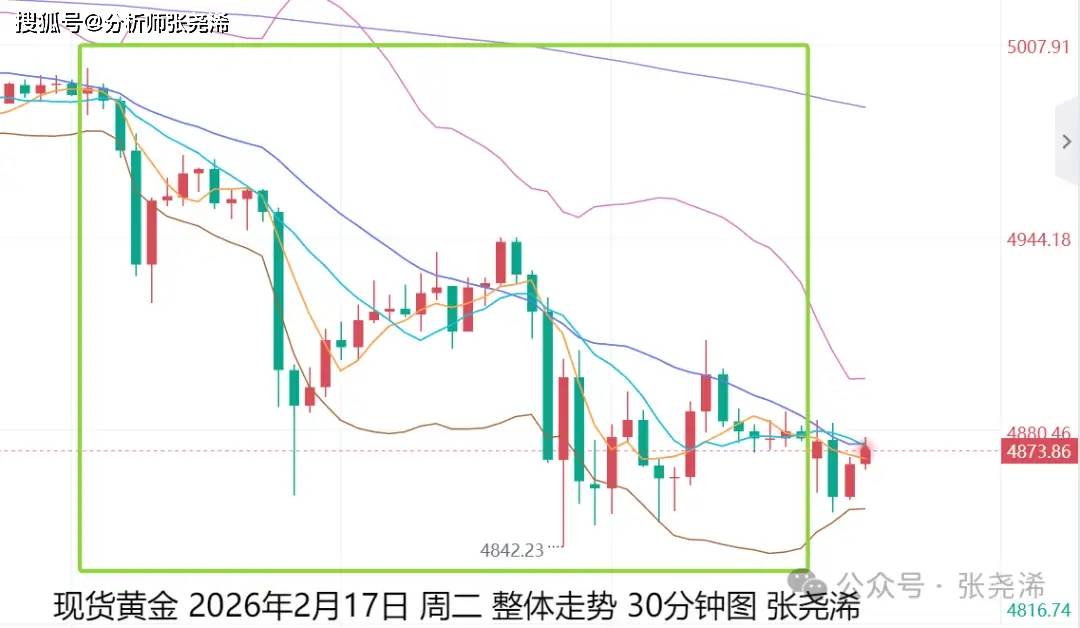
Core Viewpoint - International gold prices faced downward pressure due to positive signals from US-Iran negotiations and the formal initiation of the US-Japan trade agreement, reducing safe-haven demand [1][6]. Market Performance - Gold opened at $4995.59 per ounce, reached a high of $5000.90, and then declined to a low of $4841.30, closing at $4877.29, marking a daily drop of $118.3 or 2.37% [3]. - The market outlook for gold remains weak, with significant resistance above and no further positive fundamentals to support a rally [3][6]. Economic Indicators - Upcoming economic data to watch includes US December new housing starts (annualized), December durable goods orders month-on-month, December building permits (thousands), January industrial production month-on-month, and January Conference Board leading indicators month-on-month, with expectations leaning towards positive impacts on gold prices [5]. Federal Reserve Insights - The Federal Reserve is expected to maintain a dovish stance on interest rates, with discussions around the extent and timing of rate cuts, which may not exert significant pressure on gold prices [6]. Geopolitical Factors - Geopolitical risks have decreased significantly due to breakthroughs in US-Iran nuclear talks and peace negotiations between Russia and Ukraine, leading to diminished safe-haven demand for gold [6]. - The strengthening of the US dollar has also contributed to selling pressure on gold, although this is viewed as a temporary phase within a broader bullish market context [6]. Technical Analysis - On a monthly basis, gold prices are maintaining a bullish outlook despite recent declines, remaining above the 5-month moving average, indicating a potential for further upward movement [8]. - Weekly analysis shows that gold has encountered resistance and may test the 10-week moving average support at $4730 [8]. - Daily charts indicate that gold is currently below the mid-range and short-term moving averages, with expectations of further declines unless it stabilizes above these levels [10]. Support and Resistance Levels - Key support levels for gold are identified at $4820 and $4730, while resistance levels are at $4930 and $4990 [11]. - For silver, support is noted at $70.80 and $68.20, with resistance at $75.00 and $76.70 [11].
美CPI超预期走下降 黄金仍具看涨前景
Jin Tou Wang· 2026-02-16 06:50
Core Viewpoint - International gold prices experienced fluctuations and a slight decline, currently reported at $4989.28 per ounce, reflecting a decrease of 0.59% [1][2] Group 1: Market Performance - The international gold market opened at $5019.14 per ounce, reaching a high of $5030.62 and a low of $4954.42 during the trading session [1] - Last week, gold prices opened at $4987.98 per ounce, peaked at $5119.05 on Wednesday, and then fell to a low of $4878.77 on Thursday before rebounding to close at $5042.63, marking a weekly increase of $81.77 or 1.65% [1] Group 2: Influencing Factors - Geopolitical tensions initially drove gold prices higher, but comments from Federal Reserve officials downplaying the urgency of interest rate cuts and a White House official refuting employment concerns led to a temporary recovery in prices [1] - The support from central bank purchases and geopolitical factors, along with President Trump's push for the Fed to lower rates to "the lowest in the world," contributed to the rebound in gold prices [1] - The market reacted to AI-related fears that caused a sell-off in tech stocks, triggering liquidity issues and leading traders to sell metals to cover stock losses, which resulted in a sharp drop in gold prices [1] Group 3: Future Outlook - The current outlook suggests that gold prices may experience short-term adjustments, but the overall bullish trend remains intact due to the recent U.S. CPI report, which has raised expectations for potential interest rate cuts by the Fed [2] - The ongoing central bank purchases of gold are expected to support long-term bullish sentiment, while geopolitical uncertainties continue to create opportunities for bullish entries [2] - Key support levels for gold are identified at $4990 and $4930, with resistance levels at $5100 and $5150 [2]
黄金时间·观点:警惕金银巨震背后的流动性风险 但市场危中有机
Xin Hua Cai Jing· 2026-02-12 08:43
Core Viewpoint - The international gold and silver prices experienced significant volatility at the beginning of 2026, with a sharp decline following a substantial increase prior to January 29, raising concerns about underlying liquidity risks in the market [1][2]. Group 1: Market Dynamics - The recent drop in gold and silver prices was not due to changes in structural support factors but rather driven by high anxiety, month-end funding structures, profit-taking fears, and market panic triggered by price fluctuations [1]. - The U.S. government's policy direction remains unchanged, and the likelihood of gradual interest rate cuts by the Federal Reserve, along with ongoing global de-dollarization and central bank purchases of gold and silver, has provided some support against the downward trend [1][2]. Group 2: Price Predictions and Risks - Given the short-term price drop exceeding historical levels and the lack of new supportive events for gold prices, there is a high probability that international gold and silver prices will repeat the consolidation patterns observed in early, mid, and late 2025 [2]. - If liquidity risks escalate without new geopolitical conflicts to bolster safe-haven demand, the downward pressure on gold and silver prices could increase, with gold potentially testing levels below $4,400 per ounce and silver possibly dropping to $50-$60 per ounce, representing a decline of 20%-30% [3]. Group 3: Emotional and Behavioral Factors - The interconnectedness of all assets means that significant declines in the stock market could lead to forced selling of profitable assets, including gold and silver, to meet margin calls, highlighting the core of liquidity risk [2]. - Historical instances of "contagion effects" have shown that significant declines in the stock market can lead to sharp drops in gold and silver prices, as seen during the early pandemic and the 2008 financial crisis [3].