
黄金长期牛市

Search documents
OEXN:亚洲动量情绪波动或引发金价短期回撤
Xin Lang Cai Jing· 2026-02-12 13:19
Core Insights - The recent strong momentum in the gold market has attracted widespread attention, but the underlying funding structure may lead to volatility [1][2] - If the momentum-driven buying led by the Asian region stalls or reverses, gold prices could face a significant adjustment in the short term [1][2] - The increase in gold ETF inflows is highly dependent on specific regional market sentiments, making gold prices particularly vulnerable to shifts in local sentiment [1][2] Investment Behavior - Asian investors exhibit a notable tendency for momentum trading and are highly sensitive to price fluctuations [3] - This momentum-driven model acts as a double-edged sword; while it can create upward pressure when prices rise, it can also trigger profit-taking during mild corrections, amplifying downward pressure [3] - Recent statistics indicate that Asian capital has become a core driver of rising gold prices, making the risk of position liquidation a significant tactical variable [3] Long-term Value and Support - Despite the increasing likelihood of short-term fluctuations, the long-term value proposition of gold assets remains intact [3] - Structural investment demand globally continues to provide mid-term support for gold prices, particularly in the context of evolving economic cycles [3] - The trend of central banks, especially in emerging markets, continuing to accumulate gold is expected to remain strong, with such long-term positioning typically becoming more aggressive during price corrections [3][4] Short-term Risks and Long-term Potential - The gold market is currently at the intersection of short-term risks and long-term potential [4] - The strategy of emerging market central banks to buy on dips is expected to create a solid defense for gold prices, preventing technical corrections from evolving into a long-term bear market [4] - Overall, while the probability of price "draining" in the short term is rising, the core structure supporting gold prices remains robust, suggesting that after necessary consolidation, gold is likely to continue its long-term bullish trend [4]


张忆东:金不怕“虚火”,长期牛市逻辑不变
Xin Lang Cai Jing· 2026-02-11 10:38
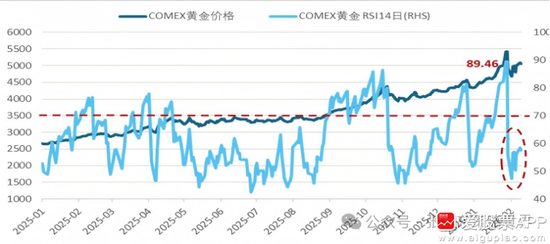
Group 1 - The speculative trading in gold has cooled down, with the RSI index for COMEX gold futures reaching a high of 89.46 on January 29, indicating overbought conditions, followed by a significant price correction of over 10% [1][4] - The long-term bullish logic for gold remains intact, driven by major historical events and geopolitical changes, with the current global order restructuring being a key factor for the ongoing gold bull market [4][17] - The market's concerns regarding the new Fed chair's balance sheet reduction are also seen as temporary, with expectations that the Fed will prioritize interest rate cuts over balance sheet reduction until at least 2026 [5][20] Group 2 - The U.S. is currently experiencing low inflation, with the core inflation rate running below the Fed's 2% target for two consecutive months, which may create room for interest rate cuts [20][21] - The recent victory of Japan's ruling party has sparked optimism for economic growth, but this sentiment may be short-lived due to potential geopolitical risks arising from increased military and constitutional changes [9][22] - The Fed's cautious approach to managing its balance sheet, as indicated by Treasury Secretary Becerra, suggests a prolonged period of liquidity support for the market [21][22]
金晟富:1.28黄金强势上涨仍未见顶!日内黄金分析参考
Sou Hu Cai Jing· 2026-01-28 02:51
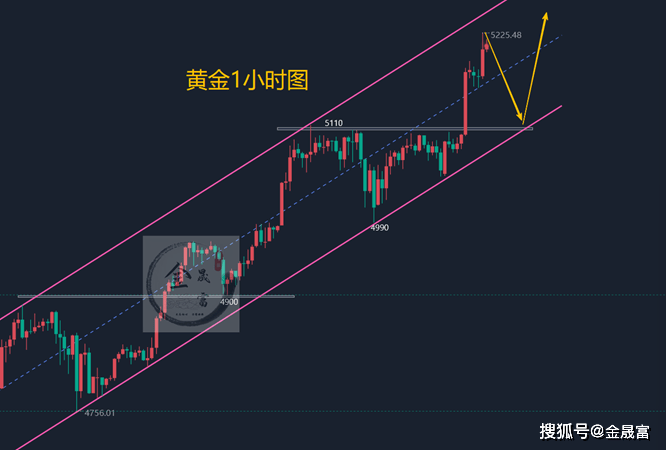
Core Viewpoint - The recent surge in gold prices is attributed to multiple factors including economic uncertainty, geopolitical tensions, and a weakening US dollar, leading to a bullish outlook for gold in the near future [1][2]. Group 1: Market Dynamics - As of January 28, gold prices reached approximately $5220.23 per ounce, marking a year-to-date increase of 19.56% [1]. - The price of gold saw a significant rise of 3.45% on January 27, closing at $5181.04 per ounce, with an intraday high of $5190.20, setting a new historical record [1]. - Analysts predict that gold prices could reach $6350 per ounce by the end of 2026 and potentially $8650 per ounce by 2027, indicating a strong long-term bullish sentiment [1]. Group 2: Economic and Geopolitical Influences - The US government is facing risks of a partial shutdown, which has become a focal point for market participants [2]. - The US dollar index fell by 1.33% to 95.75, hitting a four-year low of 95.57, largely due to comments from former President Trump regarding the dollar's value [2]. - Trump's announcement of potential tariffs on imports from South Korea and threats against Canada have heightened global trade tensions, further diminishing the dollar's appeal as a reserve currency [2]. Group 3: Technical Analysis and Trading Strategies - Current technical analysis suggests that gold may either continue to rise or face a correction, with key support levels identified at $5160 and $5150 [3][5]. - Traders are advised to adopt a cautious approach, focusing on buying on dips around $5155-$5160 while being aware of potential resistance at $5230 [6]. - The overall trading strategy emphasizes following the upward trend without attempting to predict market tops, suggesting a focus on long positions [3].
国际黄金期价上破4000美元,黄金ETF华夏(518850)逆市上涨,6个交易日“吸金”2.87亿
2 1 Shi Ji Jing Ji Bao Dao· 2025-11-07 02:34
Core Viewpoint - The A-share market opened lower on November 7, while COMEX gold futures showed strength, trading around $4007, indicating a mixed performance in gold-related products and ongoing investor interest despite recent price corrections [1] Market Performance - A-share indices opened collectively lower, with COMEX gold futures experiencing fluctuations around $4007 [1] - Gold ETF 华夏 (518850) rose by 0.19%, and gold stock ETF (159562) increased by 0.29%, with holdings in companies like 万国黄金集团, 中国黄金国际, 湖南黄金, 招金矿业, and 紫金矿业 showing strength [1] - In contrast, the non-ferrous metals ETF (516650) declined by 0.06% [1] Fund Flows - Notably, the international gold price is currently experiencing a high-level correction around $4000, yet related ETF products continue to attract capital [1] - The gold ETF 华夏 (518850) has seen a net inflow of 287 million over six consecutive trading days, while the gold stock ETF (159562) has accumulated a net inflow of 175 million in the same period [1] Long-term Outlook - Year-to-date, the spot gold price has surged over 51%, with a peak increase of 65% in October, followed by a correction of over 8% [1] - According to Guosen Securities, long-term factors such as the restructuring of the global monetary credit system, de-dollarization trends, ongoing central bank gold purchases, and structural supply-demand imbalances are key supports for gold's price increase [1] - The recent decline does not alter the fundamental logic of gold's upward trend, suggesting that the long-term bull market for gold will continue [1]

分析师称黄金处于超买区间,警惕短期回调风险,2026年或见4200美元新高
Hua Er Jie Jian Wen· 2025-09-16 07:50
Group 1 - The strong upward trend of gold is facing short-term correction risks, with analysts warning of a potential 5%-6% pullback, but the long-term bullish foundation remains solid, with expectations of surpassing $4000 per ounce by 2026 [1][4][6] - Factors driving the continuous rise in gold prices include widespread expectations of an upcoming interest rate cut by the Federal Reserve, ongoing geopolitical tensions, and concerns over the Fed's independence, combined with strong demand from central banks [2][5] - Analysts indicate that gold has entered an "unknown territory" after rapidly breaking through the $3400 and $3500 levels, suggesting that the market may experience a pullback after the current rally, which could present a buying opportunity for investors waiting on the sidelines [3][4] Group 2 - The macroeconomic fundamentals supporting the long-term bullish outlook for gold remain unchanged, with strong market demand reflected in price predictions being reached faster than expected [4][5] - Key factors supporting the long-term bull market for gold include anticipated monetary policy easing, ongoing geopolitical risks, and robust official and investment demand, particularly from central banks and ETFs [5][6] - Analysts provide optimistic long-term price forecasts, with expectations of gold prices reaching around $3800 by the end of this year and potentially exceeding $4000 by 2026, with some predicting prices could rise to $4200 [6] Group 3 - Silver has also performed strongly, reaching approximately $42.73 per ounce, a 14-year high, driven by both its investment and industrial attributes [7][10] - The rise in silver prices is supported by solid fundamentals, including strong physical demand in electronics and solar panels, along with concerns over supply shortages [10]
黄金长牛仅在“婴儿期”,机构喊出8900美元目标价!
Jin Shi Shu Ju· 2025-05-16 06:22
Core Viewpoint - Incrementum AG's annual report indicates that despite the surge in gold prices to a record $3,500 per ounce, the long-term bull market for gold is still in its early stages, with expectations of higher price increases in the latter half of this decade [1] Group 1: Price Predictions - The research team led by Ronald-Peter Stferle and Mark Valek forecasts that gold could reach $4,800 per ounce by 2030, with a potential "bull market scenario" pushing prices up to $8,900 due to rising inflation threats [1] - Since the initial prediction in 2020, gold prices have increased by 92%, yet its allocation in overall investment portfolios remains around 1% [1] Group 2: Market Dynamics - The report emphasizes that the current phase of the bull market is characterized by increasing media optimism, which could lead to a "mania phase" [1] - Although gold prices have performed well this year, they remain moderate compared to historical bull markets, with 22 new highs recorded as of April 30, compared to 43 last year [1] Group 3: Demand Drivers - Incrementum anticipates that investment demand will become a new driving force for gold prices, as investors seek to hedge against inflation and geopolitical uncertainties, despite current inflows into gold ETFs lagging behind stocks and bonds [1] - Central bank demand is highlighted as a significant support for gold prices, but the report suggests that the influx of Western financial investors is still awaited [1] Group 4: Economic Context - The report critiques the U.S. government's tightening policies, suggesting they may push the economy towards recession, which could ultimately benefit gold as the Federal Reserve is likely to lower interest rates in response to economic slowdowns [1] - Analysts warn that a weak dollar policy could undermine currency credibility and deter essential capital inflows, potentially leading to inflation and reduced purchasing power [2]