
文体用品

Search documents
轻工制造、纺织服饰行业3月投资策略展望:春节假期消费较火热,上海市优化地产政策
BOHAI SECURITIES· 2026-03-02 08:26
Group 1: Industry Overview - The consumption during the Spring Festival was robust, with domestic travel reaching 596 million trips, an increase of 95 million trips compared to the previous year, and total spending of 803.48 billion yuan, marking a historical high for both visitor numbers and spending [10][20]. - The Shanghai government has implemented measures to optimize real estate policies, which are expected to boost the real estate market and support the recovery of related industries [3][69]. - The retail sales of social consumer goods in the furniture category for 2025 is projected to be 209.19 billion yuan, reflecting a year-on-year growth of 14.62% [4][21]. Group 2: Key Company Announcements - Sun Paper Industry reported a 5.05% year-on-year increase in net profit attributable to shareholders for 2025, with total revenue of approximately 39.18 billion yuan, a decrease of 3.79% from the previous year [6][58]. - Mengjie Home Textile announced that major shareholder Li Jianwei plans to reduce his holdings by 3.2 million shares, which is about 0.43% of the company's total shares [6][59]. Group 3: Market Performance - From February 2 to February 27, the light industry sector outperformed the CSI 300 index by 2.67 percentage points, with a growth of 2.76% compared to the CSI 300's 0.09% [8][60]. - The textile and apparel sector underperformed the CSI 300 index by 0.13 percentage points, with a slight decline of 0.04% [8][65]. Group 4: Monthly Strategy - The report maintains a "neutral" rating for the light industry and textile sectors, while recommending "buy" ratings for companies such as Oppein Home, Sophia, and others [11][71]. - The report highlights the potential for recovery in the real estate sector and related industries due to recent policy optimizations in major cities [69].



打破“投资不过山海关”魔咒,东戴河新区如何构建“投资天地宽”营商环境新格局?
Huan Qiu Wang· 2026-02-12 10:23
Core Viewpoint - The Liaoning Provincial Trade Promotion Council has revised its commitments to optimize the business environment, focusing on enhancing financial services, digital services, technology trade, and language services to empower enterprises in their international endeavors [1] Group 1: Business Environment Optimization - The optimization of the business environment is identified as the most important and urgent strategic task for Liaoning during the 14th Five-Year Plan period, addressing issues such as weak service awareness and low administrative efficiency [1] - The East Dalian River New Area is positioned as a strategic hub for connecting Northeast and North China, showcasing its ambition for differentiated development through a "3+4" industrial layout [2][6] Group 2: Investment Attraction and Service Enhancement - The East Dalian River New Area has established a full-process service mechanism to enhance investment attraction, with a dedicated team of 45 people in three investment promotion offices [4] - The "Project Steward" system has been implemented to provide comprehensive support to enterprises, reducing the time required for obtaining construction permits from nearly 70 days to 45-50 days [6][8] Group 3: Industry Development and Challenges - The East Dalian River New Area aims to develop high-value-added manufacturing and faces challenges in financial innovation, talent aggregation, and industrial chain upgrades [4] - The area has successfully attracted over 120 enterprises, with 47 projects signed and 44 projects landed in 2025 alone, indicating a positive trend in investment [6] Group 4: Green Development and Sustainable Growth - The East Dalian River New Area emphasizes green development, rejecting high-pollution projects and focusing on tourism, health, and cultural industries to attract talent and boost local economy [11][12] - The area has transformed from a temporary tourist destination to a permanent residence for businesses and talent, leveraging its unique geographical advantages and resource endowments [12]


观点丨刘晓光:内需主导 激发超大规模市场潜能
Sou Hu Cai Jing· 2026-01-10 18:06
Core Viewpoint - The article emphasizes the importance of expanding domestic demand and enhancing consumption as key strategies for China's economic growth in 2026, highlighting the potential for new investment opportunities and market dynamics [3][4][11]. Group 1: Economic Context and Trends - 2026 marks the beginning of the "15th Five-Year Plan," with a focus on leveraging positive factors for economic growth and investment opportunities [2]. - The consumer market in China is vibrant, driven by various trends such as the "Su Chao" economy and the popularity of rural cultural tourism, indicating the immense potential of the super-large market [2]. Group 2: Domestic Demand and Consumption - The central economic work meeting prioritizes "domestic demand as the main driver" to build a strong domestic market, underscoring the urgency of expanding domestic demand strategies [3]. - China's population of over 1.4 billion and more than 400 million middle-income individuals provide a solid foundation for domestic demand growth, despite current challenges of insufficient demand [4]. Group 3: Policy Measures and Implementation - The government aims to enhance consumer capacity through targeted policies, including the "Urban and Rural Residents Income Increase Plan," which aligns income growth with economic development [5][4]. - The implementation of consumption upgrade policies, such as the "old-for-new" program, has already driven significant sales, with over 2.5 trillion yuan in sales linked to these initiatives [9]. Group 4: Supply and Demand Adaptation - There is a need to address the mismatch between strong supply and weak demand by enhancing the adaptability of supply to changing consumer preferences [6]. - The government plans to promote high-quality goods and services, with a goal of achieving a high-quality development pattern by 2030, where supply and consumption interact positively [6]. Group 5: Future Growth Opportunities - New consumption growth points are expected to emerge in areas such as product quality enhancement, service expansion, digital upgrades, and green health [11]. - The "Implementation Plan for Enhancing the Adaptability of Consumer Goods Supply and Demand" aims to establish three trillion-yuan consumption sectors and ten hundred-billion-yuan consumption hotspots by 2027 [12].
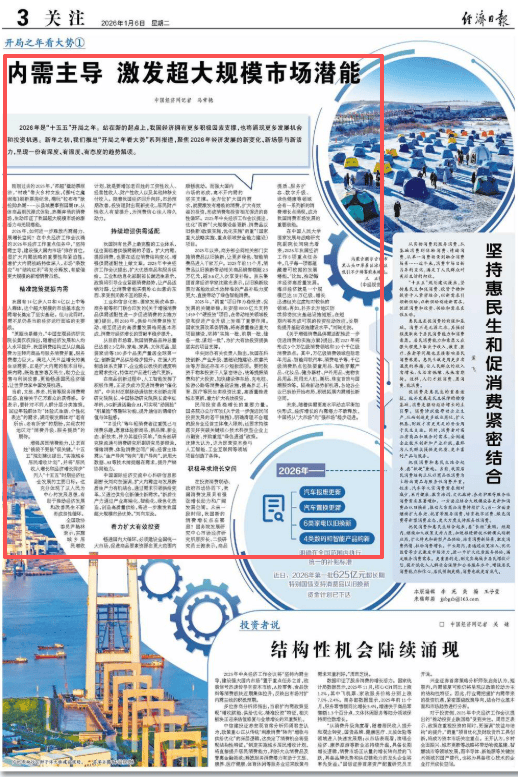
开局之年看大势丨内需主导 激发超大规模市场潜能
Jing Ji Ri Bao· 2026-01-06 05:33
Group 1 - The core viewpoint emphasizes the importance of expanding domestic demand as a key strategy for economic growth in 2026, highlighting the need for a strong domestic market [1][2] - The article discusses the significant potential of China's consumer market, driven by a population of over 1.4 billion and a growing middle-income group, which lays a solid foundation for domestic demand growth [2][3] - It points out the shift in consumer behavior from goods consumption to a balanced focus on both goods and services, indicating a substantial opportunity in service consumption [2][4] Group 2 - The article outlines the government's plan to enhance supply-demand matching by increasing the supply of quality goods and services, aiming for a high-quality development pattern by 2030 [4][5] - It highlights the role of technology, particularly AI and big data, in capturing consumer demand and driving innovation in product offerings [5][6] - The focus on effective investment is crucial for stimulating domestic demand, with policies aimed at optimizing consumption and investment strategies to create a virtuous cycle [6][7] Group 3 - The article identifies new consumption growth points in areas such as product quality improvement, service expansion, digital upgrades, and green health, which are expected to drive market development [8][9] - It mentions specific sectors projected to become trillion-yuan markets, including elderly products and smart connected vehicles, as well as billion-yuan hotspots like children's products and fitness equipment [9][10] - The overall narrative suggests that as supply and demand achieve a higher level of dynamic balance, China's economy will transition from a "large market" to a "strong market" [10]
常州市佰特菲文体用品有限公司成立 注册资本50万人民币
Sou Hu Cai Jing· 2025-12-13 00:10
Core Viewpoint - A new company, Changzhou Baitefei Sports Goods Co., Ltd., has been established with a registered capital of 500,000 RMB, indicating a focus on various retail and manufacturing sectors related to sports and leisure products [1] Company Overview - The legal representative of the company is Yang Bo [1] - The registered capital of the company is 500,000 RMB [1] Business Scope - The company operates in multiple sectors including retail and manufacturing of sports goods and equipment, office supplies, toys, daily necessities, and home goods [1] - It also engages in internet sales, excluding items that require special permits, and offers services related to business agency and import-export activities [1] - The company is involved in the sale of pre-packaged food and health food, as well as fitness and leisure activities [1] - Additional activities include technology services, development, consulting, and promotion [1]
常州市星闪文体用品有限公司成立 注册资本50万人民币
Sou Hu Cai Jing· 2025-12-12 00:04
Core Viewpoint - Changzhou Xing Shan Sports Goods Co., Ltd. has been established with a registered capital of 500,000 RMB, indicating a new player in the sports and leisure industry [1] Company Summary - The legal representative of the company is Xu Minggang [1] - The company is engaged in a wide range of activities including retail and manufacturing of sports goods and equipment, office supplies, toys, and daily necessities [1] - The company also offers services such as business agency and technical consulting, showcasing a diverse operational scope [1] Industry Summary - The establishment of the company reflects ongoing growth in the sports and leisure sector, with a focus on both retail and manufacturing [1] - The inclusion of internet sales and e-commerce in its business model indicates a strategic alignment with current market trends [1] - The company’s activities span various categories, including health food sales and fitness activities, which are increasingly relevant in today's health-conscious market [1]
政策问答·回应关切丨如何增强消费品供需适配性
Ren Min Ri Bao· 2025-11-30 04:06
Core Viewpoint - The implementation plan aims to enhance the adaptability of supply and demand in the consumer goods market, addressing the mismatch between what consumers want to buy and what is available for sale [1][2]. Group 1: Supply and Demand Adaptability - The plan emphasizes the need for consumer goods production to actively adapt to changing consumption trends, ensuring dynamic and precise matching of diverse consumer demands in terms of quality, structure, and utility [1]. - The initiative is expected to maximize consumption potential and promote smooth economic circulation by aligning what consumers desire with what companies produce [1]. Group 2: Consumer Goods Market Overview - China currently has a total of 230 million types of consumer goods, with over 100 categories, including home appliances, furniture, and clothing, leading the world in production [2]. - The strong manufacturing capability allows consumer goods companies to quickly respond to technological upgrades and subtle changes in consumer preferences, facilitating continuous product iteration and innovation [2]. Group 3: Specific Measures in the Implementation Plan - On the supply side, the plan includes accelerating the application of new technologies, expanding the supply of unique and new products, and focusing on sectors like smart connected vehicles and smart home devices [2]. - On the demand side, the plan aims to activate domestic demand by creating a favorable development environment, addressing differentiated needs across age groups, and enhancing consumer financial products and services [2]. Group 4: Future Market Potential - The implementation plan focuses on supply-side structural reforms, aiming to stimulate the multiplier effect and structural dividends of China's vast domestic market, with the potential to create trillions of yuan in new consumer markets by 2027 [3].
经济观察|破解“供需错配”,中国多部门合力促消费
Zhong Guo Xin Wen Wang· 2025-11-28 04:12
Core Viewpoint - The Chinese government is addressing the "supply-demand mismatch" in the consumer market through a new implementation plan aimed at enhancing the adaptability of consumer goods supply to meet diverse consumer needs [1][2]. Group 1: Market Overview - China's consumer market has become the second largest globally, with a total of 230 million types of consumer goods, leading in over 100 categories such as home appliances, furniture, and clothing [1]. - The rapid response of Chinese enterprises to technological upgrades and subtle changes in consumer demand is supported by strong manufacturing capabilities [1]. Group 2: Supply-Demand Mismatch - The "supply-demand mismatch" is identified as a key bottleneck for consumption upgrades, with issues such as overproduction of some products and insufficient high-quality supply in sectors like jewelry and cosmetics [2]. - Specific consumer needs, such as personalized products for the elderly and students, are not being adequately met, highlighting gaps in product functionality and safety [2]. Group 3: Implementation Plan Goals - The implementation plan sets two main targets: to establish three trillion-yuan-level consumption sectors and ten hundred-billion-yuan-level consumption hotspots by 2027, and to achieve a high-quality development pattern of positive interaction between supply and demand by 2030 [2]. Group 4: Key Measures - The plan includes five key measures: expanding new technology applications, increasing the supply of unique products, precisely matching different demographic needs, creating new consumption scenarios, and optimizing the development environment [2]. - The Ministry of Industry and Information Technology will promote the integration of new technologies like artificial intelligence into the consumer goods industry [3]. Group 5: Government Initiatives - The National Development and Reform Commission will focus on three areas: enhancing technological leadership, improving brand standards, and addressing public needs through infrastructure development [3]. - The Ministry of Commerce will implement policies to boost sales through trade-in programs and organize promotional activities to stimulate consumption [3]. - The Ministry of Culture and Tourism will support the introduction of quality cultural and tourism products and enhance consumer experiences through innovative activities [3]. Group 6: Market Regulation - The State Administration for Market Regulation emphasizes the importance of maintaining market order through enhanced supervision and enforcement actions, particularly in the safety of children's and student products [4].
我国消费品供给进入优质优价新发展阶段
Ren Min Wang· 2025-11-28 00:22
Core Viewpoint - The Chinese government has issued a plan to enhance the adaptability of consumer goods supply and demand, aiming to promote consumption and address structural mismatches in the market [1][4]. Group 1: Current State of Consumer Goods - The total variety of consumer goods in China has reached 230 million, with over 100 categories such as home appliances and furniture leading global production [2]. - The quality of consumer goods has improved significantly, with a compliance rate of over 96% for major products meeting domestic and international standards [2]. - High-end domestic products are increasingly favored, with a market penetration rate of 85% for 4K ultra-HD smart TVs and 98% for energy-efficient variable-frequency air conditioners [2]. Group 2: Structural Issues and Future Goals - Despite advancements, there are still structural mismatches in supply and demand, particularly in high-end brands for jewelry, bags, and cosmetics, as well as personalized products for the elderly and smart terminals [3]. - By 2027, the plan aims to optimize the supply structure, creating three trillion-yuan consumer sectors and ten hundred-billion-yuan consumption hotspots, including elderly products and smart connected vehicles [4]. - The goal is to transition from quantity to quality in production, addressing mismatches in consumer desires and resource allocation [4]. Group 3: Targeted Consumer Needs - The focus is shifting from mere availability of products to their quality, with an emphasis on diverse consumption scenarios [5]. - Key tasks include enhancing the supply of baby products, quality student supplies, fashionable items, and products tailored for the elderly [5][6]. - The government aims to promote large-scale consumption and upgrade the market by reforming the automotive sector and fostering green and smart home consumption [6]. Group 4: Regulatory and Quality Assurance Measures - The market regulatory authority plans to strengthen the quality and safety governance of consumer goods, ensuring a high-quality development-oriented standard system [7]. - Continuous monitoring and enforcement actions will be taken to maintain consumer confidence and improve the supply of quality products [7].
(经济观察)破解“供需错配”,中国多部门合力促消费
Zhong Guo Xin Wen Wang· 2025-11-27 13:59
Core Viewpoint - The Chinese government is addressing the "supply-demand mismatch" in the consumer market through a new implementation plan aimed at enhancing the adaptability of consumer goods supply to meet diverse consumer needs [1][2]. Group 1: Market Overview - China's consumer market has become the second largest globally, with a total of 230 million types of consumer goods, leading in over 100 categories such as home appliances and furniture [1]. - The rapid response of Chinese enterprises to technological upgrades and consumer demand changes is supported by strong manufacturing capabilities, with flexible manufacturing enabling quick production cycles [1]. Group 2: Supply-Demand Mismatch - The "supply-demand mismatch" is identified as a key bottleneck for consumption upgrades, with issues such as oversupply of certain products and insufficient high-quality offerings in sectors like jewelry and cosmetics [2]. - Specific consumer needs, such as those for elderly products and personalized items, are not being adequately met, highlighting gaps in the market [2]. Group 3: Implementation Plan Goals - The implementation plan sets two main targets: to establish three trillion-yuan-level consumption sectors and ten hundred-billion-yuan-level consumption hotspots by 2027, and to achieve a high-quality development pattern of supply and consumption interaction by 2030 [2]. Group 4: Key Measures - The plan includes five key measures: expanding new technology applications, enhancing the supply of unique products, precisely matching market segments, creating new consumption scenarios, and optimizing the development environment [2]. - The Ministry of Industry and Information Technology will promote the integration of new technologies like artificial intelligence into the consumer goods industry [3]. Group 5: Government Initiatives - The National Development and Reform Commission will focus on three areas: strengthening technological leadership, enhancing brand standards, and improving public facilities to meet consumer needs [3]. - The Ministry of Commerce will implement policies to boost sales through trade-in programs and organize promotional activities to stimulate consumption [3]. - The Ministry of Culture and Tourism will support the development of quality cultural and tourism products and enhance consumer experiences [3]. Group 6: Market Regulation - The State Administration for Market Regulation emphasizes the importance of maintaining market order through enhanced supervision and enforcement actions, particularly in the safety of children's and student products [4].