
AI周期

Search documents
未知机构:英伟达将于周三公布财报其股价隐含波动率为44所有人的目光都集中在黄仁-20260224
未知机构· 2026-02-24 04:45
Summary of Conference Call Notes Company and Industry Overview - The focus is on NVIDIA, which is set to release its earnings report on Wednesday, with an implied volatility of 4.4% in its stock price. Investors are particularly interested in CEO Jensen Huang's performance during the announcement [1][1]. - Over the past six months, NVIDIA's stock has been trading sideways, underperforming the SOX index, leading to investor frustration. The preference among investors has shifted towards upstream supply chain companies such as storage, semiconductor equipment, TSMC, and optical modules, which are starting to gain pricing power, potentially at the expense of GPU/ASIC profit margins [1][1]. Core Insights and Arguments - Market consensus for NVIDIA's Q4 revenue is approximately $65.7 billion, with company guidance at $65 billion ±2%. However, buyers expect a continuation of the typical overperformance of over $2 billion, raising actual expectations to above $68 billion. For the data center business, the market consensus is around $60 billion, but the real target is about $62 billion [2][2]. - For Q1 FY2027 (April), market expectations are around $71.5-$71.8 billion, while buyers are looking for guidance of $73.5 billion (excluding the Chinese market), with actual expectations pointing to over $74 billion. Buyers anticipate earnings per share for FY2026 to be around $9-$10, exceeding the market consensus of $7.75, and for FY2027, expectations have reached $12-$14, significantly above the market consensus of $9.50 [3][3]. - Recent capital expenditure guidance from major cloud providers like Amazon, Google, Microsoft, and Meta has seen a substantial increase, with a combined upward revision of approximately $140-$145 billion for 2026, projecting total spending to exceed $600 billion, a 60% year-over-year increase [3][3]. Pricing and Profit Margin Concerns - The average selling price for Rubin series products is estimated between $7 million and $8 million, while the GB300 series is priced at $4 million to $5 million. The RubinUltra rack is priced around $10 million, with reports indicating prices between $8.5 million and $11 million. The price increase of 100% for RubinUltra compared to RubinVera is justified by significant performance improvements [5][5]. - Management has provided guidance for Q4 gross margins at 75% ±50 basis points, with expectations for next year at 74.5%. The rationale for a bullish outlook on margins is NVIDIA's pricing power in a constrained supply environment, allowing for higher average selling prices to offset rising input costs [5][5]. - However, there are concerns regarding the sustainability of margins, particularly in 2027, as each new product generation requires more high-bandwidth memory, which could increase the absolute dollar impact of memory price hikes. Additionally, the transition to rack-level solutions introduces complexities and costs that could pressure gross margins [6][6]. Upcoming Events and Market Sentiment - The market is closely watching the upcoming events, including the Morgan Stanley TMT Conference on March 4, where Jensen Huang is expected to present, and the GTC Conference on March 16, where further details on the Rubin roadmap and NVIDIA's full-stack AI platform vision will be discussed [6][7]. - Despite a cautious outlook on stock price movements, there is a maintained long position in the investment portfolio, with suggestions to consider bullish options in mid-March to capture potential market movements around the Morgan Stanley Conference and transition into the GTC phase [7][7].

资产配置日报:“霜”降-20251021
HUAXI Securities· 2025-10-21 15:21
Market Overview - The equity market experienced a significant rebound on October 21, with the total A-share index rising by 1.62% and a trading volume of 1.89 trillion yuan, an increase of 141.4 billion yuan compared to the previous day [1][2] - The Hang Seng Index and Hang Seng Tech Index rose by 0.65% and 1.26% respectively, with net inflows from southbound funds amounting to 1.171 billion HKD [1] Driving Factors - The market's rise was driven by three main factors: a reiteration of "stabilizing the market" in a publication by the Learning Times, increasing expectations for Trump's visit to China, and positive earnings reports from companies like CATL, which saw a 41.2% year-on-year increase in net profit for Q3 [1][2][3] Market Sentiment - The market sentiment improved significantly compared to the previous day, indicating a recovery in risk appetite, as evidenced by the increase in trading volume and the performance of related sectors [2] - The concentration of trading volume rose to 44%, nearing the historical warning line of 45%, while the proportion of stocks with prices above their 95% historical percentile reached 16.5%, suggesting potential volatility in the ongoing thematic market [2] Hong Kong Market Insights - The Hong Kong stock market has rebounded over two consecutive days, recovering from a significant drop on October 17. The technology sector, particularly the Hang Seng Tech Index, is seen as undervalued after recent declines [3] - Short-term positives include expectations of improved US-China relations, while uncertainties remain regarding the impact of a strengthening US dollar on the Hong Kong market [3] Bond Market Dynamics - The bond market also showed signs of recovery, with yields on medium to long-term government bonds declining by over 1 basis point. The 10-year and 30-year government bond yields fell to 1.76% and 2.07% respectively [3][4] - The core factor driving the bond market's shift from volatility to rapid recovery is the expectation of a loose monetary policy, with the central bank conducting a 159.5 billion yuan reverse repurchase operation [5] Commodity Market Trends - The domestic commodity market showed a cooling sentiment, with precious metals stabilizing after a recent pullback. Gold and silver prices rose by 2.02% and 0.20% respectively, while industrial metals exhibited flat performance [7] - The "anti-involution" theme-related commodities faced declines, particularly coking coal and coke, which dropped by 3.49% and 2.73% respectively, reflecting weak fundamentals [8] Investment Strategy - The report suggests actively participating in thematic market trends while being cautious of structural risks. Key indicators to monitor include trading concentration and the proportion of high-priced stocks [2] - The potential for a rebound in the technology sector in Hong Kong is highlighted, with the current market conditions presenting a favorable entry point for long-term investments in AI and related industries [3]
昨日超2亿元资金“加仓”恒生科技ETF天弘(520920),机构:当前港股估值并不高,恒生科技性价比或更优
2 1 Shi Ji Jing Ji Bao Dao· 2025-10-10 02:22
Group 1 - The Hang Seng Technology Index experienced a decline of 2% on October 10, with Lenovo Group rising over 1% and Trip.com Group-S increasing by 0.27% [1] - The Hang Seng Technology ETF Tianhong (520920) fell by 1.67%, with a trading volume of 38.35 million yuan and a real-time premium rate of 0.49% [1] - As of October 9, the ETF saw a net inflow of 204 million yuan, marking two consecutive days of net inflows totaling 406 million yuan, with a latest circulation size of 1.619 billion shares and a total market size of 1.648 billion yuan [1] Group 2 - Guotai Junan Securities' latest research report highlights that the Hong Kong stock market remains attractive, particularly with undervalued technology leading stocks having significant upside potential [2] - Quantitative analysis suggests that merely considering the valuation recovery of undervalued technology leading stocks could drive the Hang Seng Technology Index up by 15%, with a potential increase of over 30% if the overall index valuation returns to historical averages [2] - The report indicates that improving fundamentals and continuous capital inflow may lead to new highs for undervalued Hong Kong stocks in the fourth quarter, with technology benefiting from the AI cycle being the main theme of the market [2]
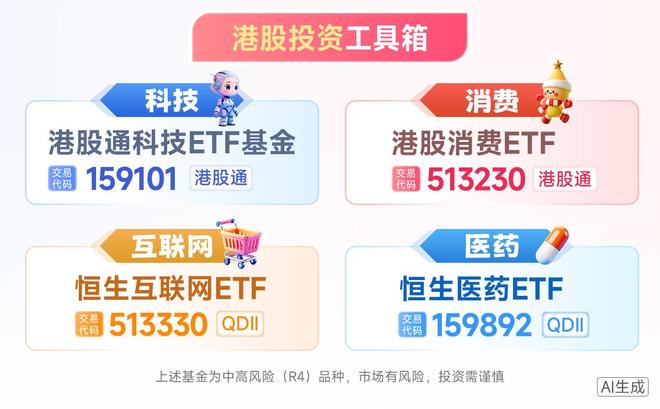
机构称受益AI周期的科技或仍是行情主线,聚焦港股通科技ETF基金(159101)布局机会
Mei Ri Jing Ji Xin Wen· 2025-09-29 06:56
Core Viewpoint - The Hong Kong Stock Connect Technology ETF (159101) has seen significant capital inflow and is favored by investors, particularly in the context of a favorable valuation environment for technology stocks [1] Group 1: Fund Performance - As of September 26, the Hong Kong Stock Connect Technology ETF (159101) has experienced a net inflow of 464 million yuan over the past 10 trading days, indicating strong investor interest [1] - The ETF closely tracks the Guozheng Hong Kong Stock Connect Technology Index, selecting 30 high market capitalization and high R&D investment technology leaders, with the top ten holdings accounting for over 75% [1] Group 2: Market Trends - On September 26, southbound funds net purchased Hong Kong stocks worth 10.541 billion HKD, with Alibaba receiving a net purchase of 2.412 billion HKD [1] - For the week ending September 26, the cumulative net purchase of southbound funds reached 43.959 billion HKD, and the total net purchase for the year has surpassed 1,153.689 billion HKD, significantly exceeding last year's total [1] Group 3: Analyst Insights - Cathay Haitong Securities believes that the current Hong Kong stock market offers outstanding value, particularly for certain technology leaders whose valuations remain low, suggesting substantial upside potential in the current technology cycle [1] - The report indicates that the AI cycle will be a key driver for the market, with the Hong Kong Stock Connect Technology ETF positioned to benefit from this trend [1]


恒生科技ETF易方达(513010)涨3.6%,市场对9月降息的乐观情绪升温
Sou Hu Cai Jing· 2025-08-25 03:27
Core Viewpoint - The Hong Kong stock market has seen significant gains, with the Hang Seng Index rising over 2% to reach a new high since 2021, driven by optimistic sentiment regarding potential interest rate cuts by the Federal Reserve [1] Group 1: Market Performance - The Hang Seng Technology Index increased by nearly 3%, while the E Fund Hang Seng Technology ETF (513010) rose by 3.6% today, marking a year-to-date increase of 29.6% [1] - As of August 25, the price-to-earnings ratio of the Hang Seng Technology Index stood at 21.77, which is at the 23.11% percentile since the index's inception [1] Group 2: Economic Context - Optimism in the market has been fueled by comments from Federal Reserve Chairman Jerome Powell at the Jackson Hole symposium, leading to increased expectations for a rate cut in September [1] - The current environment of ample liquidity and low interest rates has highlighted the valuation advantages of technology stocks [1] Group 3: Investment Insights - The E Fund Hang Seng Technology ETF tracks the Hang Seng Technology Index, providing exposure to key Chinese technology assets, including Tencent, NetEase, Alibaba, SMIC, and Xiaomi, with a low comprehensive fee rate of 0.25% [1] - According to Guotai Junan Securities, potential interest rate cuts by the Federal Reserve may improve the current pressure on the Hong Kong dollar exchange rate, making Hong Kong stocks, particularly in the technology sector, more attractive for capital inflows due to their unique asset advantages and greater elasticity benefiting from the AI cycle [1]



公募基金调研节奏加快 三大领域成关注重点
Zheng Quan Shi Bao· 2025-05-18 17:24
Core Insights - The A-share market has seen a significant increase in institutional research activity since May, with over 2,000 listed companies being investigated, particularly in high-end manufacturing, semiconductors, and healthcare sectors [1][2] - Public funds have accelerated their research pace, with top firms like Bosera Fund leading with 51 investigations, followed closely by Fortune Fund and Penghua Fund [1] - There is a clear preference for specific sectors, with over 60% of research focused on industrial machinery, semiconductor equipment, and innovative pharmaceutical companies [1][2] Industry Focus - High-end manufacturing, semiconductors, and healthcare are identified as core investment areas for institutional funds, with significant attention on technological breakthroughs and policy benefits [1][2] - The computer, communication, and other electronic equipment manufacturing sectors have also attracted interest, with over 34 companies being researched, focusing on semiconductor materials and consumer electronics [2] - The pharmaceutical manufacturing sector follows closely, with 23 companies under investigation, highlighting themes of innovative drug development and recovery in medical consumption [2] Company Highlights - Leading companies such as BeiGene, Anji Technology, and Hengda have received substantial attention, with 256, 241, and 234 institutions researching them, respectively [2] - Other notable companies include Xiangxin Technology, Xingye Silver Tin, and Deep South Circuit, each receiving research from over 100 institutions [2] - Companies like Deep South Circuit and Honghua Technology are focusing on overseas market strategies, with Deep South Circuit investing 1.274 billion yuan in a factory in Thailand to enhance its global supply chain [3]