
AI存储超级周期

Search documents
韩国股市爆发,不只是存储
Hua Er Jie Jian Wen· 2026-02-27 00:58
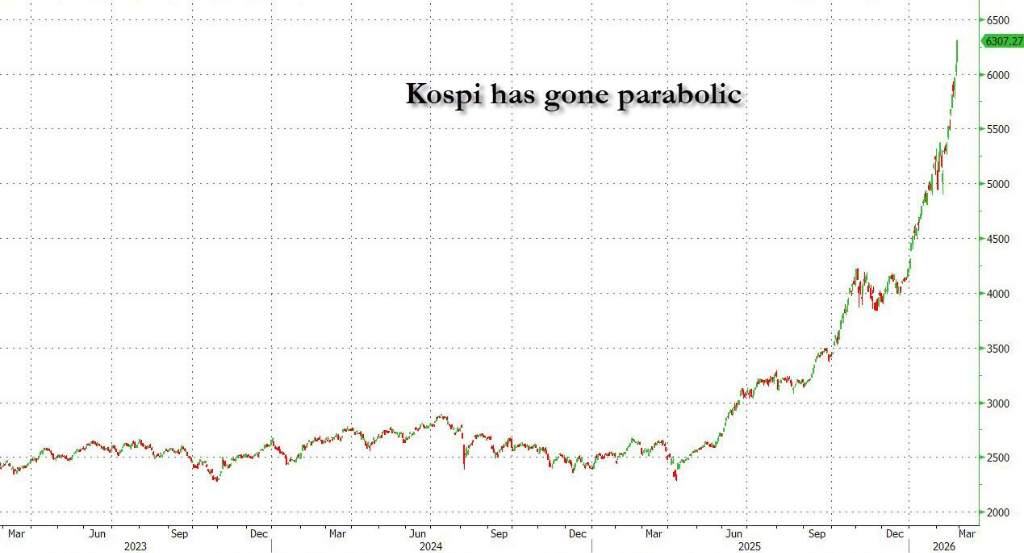
Group 1 - The core driver of the recent surge in the Korean stock market (Kospi) is the explosive demand for memory chips driven by AI infrastructure development, with the index rising nearly 50% this year [1][3] - Kospi has recently closed above 6300 points, marking a significant milestone with 10 out of the last 11 trading days showing gains, and Deutsche Bank has referred to it as "the most extraordinary stock market of 2026" [2][5] - Samsung Electronics and SK Hynix, which together account for about 40% of Kospi's total market value, have seen their stock prices rise by 82.5% and 69.8% respectively this year [2][3] Group 2 - The "Korean discount," a long-standing structural valuation issue in the Korean capital market, is being systematically addressed through governance reforms initiated by President Lee Jae-myung [6][7] - President Lee's personal experiences with stock trading losses have motivated him to implement aggressive reforms aimed at enhancing board accountability and encouraging dividends, which have positively impacted market sentiment [9] - The Bank of Korea has raised its economic growth forecast and maintained a loose monetary policy, providing liquidity support to the stock market despite rising housing prices [10][11] Group 3 - The current stock market rally is shifting the wealth allocation logic among Korean households, moving from a heavy concentration in real estate to financial investments [13][14] - High-net-worth individuals are increasingly prioritizing stock investments alongside real estate, indicating a rare sign of rising market interest [14] - President Lee's personal investments in the stock market have bolstered his reputation among retail investors, contributing to his rising approval ratings [14]

别人家的公司!SK海力士发放工资2964%奖金给员工:刷新历史上限
Xin Lang Cai Jing· 2026-02-05 04:25
Core Insights - SK Hynix has issued the highest performance bonuses in its history, amounting to 2964% of the base salary, driven by the AI storage supercycle [1] - The bonus system, known as the PS system, is funded by 10% of the annual operating profit, with the new standards set to last for 10 years [1] - The company aims to attract and retain core talent amid increasing competition in AI semiconductors [1] Financial Performance - SK Hynix achieved record sales of 97.1467 trillion KRW and operating profit of 47.263 trillion KRW last year [1] - The estimated operating profit available for performance bonuses is approximately 4.7 trillion KRW, with actual funds expected to be around 4.5 trillion KRW after excluding the NAND subsidiary Solidigm's profits [2] Bonus Structure - The new bonus structure eliminates the previous 1000% cap, allowing the entire 10% of operating profit to be allocated to the bonus pool [1] - 80% of the bonus will be distributed in the current year, while the remaining 20% will be deferred over two years [1] - A shareholder participation plan allows shareholders to convert up to 50% of their performance bonuses into stock, with an additional cash incentive for holding the stock for one year [1]
摩根大通评闪迪:“短期超额利润”不代表“长期盈利能力提升”,中期面可能回归历史“繁荣-萧条”模式
Hua Er Jie Jian Wen· 2025-12-10 10:04
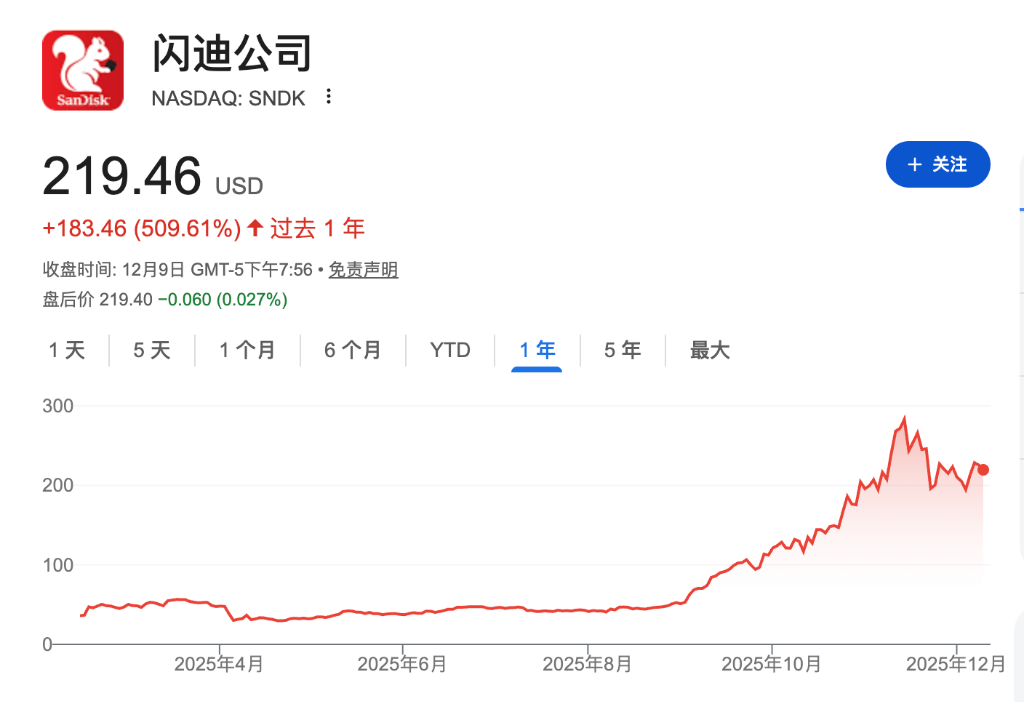
Core Viewpoint - Morgan Stanley assigns a "Neutral" rating to SanDisk with a target price of $235, indicating that while the company is experiencing peak profits driven by AI demand and joint venture cost advantages, this reflects cyclical industry conditions rather than structural improvements [1] Group 1: Market Position and Growth - SanDisk holds a relatively weak position in the rapidly growing enterprise SSD market, with a global market share of only 2-3%, significantly lower than its approximately 15% share in the overall NAND flash market [3] - The enterprise SSD market is expected to grow at a compound annual growth rate (CAGR) of 35%, reaching around $45 billion by 2027 [3] - Despite benefiting from engagements with major cloud service providers, SanDisk is still seen as a follower in the high-performance PCIe 5.0 enterprise SSD segment compared to competitors like Samsung and SK Hynix [6] Group 2: Competitive Advantages and Risks - SanDisk's joint venture with Kioxia, Flash Ventures, is considered a core competitive advantage, allowing the company to achieve 50% wafer output at equal costs, thus lowering capital intensity and improving return on investment [10] - However, this joint venture also means that SanDisk is heavily reliant on Kioxia's health and strategic direction, limiting its independent decision-making in capacity expansion and technology development [10] Group 3: Cyclical Nature of the Industry - The NAND industry is characterized by significant cyclical features, with current supply tightness and high prices being an extension of the cycle rather than a structural reversal [11] - It is anticipated that major suppliers will restart large-scale capacity construction plans around 2027, which could lead to an increase in storage capacity growth outpacing market demand growth [12] - The growth rate of traditional end-market demand is slowing, with smartphone storage capacity expected to grow at a CAGR of only 10% from 2025 to 2027, compared to 23% over the past decade [12] Group 4: Financial Projections - SanDisk is projected to achieve revenue growth of 18% and 38% in 2025 and 2026, respectively, surpassing the overall NAND market growth rates of 2% and 27% [16] - This growth is expected to increase SanDisk's market share to approximately 16% by the end of 2026, a rise of about 300 basis points from the current 13% [16] - However, these strong financial performances are primarily reflective of cyclical peaks rather than structural improvements in profitability, suggesting that investors should evaluate the company's value based on complete cycles [16]

如何看待本轮AI存储“超级周期”
2025-10-09 02:00
Summary of Conference Call on AI Storage "Super Cycle" Industry Overview - The conference call discusses the storage industry, particularly focusing on the impact of AI demand on the storage market, leading to a "super cycle" in storage products [1][4]. Key Points and Arguments - **AI Demand as a Driving Force**: AI demand is identified as the primary driver of the current storage super cycle, significantly surpassing the effects of cyclical supply-demand mismatches. The collaboration between South Korean companies Samsung and SK Hynix with OpenAI is expected to generate a demand for HBM wafers that exceeds current global production capacity by more than double [1][2][4]. - **Shift in Production Focus**: Overseas storage manufacturers are reallocating production capacity towards AI-related products, resulting in a reduction of capacity for traditional consumer embedded products, which in turn is causing price increases [1][4]. - **Price Increases**: The NAND Flash and DRAM market price indices have risen by approximately 5% and nearly 20% respectively in Q3 of this year. Several manufacturers have announced price hikes, with NAND Flash prices expected to increase by 5%-10% in Q4 2025 [1][5]. - **Impact on A-Share Companies**: A-share companies related to the storage sector are expected to benefit from the storage super cycle. Even companies with minimal AI business exposure will see price increases in niche storage products, following the trends in bulk products [1][6]. - **Emerging Opportunities for Domestic Manufacturers**: As international manufacturers exit the consumer market, domestic storage companies are poised to capture opportunities in the embedded storage sector. Companies like Jiangbolong and Baiwei have successfully integrated their products with leading smartphone brands such as OPPO and vivo [1][8]. - **Enterprise Storage Demand Growth**: The demand for enterprise-level storage is on the rise, particularly from major internet companies. It is anticipated that by 2026, the localization rate of domestic modules will significantly increase, with enterprise business revenues expected to double [3][9]. - **Future Prospects for Zhao Yi Company**: Zhao Yi Company, focused on storage, is benefiting from price increases in Chengdu and has unique customization capabilities. The company is expected to have significant collaborations in the near future, particularly in 3D facial recognition technology [3][10]. Additional Important Insights - **Consumer Market Performance**: Domestic manufacturers have not performed strongly in the consumer market, as they have shifted focus to areas like 3D parking, which has seen robust demand [7]. - **Module Manufacturers' Development**: Companies like Jiangbolong and Baiwei are focusing on enterprise storage, with Jiangbolong establishing strong partnerships to ensure stable wafer supply [11]. - **Price Trends Forecast**: The storage industry is expected to see price increases at least until Q2 2026, driven by both growth and cyclical factors, indicating a continued opportunity in the Chengdu sector [13].