AI投资狂潮

Search documents
智通港股解盘 | 互联网巨头底部开启反击 消费新老龙头齐发力
Zhi Tong Cai Jing· 2026-02-05 12:29
Market Overview - The Hang Seng Index opened lower but managed to close up by 0.14% [1] - The geopolitical situation remains stable, with Iran set to negotiate nuclear issues with the U.S. on February 6 [1] - Gold and silver prices fell significantly, with silver dropping over 14% and gold falling more than 2% to below $4,900 per ounce [1] International Relations - Russian President Putin plans to visit China in the first half of 2026 following a video call with Chinese leaders [2] - U.S. and Chinese leaders had a positive discussion regarding regional issues and economic cooperation, with a planned visit by Trump to China in April [2] - China has requested state-owned enterprises to pause new investment projects in Panama [2] Technology Sector - Despite declines in U.S. tech stocks, some Chinese tech companies like Naxin Micro (02676) reported strong earnings and plan to raise product prices by 10%-25% [3] - Baidu (09888) announced a stock buyback plan of up to $5 billion and plans to introduce a dividend policy by 2026, leading to a nearly 3% increase in its stock price [3] - Xiaomi (01810) repurchased shares worth HKD 146 million, also seeing a nearly 3% rise [3] - Tencent (00700) is expected to maintain double-digit growth in its gaming business by 2026, with advertising revenue projected to grow around 20% [3] Consumer Sector - Kweichow Moutai (600519.SH) has shown strong performance, boosting consumer valuations [4] - Oriental Selection (01797) surged over 10% due to its unique brand and membership model [4] - Pop Mart (09992) reported significant demand for its new products, with resale prices on secondary markets showing substantial premiums [4] Restaurant Sector - Yum China (09987) reported total revenue of $11.797 billion for 2025, a 4% increase year-on-year, with net profit rising by 2% [5] - Haidilao (06862) is seeing positive impacts from the return of its founder, with plans for expansion and new brand growth [5] - Brainstorm Aurora-B (06681) announced a strategic partnership to promote digital health products in Southeast Asia, with a significant stock price increase of over 15% [6] Energy Sector - The U.S. is experiencing a surge in natural gas power generation capacity, with over 29 GW under construction, but many projects may face delays due to a lack of available gas turbines [7] - Companies like Eagle Precision (01286) and Dongfang Electric (01072) are positioned to benefit from this trend, with expectations of increased demand for gas turbine components [7] Aviation Sector - Cirrus Aircraft (02507) launched the new G3 Vision Jet, enhancing its product line and expected to improve profit margins [8] - The new jet model is designed for private and corporate users, featuring significant upgrades in safety and comfort [8] - Cirrus is projected to deliver approximately 800 aircraft in 2025, with new orders expected to reach around 600 units [9]

AI狂潮如何重塑全球大宗商品超级周期?
Hua Er Jie Jian Wen· 2025-11-20 03:53
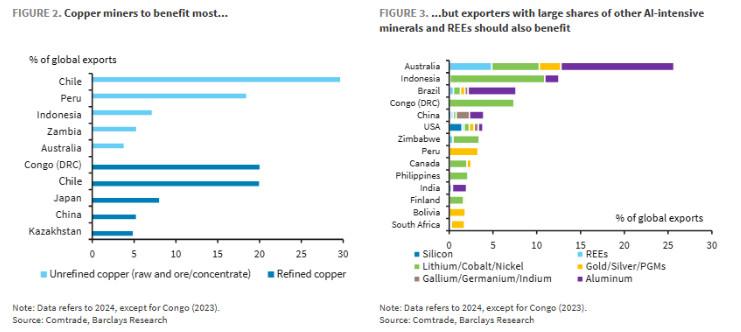
Core Insights - The Barclays research report highlights that the ongoing upgrade of AI infrastructure will lead to a significant increase in demand for specific minerals and rare earth elements, benefiting mineral-exporting countries over a multi-year investment cycle [1][4]. Group 1: AI Investment and Commodity Demand - The demand for copper is particularly emphasized as the most prominent beneficiary among AI-driven commodities, with countries like Chile, Peru, the Democratic Republic of Congo, and Australia expected to experience prolonged investment prosperity [1][5]. - The report estimates that capital expenditures from hyperscale cloud service providers will exceed $2.5 trillion over the next five years, indicating that related commodities such as energy, electrical infrastructure, and cooling systems will benefit from this AI investment cycle [4][6]. Group 2: Historical Context and Trade Dynamics - Historical commodity booms, particularly those driven by China in the early 21st century, show that commodity-exporting countries saw significant increases in fixed capital formation, contributing to GDP growth [10][13]. - The report notes a positive correlation between high export growth and the appreciation of the real effective exchange rate (REER), especially during commodity bull markets [14]. Group 3: Copper and Oil Price Decoupling - A notable feature of the current cycle is the decoupling of copper prices from oil prices, which traditionally moved in tandem. This decoupling is seen as a significant opportunity for investors [16][19]. - Countries that are major exporters of AI-critical minerals and net oil importers, such as Chile and Peru, will benefit from improved trade conditions, providing stronger support for their currencies [19][21]. Group 4: Future Outlook for Currencies - The report suggests that currencies like the Chilean peso, Peruvian sol, and Australian dollar are expected to perform well due to the copper-oil decoupling, indicating a new macroeconomic landscape driven by AI investments [22].