AIAE指标

Search documents
“存款搬家”如何影响A股?|资本市场
清华金融评论· 2025-08-29 13:09
Core Viewpoint - Since 2019, there has been a significant increase in Chinese residents' deposits, particularly from mid-2022 to mid-2023, leading to a large excess deposit scale that has attracted attention from economists and market investors. The concept of "deposit migration" has gained traction in macroeconomic and A-share strategy research, prompting discussions on its implications for the A-share market [5][19]. Group 1: Macroeconomic Implications - The recent acceleration in fiscal spending has led to a shift of fiscal deposits to corporate deposits, indicating an improvement in corporate cash reserves and a rise in economic vitality [5][9]. - Historical data suggests that the year-on-year difference in corporate-resident deposits can predict A-share corporate earnings with a one-year lead, indicating that improvements in resident deposits often reflect positively on corporate performance a year later [7]. Group 2: Market Dynamics - The migration of deposits from banks to non-bank financial institutions signifies an influx of funds into the stock market, as lower deposit rates and increasing attractiveness of equity assets drive this trend. This is expected to push up A-share valuations and indices [9][10]. - The proportion of new resident deposits to nominal GDP has historically shown that significant increases in deposits correlate with economic downturns, while decreases often align with economic recoveries, suggesting a cyclical relationship between deposit levels and market performance [10][12]. Group 3: Indicators and Predictions - The AIAE (Investor Asset Allocation Equity) ratio is proposed as a better indicator for tracking deposit migration and its impact on A-shares, reflecting changes in investor preferences between risk and safe assets [13][14]. - Current AIAE levels indicate that there is still considerable room for growth, suggesting potential upward movement in the A-share market as investor preferences shift [15]. Group 4: Long-term Fund Inflows - Insurance and wealth management products are expected to channel approximately 700 billion yuan into the stock market this year, driven by high growth in premium income and the need to address asset shortages [29][35]. - The establishment of dedicated funds for long-term investments by insurance companies is expected to further solidify the trend of "deposit migration" into the equity market, providing a stable source of capital [30][41]. Group 5: Challenges and Opportunities - The decline in yields from insurance and wealth management products is prompting a shift in investor behavior, increasing the motivation for "deposit migration" towards higher-yielding assets [36][37]. - The current low-interest environment is making "fixed income plus" and multi-asset strategies more attractive, as they offer better risk-return profiles compared to traditional deposits [39][41]. Group 6: Market Sentiment and Future Trends - The entry of high-risk preference funds into the market is influenced by overall market conditions, with a potential shift towards growth sectors as economic fundamentals improve [45][49]. - ETFs are anticipated to become a primary channel for individual investors to enter the market, particularly as market sentiment improves and personal investment activity increases [52][54].


中信建投-从理论分析到现实观察:“存款搬家”如何影响A股?
2025-08-11 01:21
Summary of Conference Call Notes Industry Overview - The report focuses on the impact of "deposit migration" on the A-share market in China, highlighting the shift of funds from low-risk bank deposits to higher-yielding assets such as insurance and investment funds. Key Points and Arguments Deposit Migration Dynamics - The current AIAE (Asset Allocation Indicator for Equity) is at a low to mid-level, indicating significant potential for growth in equity allocation [1][2][33] - China's excess deposit scale may reach 60 trillion yuan, with the formation speed of these excess deposits beginning to slow down [2][36] - The behavior of deposit migration is just starting, driven by declining deposit rates and increasing attractiveness of equity assets [2][43] Impact on A-share Market - As deposit rates decrease and equity assets become more appealing, more funds are expected to flow into stocks, insurance, and funds, which will likely push A-share valuations higher [2][19] - The AIAE (corrected) indicator predicts an annualized return of 7.48% for the entire A-share market over the next three years [2][50] Long-term Capital Inflow - Insurance and wealth management products are key channels for deposit migration, expected to provide approximately 700 billion yuan in long-term capital this year [2][62] - The insurance sector is experiencing high growth in premium income, which is driving funds into the market despite ongoing challenges with declining yields [62][74] High-risk Capital Entry - The market is transitioning into a second phase of a bull market, characterized by improved fundamentals and increased capital inflow into growth sectors [3][50] - Individual investors may enter the market through ETFs or direct investments, enhancing the growth style of the market [3][50] Risks and Challenges - Risks include macroeconomic fluctuations, historical experience failures, and potential data incompleteness [4] - The insurance sector faces challenges with declining yields on products like universal insurance, which may reduce their attractiveness to investors [74][75] Additional Important Insights - The report emphasizes the importance of monitoring the AIAE as a better indicator of investor behavior and potential market movements compared to traditional metrics [28][30] - The report also discusses the historical context of deposit growth and its correlation with economic conditions, suggesting that current trends may indicate a recovery in corporate earnings in the A-share market [14][19][24] Conclusion - The ongoing "deposit migration" trend is expected to significantly influence the A-share market, with potential for increased capital inflow and improved market conditions as investors seek higher returns in equities and other assets.

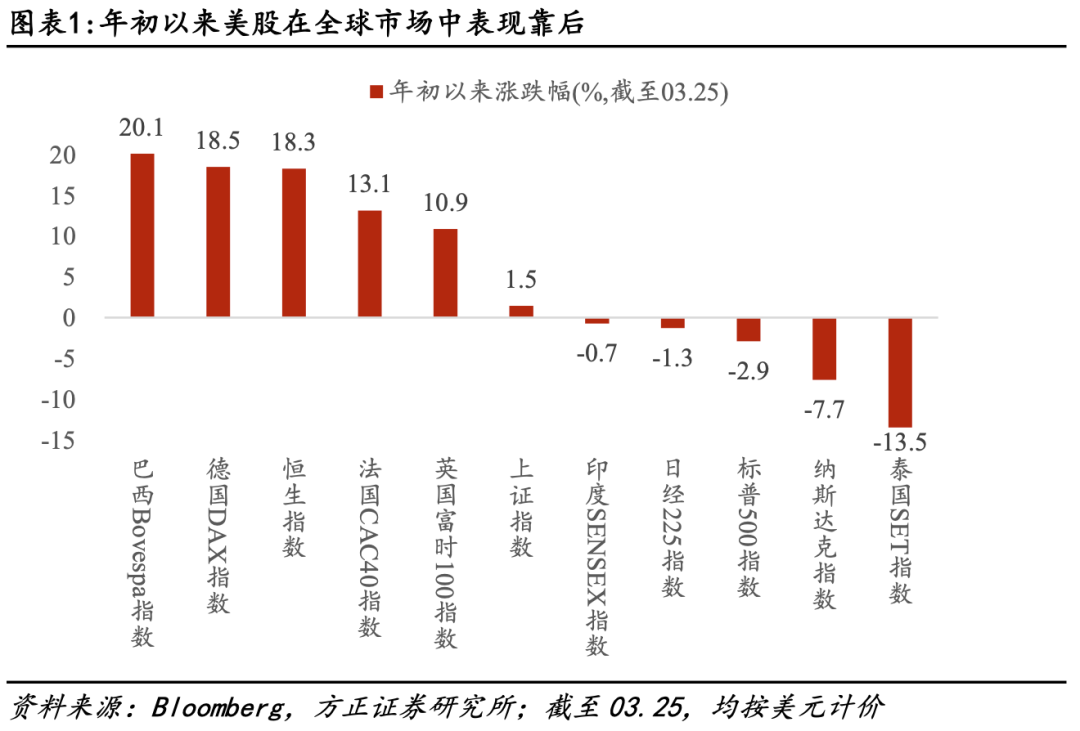
方正证券:投资美股逻辑未改 但高估值下回报预期需下调
智通财经网· 2025-04-02 00:11
核心结论 过去50余年,美股长期收益大幅领先其他资产:(1)复合收益率达10.7%:1972-2024年,美股以10.7%的复合收益率大幅跑赢其他资产,2012年以来美 股的超额优势显著;(2)美股的高收益但波动较低特征,使其成为全球风险资产中占优:风险-收益角度看,美国资产的风险收益比贴近有效边界,美股 收益率最高,波动率高于债券、房地产,但远低于大宗商品。 美股长牛的背后:盈利驱动+驱动宏观:(1)企业盈利的优势地位,是美股在全球权益市场领先的重要原因:对1970-2024年的标普500收益进行拆分,其 10.9%的复合收益中,盈利增长年化收增长6.6%,股息增长2.2%,估值变动1.8%,也即约六成是盈利贡献;(2)美股市场的相对稳定性,也即"牛长熊 短"的特征,很大程度上归因于其已成为美国居民的核心资产,"驱动宏观"属性较强:美股已成为美国居民最重要资产构成,美股大跌时,美联储倾向于 采取宽松货币政策以救市,Fed Put效应在美股市场上屡见不鲜,上市公司通过分红回购行动,同样起到股市稳定器作用。 往后看,按10年维度判断,美股长期收益大概率边际下滑:(1)按海外机构预期,未来10年美股年化收益率中位 ...