
ARCH模型

Search documents
市场低估了风险?诺奖得主恩格尔发出2026预警 | 两说
Di Yi Cai Jing Zi Xun· 2026-01-29 04:13
Group 1 - The core issue highlighted is whether the financial system has adequately priced in the new normal amidst ongoing global challenges such as tariff conflicts, AI transformations, geopolitical tensions, and climate crises [1][3] - Engel identifies several sources of uncertainty for 2025, including tariff policies, anti-science sentiments in the U.S., immigration issues, and ongoing wars, which are increasing market volatility without sufficient caution from the market [3] - Engel's ARCH model serves as a tool for monitoring volatility rather than predicting market movements, emphasizing that it can indicate when volatility is high or low but cannot forecast market direction [5] Group 2 - Engel compares current tariff policies to the Smoot-Hawley Tariff Act of the 1930s, suggesting that tariffs are detrimental to both parties involved and are unlikely to be sustainable [7] - He argues that AI should not be viewed as an independent source of market volatility, as it is fundamentally a probabilistic model that assists human decision-making rather than replacing it [7] - Engel stresses the importance of gradual and predictable policy adjustments to mitigate risks, as sudden changes can lead to reduced investment and consumption, ultimately slowing down the economy [7] Group 3 - For non-professional investors, Engel recommends using volatility control indices that automatically adjust positions based on market volatility, allowing for a gradual exit before major shocks occur [9] - He emphasizes the importance of disciplined risk management over market timing, suggesting that investors should build diversified portfolios with set volatility targets [9] - Engel expresses concern about potential escalations in wars, the re-emergence of stagflation, and stagnation in climate action, while remaining hopeful about improved U.S.-China relations that could benefit global economic stability [11]

市场低估了风险?诺奖得主恩格尔发出2026预警 | 两说
第一财经· 2026-01-29 04:01
Core Viewpoint - The article emphasizes the underestimation of risks in the current market environment, highlighting the need for awareness and preparedness among investors as uncertainties rise due to various global factors [1][3][4]. Group 1: Current Market Risks - Engel identifies several sources of uncertainty for 2025, including tariff policies, anti-science sentiments in the U.S., immigration issues, and ongoing wars, which are increasing market volatility without sufficient caution from investors [3][4]. - The prevailing market optimism may be a false sense of security, as Engel warns that these issues may not resolve in a way that enhances economic resilience or growth [4][5]. Group 2: ARCH Model Insights - Engel's ARCH model, introduced in 1982, quantifies the phenomenon of "volatility clustering" in financial markets, indicating that high volatility is often followed by more high volatility [8]. - The model serves as a tool for monitoring global financial conditions rather than predicting specific market movements, focusing on when volatility is likely to rise or fall [9]. Group 3: Trade Wars, AI, and Policy - Engel compares current trade wars to the Smoot-Hawley Tariff Act of the 1930s, suggesting that tariffs are detrimental to both parties involved and are unlikely to be sustainable [12]. - He views AI not as an independent source of market volatility but as a probabilistic tool that should assist human decision-making, cautioning against over-reliance on automated trading systems [12]. - Engel stresses the importance of gradual and predictable policy adjustments to mitigate risks, as sudden changes can lead to reduced investment and consumption, further slowing economic growth [12]. Group 4: Strategies for Individual Investors - For non-professional investors, Engel advises against attempting market timing and suggests using volatility control indices that adjust positions based on market volatility levels [15]. - He recommends constructing a diversified investment portfolio with a defined volatility target, emphasizing disciplined risk management over speculative market predictions [16]. Group 5: Future Outlook - Engel expresses concern about three major issues for 2026: escalation of wars, the re-emergence of stagflation, and stagnation in climate action, while remaining hopeful about improved U.S.-China relations [19][20]. - He believes that better collaboration between the U.S. and China could help address inflation and deflation issues, benefiting both countries and the global economy [20].
【今晚播出】市场低估了风险?诺奖得主恩格尔发出2026预警 | 两说
Di Yi Cai Jing Zi Xun· 2026-01-28 07:00
Core Insights - The article emphasizes the increasing complexity of global markets influenced by trade conflicts, AI transformations, geopolitical tensions, and climate crises, raising the question of whether hidden risks have been adequately identified [1] - It highlights the need for financial systems to either fully price in the new normal or risk falling into a collective optimism that leads to cognitive blind spots [1] - The piece introduces Robert Engle, a Nobel laureate in economics, who will provide insights on the risk landscape for 2026 and offer strategies for ordinary investors to safeguard their wealth and future [1] Summary by Sections - **Market Dynamics**: The article discusses the ongoing turbulence in global markets due to multiple overlapping crises, suggesting a critical need for risk recognition [1] - **Expert Insight**: Robert Engle, known for his work on volatility and risk trajectories, is set to analyze the risk scenarios for 2026 and propose rational survival strategies in a volatile world [1][4] - **Broadcast Information**: The insights from Engle will be featured in a program airing on January 28 and January 31, providing a platform for discussing these pressing issues [4]
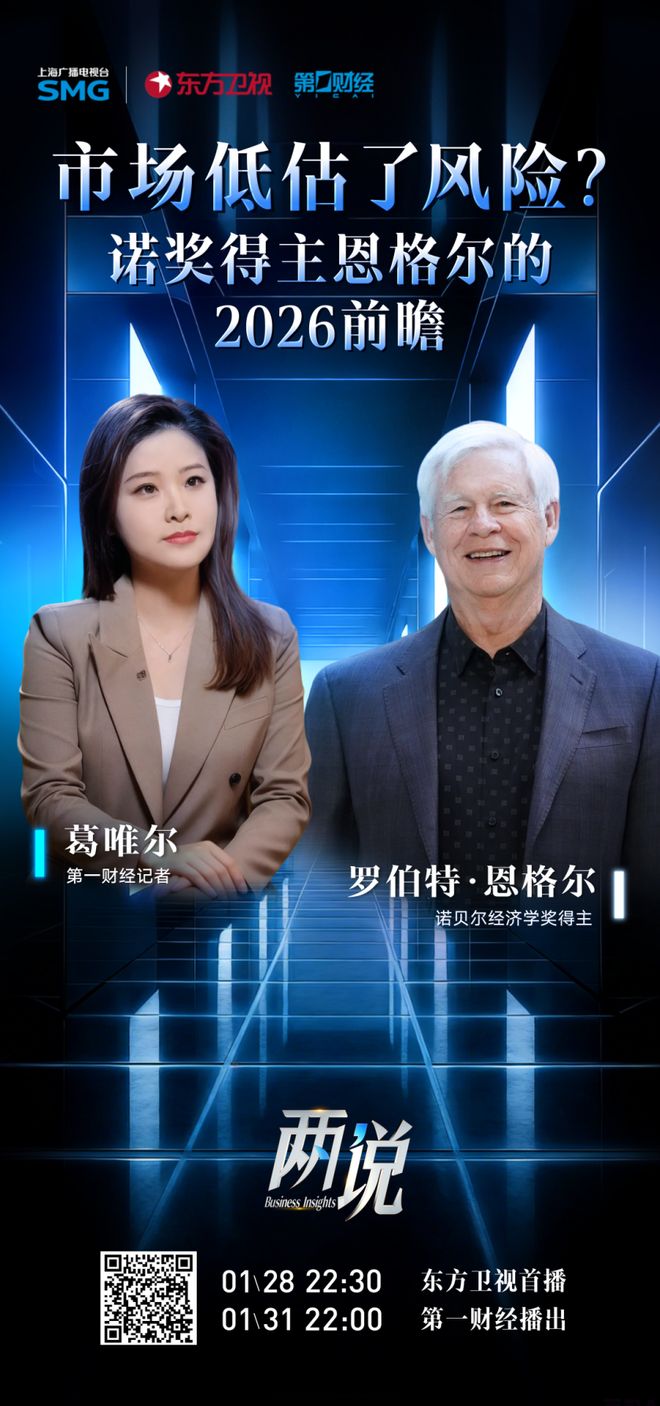
【今晚播出】市场低估了风险?诺奖得主恩格尔发出2026预警 | 两说
第一财经· 2026-01-28 06:53
Core Insights - The article emphasizes the increasing complexity of global markets influenced by trade conflicts, AI transformations, geopolitical tensions, and climate crises, raising the question of whether hidden risks have been adequately identified [1] - It highlights the need for investors to be aware of potential "black swan" and "gray rhino" events and to consider strategies for protecting their wealth and future [1] Summary by Sections - **Expert Opinion**: Robert Engle, a Nobel laureate in economics and founder of the ARCH model, provides insights and warnings regarding the risk landscape for 2026, focusing on volatility and risk trajectories [3] - **Media Coverage**: The article mentions upcoming broadcasts featuring Engle's analysis, scheduled for January 28 on Oriental TV and January 31 on First Financial [5]
独家专访诺奖得主罗伯特·恩格尔:在不确定性时代解构风险
2 1 Shi Ji Jing Ji Bao Dao· 2025-12-22 23:57
Core Viewpoint - The next financial crisis may be triggered by inflation, particularly due to fluctuating tariff policies, which could lead to significant market downturns if inflation rates remain high [1][12]. Group 1: Inflation and Economic Policies - Tariffs are likely to cause inflation, and if inflation persists, the Federal Reserve may struggle to decide between raising or lowering interest rates, leading to a collapse in bond prices and a significant drop in the stock market [1][12]. - The year 2025 is expected to be tumultuous, with frequent changes in tariff policies and significant uncertainty in the financial markets, despite a strong market performance overall [3][4]. Group 2: Market Reactions and Asset Management - Despite various global risks, including geopolitical tensions and climate change, financial markets have remained robust, supported by factors such as optimism, Federal Reserve backing, and tax cuts [4]. - Investors may consider holding cash or other assets that are less sensitive to economic fluctuations as a buffer against unpredictable events [2][16]. Group 3: Gold and Currency Dynamics - The rise in gold prices is largely driven by central banks diversifying their reserves away from the dollar, indicating a potential shift in global currency reliance [5][6]. - The dollar may continue to depreciate, and there is speculation about the emergence of a multi-currency system, with currencies like the yuan or euro potentially gaining prominence [6]. Group 4: Climate Change and Regulatory Impact - The U.S. withdrawal from the Paris Agreement and subsequent deregulation efforts are seen as attempts to diminish the visibility of climate issues, which could have long-term implications for environmental policies and market stability [7]. Group 5: Systemic Risks and Financial Stability - Current assessments indicate that while systemic risks in the banking sector appear manageable, ongoing monitoring is essential, particularly regarding climate-related risks [8]. - The volatility of AI stocks raises concerns about potential bubbles, but the overall impact on the market may not mirror past crises like the internet bubble [9][10]. Group 6: Future Outlook and Political Influence - The upcoming midterm elections in the U.S. are expected to introduce market volatility as investors speculate on potential shifts in political power and their economic implications [18]. - The uncertainty surrounding current U.S. policies, particularly those affecting immigration and scientific research, poses risks to innovation and economic growth [18].