
DDM估值模型

Search documents
WBC share price at $41: here’s how I would value them
Rask Media· 2026-03-11 00:28
Core Viewpoint - The valuation of Westpac Banking Corp (WBC) shares is a significant concern for investors, particularly those interested in dividend income, with current share price around $41 [1][2]. Group 1: Investment Appeal of Bank Shares - The financial/banking industry is favored by Australian investors, alongside tech and industrial sectors, due to the oligopolistic nature of the market dominated by major banks like Commonwealth Bank and National Australia Bank [3]. - Bank shares are particularly attractive to dividend investors because of the franking credits associated with fully franked dividends [3]. Group 2: Valuation Methods - The Price-Earnings (PE) ratio is a common valuation tool that compares a company's share price to its earnings per share, providing a basic measure of valuation [4][5]. - For WBC, the current PE ratio is calculated at 21.4x based on a share price of $41 and earnings per share of $1.92, compared to the banking sector average PE of 20x, leading to a sector-adjusted valuation of $37.98 [6]. Group 3: Dividend Discount Model (DDM) - The Dividend Discount Model (DDM) is highlighted as a more effective valuation method for banks, relying on past or forecasted dividends and assuming consistent growth [7][8]. - Using a DDM approach, WBC shares are valued at $35.10 with a blended growth and risk rate, and at $34.05 with an adjusted dividend payment of $1.61 [11]. - Considering fully franked dividends, the valuation based on a gross dividend payment of $2.30 results in a share price valuation of $48.64 [12]. Group 4: Sensitivity Analysis - A sensitivity analysis of growth and risk rates shows varying valuations for WBC shares, with a risk rate of 6% and growth rate of 2% yielding a valuation of $40.25, while a growth rate of 4% and risk rate of 10% results in a valuation of $20.13 [13]. Group 5: Strategic Considerations - Investors are encouraged to understand WBC's growth strategy, focusing on interest income versus non-interest income, and to consider economic indicators such as unemployment and consumer sentiment [14].



任泽平:此轮牛市十年一遇
Sou Hu Cai Jing· 2025-12-22 23:36
Core Viewpoint - The current bull market in China is characterized as a once-in-a-decade event driven by strong policy support, a new technological revolution, and abundant liquidity, marking a significant shift in market dynamics since September 2024 [2][3][10]. Group 1: Market Characteristics - This bull market is described as epic, with historical comparisons to previous major bull markets in 2004-2007 and 2014-2015, indicating a cyclical pattern aligned with economic cycles [4][5]. - The Shanghai Composite Index has risen by 45% and the ChiNext Index by 108.6% since their respective lows last year, showcasing unprecedented growth [6]. - Trading volume has surged from a few hundred billion to over 3 trillion, and market capitalization has increased from 70 trillion to over 100 trillion, creating a wealth effect exceeding 30 trillion [7]. Group 2: Driving Forces - The bull market is propelled by three main drivers: continuous policy easing, a new technological revolution, and ample liquidity, collectively termed as "confidence bull" [8][10]. - Policy easing began with a significant shift in September 2024, leading to lower interest rates and increased support for the private sector, which has significantly boosted market risk appetite [8]. - The technological revolution, particularly in AI, semiconductors, and robotics, is driving growth in high-risk, high-reward sectors, contributing to the market's upward momentum [9]. Group 3: Historical Missions - This bull market is seen as fulfilling three historical missions: supporting the development of new productive forces, aiding in major power competition, and repairing household balance sheets [11]. - The capital market's growth is crucial for financing new economy sectors, which struggle to secure funding through traditional banking systems [11]. - The recovery of household balance sheets is vital, as the stock market's rise has countered significant wealth losses from the real estate market, potentially stimulating consumer spending [12][14]. Group 4: Future Prospects - The outlook for the bull market hinges on whether it can sustain a "slow bull" trend, which would significantly benefit hard technology development and economic recovery [16]. - Continued macroeconomic policy easing, including interest rate cuts and fiscal stimulus, is essential for maintaining market momentum [16]. - The unique characteristics of the A-share market, dominated by retail investors, necessitate careful regulation to manage volatility and leverage [17].
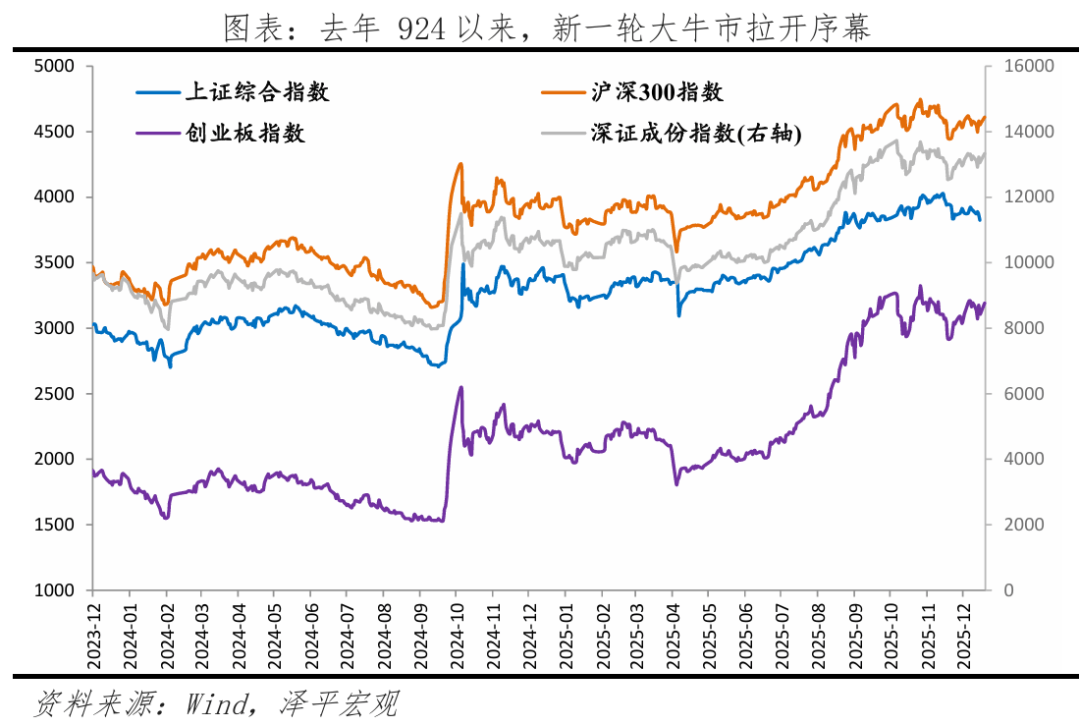
任泽平:这一轮牛市将是十年一遇,有三大驱动力、三大使命和两大前景
Sou Hu Cai Jing· 2025-08-26 01:11
Group 1 - The current bull market is characterized as a "confidence bull" driven by significant policy easing, abundant liquidity, and a new wave of technological revolution, marking it as a once-in-a-decade opportunity [4][8][13] - Since September 2024, the bull market has seen substantial gains, with the Shanghai Composite Index rising 45% from its low of 2690, and the ChiNext Index increasing by 79%, indicating a strong market recovery [5][7] - The market capitalization has surged from 70 trillion to 100 trillion, creating a wealth effect of 30 trillion, which is significant for the overall economy [7][8] Group 2 - Three main drivers of the current bull market include continuous policy easing, a new technological revolution, and ample liquidity, which together create a robust "confidence bull" [8][13] - The policy shift since September 2024 has led to a historic turning point, with measures such as interest rate cuts, relaxed housing market restrictions, and significant infrastructure investments boosting market sentiment [8][11] - The technological revolution, particularly in sectors like artificial intelligence and semiconductors, is expected to lead the market, reflecting a shift towards new economic drivers [11][14] Group 3 - The bull market is expected to fulfill three historical missions: supporting the development of new productive forces, aiding in major power competition, and repairing household balance sheets [13][15] - The capital market's prosperity is crucial for financing new economy sectors, which are often unable to secure funding through traditional banking systems due to their high-tech and asset-light nature [15][18] - The recovery of household balance sheets is vital, as the stock market's growth can offset the wealth loss from the real estate market, potentially leading to increased consumer spending [15][18] Group 4 - The outlook for the bull market includes the potential for a prolonged "slow bull" phase, which would significantly benefit hard technology development and economic recovery [17][19] - Continuous macroeconomic policy easing is essential for sustaining the bull market, with expectations for further interest rate cuts and fiscal stimulus to support demand [17][19] - The unique characteristics of the A-share market, dominated by retail investors, necessitate careful regulation of leverage to ensure healthy market development [18][19]

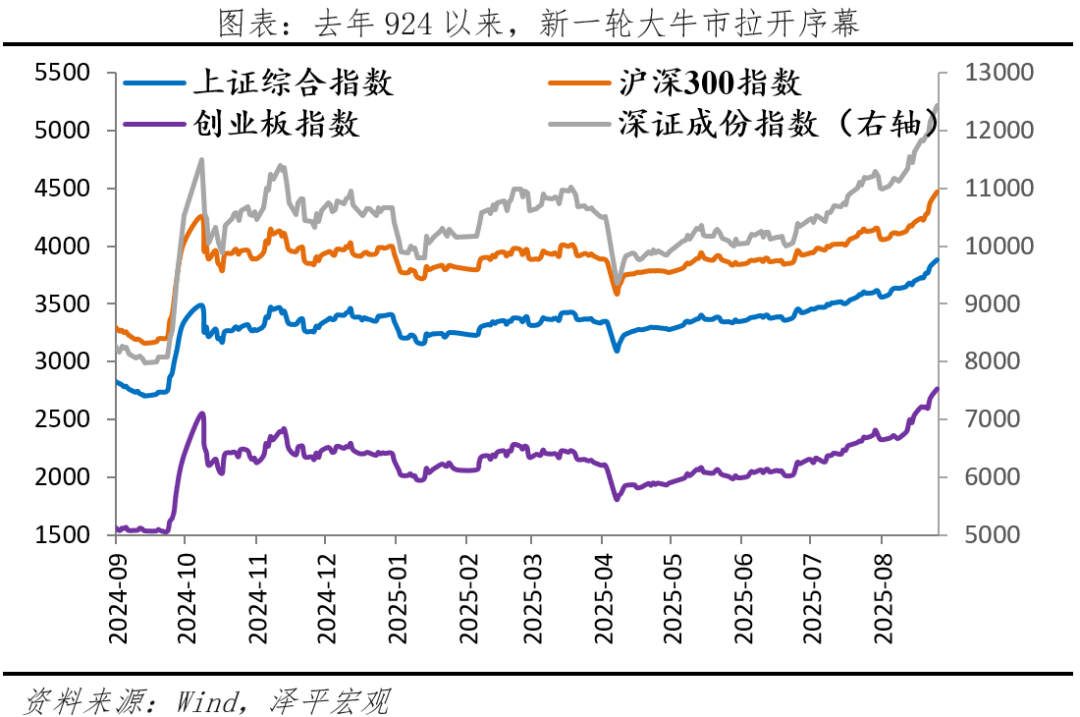
投资策略专题:开源金股,6月推荐
KAIYUAN SECURITIES· 2025-05-29 14:47
Group 1 - The report emphasizes a strategy of maintaining confidence in policies while lowering slope expectations, recommending a "4+1" investment approach focusing on domestic consumption, technology growth, cost improvement, and structural opportunities abroad, along with a stable dividend base [3][22][20] - The report identifies key sectors for investment in June, including transportation, non-bank financials, coal, environmental protection, construction decoration, beauty care, food and beverage, media, electric equipment, and social services based on an industry rotation model [4][25] Group 2 - In the media sector, Shanghai Film (601595.SH) is highlighted as a leading company benefiting from the recovery of the film market, with AI technology enhancing cost efficiency and expanding IP monetization opportunities [5][27] - In the communication sector, New Yi Sheng (300502.SZ) is recognized as a global leader in optical modules, with ongoing partnerships with major internet and communication equipment companies, driven by increasing demand for high-speed optical modules [6][30] - In the electric new energy sector, Daikin Heavy Industries (002487.SZ) is noted for being the only supplier in the Asia-Pacific region capable of delivering offshore products to Europe, with a robust order book and potential for profit growth as European offshore wind projects accelerate [7][32] - In the utilities sector, China Nuclear Power (601985.SH) is positioned as a domestic duopoly with significant cost advantages in nuclear power generation, promising future profits and dividends [8][34] - In the pharmaceutical sector, Sanofi Pharmaceutical (1530.HK) is recognized for its diverse product portfolio and strong commercialization capabilities, with promising new drug pipelines [9][36] - In the chemical sector, Zhenhua Co. (603067.SH) is highlighted as a leading global player in the chromium salt industry, expected to benefit from strong downstream demand [10][39] - In the automotive sector, XPeng Motors (9868.HK) is noted for its strong product lineup and potential for profitability as it expands its AI capabilities [11][42] - In the consumer discretionary sector, Ninebot (689009.SH) is projected to maintain high double-digit revenue growth in Q2, driven by strong sales of electric scooters and lawnmowers [12][44] - In the non-bank financial sector, Jiangsu Jinzhong (600901.SH) is expected to benefit from lower funding costs due to monetary easing, with projected earnings growth of 13% in 2025 [13][47] - In the computer sector, Zhuoyi Information (688258.SH) is recognized for its innovative AI programming products and potential benefits from high computing demand [14][50]