ETF规模变动

Search documents
资金节前避险?这类ETF规模年内“腰斩”
Mei Ri Jing Ji Xin Wen· 2026-02-15 06:33
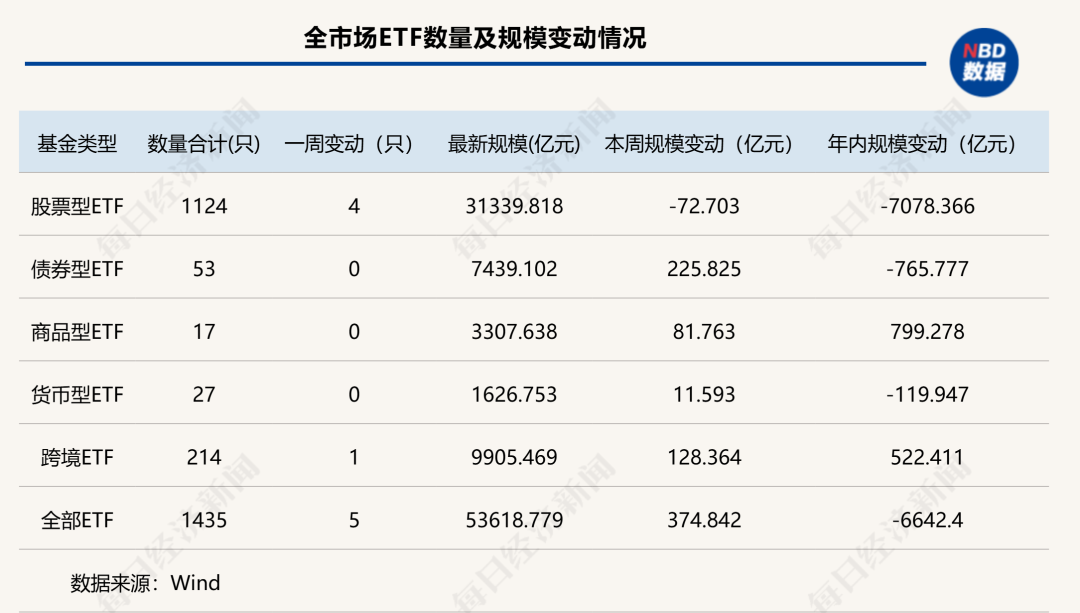
Market Overview - The A-share market experienced a week of fluctuations with major indices rebounding, including a 0.36% increase in the CSI 300 Index and a 1.22% rise in the ChiNext Index [1] - Despite the rebound, smart money has shifted direction, with stock ETFs continuing to shrink, particularly the CSI 300-linked ETFs, which have halved in size this year [1][4] ETF Performance - The total ETF market saw an increase of 374.84 billion yuan this week, bringing the total market size to 5.36 trillion yuan, primarily driven by bond and cross-border ETFs [2] - Bond ETFs gained 225.82 billion yuan, ending a five-week decline, while stock ETFs saw a slight decrease of 72.7 billion yuan [2][3] ETF Category Breakdown - As of February 14, 2023, the number of listed ETFs reached 1,435, with stock ETFs totaling 31,339.82 billion yuan, down 7,078.37 billion yuan year-to-date [3] - Bond ETFs and money market ETFs also experienced year-to-date declines of 765.78 billion yuan and 119.95 billion yuan, respectively, while cross-border and commodity ETFs saw increases of 522.41 billion yuan and 799.28 billion yuan [3] Index-linked ETF Trends - The CSI 300-linked ETF has seen a significant year-to-date decline of 5,975.29 billion yuan, with its current size at 5,880.28 billion yuan [6][7] - Other indices like the CSI 1000 and the SSE 50 also experienced substantial declines, exceeding 1,000 billion yuan each [7] Fund Management Insights - Hai Fu Tong Fund capitalized on the rebound in bond ETFs, achieving a weekly growth of 144.18 billion yuan, while other major funds like E Fund and Bosera also saw increases of over 40 billion yuan [8] - Conversely, major funds such as Huatai-PB and Huaxia Fund experienced declines in ETF sizes, with reductions of 40.64 billion yuan and 13.32 billion yuan, respectively [8] Top ETF Products - Gold ETFs have emerged as the top performers in terms of year-to-date growth, with significant increases from funds managed by Huaxia, Guotai, and Bosera [15] - The top 20 products saw limited growth, with only two in the top tier increasing in size, while the second tier showed more activity with several industry and thematic ETFs growing [12]

“国家队”减持、头部宽基缩水,ETF规模开年骤降3000亿元
Bei Jing Shang Bao· 2026-01-27 13:03
Core Viewpoint - The recent decline in the ETF market size, which has dropped to 5.67 trillion yuan from over 6 trillion yuan at the end of 2025, is attributed to the "national team" reducing its holdings in major ETFs, while the overall market remains active and resilient [1][3][8]. Group 1: ETF Market Size and Trends - As of January 26, the total ETF market size is approximately 5.67 trillion yuan, a decrease of over 300 billion yuan from the 6.02 trillion yuan recorded at the end of 2025 [1][3]. - Major ETFs such as Huatai-PB CSI 300 ETF, E Fund CSI 300 ETF, and others have experienced significant outflows, with nearly 700 billion yuan net outflow on January 26 alone [3][4]. - The largest ETF, Huatai-PB CSI 300 ETF, has seen its size shrink to about 285.35 billion yuan from a peak of nearly 440 billion yuan [4][5]. Group 2: National Team's Actions - The "national team," represented by Central Huijin and its asset management arm, has reduced its holdings in major ETFs, which has led to a decrease in the total shares of these funds [5][6]. - The total shares of Huatai-PB CSI 300 ETF have fallen to 605.17 billion shares as of January 26, down from 735.13 billion shares held by the "national team" at the end of 2025 [5][6]. Group 3: Market Regulation and Future Outlook - Regulatory actions have been taken to cool down the overheated market, including penalties for illegal stock recommendations and increasing margin requirements for investors [7][8]. - Analysts believe that the strict regulatory environment will enhance the investability of the Chinese market and support long-term growth, with a focus on sectors aligned with national strategies such as technology and high-end manufacturing [8][9]. - The long-term outlook for ETF growth remains positive, with expectations that the total market capitalization of stocks will continue to rise, leading to an increase in ETF sizes [9].

这类产品单周“失血”超4000亿元,ETF总规模跌破6万亿元丨ETF规模周报
Sou Hu Cai Jing· 2026-01-25 02:44
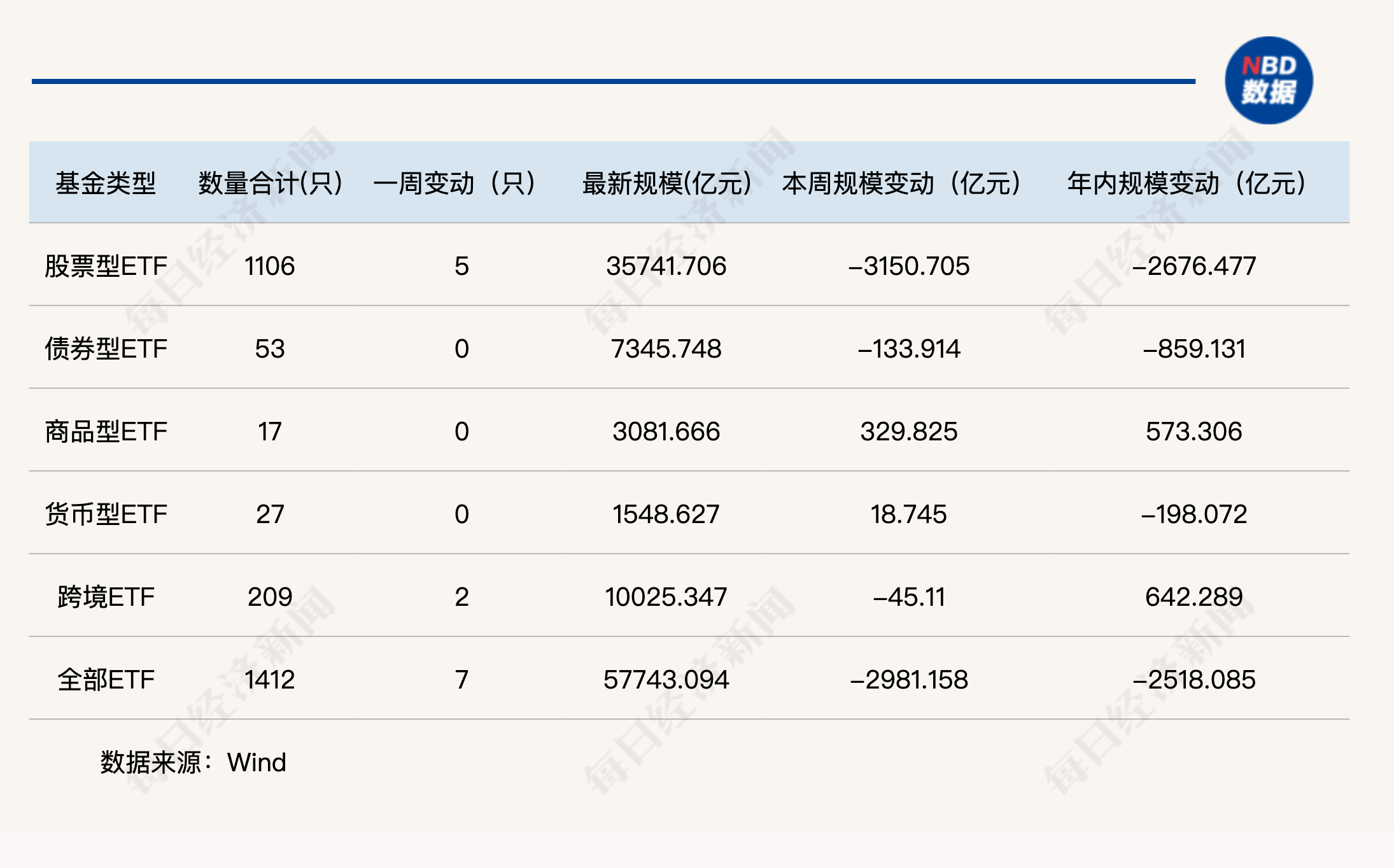
Market Overview - A-shares experienced mixed fluctuations from January 19 to January 23, with the CSI 300 index declining by 0.62% and the CSI A500 index increasing by 0.78% [1] - The ETF market showed a stark contrast, with significant inflows into gold, chemical, and technology chip ETFs, while large funds withdrew over 400 billion yuan from broad-based ETFs, reducing the total ETF scale below 6 trillion yuan [1][2] ETF Scale Changes - The total market ETF scale decreased by 2981.16 billion yuan this week, with stock ETFs shrinking by 3150.7 billion yuan, primarily due to a 4018.04 billion yuan drop in broad-based ETFs [2] - As of January 24, the total number of listed ETFs reached 1412, with 7 new ETFs launched this week [2][3] Performance of Specific ETFs - The CSI 300 index-linked ETFs saw a significant drop of 2579.72 billion yuan this week, with a total year-to-date decline exceeding 3300 billion yuan [4][8] - Gold ETFs experienced a surge, gaining 292.34 billion yuan, making them the top performers this week, while chemical sector ETFs also saw growth of over 100 billion yuan [5][15] Fund Management Changes - The top three fund management companies collectively lost over 800 billion yuan in ETF scale this week, with notable declines from Huaxia, E Fund, and Huatai-PB [9][13] - Conversely, Guotai Fund, relying on its gold ETF, saw a scale increase of nearly 100 billion yuan, moving up in rankings [9][13] Notable ETF Transactions - Several broad-based ETFs recorded significant trading volumes, with the Southbound CSI 1000 ETF achieving a transaction volume of 18.2 billion yuan, marking a new high since its listing [19] - The Hong Kong Stock Exchange announced the inclusion of 98 ETFs into the northbound stock connect, increasing the total number of products to 364 [18]
这类ETF单周缩水超2000亿元,发生了什么?
Mei Ri Jing Ji Xin Wen· 2026-01-18 05:55
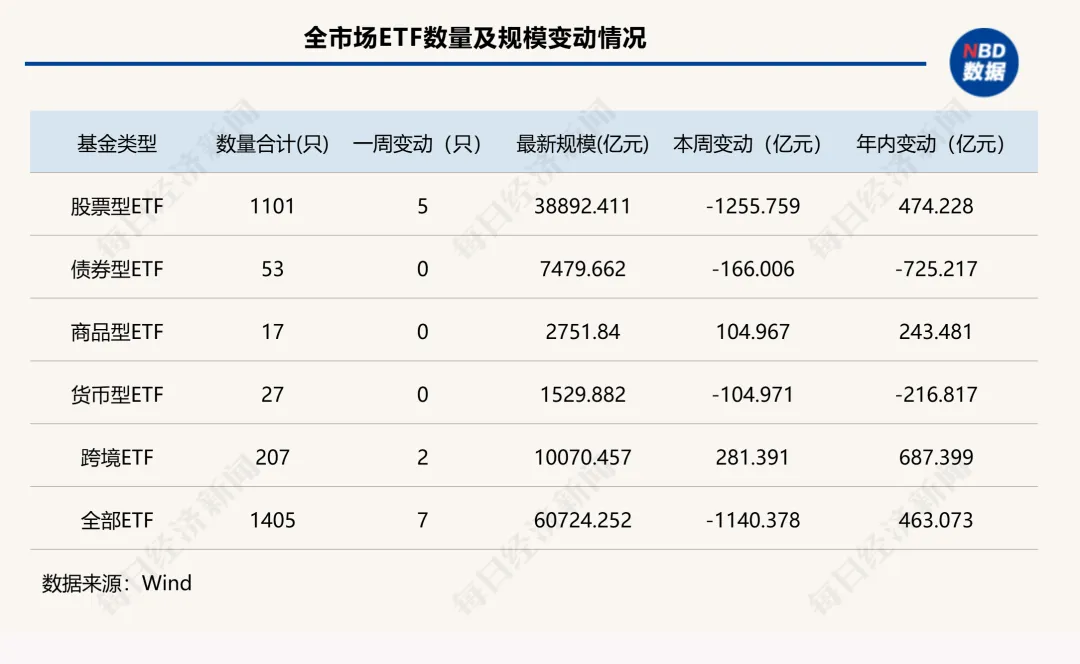
Market Overview - A-shares experienced volatility with the CSI 300 index declining by 0.57% and the ChiNext index increasing by 1% during the week of January 12 to January 16 [1][18] - The Hong Kong market rebounded, with the Hang Seng Index rising by 2.34% [1] ETF Market Dynamics - The ETF market faced a significant downturn, with a loss exceeding 200 billion yuan in a single week, leading to a total scale drop below 4 trillion yuan for stock ETFs [1][19] - Major ETF managers, including Huaxia, E Fund, and Huatai-PB, saw their management scales shrink by over 340 billion yuan due to the outflow of funds from broad-based ETFs [1][19] - Despite the downturn in stock ETFs, cross-border ETFs saw a historic increase, surpassing 1 trillion yuan in total scale for the first time [1][33] ETF Scale Changes - The total market ETF scale decreased by 1,140.38 billion yuan, with stock ETFs alone shrinking by 1,255.76 billion yuan [2][19] - Bond and money market ETFs also faced declines, with reductions of 166.01 billion yuan and 104.97 billion yuan, respectively [2][19] - Conversely, cross-border ETFs added 289.39 billion yuan, marking a significant growth [2][19] ETF Product Performance - The CSI 300 index-linked ETFs saw a dramatic scale reduction of 1,091.49 billion yuan, primarily due to a net outflow of 1,033.66 billion yuan [4][21] - In contrast, the Hong Kong Internet index-linked ETFs experienced a growth of over 100 billion yuan, becoming the "increment king" of the week [4][21] Fund Management Changes - Huaxia Fund's ETF management scale briefly surpassed 1 trillion yuan but fell back below this threshold due to significant fund outflows [15][32] - E Fund and Huatai-PB also reported substantial reductions in their ETF management scales, with E Fund's scale dropping below 900 billion yuan [7][27] Notable ETF Developments - The first gold ETF in the domestic market surpassed 1 trillion yuan, becoming a significant milestone [17][34] - The total number of listed ETFs reached 1,405, with 7 new ETFs launched during the week [1][20]
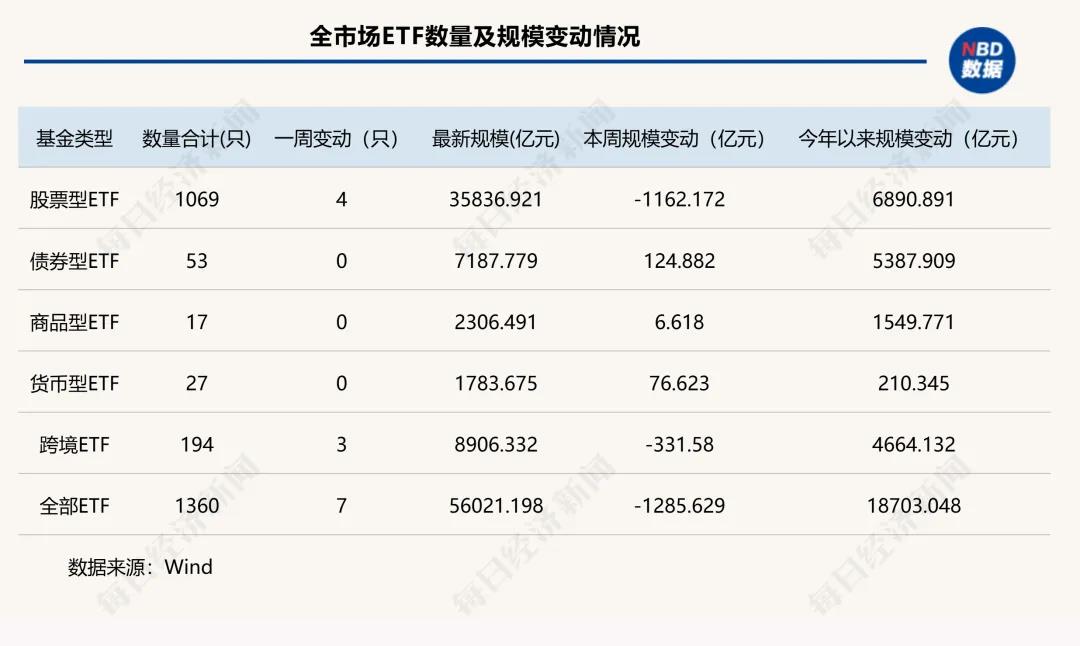
股票型ETF单周缩水超1100亿元 这两类产品却成避风港 | ETF规模周报
Mei Ri Jing Ji Xin Wen· 2025-11-23 05:35
Market Overview - A-shares experienced a significant adjustment from November 17 to November 21, with the CSI 300 index dropping by 3.77%, the ChiNext index falling by 6.15%, and the STAR 50 index decreasing by 5.54% [1] - The Hong Kong stock market also faced declines, with the Hang Seng Index down by 5.09% and the Hang Seng Tech Index dropping by 7.18% [1] ETF Market Dynamics - The ETF market saw a "mass migration" of funds, with stock ETFs shrinking by over 110 billion yuan in a week, particularly the CSI 300 index-linked products which lost 42.2 billion yuan, accounting for over 36% of the total shrinkage [1][2] - Conversely, fixed income and gold-related products emerged as safe havens, with bond ETFs increasing by 12.4 billion yuan, reaching a total of 718.7 billion yuan, marking a year-to-date growth of 538.7 billion yuan, nearly tripling in size [1][17] - Commodity ETFs maintained growth momentum, surpassing 230 billion yuan in total size, with a year-to-date increase exceeding 200% [1] ETF Size and Performance - As of November 22, the total number of listed ETFs reached 1,360, with a total size significantly reduced to 5.6 trillion yuan, reflecting a weekly decrease of 128.56 billion yuan [2][3] - Stock ETFs saw a weekly reduction of 116.22 billion yuan, with broad-based index ETFs experiencing a sharp decline of 72.55 billion yuan, accounting for over 60% of the total shrinkage [2][3] Index-linked ETF Performance - The CSI 300 index-linked ETFs saw a reduction of 42.29 billion yuan, bringing their total size down to 1.1496 trillion yuan, contributing significantly to the overall decline in stock ETFs [4][6] - Despite the overall shrinkage, some index-linked ETFs, such as those linked to the Hang Seng Tech Index, experienced net inflows, indicating a "buy the dip" mentality among investors [2][4] Fund Management Insights - Major fund management companies faced significant losses, with four firms losing over 10 billion yuan in ETF size, including Huaxia Fund and E Fund, which saw reductions of 20.24 billion yuan and 27.78 billion yuan, respectively [8][10] - In contrast, Hai Futong Fund experienced a notable increase of 4.57 billion yuan, primarily due to the strong performance of its short-term bond ETF, which surpassed 70 billion yuan in size [8] Year-to-Date Growth Trends - Year-to-date, the CSI 300 index, SGE Gold 9999 index, and Hang Seng Tech index-linked ETFs have seen growths of 164.32 billion yuan, 136.83 billion yuan, and 99.68 billion yuan, respectively [7][11] - Conversely, the China Securities 500 index and STAR 50 index-linked ETFs have experienced significant year-to-date declines of 65.40 billion yuan and 13.11 billion yuan, respectively [7] Regulatory Updates - The Shanghai and Shenzhen Stock Exchanges have issued revised guidelines for ETF naming conventions, requiring that ETF names include the core elements of the investment target and the fund manager's abbreviation, with a deadline for compliance set for March 31, 2026 [16]