
货币型ETF

Search documents
ETF生态周报(2026.03.16-03.20):ETF市场整体综合面板-20260324
HWABAO SECURITIES· 2026-03-24 11:58
1. Report Industry Investment Rating - Not provided in the content 2. Core Viewpoints - The overall scale of the ETF market has slightly shrunk compared to the beginning of the year, with the number of listed funds increasing. The performance of different types of ETFs has shown significant differentiation, and the flow of funds has also changed marginally. The trading congestion of bond ETFs has decreased, while the trading of stock ETFs has shifted towards growth and technology. The issuance of ETFs has shown a trend of decline in the number of ongoing issuances and an increase in the number of waiting - to - be - issued products [3][58][72] 3. Summary by Directory 3.1 Scale: Total Expansion and Structural Stratification (Market/Product/Institution) 3.1.1 Market/Product Scale - As of March 20, 2026, the total scale of the entire market's ETFs reached 5.10 trillion yuan, a decrease of 0.92 trillion yuan from the beginning of the year. The number of listed funds increased to 1,458, with 55 new funds added. Stock - type ETFs were the main force in scale, but their scale decreased by 0.89 trillion yuan compared to the beginning of the year. Bond - type ETFs had the largest shrinkage in scale, while commodity - type ETFs increased by 8.2092 billion yuan. Cross - border ETFs added 10 new funds, indicating an increasing demand for diversified asset allocation [3][11][36] 3.1.2 Institution Scale - Last week, the ETF scale of leading institutions decreased by over 10 billion yuan, with the equity side generally under pressure. Only a few fixed - income and money - market directions received marginal support. The differentiation among institutions increased, with some institutions experiencing significant declines in both equity and ETF scales, while others showed relatively stable performance in the money - market segment [13][16] 3.2 Performance: Rise - Fall Differentiation and Valuation Position 3.2.1 Major Types of ETFs - Last week, the domestic equity market was generally weak, with broad - based indexes generally retreating. Small - and medium - cap indexes had larger declines, and their valuation quantiles were at high levels. Defensive sectors also failed to avoid the decline. Bond - type ETFs provided a hedge, and cross - border (QDII) ETFs were also weak. The valuation structure showed that core broad - based indexes were relatively stable, while growth and small - and medium - cap indexes had higher valuations and greater volatility [19][20][24] 3.2.2 CITIC First - Level Industry Index - The performance of industries last week showed obvious differentiation. Most industries had high valuation quantiles but different涨跌 trends. High - valuation sectors were concentrated in strong - performing industries, while low - valuation sectors were generally weak. High - valuation cyclical sectors were particularly under pressure [28] 3.2.3 Representative ETF Products - The current market shows obvious differentiation between high and low valuations, with defensive and risk - averse funds being active. In terms of scale, Huatai - Peregrine CSI 300 ETF ranked first. In terms of trading activity, bond - type ETFs were prominent, reflecting risk - averse sentiment. Some ETFs such as military - leading ETFs and dividend ETFs had high valuation quantiles, while others like Hang Seng Tech ETF and pharmaceutical ETFs had low valuations, which were attractive for long - term investors [30] 3.3 Funds: Sector Liquidity and Net Inflow Structure 3.3.1 Overall Market Overview: Scale and Net Redemption/Subscription - As of March 20, 2026, the market continued to expand, but different types of ETFs had different scale changes. Stock - type ETFs were still the main force, bond - type ETFs had the largest shrinkage, and commodity - type ETFs increased due to risk - averse demand [36] 3.3.2 Inside the Equity Market: Broad - Based vs. Industry/Theme vs. Strategy - As of March 20, 2026, the funds of major broad - based ETFs showed marginal improvement in the short - term, but the medium - term pressure of net outflows still existed. Long - term funds continued to migrate towards themes and cyclical sectors, while short - term funds showed a style - switching trend [48] 3.3.3 Leveraged Funds - Last week, there was an obvious differentiation between redemption/subscription and margin trading. Some broad - based ETFs had strong inflows of funds through both margin trading and subscription, while some products were mainly dominated by leveraged funds, and most products had weak short - term fund popularity [51] 3.4 ETF Trading Congestion 3.4.1 Trading Intensity - As of March 22, 2026, the total trading volume of the ETF market decreased compared to the previous week. Funds shifted from bonds to equities and cross - border assets. The trading activity of bond - type ETFs declined, and the turnover structure of stock - type ETFs shifted from defensive to growth and technology sectors [58][61][64] 3.5 Issuance Dynamics - Last week, the ETF issuance market continued to decline, with the number of ongoing issuances decreasing and the number of waiting - to - be - issued products increasing. The number of newly established funds increased significantly, and the supply side improved. However, the number of ETFs scheduled to be listed in the next two weeks is limited [72][74]
ETF生态周报(2026.03.16-03.20)——ETF市场整体综合面板
华宝财富魔方· 2026-03-24 09:50
Market Overview - As of March 20, 2026, the total market size of ETFs reached 5.10 trillion yuan, a decrease of 0.92 trillion yuan since the beginning of the year, with the number of listed ETFs increasing to 1,458, adding 55 new ones [2][26] - The stock-type ETFs accounted for 2.95 trillion yuan, while commodity-type ETFs saw a significant increase of 820.92 billion yuan to 3325.55 billion yuan, indicating sustained demand for hedging [2][26] - The top 20 fund companies experienced a general decline in ETF volumes, with significant pressure on equity sectors, leading to increased differentiation among leading institutions [2][8] Performance Analysis - The domestic equity market saw a substantial pullback, with the CSI 500 and CSI 1000 indices dropping by 6.00% and 5.29% respectively, while valuation levels remained historically high [11][12] - Defensive sectors did not perform well, with the power ETF declining by 2.97%, indicating that even traditionally safe investments were affected by market conditions [11][12] - The military and dividend ETFs had high PE ratios of 96.54 and 99.26 respectively, while the Hang Seng Technology ETF and pharmaceutical ETF remained at lower valuation levels, suggesting potential long-term investment appeal [11][18] Fund Flows - There was a marginal shift in fund flows, with broad-based ETFs seeing a net inflow of 126.08 billion yuan over the past five days, marking a return to positive territory for the first time recently [3][32] - However, over a 60-day period, broad-based ETFs still experienced a net outflow of 10,101.11 billion yuan, indicating ongoing mid-term pressure [3][32] - The recent inflow into the ChiNext index of 52.59 billion yuan suggests a notable shift of funds from safe-haven assets towards growth-oriented equities [21][32] Trading Activity - The trading volume of ETFs reached approximately 2.58 trillion yuan, reflecting a decrease from the previous week, with a notable shift of funds from bonds to equities and cross-border investments [39][41] - The trading activity of bond ETFs decreased significantly, while stock-type ETFs, particularly those related to the A500 index, remained highly active [41][45] - The turnover rate for bond ETFs showed a downward trend, indicating a shift in trading frequency and a potential move towards more stable asset allocations [42][45] Issuance Dynamics - A total of 10 ETFs were listed last week, with a combined share of 3.633 billion, indicating a recovery in supply [49][51] - The number of ETFs currently in issuance decreased to 49, while the number of newly established funds increased significantly to 47, suggesting a more robust supply side for the market [49][51] - Future listings are expected to be limited, with only three ETFs announced for the next two weeks, reflecting a potential contraction in supply [51]


ETF两市成交额报5252.29亿元
Mei Ri Jing Ji Xin Wen· 2026-02-27 07:23
Core Viewpoint - The total trading volume of ETFs in the market reached 525.29 billion yuan as of the market close on February 27 [1] Summary by Category Stock ETFs - The trading volume for stock ETFs amounted to 141.7 billion yuan [1] Bond ETFs - The trading volume for bond ETFs was 281.448 billion yuan [1] Money Market ETFs - The trading volume for money market ETFs reached 22.716 billion yuan [1] Commodity ETFs - The trading volume for commodity ETFs was 10.253 billion yuan [1] QDII ETFs - The trading volume for QDII ETFs totaled 46.672 billion yuan [1]
ETF两市成交额报4493.67亿元
Mei Ri Jing Ji Xin Wen· 2026-02-25 07:17
Core Viewpoint - The total trading volume of ETFs in the market reached 449.37 billion yuan as of the market close on February 25 [1] Group 1: ETF Trading Volume - The trading volume of stock ETFs amounted to 160.5 billion yuan [1] - The trading volume of bond ETFs was 185.58 billion yuan [1] - The trading volume of money market ETFs reached 28.95 billion yuan [1] - The trading volume of commodity ETFs was 14.01 billion yuan [1] - The trading volume of QDII ETFs totaled 37.84 billion yuan [1]
ETF两市成交额2492.43亿元
Jin Rong Jie· 2026-02-25 03:52
Core Viewpoint - The total trading volume of ETFs in the market has reached 249.243 billion yuan, with significant contributions from various types of ETFs [1] Group 1: Trading Volume Breakdown - The trading volume for stock ETFs is 91.68 billion yuan [1] - The trading volume for bond ETFs is 100.315 billion yuan [1] - The trading volume for money market ETFs is 14.525 billion yuan [1] - The trading volume for commodity ETFs is 7.66 billion yuan [1] - The trading volume for QDII ETFs is 21.842 billion yuan [1] Group 2: Top Performing ETFs - The highest trading volume non-money market ETFs are as follows: - Huaxia CSI A500 ETF (512050) with a trading volume of 6.851 billion yuan [1] - A500 Fund (563360) with a trading volume of 5.876 billion yuan [1] - Guotai CSI A500 ETF (159338) with a trading volume of 5.169 billion yuan [1]
资金节前避险?这类ETF规模年内“腰斩”
Mei Ri Jing Ji Xin Wen· 2026-02-15 06:33
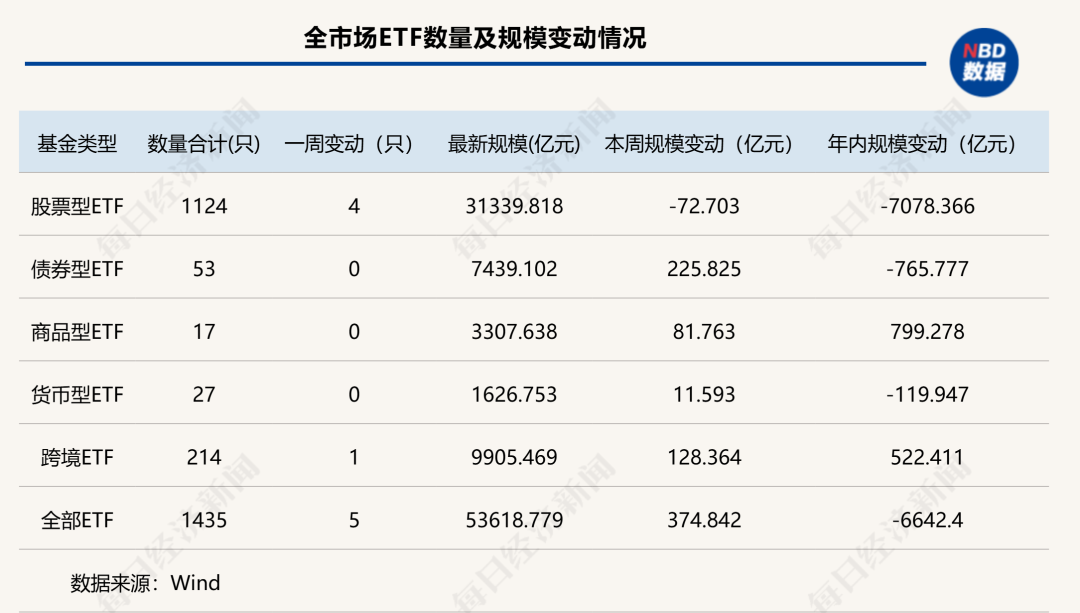
Market Overview - The A-share market experienced a week of fluctuations with major indices rebounding, including a 0.36% increase in the CSI 300 Index and a 1.22% rise in the ChiNext Index [1] - Despite the rebound, smart money has shifted direction, with stock ETFs continuing to shrink, particularly the CSI 300-linked ETFs, which have halved in size this year [1][4] ETF Performance - The total ETF market saw an increase of 374.84 billion yuan this week, bringing the total market size to 5.36 trillion yuan, primarily driven by bond and cross-border ETFs [2] - Bond ETFs gained 225.82 billion yuan, ending a five-week decline, while stock ETFs saw a slight decrease of 72.7 billion yuan [2][3] ETF Category Breakdown - As of February 14, 2023, the number of listed ETFs reached 1,435, with stock ETFs totaling 31,339.82 billion yuan, down 7,078.37 billion yuan year-to-date [3] - Bond ETFs and money market ETFs also experienced year-to-date declines of 765.78 billion yuan and 119.95 billion yuan, respectively, while cross-border and commodity ETFs saw increases of 522.41 billion yuan and 799.28 billion yuan [3] Index-linked ETF Trends - The CSI 300-linked ETF has seen a significant year-to-date decline of 5,975.29 billion yuan, with its current size at 5,880.28 billion yuan [6][7] - Other indices like the CSI 1000 and the SSE 50 also experienced substantial declines, exceeding 1,000 billion yuan each [7] Fund Management Insights - Hai Fu Tong Fund capitalized on the rebound in bond ETFs, achieving a weekly growth of 144.18 billion yuan, while other major funds like E Fund and Bosera also saw increases of over 40 billion yuan [8] - Conversely, major funds such as Huatai-PB and Huaxia Fund experienced declines in ETF sizes, with reductions of 40.64 billion yuan and 13.32 billion yuan, respectively [8] Top ETF Products - Gold ETFs have emerged as the top performers in terms of year-to-date growth, with significant increases from funds managed by Huaxia, Guotai, and Bosera [15] - The top 20 products saw limited growth, with only two in the top tier increasing in size, while the second tier showed more activity with several industry and thematic ETFs growing [12]
ETF两市成交额2307.16亿元
Xin Lang Cai Jing· 2026-02-10 06:49
Summary of Key Points Core Viewpoint - The total trading volume of ETFs in the market has reached 230.79 billion yuan, indicating significant activity across various ETF types [1][2]. Trading Volume by ETF Type - Stock ETFs have a trading volume of 82.71 billion yuan - Bond ETFs have a trading volume of 85.31 billion yuan - Money market ETFs have a trading volume of 10.86 billion yuan - Commodity ETFs have a trading volume of 9.15 billion yuan - QDII ETFs have a trading volume of 26.59 billion yuan [1][2]. Top Non-Money Market ETFs - The highest trading volumes among non-money market ETFs are: - Huaxia CSI A500 ETF (512050) with 8.19 billion yuan - A500 Fund (563360) with 5.90 billion yuan - GF CSI Hong Kong Innovative Medicine QDII ETF (513120) with 5.19 billion yuan [1][2].
ETF两市成交额3460.22亿元
Xin Lang Cai Jing· 2026-02-09 04:46
Core Viewpoint - The total trading volume of ETFs in the market has reached 346.12 billion yuan, with significant contributions from various types of ETFs [1] Group 1: Trading Volume by ETF Type - The trading volume for stock ETFs is 95.95 billion yuan [1] - The trading volume for bond ETFs is 170.19 billion yuan [1] - The trading volume for money market ETFs is 21.40 billion yuan [1] - The trading volume for commodity ETFs is 15.69 billion yuan [1] - The trading volume for QDII ETFs is 25.85 billion yuan [1] Group 2: Top Non-Money Market ETFs - The highest trading volume non-money market ETF is the Huaxia CSI A500 ETF (512050) with a volume of 9.53 billion yuan [1] - The second highest is the A500 Fund (563360) with a volume of 6.44 billion yuan [1] - The third highest is the Guotai CSI A500 ETF (159338) with a volume of 5.20 billion yuan [1]
“千亿ETF”仅剩3只!股票型ETF开年“失血”超7000亿元
Mei Ri Jing Ji Xin Wen· 2026-02-08 03:30
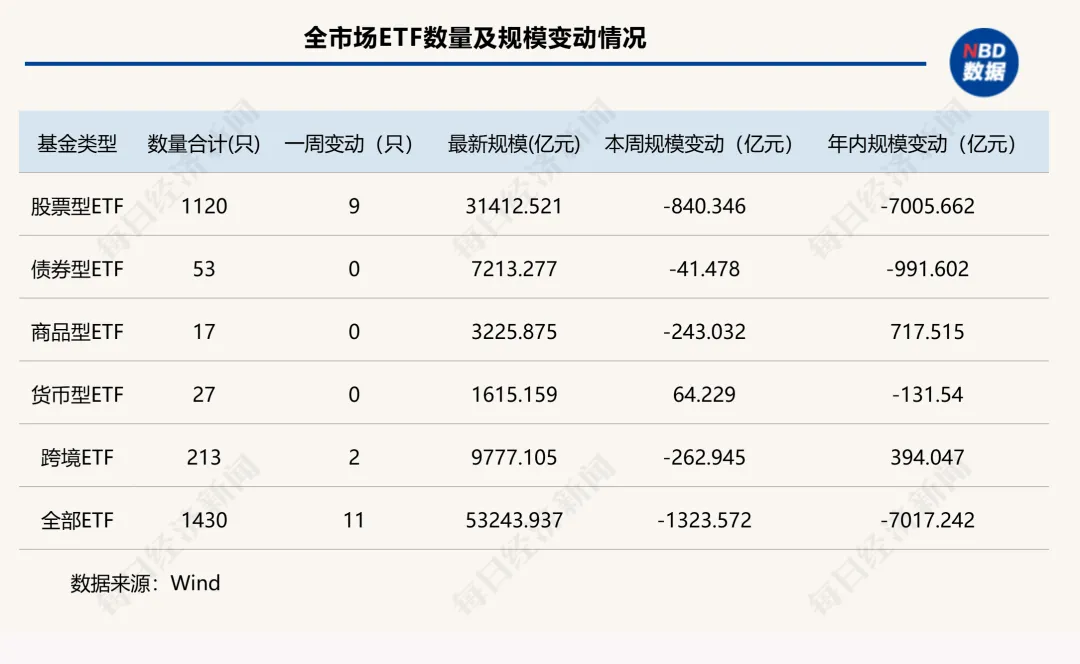
Market Overview - A-shares experienced fluctuations with major indices declining, including a 1.13% drop in the CSI 300 and a 3.28% drop in the ChiNext Index [1][16] - The ETF market is undergoing significant changes, with stock ETFs shrinking by over 700 billion yuan this year, reducing the number of "billion club" products to just three [1][16] ETF Market Dynamics - As of February 7, the total ETF market size decreased to 5.32 trillion yuan, with a weekly decline of 1,323 billion yuan [2][17] - Stock ETFs alone saw a reduction of 840.35 billion yuan, bringing their total size down to 31,412.52 billion yuan [3][18] - The number of ETFs listed reached 1,430, with 11 new ETFs introduced in the week, including 9 stock ETFs [2][17] Fund Management Changes - Fund size reshuffling is evident, with Guotai Fund maintaining its position in the top five, while Huabao Fund entered the top ten [1][22] - Major funds like Huaxia and E Fund have seen their ETF sizes shrink by over 100 billion yuan this year [1][22] Performance of Specific ETFs - The SGE Gold 9999 index saw a significant reduction of over 22 billion yuan, marking it as the largest decline among major indices [4][19] - The CSI 300 ETF managed by Huatai-PB has shrunk by over 2,000 billion yuan this year, now standing at 2,208.55 billion yuan [29][30] Institutional Fund Performance - Five institutions reported ETF size reductions exceeding 100 billion yuan, with Southern Fund experiencing the largest drop of 268.53 billion yuan [22][26] - Conversely, Huabao Fund and Hai Futong Fund both saw increases of over 30 billion yuan in their ETF sizes [23][26] Growth and Decline of ETFs - Only two products in the top 20 managed to achieve size growth, indicating a general trend of decline in the ETF market [26][27] - The "billion club" for ETFs has diminished, with only three members remaining due to widespread shrinkage [26][30]
ETF两市成交额4272.71亿元
Xin Lang Cai Jing· 2026-01-30 04:31
Group 1 - The total trading volume of ETFs in the two markets is reported at 427.27 billion yuan [1] - Among the types of ETFs, stock ETFs have a trading volume of 153.7 billion yuan, bond ETFs 167.07 billion yuan, money market ETFs 18.44 billion yuan, commodity ETFs 39.31 billion yuan, and QDII ETFs 32.31 billion yuan [1] - The highest trading volumes for non-money market ETFs are recorded for the A500 fund (563360) at 10.377 billion yuan, Huaxia CSI A500 ETF (512050) at 9.188 billion yuan, and Southern CSI 500 ETF (510500) at 8.785 billion yuan [1]