JOLTS数据

Search documents
美联储降息筹码再加重?JOLTS数据大爆冷,黄金又要飞了?
Sou Hu Cai Jing· 2026-02-06 06:09
Core Viewpoint - The market's perception of the U.S. economy is shifting as labor data, particularly the December JOLTS report, indicates a cooling labor market, prompting a reassessment of economic conditions and potential Federal Reserve policy changes [1][2]. Group 1: JOLTS Data Interpretation - The December JOLTS report revealed job vacancies dropped to 6.542 million, significantly below expectations and marking a five-year low [3]. - The previous month's data was notably revised down, suggesting a sustained decline in labor demand rather than a temporary fluctuation [5]. - By the end of 2024, job vacancies are projected to be around 7.5 million, reflecting a decrease of nearly 1 million positions from the previous year [5]. Group 2: Labor Market Dynamics - The decline in job vacancies indicates a cautious approach from businesses regarding expansion, aligning with a slower economic pace [6]. - Despite the drop in vacancies, other indicators such as hiring rates and voluntary resignations show a slight increase, suggesting that the labor market is stabilizing rather than collapsing [6]. - The current labor market is transitioning from an "overheated" state to a more balanced condition, rather than experiencing rapid deterioration [6][7]. Group 3: Impact on Federal Reserve Policy and Gold - The JOLTS data's significant shortfall suggests a reduction in wage pressures, which could influence the Federal Reserve's interest rate decisions [9]. - As the market anticipates a potential shift towards rate cuts, lower real interest rate expectations may support gold prices, making interest rate expectations a critical variable for gold investors [9]. - The JOLTS report's declining response rate raises concerns about its accuracy, and recent government disruptions have affected data release schedules, potentially amplifying market reactions [9]. Group 4: Long-term Investment Strategies for Gold - The ongoing decline in job vacancies indicates a reduction in economic "tension," suggesting that businesses are less eager to expand, which may slow economic momentum [12]. - While this does not guarantee immediate increases in gold prices, it enhances gold's hedging value in asset allocation, particularly as interest rate cycles may shift [13]. - Investors are encouraged to focus on understanding macroeconomic trends rather than making impulsive decisions based on single data points, as changes in macro logic often precede price movements [13].

JOLTS数据添鸽派信号沪金获撑960
Jin Tou Wang· 2025-12-10 06:01
Group 1 - The core viewpoint of the news indicates that the U.S. job market is experiencing a cooling trend, with job vacancies slightly increasing while hiring numbers are declining [3] - In October 2025, the number of job vacancies in the U.S. was 7.67 million, slightly above the 7.615 million from the same month last year and the 7.658 million in September [3] - The number of hires in October was 5.149 million, down from 5.367 million in September and 5.35 million in October of the previous year [3] Group 2 - The number of resignations in October was 2.941 million, which represents a decrease of 187,000 month-over-month and 276,000 year-over-year [3] - The most significant year-over-year declines in resignations were observed in the accommodation and food services sector, as well as in the healthcare and social assistance sector, with decreases of 136,000 and 114,000 respectively [3] - The number of layoffs and discharges increased to 1.854 million in October, marking an increase of 73,000 month-over-month and 66,000 year-over-year, the highest level since January 2023 [3] Group 3 - The recent trend in gold futures shows a slight upward movement, currently trading around 957.44 yuan per gram, with a 0.37% increase [1] - The gold futures have fluctuated between a high of 959.02 yuan per gram and a low of 952.22 yuan per gram, indicating a short-term bullish trend [1] - Technical analysis suggests that gold futures are in a consolidation phase, with key resistance at 972 yuan and support at 952 yuan, with a potential downward target of 945 yuan if the support is breached [4]
聚焦今夜美国GDP:整体增长预计反弹,但消费、就业难言乐观?
Hua Er Jie Jian Wen· 2025-07-30 10:41
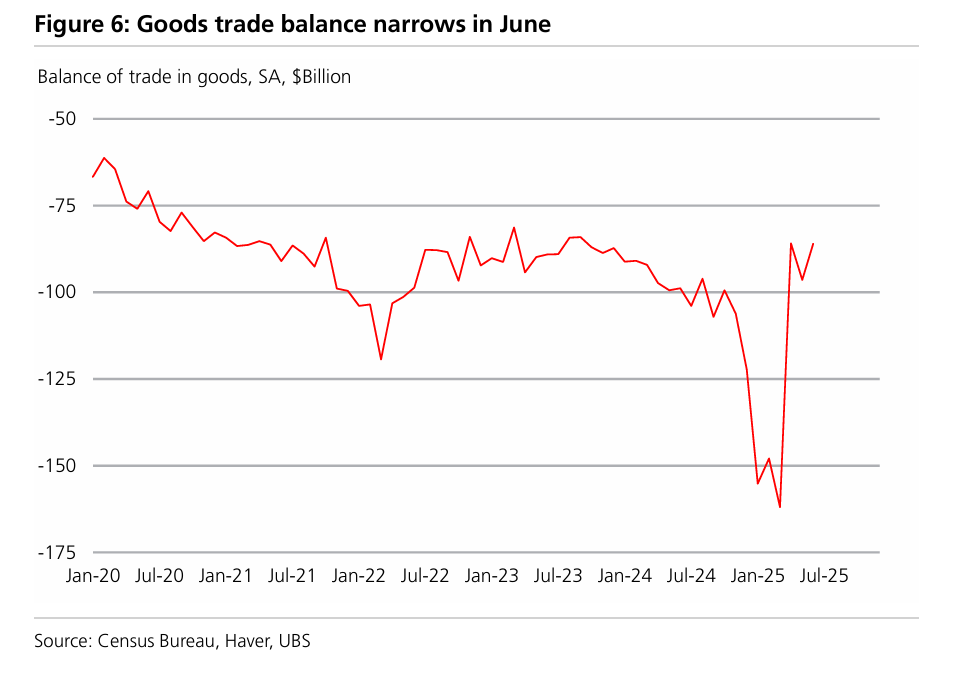
Core Viewpoint - The upcoming U.S. Q2 GDP data may show a strong rebound on paper, but it is likely misleading due to underlying weaknesses in consumer spending and business investment, indicating a slowdown in the economy's potential momentum [1][2]. Economic Growth and Trade - The anticipated Q2 GDP growth is projected at 2.4%, reversing the Q1 contraction of 0.5%, with UBS raising its forecast to 2.6% [1][2]. - This growth is primarily driven by a significant contribution from net exports, expected to add up to 4.1 percentage points to GDP growth, following a sharp decline in imports, which are projected to drop over 25% [2][5]. Domestic Demand and Consumer Spending - Domestic demand, which constitutes over two-thirds of the U.S. economy, is showing concerning signs, with consumer spending expected to only achieve a modest recovery in Q2 after stagnation in Q1 [7]. - Business investment in equipment is also anticipated to remain flat or potentially decline, reflecting weak consumer confidence, as indicated by a slight increase in the consumer confidence index to 97.2, still below the average of 104.5 for 2024 [7][8]. Labor Market and Federal Reserve Policy - The labor market's performance is crucial for the Federal Reserve's policy decisions, with expectations that the Fed will maintain its interest rate range of 4.25%-4.50% amid mixed economic signals [8]. - Job openings have decreased significantly, with June seeing a reduction of 275,000 positions, bringing the total to 7.44 million, and the hiring rate nearing the lowest point of the current expansion cycle [8][11]. Long-term Economic Challenges - The long-term outlook for the U.S. economy faces structural challenges, with the Congressional Budget Office estimating that recent fiscal policies will increase the national debt by $3.4 trillion over the next decade, while only providing a modest GDP boost of 0.5% [11].