
美国劳动力市场

Search documents
美国2月非农就业数据点评:弱非农对美联储影响较小,关注中东局势变化
KAIYUAN SECURITIES· 2026-03-07 07:35
Employment Data - In February, the U.S. non-farm employment decreased by 92,000, significantly below the market expectation of an increase of 55,000[3] - The unemployment rate rose to 4.4%, higher than market expectations[3] - The average hourly wage increased by 3.8% year-on-year, exceeding market expectations[3] Labor Market Insights - The labor force participation rate remained stable at approximately 62.0%[5] - The number of permanent jobless individuals increased, indicating a rise in long-term unemployment[5] - The private sector saw a loss of 86,000 jobs, with significant declines in education and healthcare services (34,000 jobs lost) and goods manufacturing (25,000 jobs lost)[4][17] Wage and Work Hours - Average hourly earnings were recorded at $37.32, with a month-on-month increase of 0.4%[6] - The average weekly working hours remained stable at 34.3 hours, reflecting a relatively low operational level for U.S. businesses[6][30] Federal Reserve Outlook - Current employment data is unlikely to significantly influence Federal Reserve decisions, as the labor market has not shown a substantial downturn[7][40] - The geopolitical situation in the Middle East poses risks to global oil prices, which could impact U.S. inflation and economic growth[8][40] - The Federal Reserve may consider 1-2 rate cuts in 2026, with the first cut potentially occurring in May 2026 after the new chair takes office[9][41]
美国需求有所降温——2025年四季度美国GDP数据点评【陈兴团队·华福宏观】
陈兴宏观研究· 2026-02-21 06:00
Economic Growth - The fourth quarter GDP annualized growth rate significantly dropped to 1.4%, well below the expected 2.8% and down from the previous 4.4% [2] - Year-on-year GDP growth rate (constant prices) decreased to 2.2%, down from 2.3%, indicating a return to a downward trend [2] - Key contributors to the decline included private consumption, net exports, and government spending, while investment showed a notable rebound [2] Investment and Consumption - Private domestic final purchases (PDFP) annualized growth rate fell to 2.66%, down from 2.73%, indicating a continued cooling of domestic demand, although at a slower pace [2] - Investment rebounded, countering the decline in consumption, with non-residential investment benefiting from a recovery in manufacturing and strong demand for AI investments [2][10] - Residential investment remained weak due to high interest rates suppressing home-buying intentions [10] Consumer Behavior - Consumer spending in the fourth quarter recorded an annualized growth rate of 2.4%, down 1.1 percentage points from the previous quarter [5] - The year-on-year growth rate for consumer spending fell to 2.2%, down from 2.6%, with goods consumption being the primary drag on overall spending [5] Labor Market - The unemployment rate in January fell to 4.3%, down from 4.4%, with labor force participation rising to 62.5% [16] - Non-farm payrolls added 130,000 jobs in January, exceeding market expectations, indicating a stabilization in the labor market [16] Real Estate Market - Existing home sales in January totaled 3.91 million units, down 4.4% year-on-year, indicating a continued low level in the housing market [13] - Mortgage rates remain high, limiting the stimulus to sales despite a recent decline in 30-year mortgage rates to 6.01% [13] Trade and Exports - In the fourth quarter, exports recorded an annualized growth rate of -0.9%, while imports narrowed to -1.3%, reflecting weak domestic demand [15] - The contribution of net exports to GDP growth fell to nearly zero, down from 1.62% in the previous quarter, due to synchronized declines in both exports and imports [15]


坚定降息派、特朗普亲信美联储理事米兰:美国劳动力市场的改善可以令今年少些降息。
Hua Er Jie Jian Wen· 2026-02-19 22:05
Core Viewpoint - The improvement in the U.S. labor market may lead to fewer interest rate cuts this year, according to Federal Reserve Governor Michelle Bowman, who is known for her dovish stance and ties to former President Trump [1]. Group 1 - The U.S. labor market is showing signs of improvement, which could influence the Federal Reserve's monetary policy decisions [1]. - Michelle Bowman, a Federal Reserve Governor, suggests that the current labor market conditions may reduce the need for aggressive interest rate cuts this year [1].
美元头寸达到14年多来最负面水平
Sou Hu Cai Jing· 2026-02-16 14:24
Core Viewpoint - The latest survey by Bank of America indicates that the sentiment towards the US dollar has reached its most negative level in over 14 years, with significant bearish positions being recorded [1] Group 1: Dollar Positioning - In February, the size of short positions on the dollar, which bets on its decline, reached the largest level since January 2012, marking a notable shift in investor sentiment [1] - Fund managers' exposure to the dollar has fallen below the lows seen in April of the previous year, indicating a lack of confidence in the currency [1] Group 2: Market Sentiment and Risks - Concerns regarding the independence of the Federal Reserve have diminished following President Trump's nomination of Kevin Warsh as Fed Chair, yet this has not translated into increased demand for the dollar or renewed optimism for US assets [1] - Respondents of the survey identified further signs of weakness in the US labor market as a primary risk contributing to the dollar's decline [1]
US jobless claims fall by less than expected to 227,000
Invezz· 2026-02-12 14:22
Core Insights - The number of Americans filing new claims for unemployment benefits has declined, indicating resilience in the US labor market despite signs of cooling hiring momentum and recent weather-related disruptions [1] Labor Market Data - Seasonally adjusted initial jobless claims fell by 5,000 to 227,000 in the week ending February 7, according to the Labor Department [1]

BlueberryMarkets:美国1月新增就业13万超预期,降息或延后
Sou Hu Cai Jing· 2026-02-12 08:03
Group 1 - The January non-farm payroll report from the U.S. Bureau of Labor Statistics indicates a significant increase in employment, with 130,000 new jobs added, marking the largest growth since the second half of 2025, while the unemployment rate slightly decreased by 0.1 percentage points to 4.3% [2] - Employment growth in January showed clear industry differentiation, with healthcare, social assistance, and construction leading the way, adding 82,000, 42,000, and 33,000 jobs respectively, while federal government and financial sectors saw job losses [2] - Average hourly earnings for private sector non-farm employees rose by $0.15 to $37.17, reflecting a year-on-year increase of 3.7%, indicating a moderate wage growth [2] Group 2 - Concerns about the sustainability of employment growth persist, as January's data collection was affected by multiple cold waves, potentially leading to data inaccuracies, and job growth remains concentrated in a few sectors, with manufacturing employment continuing to lag [3] - The employment data has a direct impact on Federal Reserve policy, with the Fed having paused interest rate cuts for three consecutive times, maintaining rates in the 3.50%-3.75% range, and the strong January non-farm data has significantly cooled market expectations for short-term rate cuts [3] - The labor market's resilience is better than expected, but issues such as structural imbalances and insufficient growth sustainability remain unresolved, suggesting that future Federal Reserve policy adjustments will depend on upcoming economic data to balance inflation and employment goals [3]

2026年1月美国就业数据点评:影响有限,静待变局
Tebon Securities· 2026-02-12 06:37
Labor Market Insights - In January 2026, the U.S. added 130,000 non-farm jobs, exceeding the market expectation of 70,000[2] - The unemployment rate decreased to 4.3%, lower than the expected 4.4%[2] - The labor force participation rate rose to 62.5%, surpassing expectations[2] - Hourly wage growth increased by 0.4% month-on-month and 3.7% year-on-year[2] - The total employment figure for 2025 was revised down by 862,000[2] Sectoral Employment Trends - Job growth in January was concentrated in healthcare (82,000 jobs), social assistance (42,000 jobs), and construction (33,000 jobs)[2] - The number of part-time workers decreased by 453,000, indicating a potential improvement in the labor market[2] - The number of individuals wanting to work but not in the labor force fell by 399,000[2] Market Reactions and Expectations - Following the non-farm data release, the market initially pushed back the June rate cut expectation to July, but later adjusted to favor a June cut probability of 47.1%[2][10] - U.S. Treasury yields rose post-data release, while gold prices experienced temporary fluctuations but remained stable[2] - The S&P 500 and Nasdaq indices showed a pattern of high-level fluctuations, indicating market uncertainty[2] Risk Factors - Potential escalation in U.S.-China tensions could lead to significant impacts on trade and financial markets[12] - Geopolitical crises, particularly in the Middle East, may heighten global risk aversion and market volatility[12] - A downturn in the U.S. economy could exert additional pressure on the global economic environment[12]
美国去年就业增长为2003年以来非衰退年最弱
Xin Lang Cai Jing· 2026-02-11 17:58
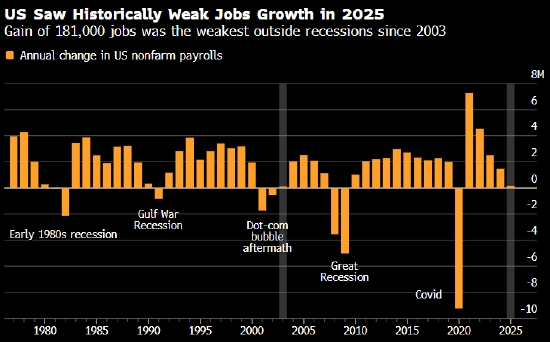
Group 1 - The U.S. labor market has experienced one of the worst hiring years in decades, with a revision showing only 181,000 new jobs added in 2025, marking the lowest annual increase in non-recession years since 2003 [1][3] - The revised data indicates an average monthly job addition of only 15,000, significantly lower than the previously reported 49,000 [1][3] - Economists were unexpectedly surprised by the labor market's rebound in January, with non-farm employment growth exceeding nearly all predictions and the unemployment rate declining unexpectedly [5]
美国劳动力市场趋稳 或为美联储按兵不动留空间
Sou Hu Cai Jing· 2026-02-11 14:02
Core Insights - The U.S. non-farm employment growth accelerated in January, adding 130,000 jobs, significantly exceeding expectations [1] - The unemployment rate decreased to 4.3%, indicating a stabilization in the labor market, which may allow the Federal Reserve to maintain interest rates for a period while monitoring inflation [1] Employment Growth Factors - The stronger-than-expected job growth was partly due to fewer seasonal holiday workers hired by retailers and delivery companies compared to previous years [1] - January is typically a month with high seasonal layoffs, but the lower seasonal hiring may have correspondingly reduced the scale of layoffs, thereby boosting employment growth [1] Labor Market Conditions - Despite the increase in non-farm employment, the labor market remains lukewarm, struggling even amid strong economic growth [1] - Concerns over employment and high inflation have diminished public satisfaction with the economic policies of the Trump administration [1]
美债收益率微幅走低 市场静候1月非农数据
Xin Lang Cai Jing· 2026-02-11 08:12
Group 1 - The core viewpoint of the article indicates that U.S. Treasury yields have slightly decreased ahead of the January employment data, which is expected to show moderate growth [1] - Analysts predict that 55,000 new jobs will be added in January, slightly above the previous value of 50,000 [1] - The focus for investors is also on the U.S. Treasury's issuance of $42 billion in 10-year bonds [1] Group 2 - According to Tradeweb data, the two-year Treasury yield has decreased by 0.4 basis points to 3.447%, while the 10-year yield has fallen by 0.8 basis points to 4.136% [1]