V型反弹

Search documents
V 型反弹惊魂一幕:亚太市场止跌背后的波动逻辑与风险启示
Sou Hu Cai Jing· 2026-02-06 07:22
Core Viewpoint - The recent market volatility, characterized by a rapid switch between panic and recovery, highlights the fragility of the current market environment, driven by high valuations, high leverage, and strong asset interconnectivity [2] Group 1: Causes of Volatility - The current market adjustment is not triggered by a single event but is a culmination of multiple risk factors, including weak U.S. employment data and the high valuations of technology stocks over the past six months, which have led to capital withdrawal [3] - The strong interconnectivity among core assets and high-leverage trading have amplified panic, with technology stocks acting as the "leading engine of decline," directly impacting related markets like cryptocurrencies, where the correlation coefficient between Bitcoin and tech stocks has remained above 0.8 [3] - Over $2.3 billion in long positions in the Bitcoin market were liquidated within 24 hours, exacerbated by rising margin requirements for silver, leading to a "liquidation-style sell-off" [3] Group 2: Stabilization Factors - The rapid recovery in the Asia-Pacific market is attributed to three main factors: the exhaustion of selling pressure in technology stocks, the triggering of technical buy orders at key support levels, and a marginal easing of regulatory policy expectations [4] - After the overnight sell-off, some technology giants saw their price-to-earnings ratios revert to near their one-year averages, attracting long-term capital for bargain hunting [4] - Bitcoin rebounded after breaking below the $60,000 mark, hitting a previous high transaction area, while gold also saw a rebound after dropping below the $4,700 support level [4] Group 3: Market Outlook - The market is likely to maintain a volatile pattern in the short term, as technology stock valuations still require time to adjust, and the high-leverage risks in cryptocurrencies and precious metals have not been fully released [7] - Long-term, the technological advancements in the tech industry and global demand for safe-haven assets will support the long-term value of core assets, but investors should remain cautious of "valuation corrections" and "policy adjustments" that may exert short-term pressure [7] - The recent V-shaped rebound serves as a typical manifestation of the rapid release of panic in capital markets, signaling the need for investors to adhere to principles of low leverage, diversification, and a focus on fundamentals in a high-volatility environment [7]


国泰海通|宏观:有待稳固的“V型”反弹——12月工业企业利润数据点评
国泰海通证券研究· 2026-01-27 14:03
Core Viewpoint - In 2025, the cumulative year-on-year profit growth rate of industrial enterprises above designated size was 0.6%, with a significant V-shaped rebound in December, showing a 5.3% year-on-year increase. This improvement is attributed to the synergy of volume and price, increased industrial production activity, narrowing decline in PPI, and a substantial recovery in profit margins, along with policy benefits, low base effects, and concentrated year-end order deliveries [1] Summary by Sections Profit Growth and Drivers - The December profit growth was driven by improved industrial production activity and a narrowing decline in PPI, leading to a significant recovery in profit margins [1] - The structural analysis indicates that the profit share of upstream and midstream industries has increased, showing strong recovery, while downstream industries experienced differentiation, with only a few sectors like automotive and food seeing profit contraction [1] Demand and Inventory Management - Companies have begun proactive inventory reduction, leading to an expanded revenue decline in December, indicating that the foundation of terminal demand remains unstable [1] - The future pace of profit recovery will depend on the warming of domestic demand and the continued transmission of policy effects [1]


12月工业企业利润数据点评:有待稳固的V型反弹
GUOTAI HAITONG SECURITIES· 2026-01-27 09:40
Profit Growth Overview - In 2025, the cumulative year-on-year profit growth rate for industrial enterprises was 0.6%, with December showing a significant increase of 5.3% compared to November's -13.1%[1] - The profit recovery is characterized as a "V-shaped" rebound, driven by improved production activity, narrowing PPI declines, and a substantial recovery in profit margins[1][4] Contributing Factors - The increase in profits is attributed to a combination of rising production volumes, improved pricing environments, and enhanced profit margins, with December's profit margin rising from 5.29% to 5.31%[5] - The industrial added value in December rose to 5.2%, up from 4.8% in November, indicating improved industrial production activity[5] Sector Performance - The profit share of upstream and midstream industries increased to 29.6% and 53.7%, respectively, while the downstream sector saw a slight decrease to 16.7%[6] - Upstream sectors like coal mining and non-ferrous metals showed strong profit recovery, while downstream sectors like automotive and food experienced profit contractions[6][14] Revenue Trends - Cumulative revenue growth for industrial enterprises in 2025 was 1.1%, with December showing a decline of 3.2%, indicating ongoing challenges in end-demand recovery[10] - The inventory growth rate for industrial finished products was 3.9%, signaling a shift from replenishment to destocking as companies respond to weak demand[10] Future Outlook - The sustainability of profit recovery is contingent on the strengthening of domestic demand and the continued effectiveness of policy measures[15] - Risks include external uncertainties and the potential for domestic demand recovery to fall short of expectations[16]
Margins are improving despite tariffs, says Fundstrat's Tom Lee
Youtube· 2025-10-31 20:27
Market Sentiment - The current market sentiment is characterized as the "most hated rally," with a significant portion of high net worth retail investors showing negative returns of -11.7% year-to-date [2][3] - Historical context indicates that similar negative sentiment has only occurred three times in the past 35 years, correlating with bear markets in 1990 and 2022 [3] Fund Manager Performance - Approximately 80% of fund managers are trailing their respective benchmarks this year, marking the worst performance in nearly 25 years [4] - This underperformance may lead to a year-end chase as fund managers realize the implications of not being engaged in the market [4] Earnings and Profit Margins - Companies are experiencing improved profit margins despite tariff challenges, attributed to the utilization of AI technologies [5][6] - The fading tariff headwinds combined with the benefits from AI are expected to continue driving margin growth [6] Federal Reserve Outlook - Fed fund futures still project a potential rate cut in December, despite recent statements from Fed Chair Powell suggesting a less certain outlook [7][9] - Inflation is reportedly declining, with 54% of CPI components showing outright deflation, indicating a potential for further rate cuts [8] Economic Conditions - The ongoing government shutdown is contributing to economic slowdowns, including impacts on air traffic, which may further weaken inflation [11] - The labor market is also showing signs of weakness, supporting the argument for potential rate cuts in the near future [11]
V型反弹-20250829
申银万国期货研究· 2025-08-29 00:31
Market Overview - The three major A-share indices experienced a "V-shaped" rebound, with the Shanghai Composite Index rising by 1.14% to 3843.6 points, the Shenzhen Component Index increasing by 2.25%, and the ChiNext Index climbing by 3.82%. The STAR 50 surged by 7.23%. The total market turnover was 3 trillion yuan, down from 3.2 trillion yuan the previous day [1] - In the first half of 2025, mergers and acquisitions (M&A) in the A-share market continued to heat up, becoming a "strong engine" for listed companies to drive performance growth and a core path for optimizing strategic layout and achieving industrial upgrades. There were 1113 domestic M&A transactions this year, with a total transaction amount of 509.214 billion yuan, representing a 62.75% increase compared to the same period last year. The most popular sectors for completed M&A transactions were traditional industries, intelligent manufacturing, and energy and electricity [1] Financial Market Insights - The U.S. stock indices rose, with significant gains in the communication and electronics sectors, while the coal sector declined. The market turnover was 3 trillion yuan. As of August 26, the financing balance increased by 20.194 billion yuan to 22,123.54 billion yuan. It is anticipated that domestic liquidity will remain loose, and more incremental policies may be introduced in the second half of the year to boost the real economy. The probability of a rate cut by the Federal Reserve in September has increased, enhancing the attractiveness of RMB assets. The market is currently in a "policy bottom + liquidity bottom + valuation bottom" resonance period, with a high probability of continued market performance, although sector rotation and structural differentiation need to be adapted to [2][8] Commodity Market Analysis - Soybean meal showed weak fluctuations in the night session, while rapeseed meal saw a slight increase. The optimistic outlook for U.S. soybean production has strengthened market expectations for high yields in the new season. Ongoing trade talks between China and the U.S. have boosted confidence in U.S. soybean exports. In the domestic market, the announcement of the auction of 164,000 tons of imported soybeans by the China Grain Reserves Corporation has strengthened expectations for improved domestic raw material supply, leading to a bearish outlook for soybean meal in the short term [3][24] - Precious metals, particularly gold and silver, continued to strengthen. Concerns arose from Trump's attempts to challenge the independence of the Federal Reserve. The dovish stance indicated by Powell at the Jackson Hole meeting has increased expectations for a rate cut in September, benefiting precious metals. However, rising inflation data and geopolitical risks have limited the upward potential for gold. The long-term drivers for gold remain supportive, with the overall trend for gold and silver expected to be strong as the rate cut approaches [3][16] Industry News - The National Bureau of Statistics announced plans to accelerate the construction of data industry clusters and introduce several industrial policies this year, predicting that the added value of the digital economy will reach approximately 49 trillion yuan by the end of the year, accounting for about 35% of GDP [6] - The Ministry of Finance reported that in July, the issuance of new local government bonds reached 703.2 billion yuan, including 86.3 billion yuan in general bonds and 616.9 billion yuan in special bonds [5]

Fundstrat 投资人Tom Lee谈稳定币、ETH和特斯拉:基本面当作投资依据的群体正在缩小
Sou Hu Cai Jing· 2025-07-09 04:28
Group 1 - Thomas Lee discusses the differences between the "new generation" of retail and institutional investors, highlighting the impact of social media and demographic changes on retail investor behavior [2][4][5] - Lee emphasizes the cyclical nature of retail investor interest in stocks, noting that every 20 years, retail investors tend to regain confidence in the stock market [5][4] - The rise of stablecoins is seen as a significant trend, with companies like Circle being highlighted as successful IPOs, indicating a shift towards "tokenizing" equity in the crypto space [3][22] Group 2 - Fundstrat was founded to provide institutional-level research that is accessible to all, with a focus on the changing dynamics of retail investor engagement [4][5] - Lee believes that the current market transformation is largely due to social media platforms like X (formerly Twitter), which have empowered retail investors [17][6] - The discussion includes the potential for Ethereum to benefit from the growth of stablecoins, with Lee predicting a resurgence in interest for Ethereum as a programmable currency [22][23] Group 3 - Lee argues that retail investors are more focused on specific stocks and their personal experiences with companies, contrasting with institutional investors who often take a more macroeconomic view [14][15] - The conversation touches on the importance of understanding the unique characteristics of companies like Tesla and Palantir, which have strong brand loyalty and customer engagement [18][30] - The potential for a V-shaped market recovery is discussed, with Lee asserting that retail investors are driving this rebound despite institutional skepticism [13][15] Group 4 - The interview highlights the innovative strategies of companies like MicroStrategy and Bitmine, which are leveraging their positions in the crypto market to create value [24][22] - Lee outlines the advantages of treasury companies in the crypto space, emphasizing their ability to manage volatility and create unique investment opportunities [26][24] - The discussion concludes with insights on the evolving role of companies like Robinhood, which are reshaping the brokerage landscape for younger investors [31][30]

43.44万亿元!前4月规模以上工企营收创历史同期最高纪录,实现利润总额累计同比增速创8个月以来新高
Sou Hu Cai Jing· 2025-05-27 11:25
Core Insights - The profit of China's industrial enterprises above designated size reached 21,170.2 billion yuan in the first four months of this year, marking a year-on-year increase of 1.4%, the highest cumulative growth rate in nearly eight months [1][16][21] - In April alone, the profit of these enterprises grew by 3.0% year-on-year, indicating a significant recovery trend [1][16] - The total operating revenue for these enterprises in the first four months was 43.44 trillion yuan, setting a historical record for the same period [1][4] Economic Environment - The V-shaped rebound in profit growth suggests a fundamental change in the operating environment for industrial enterprises, driven by a series of policies aimed at boosting domestic demand and improving external conditions [1][18] - The U.S. Federal Reserve's new round of interest rate cuts since September has also contributed to increased demand from European and American consumers, positively impacting China's exports [1][18] Industry Performance - Among 41 major industrial categories, 23 reported year-on-year profit growth, with a growth rate of nearly 60% [17] - The agricultural and food processing industry saw a profit increase of 45.6%, while the non-ferrous metal smelting and rolling industry grew by 24.5% [17] - The equipment manufacturing sector, particularly high-tech manufacturing, demonstrated robust profit growth, with 7 out of 8 sub-sectors achieving double-digit growth [18][20] Company Performance - State-owned enterprises reported negative growth in both revenue and profit, while foreign-invested and private enterprises showed positive performance, with private enterprises' profit increasing by 14.1% [19] - The operating profit margin for enterprises increased to 4.87%, reflecting seasonal fluctuations and a higher growth rate compared to the previous year [19] Future Outlook - The combination of improved external demand and domestic policy support is expected to sustain the growth of industrial profits, with ongoing initiatives likely to enhance internal demand [20][21] - The resilience of China's manufacturing sector is anticipated to lead to a new cycle of prosperity, with expectations for continued profit growth in the future [21]

V型反弹来袭!Tom Lee看好这10只被错杀的大盘股
Jin Rong Jie· 2025-05-19 05:48
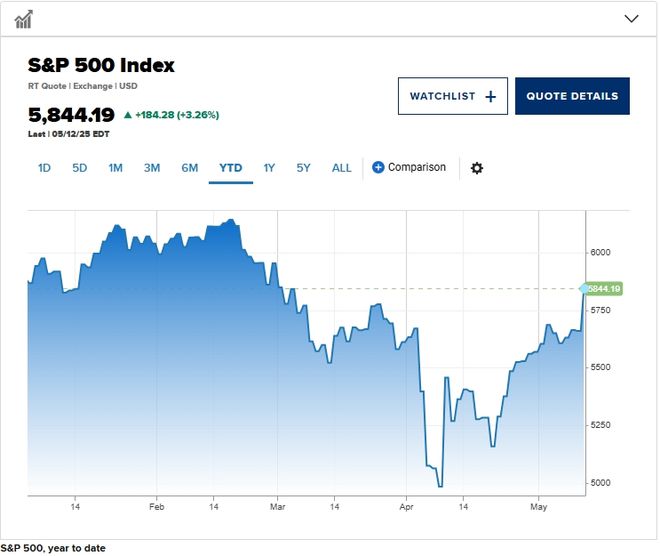
Group 1 - The U.S. stock market is experiencing a "V-shaped" rebound following a significant sell-off triggered by President Trump's announcement of increased tariffs [1][3] - The S&P 500 index briefly entered bear market territory, but has since risen over 2% since April 2, when the tariff plans were first announced [1] - Historical data shows that out of 18 waterfall declines since 1950, 17 have led to a V-shaped recovery, indicating a strong likelihood of continued market improvement [3] Group 2 - Fundstrat's Tom Lee has compiled a list of large-cap stocks that investors should focus on during the rebound, particularly those that have already declined significantly prior to the tariff announcement [4] - Stocks selected must have a market capitalization exceeding $15 billion and have dropped over 30% between mid-February and early April [4] - Lululemon (LULU) is highlighted as a stock that meets all criteria, having fallen over 21% year-to-date but rebounding more than 7% in the recent rally [4] Group 3 - Super Micro Computer (SMCI) is another stock on the list, which has seen nearly a 10% increase year-to-date, with a more than 4% rise in the recent market surge [5] - Analysts maintain a "neutral" rating on SMCI, but the average target price suggests over 20% upside potential [5]