
VIX波动率指数

Search documents
看跌保护需求创四年新高,高盛交易员:专业投资者正在为"某种突破"做准备
Hua Er Jie Jian Wen· 2026-02-23 11:26
Core Insights - Professional investors are aggressively buying downside protection despite the S&P 500 trading in one of its narrowest ranges historically, indicating a potential directional breakout in the market [1][3][4] Group 1: Market Behavior - The S&P 500 has experienced a closing range of only 3.7% over the past two months, significantly below the 20-year median of 8.6%, marking one of the narrowest two-month ranges in history [3][4] - Individual stocks are exhibiting extreme volatility, with the average realized volatility of single stocks surpassing the index volatility by approximately 25 percentage points [3][4] - Institutional investors are showing a defensive posture, reducing risk in anticipation of the index reflecting signals from individual stocks [3][4] Group 2: Institutional Investor Actions - Long-term asset management institutions have net sold $4 billion this week and $10 billion this month, marking one of the largest monthly sell-off tendencies in four years [4][5] - Technology, media, and telecommunications sectors accounted for 70% of net sales, with significant selling in software and internet stocks while buying semiconductor and memory chip stocks [4][5] - The overall trading activity has increased, primarily driven by short selling, with seven out of eleven sectors experiencing net sales [4][5] Group 3: Options Market Dynamics - The S&P 500 one-month options skew is at its steepest level in four years, indicating expensive downside puts and cheap upside calls [5][6] - There is a notable decline in demand for S&P 500 call options, reflecting a shift towards defensive positioning among professional investors [5][6] - The futures market is also showing signs of fatigue, with previously popular cyclical positions being liquidated [6][7] Group 4: Technical Indicators - The gamma dynamics are critical as the market approaches key technical levels, with a potential shift to negative gamma that could exacerbate downward pressure during minimal sell-offs [7][8] - The upcoming earnings report from Nvidia is anticipated to be a catalyst for a directional breakout in the market [8]

历史性撕裂!VIX指数“失灵”,恐慌情绪转向大宗商品与汇率战场
Zhi Tong Cai Jing· 2026-02-02 03:20
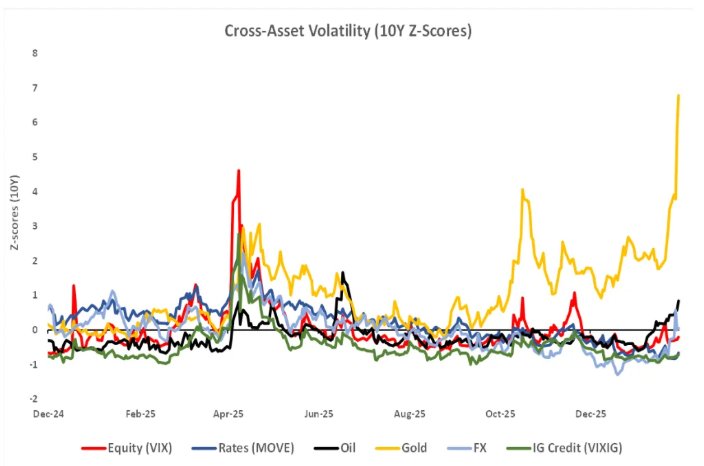
Market Volatility - The stock market has experienced lower volatility compared to other markets, while precious metals, currencies, and commodities have seen increased volatility [1] - Gold prices surged to a historical high but faced the largest drop since the 1980s, influenced by speculation of U.S. intervention in currency rates and geopolitical concerns [1][3] - The Chicago Board Options Exchange Volatility Index (VIX) remains below the average level of the past year, indicating subdued stock market volatility [1] Gold Market Dynamics - Gold prices have risen significantly due to U.S. President Trump's policies, with a record monthly increase despite a recent 9% drop [3] - The demand for call options on gold has surged, with the SPDR Gold Trust (GLD) accumulating over $20 billion in the past eight months [3] - The implied volatility of GLD reached historical highs relative to the S&P 500 index, indicating a shift in perception of precious metals as safe-haven assets [6] Currency and Interest Rate Impact - The relationship between gold prices and the USD/JPY exchange rate has become a popular trading strategy, with institutional investors betting on rising gold prices alongside interest rate changes [7] - The appointment of Kevin Warsh as Federal Reserve Chair has led to a more stable bond market response, with investors less inclined to bet on long-term interest rate fluctuations [10] Stock Market Correlation - Individual stock volatility remains high, as evidenced by Microsoft's 10% drop following disappointing earnings, while overall stock market volatility remains low [3] - The correlation between gold and stocks has slightly increased due to inflows into both asset classes, contrasting with historical trends where their correlation hovered around zero [6]

VIX空头创纪录!对冲基金豪赌平静,但极端仓位往往不祥
Jin Shi Shu Ju· 2025-08-27 01:41
Group 1 - Hedge funds are betting on the continued calmness of the market by shorting the VIX volatility index at the highest level since September 2022, with a net short position of approximately 92,786 contracts as of August 19 [2] - The significant shorting of VIX may indicate either confidence or complacency in the market, as noted by Chris Murphy, who warns that excessive positioning could lead to unexpected volatility spikes [2] - Historical patterns suggest that extreme positions in low volatility often precede market turmoil, as seen in February when the S&P 500 peaked amid rising trade conflict concerns [2] Group 2 - The CFTC data does not account for positions in exchange-traded products or those using hedging strategies, yet the VIX remains below 15, with a recent drop to its lowest point of the year following expectations of a rate cut by the Federal Reserve [3] - Many strategists recommend using S&P 500 put options and newly popularized resettable puts for short-term market fluctuations, while buying VIX call options is notably absent from common hedging strategies [3] - The implied volatility of VIX call options has risen relative to S&P 500 put options, suggesting that standard S&P 500 puts may be a more reliable hedging method in the current market environment [3]