泡沫风险

Search documents
VIX指数失灵 恐慌转向大宗商品与汇率战场:黄金创80年代来最大单日跌幅、1999年来最大月度涨幅
Sou Hu Cai Jing· 2026-02-02 04:28
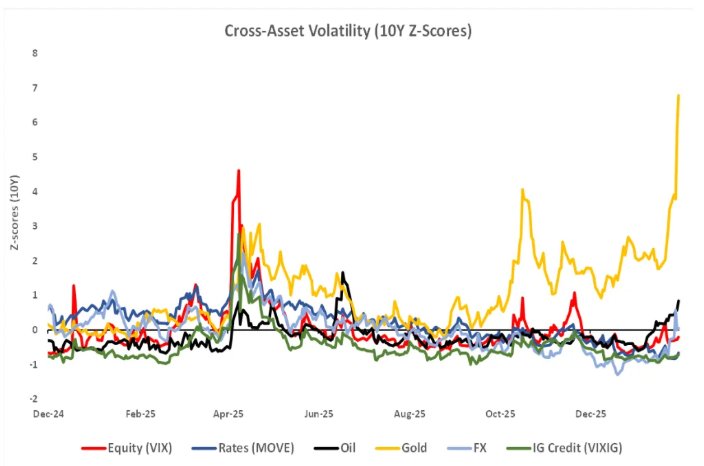
Group 1 - The global asset classes have shown significant divergence this year, with stock market volatility remaining low while volatility in precious metals, foreign exchange, and commodities has increased [1] - The Chicago Board Options Exchange Volatility Index (VIX) has not adequately reflected current macro-level risk signals, indicating a shift in market fear from equities to commodities and currencies [1] - Gold prices reached a historical high earlier this year but experienced the largest single-day drop since the 1980s last week, while the dollar's exchange rate saw its largest single-day decline since April [1] Group 2 - Despite concerns over an artificial intelligence stock bubble, core volatility has concentrated in non-equity areas, with gold and oil prices showing significant fluctuations [1][2] - The volatility in individual stocks has decreased overall market correlation, leading to a lower overall volatility index, as investors focus on earnings and the sustainability of AI trading [2] - The demand for gold ETFs has surged, with a growth of over $20 billion in the past eight months, although the safe-haven attribute of precious metals has weakened due to significant price fluctuations [2]
历史性撕裂!VIX指数“失灵”,恐慌情绪转向大宗商品与汇率战场
Zhi Tong Cai Jing· 2026-02-02 03:20
Market Volatility - The stock market has experienced lower volatility compared to other markets, while precious metals, currencies, and commodities have seen increased volatility [1] - Gold prices surged to a historical high but faced the largest drop since the 1980s, influenced by speculation of U.S. intervention in currency rates and geopolitical concerns [1][3] - The Chicago Board Options Exchange Volatility Index (VIX) remains below the average level of the past year, indicating subdued stock market volatility [1] Gold Market Dynamics - Gold prices have risen significantly due to U.S. President Trump's policies, with a record monthly increase despite a recent 9% drop [3] - The demand for call options on gold has surged, with the SPDR Gold Trust (GLD) accumulating over $20 billion in the past eight months [3] - The implied volatility of GLD reached historical highs relative to the S&P 500 index, indicating a shift in perception of precious metals as safe-haven assets [6] Currency and Interest Rate Impact - The relationship between gold prices and the USD/JPY exchange rate has become a popular trading strategy, with institutional investors betting on rising gold prices alongside interest rate changes [7] - The appointment of Kevin Warsh as Federal Reserve Chair has led to a more stable bond market response, with investors less inclined to bet on long-term interest rate fluctuations [10] Stock Market Correlation - Individual stock volatility remains high, as evidenced by Microsoft's 10% drop following disappointing earnings, while overall stock market volatility remains low [3] - The correlation between gold and stocks has slightly increased due to inflows into both asset classes, contrasting with historical trends where their correlation hovered around zero [6]

警惕!白银刷新46年暴跌纪录,振幅超12%,是抄底机会还是末日预警?年底理财别当接盘侠?
Sou Hu Cai Jing· 2025-12-30 13:16
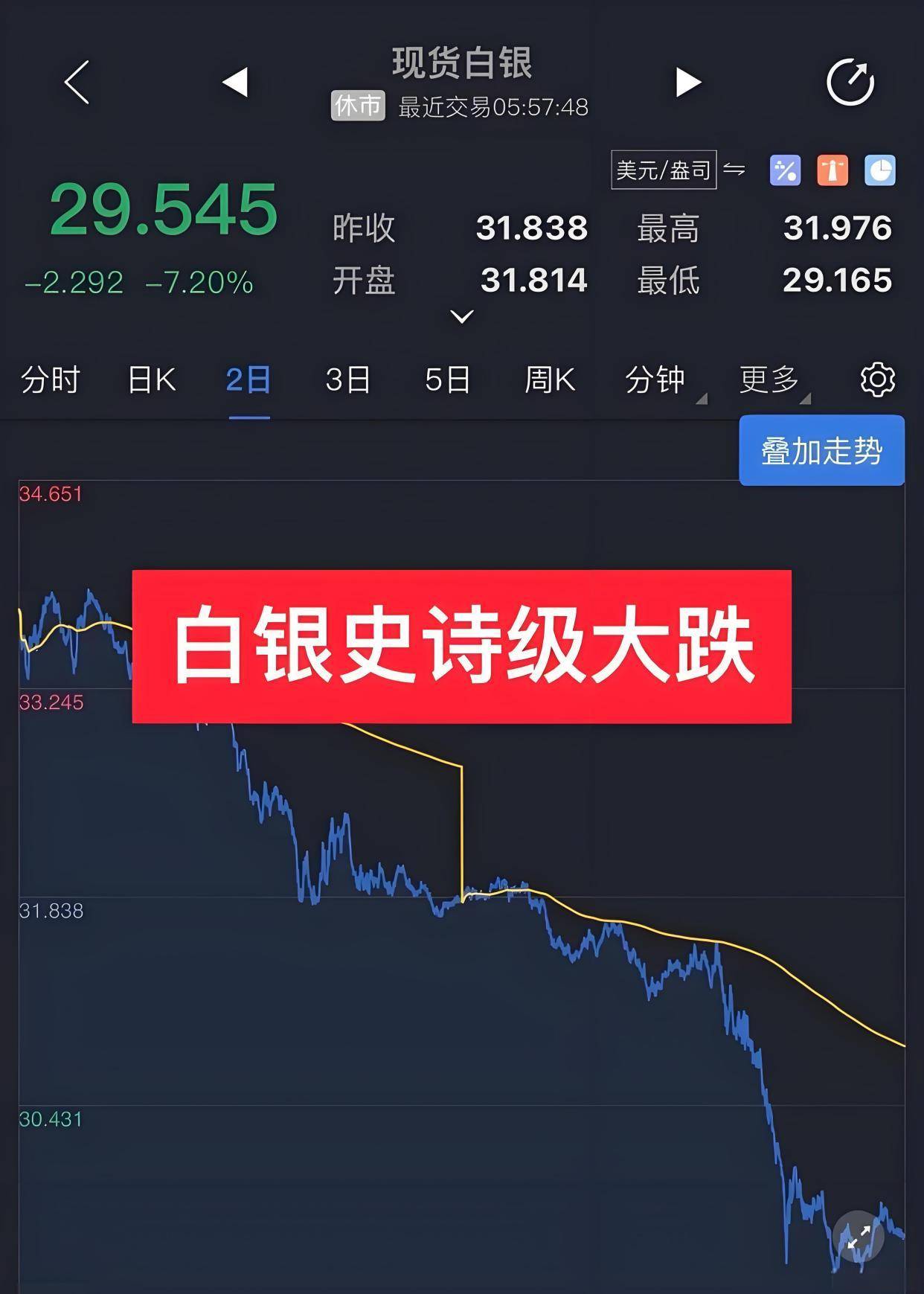
Group 1 - The core event was a dramatic fluctuation in silver prices on December 29, 2025, where silver initially surged nearly 6% to a historical high of $83.971 per ounce, only to plummet nearly 10% later in the day, marking the largest annual reversal since 1979 [1][3][7] - The volatility in silver prices triggered a "domino effect," causing significant declines in other precious metals, with gold dropping below $4500 per ounce and platinum and palladium experiencing declines of 14% and 16% respectively [7][8] - The market sentiment shifted rapidly from extreme optimism to panic, with many investors who had previously reported profits now rushing to cut losses [7][22] Group 2 - The sharp decline in silver prices was attributed to four main factors: increased margin requirements by exchanges, year-end tax considerations, technical overbought conditions, and forced selling by passive funds [10][16][18] - The Chicago Mercantile Exchange and the Shanghai Futures Exchange both raised margin requirements, increasing the financial pressure on leveraged investors, which exacerbated the sell-off [10][22] - Investors faced a "time bomb" regarding tax implications, as selling before December 31 would incur higher short-term capital gains taxes, leading to potential concentrated selling in January [16][22] Group 3 - There is a debate in the market regarding the long-term outlook for silver, with optimists believing that the recent drop is a temporary reset, supported by strong industrial demand, particularly in the solar and electric vehicle sectors [20][22] - Conversely, pessimists warn of a "generational bubble" in silver prices, citing historical precedents where similar market conditions led to significant downturns [20][22] - The supply-demand dynamics remain complex, with a persistent supply deficit and potential technological advancements in the solar industry that could reduce silver demand in the future [20][22]
繁荣_萧条已成为常态:美国银行剖析新泡沫时代_ZeroHedge
2025-12-17 02:09
Summary of Key Points from the Conference Call Industry Overview - The analysis focuses on the **artificial intelligence (AI)** sector and its implications for the broader **technology industry** in the context of potential asset bubbles and market volatility [1][2][3][9]. Core Insights and Arguments - **Bubble Formation**: The current environment is characterized by signs of an emerging bubble, similar to historical tech booms, driven by rapid advancements in AI and government support [2][3][9]. - **Market Dynamics**: The U.S. stock market is experiencing a lag compared to global markets, with concerns about low valuations and the "American exceptionalism" narrative reaching its peak [3][18]. - **Volatility Indicators**: The U.S. technology sector shows signs of bubble risk, with volatility increasing as prices rise, a typical characteristic of asset bubbles [11][12][18]. - **Government Influence**: Unlike previous tech bubbles, the current situation is exacerbated by government policies that support AI development, which is seen as crucial for geopolitical competitiveness [9][25]. - **Investment Risks**: The potential for a significant downturn exists if AI fails to meet high expectations, with the timing of any bubble peak being particularly uncertain [30][43]. Additional Important Content - **Historical Context**: The report draws parallels with past bubbles, such as the 1920s and 1990s, highlighting that major technological leaps often lead to prolonged asset bubbles [6][8][18]. - **Market Sentiment**: There is a prevailing fear of missing out (FOMO) among investors, which is driving speculative behavior and contributing to market instability [3][26]. - **Valuation Comparisons**: Current valuations of U.S. tech companies, while elevated, remain below the peaks seen during the late 1990s internet bubble, suggesting potential for further price increases [18][21]. - **Sector-Specific Trends**: Certain sectors, such as nuclear energy and quantum computing, are exhibiting bubble-like instability, indicating that not all areas of the market are equally affected [14][26]. - **Future Projections**: The AI sector is expected to see substantial growth, with predictions of annual spending reaching $3-4 trillion by 2030, but this growth is contingent on achieving significant technological breakthroughs [29][30]. Conclusion - The analysis concludes that the AI sector is likely to experience further bubble-like conditions, with large tech companies thriving amidst these dynamics. However, the timing of any potential market corrections remains highly uncertain, necessitating close monitoring of market signals [38][43].
“央行中的央行”警告:黄金与股市走势趋同 可能是泡沫信号
Di Yi Cai Jing· 2025-12-09 00:28
Core Viewpoint - The International Bank for Settlements (BIS) reports that the simultaneous surge in gold and stock prices this year is unprecedented in at least half a century, indicating potential bubble risks in both asset classes [1][2]. Group 1: Gold Market Dynamics - Gold has shown speculative characteristics, with a nearly 60% increase this year, potentially marking the largest annual gain since 1979, raising discussions about its traditional role as a safe-haven asset [2][3]. - The cumulative increase in gold prices since 2022 has exceeded 150%, influenced by factors such as rising inflation post-COVID-19 and geopolitical tensions from the Russia-Ukraine conflict [3]. - The BIS highlights that the price of gold exchange-traded funds (ETFs) has consistently remained above their net asset value (NAV), indicating strong buying pressure and obstacles to arbitrage [3]. Group 2: Central Bank and Investor Behavior - Central banks' significant gold purchases have established a solid foundation for gold prices, attracting retail investors who are also participating in the upward trend [4]. - Factors driving metal price increases this year are similar to those in the late 1970s, including geopolitical concerns and a weakening dollar [4]. - Investors are seeking diversification in precious metals like gold and silver, particularly those worried about the declining purchasing power of currencies [4]. Group 3: Broader Market Concerns - The BIS warns of increasing vulnerability in risk appetite environments, stemming from concerns over AI sector valuations and recent significant drops in cryptocurrencies like Bitcoin [5][6]. - Central banks, including the European Central Bank and the Bank of England, have issued warnings about the risks of an AI bubble, fearing a potential market collapse if optimistic investor expectations are not met [6]. - The current political climate may lead to a series of chain reactions affecting commodity prices, with rising operational costs contributing to a fragmented global economy [5].
“央行中的央行”警告:黄金与股市走势趋同,可能是泡沫信号
Di Yi Cai Jing· 2025-12-09 00:23
Group 1 - The International Bank for Settlements (BIS) reports that for the first time in 50 years, gold and stock prices have surged simultaneously, indicating potential bubble risks in both asset classes [1][4] - Gold has seen a nearly 60% increase this year, potentially marking its largest annual gain since 1979, raising discussions about its traditional role as a safe-haven asset [2][4] - BIS's economic advisor, Hyun Song Shin, notes that gold is increasingly behaving like a speculative asset, with retail investors significantly entering the gold market [2][4] Group 2 - The BIS highlights that the simultaneous rise of gold and the S&P 500 index could pose challenges for investors seeking safe havens if both markets were to crash [2][4] - The report indicates that retail investors are heavily investing in gold, as evidenced by gold exchange-traded funds (ETFs) trading above their net asset values (NAV), suggesting strong buying pressure [4] - Factors driving the rise in gold prices include geopolitical concerns, a weakening dollar, and significant purchases by central banks, reminiscent of the 1970s [4][5] Group 3 - The BIS warns of increasing vulnerability in equity markets, particularly due to concerns over AI sector valuations and recent significant drops in cryptocurrencies like Bitcoin [5][6] - The current political environment and rising operational costs are contributing to a fragmented global economy, which may further elevate commodity prices [5] - The performance of AI companies, which are heavily investing in data centers, is a key factor for market stability, with upcoming earnings reports potentially impacting investor sentiment [6]

“央行中的央行”警告:黄金与股市走势趋同,可能是泡沫信号
第一财经· 2025-12-09 00:08
Core Viewpoint - The International Bank for Settlements (BIS) reports a simultaneous surge in gold and stock prices, a phenomenon not seen in over fifty years, indicating potential bubbles in both asset classes [3]. Group 1: Gold Market Analysis - Gold has experienced a nearly 60% increase this year, potentially marking its largest annual gain since 1979, raising discussions about a shift in its traditional role as a safe-haven asset [5]. - BIS's economic advisor, Hyun Song Shin, notes that gold is increasingly behaving like a speculative asset, with retail investors significantly entering the gold market [6]. - The cumulative increase in gold prices since 2022 exceeds 150%, driven by inflation, geopolitical tensions, and central banks' substantial gold purchases [6]. - The price of gold exchange-traded funds (ETFs) has consistently remained above their net asset value (NAV), indicating strong buying pressure and potential barriers to arbitrage [6]. - Factors driving the rise in metal prices this year are similar to those in the late 1970s, including geopolitical concerns and a weakening dollar [7]. Group 2: Stock Market Vulnerabilities - BIS warns of increasing vulnerabilities in risk appetite, particularly concerning the valuation of AI stocks and recent significant drops in cryptocurrencies like Bitcoin [9]. - Concerns have been raised by the European Central Bank and the Bank of England regarding the risks of an AI bubble, fearing a market collapse if optimistic investor expectations are not met [9]. - The interconnected financing chains in the AI sector have been criticized for potentially creating a "false prosperity," where companies inflate revenues through mutual contracts, risking a collapse if any part of the chain fails [10]. - The current profitability of AI companies contrasts with the dot-com bubble era, where many firms were unprofitable, but the sustainability of their large investments remains uncertain [10]. - Oracle's upcoming earnings report is viewed as a critical event that could influence market sentiment towards the AI sector, with potential implications for overall stock market confidence [10][11].

2000亿英镑大调仓!AI泡沫风险逼退英国养老金
Jin Shi Shu Ju· 2025-12-04 08:12
Core Viewpoint - UK pension funds are reducing their exposure to the US stock market due to concerns over market concentration in a few tech stocks and potential bubble risks in the AI sector [1][4]. Group 1: Market Trends and Adjustments - Several UK pension plans managing over £200 billion in assets have shifted their asset allocation towards other regions or increased protective measures against potential stock price declines [1]. - The Nasdaq Composite Index, driven by major tech stocks like Nvidia, Alphabet, and Meta, has surged over 20% this year, raising concerns about market dominance by a few stocks and the risk of significant sell-offs for retirement savers [1][4]. - The concentration of US tech stocks, coupled with their historically high valuations, is prompting increased scrutiny regarding the risks posed to fund members [2][4]. Group 2: Specific Fund Strategies - The Standard Life investment plan is reducing its US stock allocation while increasing exposure to UK and Asian markets, reflecting sensitivity to potential market volatility [2]. - The Aon Master Trust sold approximately 10% (around £700 million) of its global stock portfolio this summer, primarily from US stocks, to capitalize on opportunities in the UK bond market [2]. - Fidelity is maintaining its US stock exposure but is focusing on more stable companies and increasing gold holdings for risk hedging, particularly for members nearing retirement [3]. Group 3: Institutional Warnings and Market Sentiment - The European Central Bank and the IMF have warned that high valuations of US tech stocks could pose significant risks if market optimism around AI fades [4]. - Despite concerns, some pension fund managers are hesitant to reduce their allocations to strong-performing US tech stocks due to fears of missing out on further gains [5]. - The Border to Coast fund has slightly increased its US stock exposure while reducing some AI-related positions, indicating a cautious approach to the evolving competitive landscape in the AI sector [6].




英国养老基金因担忧人工智能泡沫抛售美股
Xin Lang Cai Jing· 2025-12-02 10:16
Core Viewpoint - UK pension funds are reducing their exposure to US stocks due to concerns over market concentration in a few technology stocks and potential bubble risks in the artificial intelligence (AI) sector [2][9]. Group 1: Market Adjustments - Several pension funds managing over £200 billion in assets have begun reallocating their investments, either shifting funds to other regional markets or taking measures to hedge against potential stock price declines [2][9]. - The Nasdaq Composite Index, primarily driven by technology stocks, has risen over 20% this year and has more than doubled since the beginning of 2023, largely due to the performance of the "Magnificent Seven" tech giants [2][9]. Group 2: Specific Fund Strategies - Phoenix Group's Standard Life is gradually reducing its US stock allocation and increasing exposure to UK and Asian markets, managing £36 billion in assets [3][10]. - Aon Master Trust, managing £12 billion, sold about 10% of its global equity portfolio, primarily US stocks, to capitalize on opportunities in the UK bond market while also addressing AI bubble concerns [4][11]. - Fidelity's FutureWise fund, managing £23.9 billion, has not reduced US stock exposure but is shifting holdings to more stable companies and increasing gold allocations for risk hedging [5][12]. Group 3: Risk Awareness and Market Sentiment - The Bank of England and the International Monetary Fund have warned about the high valuations of tech stocks, emphasizing that a decline in optimism regarding AI could pose significant risks to investment portfolios [6][13]. - Despite concerns, some fund managers remain reluctant to reduce holdings in major tech stocks due to their strong performance and fears of missing out on future gains [6][13]. Group 4: Investment Trends - The "Nest" workplace pension plan, managing £58 billion, is not selling existing US stock holdings but is directing new contributions towards private markets, gradually reducing reliance on large tech stocks [5][12]. - The "Border to Coast" local government pension fund has slightly increased its overall US stock exposure while reducing investments in certain AI-related stocks, focusing on companies that may benefit from changes in the competitive landscape [7][14].


Nvidia stock trades in the red on Friday: here's why NVDA may bounce back strongly
Invezz· 2025-11-28 15:38
Core Viewpoint - Nvidia stock (NASDAQ: NVDA) experienced a decline, raising concerns about inflated valuations and potential "bubble" risks, while some bullish investors perceive the selloff as mere market noise [1] Group 1 - The stock price of Nvidia has tumbled into negative territory, indicating a significant market reaction [1] - The decline has sparked renewed discussions regarding the sustainability of Nvidia's current valuation levels [1] - Despite the downturn, bullish investors maintain a positive outlook, viewing the selloff as a temporary fluctuation rather than a fundamental issue [1]