基金代销

Search documents
京东也被白银LOF摆了一道
Xin Lang Cai Jing· 2026-02-11 07:12
2 日晚间,白银 LOF 在调整了估值方法后, 2 日盘中在京东金融平台上申请了"极速赎回"的用户收到 一条来自京东金融的提示:"赎回确认金额小于实时到账金额,需补款 XXX 元,请保持小金库余额充 足,或进行汇款补款。" 此后,在 2 月 3 日下午 14 点左右,许多在京东金融上购买了白银 LOF 的投资者又收到了一条短信提 示: 为保障您的资金安全、避免后续产生追款流程,白银 LOF 极速赎回的到账比例已经从前一天净值 的 80%下调为 60%。 炒股就看金麒麟分析师研报,权威,专业,及时,全面,助您挖掘潜力主题机会! 白银LOF在 2 月 2 日通过调整估值方法录得 31.5% 的跌幅后,京东金融以一种独特的自身卷入了这场漩 涡当中。 由于京东事先为部分"极速赎回"的客户按 1 月 30 日晚的净值垫付了 80% 的赎回金额,白银LOF的夜间 巨震使得京东制造了 2026 年中国基金圈非常魔幻的一幕:基民卖掉基金的钱还没捂热,就收到了一 条"补款提醒": 对于只在银行、券商、直销等传统代销平台购买基金的"老登基民"而言,京东金融的这一波操作很容易 看得一头雾水。 但把事情的前因后果拆开来放大看,京东金 ...


蚂蚁、京东、同花顺,下架这些功能
Zhong Guo Zheng Quan Bao· 2026-02-03 14:47
Group 1 - The core issue revolves around a fund company's violation of sales regulations, leading to major distribution channels like Ant Wealth and Tonghuashun removing real-time valuation and related short-term ranking features [1][3] - Regulatory authorities have mandated that fund sales institutions and third-party platforms conduct self-inspections and remove misleading features that could confuse investors, such as "real-time valuation" and "ranking lists" [3][4] - Many institutions have already begun to comply with these regulations by suspending features that could mislead investors, including real-time valuation and various ranking lists [4][5] Group 2 - The industry is undergoing a self-check process regarding the qualifications of influencers (referred to as "DVs") collaborating with fund companies, ensuring they possess the necessary qualifications for fund sales [2][5] - Despite regulatory actions, some platforms continue to display modified versions of real-time valuation, using alternative methods to indicate fund performance, which could still mislead investors [6][7] - The regulatory push aims to discourage short-term trading behaviors and promote the fundamental purpose of mutual funds as long-term investment tools, thereby stabilizing the market [6][7]

基金代销格局重塑进行时:“鲶鱼”入局 “差生”离场
Shang Hai Zheng Quan Bao· 2026-01-18 18:32
Group 1 - The fund distribution industry is experiencing a transformation with new entrants adopting a "buy-side advisory" approach, which is reshaping the market dynamics [1][2] - New institutions like E Fund Wealth Management are being added as distribution partners for multiple funds, indicating a shift in strategy among fund companies [2] - The entry of new players is seen as a potential catalyst for accelerating industry evolution, despite the prevailing challenges faced by traditional players [2][3] Group 2 - The industry is witnessing a rapid reshuffle, with many traditional firms exiting the market due to increasing competition and regulatory pressures [3] - The recent fee reforms initiated in July 2023 are driving a systematic adjustment in the fund distribution sector, emphasizing the need for a more sophisticated approach beyond the traditional sales model [3][4] - The transition towards a buy-side advisory model is being supported by policy changes and market demands, which are expected to enhance the growth potential of the public fund industry [4]
万得基金荣获上海金融创新成果奖
Wind万得· 2026-01-12 22:39
Core Viewpoint - The article highlights the recognition of Wind Fund for its innovative financial technology solutions, particularly its "one-stop fund research and trading management intelligent service platform," which won the "Shanghai Financial Innovation Achievement Award" [1][3]. Group 1: Award and Recognition - The "Shanghai Financial Innovation Achievement Award" is the first provincial-level government award focused on financial innovation in China, aimed at recognizing contributions to financial innovation and the development of Shanghai as an international financial center [1]. - Wind Fund is the only fund distribution agency to receive this award, reflecting its commitment to financial technology and innovation [3]. Group 2: Technological Innovations - Wind Fund's platform integrates "intelligent research, rapid trading, and beneficial management," enhancing the efficiency of asset management institutions and promoting the digital transformation of investment research and asset management [3]. - The newly upgraded "i Xiao Wan Intelligent Wealth Manager" utilizes financial data and AI capabilities to provide services such as portfolio tracking, market analysis, and asset allocation assistance, creating an interactive and executable intelligent experience [4]. Group 3: Future Outlook - Wind Fund aims to continue reshaping investment research with AI, driving trading through digital intelligence, and deepening management transformation with large models, transitioning the industry from a "labor-intensive" to a "technology-driven" model [5]. Group 4: Client Base and Services - Wind Fund ranks among the top independent sales institutions, with over 500 institutional clients, including banks, insurance companies, public funds, and large enterprises, providing comprehensive fund research, trading, and management services [6]. - The platform offers efficient and convenient one-stop solutions for various financial institutions, enhancing their investment research and trading capabilities [6]. Group 5: Past Achievements - The intelligent investment research system employs AI to analyze global macroeconomic trends, industry dynamics, and fund market developments, assisting institutions in making informed investment decisions [8]. - The asset allocation service generates tailored fund combinations and optimization strategies based on client profiles and market conditions, improving efficiency and stability [8]. - The rapid trading feature streamlines the entire process from account opening to trading, significantly reducing operational costs and enhancing execution efficiency [8]. - The deep management capabilities include profit and loss analysis and performance attribution, enabling institutions to identify risks and opportunities in real-time [8].

陆基金总经理陈祎彬 :让专业服务成为价值创造的核心引擎
Zhong Zheng Wang· 2026-01-12 13:39
Core Viewpoint - The new public fund fee regulation, effective from 2026, signifies a shift towards high-quality development in the asset management industry, focusing on customer value rather than sales [1][2] Group 1: Regulatory Changes and Industry Impact - The China Securities Regulatory Commission has revised the sales fee management regulations for publicly offered securities investment funds, marking a systematic overhaul of the fee structure in the fund industry [2] - The fee reduction is seen as a starting point for enhancing buyer services, emphasizing the importance of customer value over traditional revenue models [2][3] Group 2: Company Strategy and Service Enhancement - The company aims to deepen customer engagement through improved service quality and long-term trust, countering the impact of fee reductions on revenue [2][3] - The introduction of professional advisory services is viewed as the future direction for the fund distribution industry, necessitating a shift from traditional sales methods to a more integrated approach combining research and service [2][3] Group 3: Technology and Customer Experience - The company has integrated customer experience metrics into its performance evaluation, focusing on investment satisfaction rather than sales targets [3] - Over 90% of the company's investment clients have achieved positive returns in the past two years, with an average return of over 13% for non-monetary public fund clients in 2025 [3] - The use of technology, particularly through a "goal-based allocation method," has been pivotal in guiding investors towards long-term objectives, serving nearly 700,000 users with an average reinvestment rate exceeding 60% [3][4] Group 4: Future Directions and Goals - The company has set clear development goals for the 14th Five-Year Plan, focusing on completing the transformation to buyer services and enhancing brand value in the industry [5][6] - Three core areas of focus include strengthening advisory capabilities, enhancing technological support through automation and AI, and integrating resources for comprehensive wealth and lifestyle solutions [6] - The upcoming fee reform is anticipated to prioritize investor interests, presenting both a clear direction and greater responsibility for the company [6]
蚂蚁、天天基金、京东等巨头,出手了!
中国基金报· 2026-01-11 13:07
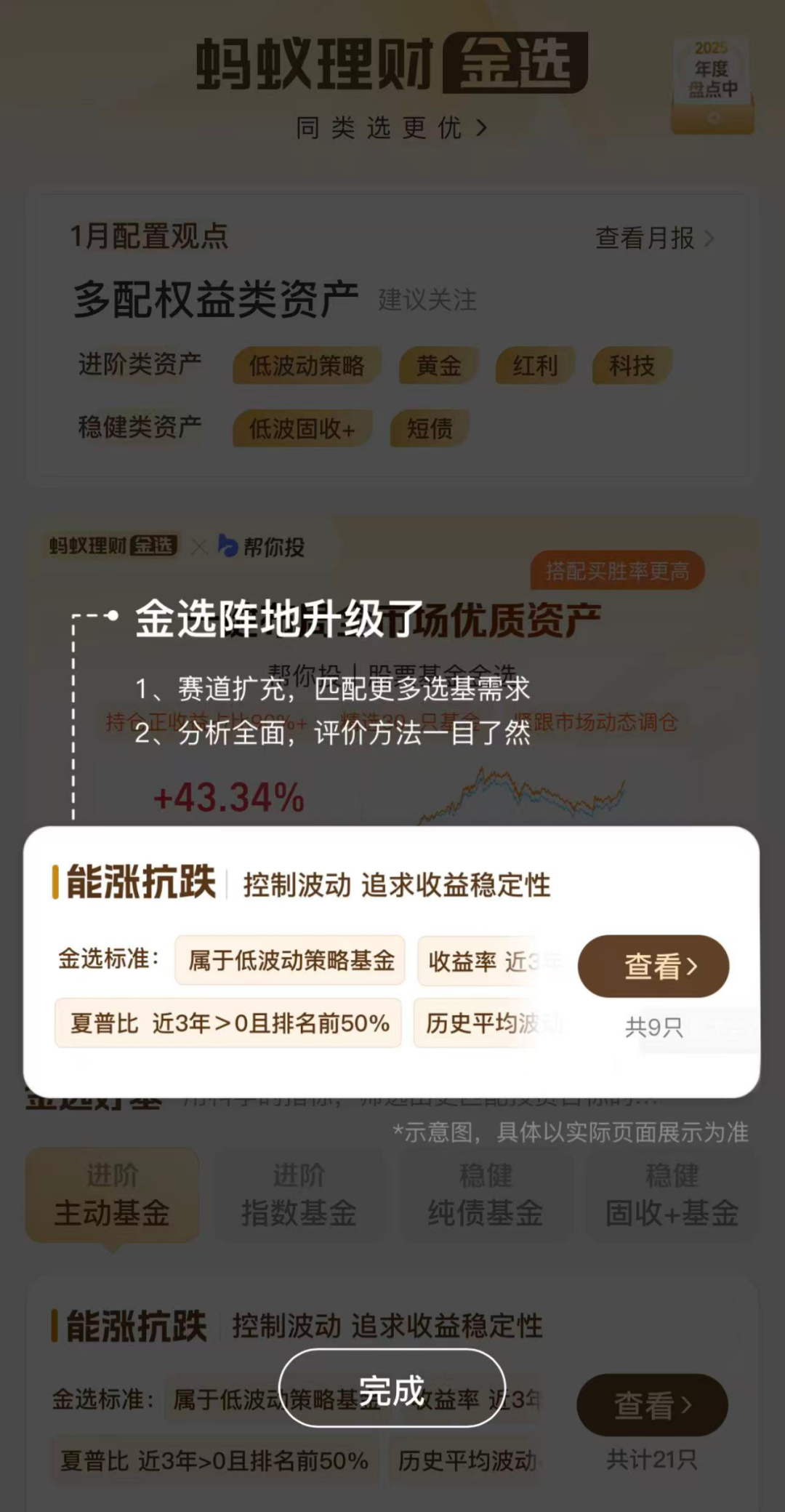
Core Viewpoint - The article highlights the transformation of major fund distribution platforms in China, focusing on enhancing investor experience and long-term satisfaction rather than merely competing for scale [2][4]. Group 1: Ant Fund's Strategy Changes - Ant Fund has introduced a new "can rise and resist fall" category for actively managed funds, emphasizing volatility indicators such as historical average volatility and maximum drawdown [4]. - The platform has revamped its fund labeling system, categorizing funds based on investment style and holdings, such as "balanced," "growth," "technology," and "low volatility" [7]. - Ant Fund aims to improve transparency and investor experience by addressing common issues like "not knowing what to buy" and "not knowing what was bought" through its labeling system [7][8]. Group 2: Tian Tian Fund's Data Integration - Tian Tian Fund has incorporated performance benchmarks, investor returns, fund performance, and fund company co-investment data to enhance transparency and assist users in making informed investment decisions [10]. - The platform emphasizes long-term investment value by comparing investor returns over different holding periods, thereby promoting a more scientific investment selection process [10][12]. - Tian Tian Fund has launched a "superior excess zone" to identify high-potential products for sustainable excess returns, focusing on user profitability and experience [12]. Group 3: JD Wealth's AI Collaboration - JD Wealth is exploring the TAMP (Total Asset Management Platform) model, leveraging "finance + AI" to reshape the wealth management ecosystem, with significant growth in client numbers and asset retention [14]. - The platform aims to enhance its core capabilities through user insights and behavior analysis, asset selection, and dynamic asset allocation [14]. - JD Wealth has reported impressive growth figures, including an 82% increase in equity retention and a 241% increase in personal pension retention by 2025 [14]. Group 4: Industry Transformation and Investor Experience - The industry is shifting from a "seller-driven" to a "buyer-advisory" model, focusing on responsible sales and long-term returns rather than just scale [16][17]. - Future efforts will include enhancing service models, adjusting performance evaluation metrics to prioritize user retention and profitability, and innovating business practices to align with client interests [17][18]. - The transformation aims to create a virtuous cycle of investor benefits, institutional growth, and market prosperity, ultimately fostering sustainable development in the capital market [18].

蚂蚁、天天基金、京东等巨头,出手了!
Zhong Guo Ji Jin Bao· 2026-01-11 12:54
Group 1: Industry Trends - Leading fund distribution platforms are shifting focus from scale competition to enhancing investor experience and long-term satisfaction [1][11] - Major platforms like Ant Group, Tiantian Fund, and JD.com are actively restructuring product labels and selection systems to better align with user perspectives [1][2][10] - The introduction of performance benchmarks and multi-dimensional data aims to increase transparency in investment decisions [6][9] Group 2: Ant Group's Strategy - Ant Group's fund selection has introduced a new "can rise and resist fall" category, emphasizing volatility metrics such as historical average volatility and maximum drawdown [2][5] - The platform has enhanced its fund labeling system to categorize funds based on investment style and holdings, improving investor understanding and experience [5][12] - Ant Group's "Jin Xuan" has upgraded its methodology to provide objective and transparent fund analysis, encouraging diversified asset allocation [5][12] Group 3: Tiantian Fund's Innovations - Tiantian Fund has incorporated performance benchmarks and investor returns data to present a clearer picture of fund performance and operational characteristics [6][9] - The platform has launched a "superior zone" to identify funds with sustainable excess return potential through rigorous quantitative and qualitative analysis [9][12] - Tiantian Fund aims to enhance long-term investor experience by providing comprehensive decision-making references [9] Group 4: JD.com's AI Integration - JD.com is exploring a TAMP (Total Asset Management Platform) model, leveraging AI to reshape the wealth management ecosystem [10] - The platform reported significant growth in various asset categories, including an 82% increase in equity holdings and a 241% increase in personal pension holdings [10] - JD.com plans to enhance its core capabilities through user insights and behavior analysis, aiming for a more personalized service approach [10] Group 5: Overall Industry Transformation - The industry is transitioning from a sales-driven model to a client-centric advisory approach, focusing on long-term returns rather than short-term sales [11][12] - There is a push for a more responsible sales model that prioritizes investor needs and experiences, fostering a sustainable development cycle for the market [13] - The transformation emphasizes the importance of aligning sales practices with genuine investor demands to improve overall investment experiences [13]
“最后一公里”的变革: 基金代销巨头转向长期主义
Zhong Guo Zheng Quan Bao· 2026-01-08 22:12
Core Insights - The public fund industry in China is experiencing a significant transformation, driven by regulatory changes aimed at reducing fees and promoting long-term investment strategies [1][4][6] - Internet distribution channels are becoming crucial in connecting investors with public fund products, emphasizing the need for transparency and improved investor experience [1][2] Group 1: Regulatory Changes - The implementation of the "Regulations on the Management of Sales Fees for Publicly Raised Securities Investment Funds" aims to lower subscription and service fees, guiding the industry back to long-term investment principles [1][4] - New regulations restrict the commission structure, encouraging institutions to focus on retaining clients through enhanced service rather than frequent trading [4] Group 2: Changes in Sales Practices - Fund sales platforms are shifting their focus from short-term performance metrics to long-term indicators, such as three-year performance and risk-adjusted returns, to better inform investor decisions [2][3] - Platforms like Ant Fund and Tiantian Fund are introducing new data dimensions to enhance transparency and assist investors in making informed choices [2][3] Group 3: Emphasis on Risk Management - The sales process is increasingly incorporating risk adaptation, with platforms showcasing historical volatility to align products with investors' risk tolerance [3] - The introduction of features that highlight real investor performance aims to connect product value directly with investor satisfaction [3] Group 4: Future Trends - The industry is expected to see a shift towards equity fund sales, aligning with policy directions to support long-term capital market funding [5] - A transformation from sales-driven to service-driven models is anticipated, reducing reliance on low-risk volume sales strategies [5][6] Group 5: Long-term Investment Focus - The sales ecosystem is evolving to prioritize long-term performance over short-term gains, with a focus on investor experience and satisfaction [6] - Data indicates that users of Ant Fund's "Gold Selection" equity funds have a higher probability of achieving positive returns compared to non-"Gold Selection" users, highlighting the benefits of long-term holding [6]
从“卖产品”到“创价值” 基金代销机构考核转向
Zheng Quan Ri Bao· 2025-12-09 15:53
Core Viewpoint - The ongoing termination of partnerships between fund managers and distribution agencies reflects a shift in the public fund industry towards a value-oriented assessment of partners, driven by rising compliance costs, fee reform impacts, and intensified competition among leading firms [1][4]. Group 1: Termination of Partnerships - As of December 9, 34 fund managers have announced the termination of partnerships with 16 distribution agencies, including independent sales institutions, banks, and futures companies [1]. - Notable terminations include Zhongyou Chuangye Fund's cessation of collaboration with Beijing Weidongli Fund Sales Co., and the complete withdrawal of Fangzheng Zhongqi Futures from fund sales, effective November 28 [2]. - The terminations predominantly involve small independent sales agencies and cross-industry participants like futures companies, which struggle to sustain resource investment in fund sales [2]. Group 2: Market Dynamics - The fund distribution industry has developed a pronounced head effect, with large distribution agencies dominating market share, client resources, and brand influence, making it difficult for smaller agencies to compete [3]. - The reform of public fund fee structures has led to a decline in management fees, custody fees, and distribution commissions, directly impacting the profitability of distribution agencies, particularly smaller ones [3]. Group 3: Compliance and Internal Control - The survival of small distribution agencies is increasingly challenged by pressures related to compliance, resources, profitability, and the need for business model transformation [4]. - Regulatory bodies have intensified compliance requirements for fund distribution, while many small agencies remain reliant on traditional sales models and lack technological investment and innovative service capabilities [4]. Group 4: Shift in Evaluation Criteria - Fund companies are shifting their evaluation criteria for distribution partners from a focus on scale to a more comprehensive and long-term assessment, considering compliance, client scale, market influence, and sales performance [4]. - This transition is part of a broader regulatory push to guide the industry from a "seller-driven" model to a "buyer advisory" model, emphasizing the creation of long-term value for clients [5]. Group 5: Strategic Adaptation - Distribution agencies are encouraged to explore differentiated services or transition into technology service providers as viable strategies to navigate the industry reshuffle [6]. - The choice of strategy should align with the agency's available resources and business strengths to effectively stand out in a competitive landscape [6].
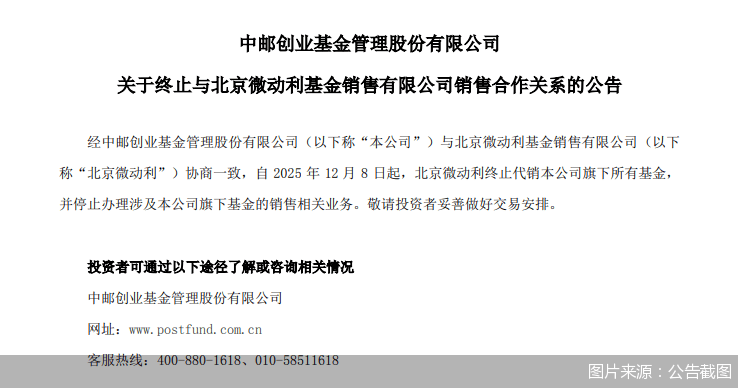
相继解约!多家代销机构遭基金公司终止合作
Sou Hu Cai Jing· 2025-12-08 11:33
Core Viewpoint - Several public funds are terminating their sales cooperation with certain distribution agencies, indicating a trend of public funds reassessing their partnerships in the distribution market [1][4][5]. Group 1: Termination of Cooperation - On December 8, Zhongyou Chuangye Fund announced the termination of its sales cooperation with Beijing Weidongli Fund Sales Co., Ltd, effective immediately [4]. - In the past month, over ten public funds, including Bosera Fund, Guotai Fund, and others, have also ended their sales cooperation with Beijing Weidongli [4]. - The reasons for these terminations may include the proactive withdrawal of distribution agencies from the public fund sales market or poor performance leading to the end of cooperation [1][4][6]. Group 2: Regulatory and Compliance Issues - Beijing Weidongli faced regulatory actions in 2022 due to violations in information disclosure and other areas, resulting in a three-month suspension of related business by the Beijing Securities Regulatory Bureau [4]. - The current trend of terminating partnerships is partly driven by compliance considerations, as public funds prioritize working with distribution agencies that meet regulatory requirements [6]. Group 3: Market Dynamics and Strategic Adjustments - The competitive environment in the fund distribution market is intensifying, leading some agencies to voluntarily exit the business due to cost considerations or insufficient competitiveness [6]. - Public funds are increasingly focusing on enhancing their channel integration capabilities and are likely to prefer partnerships with leading distribution agencies [6].