助贷

Search documents
助贷行业“24%+权益”模式面临生死考验
经济观察报· 2025-07-23 10:54
Core Viewpoint - The "24%+ equity" model in the lending industry is facing significant challenges as regulatory scrutiny increases, potentially leading to stricter regulations on equity services and fees [1][27]. Group 1: Overview of the "24%+ Equity" Model - The "24%+ equity" model allows borrowers to obtain consumer loans at an annual interest rate of 24% while also purchasing equity services from lending platforms or licensed consumer finance institutions [3][13]. - This model has become popular as lending institutions seek to increase non-interest income through equity services amid difficulties in earning interest spread [1][27]. Group 2: Regulatory Concerns and Industry Response - Recent regulatory notifications have prompted concerns among lending platforms and licensed consumer finance institutions about the sustainability of the "24%+ equity" model [5][6]. - The introduction of the "New Lending Regulations" in April has restricted platforms from charging interest fees in any form, raising fears that equity service fees may be viewed as disguised interest rate increases [7][11]. - Many lending institutions are preparing to exit the "24%+ equity" model, focusing instead on high-quality customer segments with interest rates below 24% [8][28]. Group 3: Financial Implications and Market Dynamics - The "24%+ equity" model has allowed some lending platforms to generate substantial revenue, with some platforms collecting hundreds of thousands of yuan in equity fees monthly [17]. - However, the model has also led to issues such as bundled sales and forced purchases, which have raised consumer complaints and could lead to increased regulatory scrutiny [19][20]. - The potential for regulatory changes has caused many lending institutions to reconsider their business strategies, with some halting plans to expand the "24%+ equity" model [25][26]. Group 4: Future Outlook - The future of the "24%+ equity" model remains uncertain, with industry players awaiting regulatory decisions that could significantly impact their operations [28]. - If the model is deemed unsustainable, lending platforms may need to adjust their focus to maintain profitability, potentially leading to a reduction in overall business scale [28][29].


监管摸底助贷权益类产品:拆解“服务费”障眼法
Bei Jing Shang Bao· 2025-07-20 03:06
Core Viewpoint - The regulatory scrutiny on consumer finance companies and lending platforms regarding membership rights products is intensifying, focusing on potential violations such as bundled sales, false advertising, and hidden fees, particularly in the context of the "24% + rights" model that has emerged as a workaround to the 24% interest rate cap [1][4][5]. Regulatory Investigation - Regulatory bodies are conducting thorough investigations into the membership rights products offered by consumer finance companies and their partner lending platforms, aiming to understand the business models, fee structures, and any potential consumer harm [4][5][6]. - The investigation includes inquiries about hidden fees, binding conditions related to loan applications, and whether membership fees are being charged in a manner that violates existing regulations [4][7]. Market Impact - The anticipated regulatory changes are expected to significantly impact small to medium-sized lending platforms that rely on the "24% + rights" model, potentially accelerating market consolidation [2][11]. - The demand for "24%+" clientele remains uncertain, as institutions must adapt their business strategies in response to regulatory pressures [2][11]. Consumer Experience - Consumers have reported being charged additional membership fees alongside their loan repayments, leading to effective interest rates exceeding the legal limit of 24% [12][14]. - Complaints regarding undisclosed membership fees and the lack of clarity about the services provided have been prevalent, indicating potential violations of consumer rights [12][16]. Industry Trends - The "24% + rights" model has become widely adopted among lending platforms as a means to maintain profitability in light of regulatory constraints on interest rates [10][11]. - Many platforms are transitioning away from the previously common "dual guarantee" model, which often resulted in hidden fees, towards more compliant structures [10][11][18]. Compliance Challenges - The industry is facing significant challenges in achieving compliance with the new regulations, particularly for smaller platforms that may struggle to operate within the 24% interest rate cap [18][19]. - There is a call for clearer regulatory guidelines regarding the boundaries of membership fees and their integration into overall loan costs, as well as a potential transitional period for compliance [18][19].

监管风暴来袭!这地取消7家助贷机构资质
Bei Jing Shang Bao· 2025-07-16 12:02
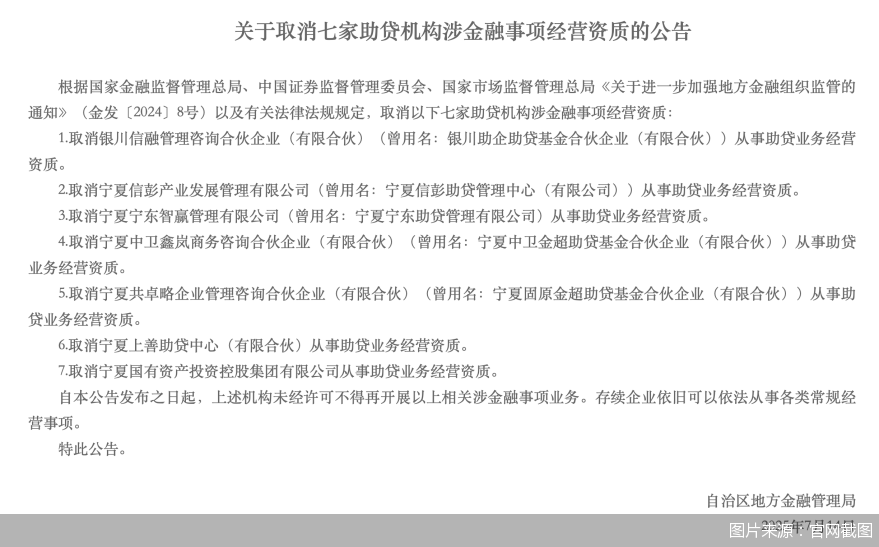
Core Viewpoint - The regulatory actions in Ningxia reflect a tightening oversight of the lending assistance industry, aiming to eliminate irregularities and promote sustainable development within the sector [1][3][5] Group 1: Regulatory Actions - Ningxia Financial Bureau announced the cancellation of operating qualifications for 7 lending assistance institutions, including Yin Chuan Xin Rong Management Consulting Partnership [1][2] - These institutions are prohibited from conducting financial-related business without permission, although they can still engage in regular business activities [2] Group 2: Reasons for Regulatory Actions - The cancellation of qualifications is partly due to serious credit issues among the actual controllers of some institutions, with examples of legal actions against them for significant financial obligations [2][3] - The operational models of these institutions may not align with national regulatory standards, including issues like operating beyond permitted scopes and unclear funding sources [3] Group 3: Industry Trends - The tightening of regulations in the lending assistance sector has been ongoing since 2024, with efforts from the Ministry of Public Security and financial regulatory authorities to combat illegal financial activities [3] - The release of the "New Regulations on Internet Lending Assistance Business" in April 2025 aims to enhance the standardization and transparency of the industry [3] Group 4: Compliance and Future Outlook - Many consumer finance institutions are adapting to the new regulations by collaborating with major platforms like Ant Group, JD.com, and ByteDance, indicating that compliance is becoming essential for survival in the lending assistance sector [4] - The regulatory environment suggests that lending assistance institutions must develop in a compliant and orderly manner, enhancing internal governance and risk management capabilities [5]
独家 | 助贷新规实施仅剩2个月,监管集中摸底“24%+权益”模式
Di Yi Cai Jing· 2025-07-15 12:07
Core Viewpoint - The implementation of the new regulations on internet lending by commercial banks is prompting regulatory bodies to investigate the "24% + rights" model, which has raised concerns about its impact on borrowers' overall financing costs [1][3][4] Group 1: Regulatory Changes - The new regulations require lending institutions to include guarantee service fees in the comprehensive financing costs, effectively lowering the annualized interest rates in the lending industry to below 24% [1][3] - Regulatory bodies have issued questionnaires to several licensed consumer finance companies to understand the operational details of the "24% + rights" model and its implications for borrowers [1][2] Group 2: Industry Response - In response to the regulatory changes, consumer finance companies are exploring the "24% + rights" model as a way to cater to high-risk borrowers while remaining compliant [3][4] - The model involves adding value-added services linked to membership rights, which may inadvertently lead to increased costs for borrowers if not managed properly [3][4] Group 3: Consumer Complaints - There have been over 5000 complaints related to the "loan + rights" model, primarily concerning default selections for rights services and complex refund processes [4] - The complaints highlight two main issues: consumers being charged for services they did not knowingly opt into and the difficulties in obtaining refunds for these services [4]
东融助贷集团胡玉建:多维布局加码数字化升级
Jiang Nan Shi Bao· 2025-06-17 06:45
Group 1 - The chairman of Dongrong Lending Group, Hu Yujian, praised the Jinan branch for its performance since its establishment in 2022, achieving over 10 consecutive months of exceeding monthly targets [1] - The Jinan branch is considered a key strategic point for the group, and there are expectations for it to continue to achieve record performance and contribute more to the group's development in the Jinan region [1] - The lending industry is still in an early development stage with low market share and insufficient standardization, presenting strategic opportunities for Dongrong to build a leading brand [1] Group 2 - Hu Yujian emphasized two main requirements for the Jinan branch's 2025 development goals: focusing on achieving high-quality monthly and annual targets, and enhancing customer service to build a strong reputation [2] - The second regional general manager, Li Ning, encouraged the Jinan team to maintain their current enthusiasm, improve professional skills, and strive for exceptional performance [2] - Dongrong Technology Group aims to strengthen team building, continuously innovate service models, and optimize customer experience to provide better financing solutions for those in need [2]
变相加息?助贷新玩法,遭大量投诉!
第一财经· 2025-06-15 06:35
Core Viewpoint - The article discusses the emergence of a new lending model called "24% + Rights" in response to regulatory changes that lower annual interest rates from 36% to 24% for lending institutions, highlighting the challenges and complaints associated with this model [1][3][16]. Group 1: Regulatory Changes - The new regulations from the National Financial Regulatory Administration require lending institutions to clearly define service and guarantee fees, effectively lowering the annual interest rate to below 24% [3][4]. - The implementation of these regulations is set for October 1, leaving less than four months for the industry to adapt [3]. Group 2: New Lending Model - The "24% + Rights" model is characterized by two types of products: small rights products, which charge monthly fees for limited services, and large rights products, which tie fees to loan amounts and can cost from 199 to 1999 yuan [4][8]. - Many lending platforms are bundling these rights products to circumvent the interest rate cap, with some users reporting issues such as default fee selections and difficulties in obtaining refunds [1][16]. Group 3: Profitability and Competition - The profitability of the "24% + Rights" model comes from selling financial rights products and earning commissions from third-party rights suppliers [10][11]. - The competition among third-party rights suppliers is intensifying, with many suppliers focusing on price to win contracts, leading to a price war in the market [12][14]. Group 4: Compliance and Sustainability Concerns - The compliance and sustainability of the "24% + Rights" model are under scrutiny due to rising consumer complaints, particularly regarding default selections and complex refund processes [16][17]. - Industry insiders emphasize that resolving customer complaints is crucial for the model's longevity within regulatory frameworks, suggesting that true adherence to customer consent and transparent service models is necessary for sustainable development [18][19].

变相加息?助贷新玩法,遭大量投诉!
第一财经· 2025-06-15 06:34
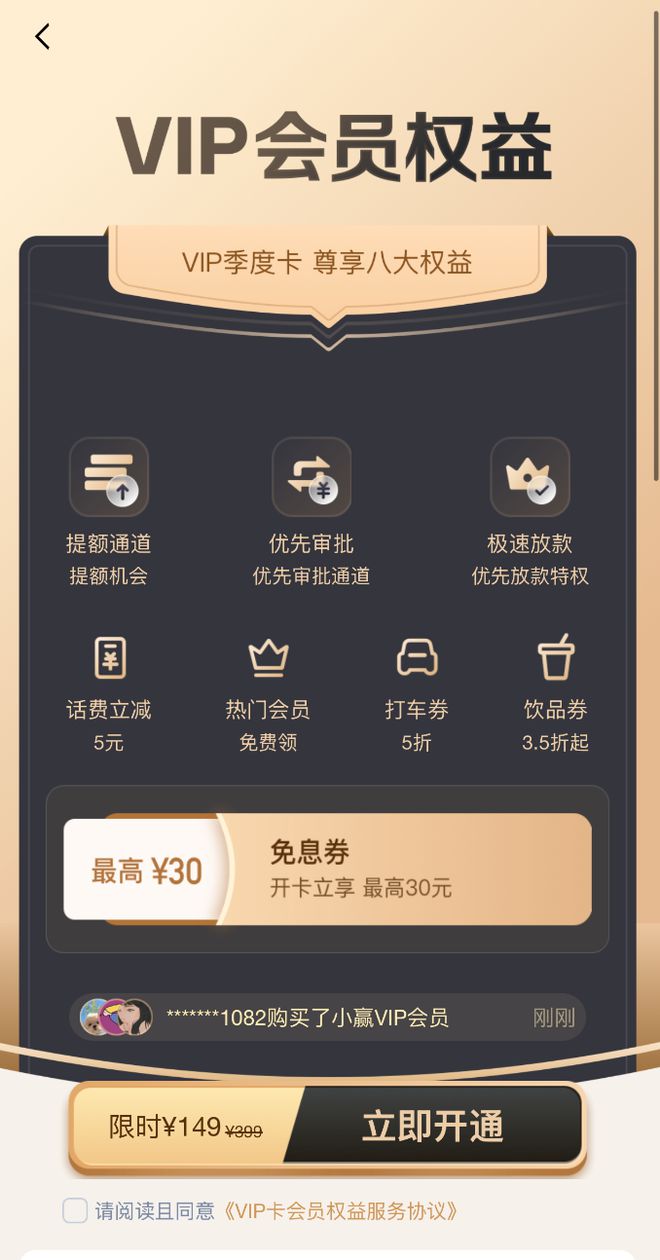
Core Viewpoint - The article discusses the emergence of a new lending model called "24%+ equity" in response to regulatory changes that lower annual interest rates from 36% to 24% for lending institutions. This model allows platforms to bundle additional services or memberships to circumvent interest rate limits, raising concerns about compliance and consumer complaints [1][4][17]. Group 1: Regulatory Changes - The new lending regulations, effective from October 1, require commercial banks to clarify service fees and include them in the total financing cost, effectively capping interest rates at 24% [4][17]. - Many lending institutions have begun transitioning to comply with these new regulations, with significant changes noted since May [4][5]. Group 2: Emergence of "24%+" Model - The "24%+" model has two main forms: small equity products, which charge monthly fees for limited services, and large equity products, where fees are tied to loan amounts and can exceed 1,000 yuan in a single charge [5][9]. - The small equity products offer various financial and lifestyle services for a monthly fee, while large equity products charge higher fees based on the loan amount, often without explicit consent from borrowers [6][9]. Group 3: Profitability and Business Dynamics - Platforms can profit from financial equity products and by purchasing third-party services at a discount, allowing them to sell at a higher price [11][12]. - The rise of third-party equity suppliers has created a competitive market, with these suppliers acting as intermediaries between lending platforms and service providers [13][15]. Group 4: Consumer Complaints and Compliance Issues - The "24%+ equity" model has led to a surge in consumer complaints, particularly regarding unauthorized charges and complicated refund processes, with over 5,000 complaints reported [17][18]. - Regulatory scrutiny is increasing, with past guidelines prohibiting disguised high-interest loans under the guise of service fees, raising questions about the sustainability of the new model [17][18]. Group 5: Future Outlook - The ability to address consumer complaints effectively will be crucial for the long-term viability of the "24%+ equity" model within regulatory frameworks [18]. - Industry experts suggest that merely relying on technology to navigate regulations is insufficient; a genuine commitment to transparency and customer consent is essential for sustainable growth [18].

助贷“24%+权益”新玩法兴起,变相加息遭遇大量客诉
Di Yi Cai Jing Zi Xun· 2025-06-15 05:54
Core Viewpoint - The implementation of new regulations in the lending industry is prompting institutions to shift from an annual interest rate of 36% to 24%, while a new model called "24% + Equity" is emerging as a workaround to these limits [1][10]. Group 1: Regulatory Changes - The new regulations from the National Financial Regulatory Administration, effective from October 1, require commercial banks to clarify service fees and include them in the comprehensive financing cost, effectively lowering the annual interest rate to below 24% [1][10]. - Many lending institutions have begun transitioning to comply with the new regulations since May, indicating a significant industry shift [1][10]. Group 2: Emergence of "24% + Equity" Model - The "24% + Equity" model is characterized by two types of products: small equity products, which charge monthly fees for limited financial and lifestyle services, and large equity products, which tie fees to the loan amount and can cost from 199 to 1999 yuan [2][5]. - The model allows institutions to maintain profitability by offering virtual services and leveraging third-party equity suppliers, creating a new revenue stream [7][9]. Group 3: Consumer Complaints and Issues - There has been a significant increase in consumer complaints related to the "24% + Equity" model, with over 5000 complaints reported, primarily concerning default selections for services and complicated refund processes [10][11]. - The model's compliance and sustainability are under scrutiny, as the regulatory environment may impose further restrictions on such practices [10][12]. Group 4: Third-Party Equity Suppliers - The rise of the "24% + Equity" model has led to the emergence of third-party equity suppliers, who act as intermediaries between lending platforms and service providers, earning commissions for their services [8][9]. - Competition among these suppliers is intensifying, with a focus on pricing as the primary factor for procurement decisions [9][10]. Group 5: Future Outlook - The sustainability of the "24% + Equity" model hinges on the ability to address consumer complaints effectively and adhere to regulatory requirements, emphasizing the need for transparency and customer consent [11][12].
银行收紧资金供应,中小助贷平台“成本涨了三个百分点”
Di Yi Cai Jing· 2025-06-15 05:45
Core Insights - The implementation of the new lending regulations is set to reshape the industry landscape, with a focus on a 24% annual interest rate becoming a critical threshold for the lending sector [1][2][3] - Banks are increasingly rejecting loans with interest rates between 24% and 36%, leading to a rise in funding costs for smaller lending institutions [2][3] - Major lending platforms like Ant Group and JD.com continue to dominate the "white list" of approved institutions, while new entrants like "Hanglv Zongheng" are emerging as significant players [1][6] Lending Rate Dynamics - The new regulations emphasize that banks must clearly define service fees and include them in the overall financing cost for borrowers, with a focus on maintaining a 24% cap for legal protection [2][8] - There is a notable shift in the lending landscape, with banks tightening their approval processes for loans in the 24%-36% interest rate range, which has historically been accepted [2][3] Structural Changes in the Market - Smaller lending institutions are experiencing a rapid increase in funding costs, while larger institutions are less affected due to their focus on loans below the 24% threshold [3][4] - The tightening of credit from banks is forcing smaller lenders to reconsider their business models, as they struggle to cover costs without offering higher interest loans [3][4] Collaboration Trends - Banks are increasingly seeking partnerships with leading institutions and new "cross-industry players" to enhance their customer acquisition strategies [5][7] - Recent collaborations include banks partnering with platforms like "Hanglv Zongheng," which has a user base exceeding 100 million, indicating a shift towards leveraging established user bases for loan distribution [7][8] Regulatory Compliance - The new regulations require banks to enhance their due diligence and establish clear agreements with lending platforms, ensuring compliance with the new standards [8] - Recent penalties for non-compliance highlight the regulatory scrutiny in the lending sector, emphasizing the need for banks to adhere to the new guidelines [8]
网贷市场,银行被迫当乙方
Tai Mei Ti A P P· 2025-06-13 02:21
Core Viewpoint - The personal credit market in China is experiencing a divergence between banks and lending platforms, with banks facing increasing pressure on retail loan performance while lending platforms report strong growth in credit issuance and profitability [2][9]. Banking Sector - Banks, represented by institutions like China Merchants Bank (CMB), are struggling with retail loan performance, showing a retail non-performing loan (NPL) ratio of 1.01%, up 0.03 percentage points from the end of last year [2][3]. - CMB's retail loan balance decreased from 13.43 trillion yuan to 13.37 trillion yuan, with a mere 0.38% growth in retail loans during the first quarter, significantly lower than the 6.49% growth in corporate loans [3][4]. - The overall trend shows that all six major banks experienced a rare increase in personal loan NPL ratios, with one bank reporting a personal consumption loan NPL ratio of 12.37% [4]. - The asset quality pressure is attributed to economic downturns leading to higher unemployment and reduced income growth, impacting borrowers' repayment capabilities [4][10]. Lending Platforms - Lending platforms, such as Qifu Technology and Xiaoyin Technology, reported strong performance in the first quarter, with significant year-on-year growth in loan issuance, revenue, and net profit [5][6]. - For instance, Qifu Technology's loan balance increased by 2.38%, with a quarterly loan issuance of 88.89 billion yuan, reflecting a 15.76% year-on-year growth [5]. - The asset quality of these platforms remains stable, with most reporting a decrease in NPL ratios, and some platforms like Xiaoyin Technology showing a 63.45% increase in loan issuance [6][7]. - The overall performance of lending platforms contrasts sharply with banks, as they have adapted their risk preferences and improved their risk assessment systems, allowing for more agile responses to market conditions [9][10]. Market Dynamics - The relationship between lending platforms and banks has shifted, with lending platforms becoming the primary players (甲方) and banks taking a secondary role (乙方) in the lending process [8][10]. - Smaller banks are increasingly reliant on larger lending platforms for retail business expansion, often leading to unfavorable financial outcomes due to high funding costs and competitive pressures [10][11]. - New regulations have compressed interest rates for smaller lending platforms, creating challenges for their survival, while larger platforms continue to attract funding and maintain lower financing costs [11].