
种植业

Search documents
新春走基层|四川大邑县:远程巡田,庄稼汉过上旅游年
Bei Jing Ri Bao Ke Hu Duan· 2026-02-21 01:40
Core Insights - The article highlights the transformation in agricultural practices due to the adoption of smart farming technologies, exemplified by the case of a farmer in Deyang County, Sichuan, who can now manage his crops remotely and enjoy leisure activities during the busy farming season [1][2]. Group 1: Smart Agriculture Technology - The "Jishiyu" smart agriculture digital service platform has been established in Deyang County in collaboration with universities and institutions, providing free services to large-scale grain growers to monitor crop conditions and weather data [2]. - The platform allows farmers to check crop growth, pest conditions, and soil moisture levels, significantly enhancing their ability to manage agricultural tasks efficiently [2][3]. Group 2: Impact on Farming Practices - The integration of smart agriculture tools has led to a shift in traditional farming practices, enabling farmers to conduct remote inspections and receive actionable insights on irrigation and pest control [3]. - The use of drones for pesticide application and mechanized planting has increased productivity, allowing one farmer to manage up to 1,000 acres of land, showcasing the potential for growth in the new agricultural workforce [3].


看!春耕里的新质生产力(新春走基层)
Ren Min Ri Bao· 2026-02-20 22:26
Group 1: Agricultural Innovation in Henan - The introduction of smart irrigation robots in Henan's agricultural practices allows farmers to remotely control irrigation through mobile devices, significantly improving efficiency and reducing labor costs [2][3] - The smart irrigation robots utilize soil sensors to provide real-time data on soil moisture, enabling precise irrigation management and reducing water usage by 40% while lowering irrigation costs by 50% [3] - The technology has led to an increase in wheat yield by 15% per acre, showcasing the impact of integrating industrial robotics into agriculture [3] Group 2: Digital Empowerment in Sichuan - In Sichuan, the "Jishi Yu" smart agriculture platform enables farmers to monitor crop conditions remotely, allowing them to manage their fields more effectively and even take vacations without worry [6][7] - The platform provides real-time data on soil moisture and pest conditions, enhancing decision-making for irrigation and pest control, thus improving overall crop management [7] - The use of drones for pesticide application and automated planting machines exemplifies the shift towards digital and automated solutions in agriculture, allowing one person to manage up to a thousand acres [7]
新春走基层|广西巴立村:户户皆有大学生 深山书写振兴答卷
Xin Lang Cai Jing· 2026-02-19 09:40
Core Viewpoint - The transformation of Balili Village in Guangxi from a deeply impoverished area to a thriving community with improved infrastructure, economic stability, and educational achievements exemplifies successful rural revitalization efforts in China [1][5]. Infrastructure Development - The first step in Balili Village's poverty alleviation was improving transportation, water, and electricity access, with significant milestones including the construction of the first mechanized road in 1979 and the completion of a cement road in 2012 [2]. - Recent initiatives have focused on enhancing water safety and supply systems, which have provided a stable foundation for local industry development [2]. Economic Growth - The village has developed key industries such as sugarcane planting and livestock farming, supported by government policies, technical assistance, and training programs [2]. - Average annual income for villagers has reached approximately 60,000 to 70,000 yuan, with individual households reporting earnings of over 30,000 yuan from sugarcane alone [3]. Educational Advancements - Balili Village has prioritized education as a long-term investment, resulting in significant educational achievements, including the emergence of its first "985" university student and an average of one university student per household [4]. - The cultural shift towards valuing education has transformed the village from a place of scarcity to one where knowledge and learning are celebrated [4]. Community and Cultural Revival - The village has seen a revival of traditional customs and a strong sense of community, with families engaging in cultural practices during festivals, reflecting improved living conditions and social cohesion [3][4]. - Balili Village's story is a microcosm of broader rural changes in China, showcasing the impact of party leadership, policy support, and community efforts in achieving sustainable development [5].
山西省财政5670万资金支持冬小麦促弱转壮
Xin Lang Cai Jing· 2026-02-19 02:33
Group 1 - The core viewpoint of the article highlights the proactive measures taken by the Shanxi Provincial Finance Department to support winter wheat production in response to late sowing and weak seedling conditions [1] - An emergency fund of 56.7 million yuan has been allocated to assist 27 counties in the province with initiatives aimed at strengthening winter wheat growth [1] - The focus of the funding is on providing subsidies for disaster prevention and stabilization measures, particularly for the additional application of seedling-enhancing fertilizers [1]
2025年云南省早稻总产量11.9万吨,占全国早稻总产量的0.42%
Chan Ye Xin Xi Wang· 2026-02-19 02:12
Group 1 - The core viewpoint of the report indicates a decline in the early rice planting area in Yunnan Province for 2025, with a reduction of 2.2 thousand hectares compared to 2024, representing a decrease of 10.5% and a significant drop in growth rate by 19.95 percentage points from the previous year [1] Group 2 - In 2025, the unit yield of early rice in Yunnan Province is projected to be 6,333 kilograms per hectare, which is an increase of 53.1 kilograms per hectare, reflecting a growth of 0.8% and an increase in growth rate by 0.23 percentage points compared to the previous year [2] - The total output of early rice in Yunnan Province for 2025 is estimated at 119,000 tons, a decrease of 12,000 tons or 9.2% from 2024, with a reduction in growth rate by 19.24 percentage points compared to the previous year; this total output accounts for 0.42% of the national early rice output [2]

新春走基层丨东极暖阳:乡村兴、文旅热、市场旺、边境安
Jing Ji Ri Bao· 2026-02-19 01:16
Core Insights - The article highlights the economic and cultural revitalization of Fuyuan City, located at the easternmost point of China, emphasizing its agricultural development, tourism growth, and community engagement [1][2][4]. Agricultural Development - Fuyuan is a major grain-producing county, with the Jiu Cheng Rice Planting Cooperative established in 2015, now comprising 170 members and cultivating 120,000 acres [2]. - In 2023, the cooperative was recognized as a national model, projecting a total output of over 25,000 tons of rice, corn, and soybeans by 2025, with revenue expected to reach 120 million yuan and average farmer dividends exceeding 8,000 yuan [2]. - The cooperative plans to invest 9.7 million yuan in developing a new greenhouse and a picking garden [2]. Tourism Growth - Fuyuan is known for its rich aquatic resources, being the largest producer of freshwater fish in China, with a historical fish market that sees significant activity during the festive season [5][6]. - The city anticipates receiving 2.82 million tourists in 2025, generating a total tourism revenue of 3.105 billion yuan, reflecting year-on-year growth of 16.8% and 21.4% respectively [7][8]. Cultural Heritage - Fuyuan is home to the Hezhe ethnic group, with a strong cultural heritage in fishing and fish-skin art, which is being preserved and promoted through local artisans [7]. - The city has been designated as a national civilized city, leveraging its unique geographical advantages to enhance its cultural identity and tourism appeal [10]. Infrastructure and Development - The local government is focused on ecological protection and sustainable development, particularly in the Black Blind Island area, which is crucial for biodiversity [9][10]. - Significant investments are being made in infrastructure, including the construction of transportation links to enhance connectivity with Russia and support local economic growth [10].
雨水逢新春 温室育种忙
Xin Lang Cai Jing· 2026-02-18 13:09
Core Viewpoint - The article highlights the significance of the Rain Water solar term as a crucial period for spring farming preparations, particularly focusing on the cultivation and selection of cucumber varieties by breeding experts during the Chinese New Year holiday [1]. Group 1: Industry Insights - The Rain Water solar term marks the beginning of favorable conditions for spring farming, with the weather warming up and winter cucumbers entering their peak fruiting period [1]. - The cucumber breeding institute, part of the National Cucumber New Variety Technology Promotion Center, has developed over 140 varieties, supplying more than 30 provinces, cities, and autonomous regions across the country [1]. - Breeding experts are conducting rigorous selection processes in greenhouses during the holiday to ensure the identification of high-quality cucumber varieties for the upcoming planting season [1]. Group 2: Research and Development - Selected cucumber varieties undergo further testing in laboratories for disease resistance and quality gene assessments, emphasizing the importance of scientific validation in the breeding process [1]. - The urgency of completing the selection of new varieties before the Spring Festival is highlighted, as timely planting is essential for successful crop yields [1].
播土豆、育秧苗、采春茶……人勤春来早 春耕春管向“新”而行
Yang Shi Wang· 2026-02-18 06:48
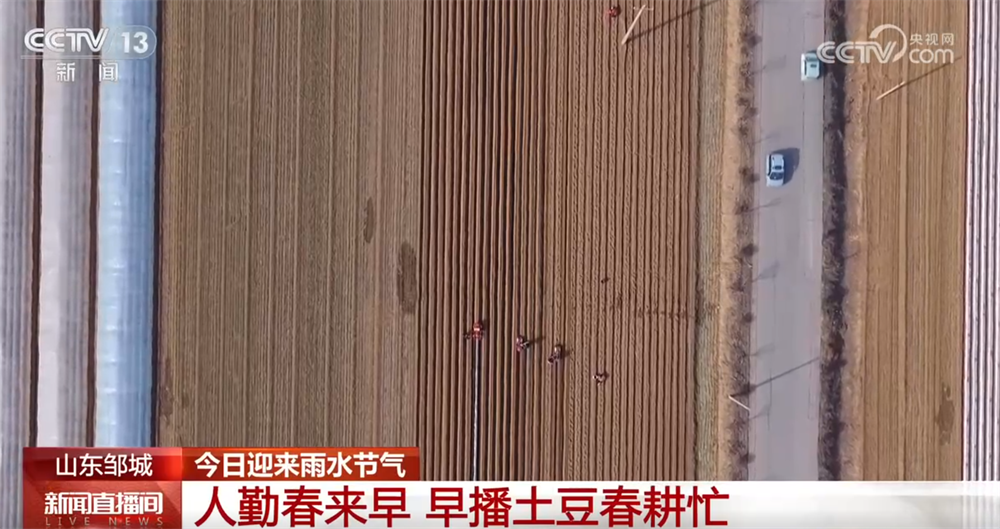
Group 1 - The significance of the Rain Water solar term for agriculture is highlighted, marking the beginning of spring farming activities in northern regions [4] - In Shandong Zoucheng, over 30,000 acres of spring potato planting are underway, utilizing advanced agricultural machinery and the "three-film coverage" efficient planting model to enhance early planting and harvesting [4] - In Guangdong Taishan, a smart seedling cultivation factory employs a vertical circulation method that improves seedling survival rates and shortens the cultivation cycle, allowing for multiple rounds of seedling production within a season [7] Group 2 - In Chongqing Yongchuan, the first batch of spring tea is being harvested as tea trees begin to sprout new buds, benefiting from sufficient rainfall and rising temperatures after the beginning of spring [10] - The Rain Water solar term is associated with three phenomena: otters sacrificing fish, wild geese returning, and the awakening of plants, indicating seasonal changes that affect agricultural practices [10]
央媒看贵州丨光明日报:茶台村的致富路
Xin Lang Cai Jing· 2026-02-18 02:51
Core Viewpoint - The report highlights the significant improvements in transportation infrastructure in Guizhou Province, particularly in Tea Table Village, which have facilitated economic development and enhanced the livelihoods of local residents [2][3]. Transportation Infrastructure - Since the introduction of high-speed rail in 2014, Guizhou has seen comprehensive development in its railway and road networks, with all nine cities connected by high-speed rail and villages accessible by paved roads [2]. - The improved transportation has drastically reduced travel times, allowing local agricultural products to reach major cities like Chongqing, Beijing, and Shanghai within hours [3]. Economic Development - The enhanced transportation has opened up markets for local farmers, enabling them to sell products such as tea and citrus fruits more efficiently [3]. - Local entrepreneur Luo Changhua transitioned from migrant work to becoming a major agricultural producer, leveraging improved infrastructure to grow his business [3]. Educational and Technical Support - The collaboration with Guizhou University has provided local farmers with access to expertise in agricultural practices, further enhancing productivity and sustainability in the region [3]. Community Impact - The report emphasizes that improved transportation has transformed the perception of the mountainous region from a barrier to a resource, contributing to a more prosperous and comfortable lifestyle for local residents [3].
2025年广东省早稻总产量533.2万吨,占全国早稻总产量的18.7%
Chan Ye Xin Xi Wang· 2026-02-18 02:08
2016-2025年广东省早稻单位面积产量统计图 数据来源:国家统计局 2025年广东省早稻总产量533.2万吨,比2024年增加5.5万吨,增长1%,比上年增幅增加1.42个百分点; 2025年广东省早稻总产量占全国早稻总产量的18.7%。 相关报告:智研咨询发布的《2026-2032年中国水稻行业市场行情动态及发展趋向分析报告》 2025年广东省早稻播种面积865.2千公顷,比2024年减少4.5千公顷,下降0.5%,比上年增幅减少0.94个 百分点。 2016-2025年广东省早稻播种面积统计图 数据来源:国家统计局 2025年广东省早稻单位面积产量6162.7公斤/公顷,比2024年增加95.2公斤/公顷,增长1.6%,比上年增 幅增加2.38个百分点。 2016-2025年广东省早稻总产量统计图 数据来源:国家统计局 ...
