
渔业

Search documents
海上渔汛来
Xin Hua Wang· 2025-09-04 07:13
Core Points - The fishing season in the Bohai and Yellow Seas has officially resumed after a four-month moratorium, allowing fishermen to set sail for a new season of harvest [1][2] - Fishermen are experiencing significant catches, with reports of individual boats bringing in tens of thousands of pounds of fish in a single outing, indicating a successful start to the season [1][2] - The implementation of the seasonal fishing moratorium has played a crucial role in the recovery of fish stocks, leading to stable catch volumes and improved fishing conditions for local fishermen [2] Industry Summary - The seasonal fishing moratorium, in place for 30 years, has been effective in protecting marine resources, allowing fish populations to recover and ensuring sustainable fishing practices [2] - Recent data indicates that the overall catch volume in China's coastal waters has stabilized, with certain species like hairtail, anchovy, and crab maintaining steady yields, while others like mackerel and squid show increasing trends [2] - The moratorium not only supports the recovery of fish stocks but also contributes to the consistent supply of high-quality seafood, aligning with broader food security initiatives [2]
歌起深蓝 广铸粮仓:广东书写“向海要粮”史诗 | 海上新广东系列报道⑤
Nan Fang Nong Cun Bao· 2025-09-04 06:33
Core Viewpoint - Guangdong is transforming its marine economy by expanding deep-sea aquaculture, aiming to enhance food security and economic growth through modern technology and sustainable practices [10][11][164]. Group 1: Marine Economy Development - Guangdong's marine production value is projected to exceed 2 trillion yuan in 2024, accounting for about one-fifth of the national total, maintaining its position as the leader in China's marine economy for 30 consecutive years [10][11]. - The province is shifting focus from traditional nearshore aquaculture to deep-sea farming, addressing challenges such as space constraints and ecological overload [17][18][19]. Group 2: Technological Advancements - Modern aquaculture platforms like "Haiwei 2" and "Gesheng 1" are being developed, featuring advanced designs that enhance stability and operational efficiency [34][35][36]. - The "Zhanong 1" platform, capable of submerging during severe weather, showcases innovative technology that improves resilience against typhoons [56][60][67]. Group 3: Policy Support and Investment - The government has introduced 17 measures to support modern marine ranching, including a 2 billion yuan special fund for industry innovation and development [43][44]. - Over 100 modern marine ranching projects are underway across Guangdong, creating a comprehensive ecosystem that integrates various aspects of the marine industry [45][47]. Group 4: Aquaculture Production and Performance - In 2024, Guangdong's aquaculture production is expected to reach 3.7683 million tons, with a year-on-year growth of 5.47%, marking the highest growth rate in nearly a decade [49]. - The province's marine fish farming output is projected to be 975,400 tons, representing nearly half of the national total, further solidifying its leading position [50][51]. Group 5: Brand and Market Expansion - Guangdong is enhancing its seafood brand through processing innovations and market expansion, allowing local products to reach broader markets [115][116]. - The province's seafood industry is expected to generate a total economic output of 471.825 billion yuan in 2024, reflecting the successful integration of the entire supply chain from production to sales [148][150].


冰美式变温水!日韩“史上最热”夏季,韩国央行预警热浪推高CPI
Di Yi Cai Jing· 2025-09-04 05:08
Core Insights - Extreme weather has emerged as a significant uncertainty impacting the South Korean economy, with warnings from the Bank of Korea regarding its potential effects [1][5] - Both Japan and South Korea experienced record-high summer temperatures, with Japan's average temperature from June to August rising by 2.36 degrees Celsius compared to historical averages, marking the hottest summer on record [1][3] - The ongoing heatwave is expected to persist, with forecasts indicating continued high temperatures in both countries into September [1][3] Weather Impact - Japan's average temperature for June to August reached a record high, with Tokyo experiencing over 23 days of temperatures exceeding 35 degrees Celsius [3] - South Korea issued heatwave warnings in 182 out of 183 regions, with significant drought conditions reported in Gangwon Province, leading to severe water shortages [4] Economic Consequences - The extreme heat has adversely affected agricultural sectors in both countries, particularly rice production in Japan, where prices have surged by 90.7% year-on-year [6] - The Bank of Korea's report highlighted that climate disasters are pushing up prices and weakening growth potential, with estimates indicating a 0.3 percentage point increase in the Consumer Price Index (CPI) for the third quarter due to recent extreme weather [6]

耕海牧渔鱼虾满仓、土地轮作增效益 科技赋能绘就金秋好“丰”景
Yang Shi Wang· 2025-09-04 04:48
Group 1: Fishing Industry - The seasonal fishing moratorium, implemented in China since 1995, is crucial for the conservation of marine fishery resources, with the recent four-month closure for the Yellow and Bohai Seas ending on September 1 [1] - The first batch of nearshore fishing boats has returned to port, bringing back a variety of seafood including anchovies, mackerel, and squid, leading to a bustling atmosphere at Dalian's Longwangtang Fishing Port [3][4] - Due to the limited catch from smaller nearshore vessels, there is a high demand for seafood, with prices expected to decrease as larger offshore vessels return in the coming days [4][6][10] Group 2: Aquaculture Developments - In Fujian Province, the harvesting of oysters is underway, with local workers efficiently collecting and packaging the oysters, which are in high demand due to their quality [13][17] - The oyster farming area in Liyu Town spans 15,000 acres, producing approximately 10 million oysters annually, generating nearly 200 million yuan in revenue [19] - In Shandong Province, the innovative "shrimp-lotus co-cultivation" model has extended the market availability of crayfish, enhancing farmers' income [20][26] Group 3: Agricultural Innovations - In Xinjiang's Hetian region, a new model combining saline-alkali land improvement with ecological aquaculture has been successfully implemented, with a survival rate of over 80% for South American white shrimp [28] - The total area for aquaculture in Hetian has exceeded 3,520 acres, producing various seafood products including crabs and shrimp [28] - In Chongqing's Tongnan District, over 10,000 acres of sorghum are being harvested, with farmers utilizing crop rotation strategies to maximize land efficiency [30][33] Group 4: Export Opportunities - The Sunlight Rose grapes from Lingbao, Henan, are being harvested and exported to Southeast Asia, with over 100 tons already shipped and thousands of tons in orders expected to increase sales significantly by 2025 [34][35]

獐子岛集团股份有限公司关于持股5%以上股东权益变动触及1%刻度的提示性公告
Shang Hai Zheng Quan Bao· 2025-09-03 22:38
Core Viewpoint - The announcement highlights a change in the shareholding structure of Zangzi Island Group Co., Ltd., specifically regarding a significant shareholder's reduction in stake due to trading activities [3]. Group 1: Shareholding Changes - The major shareholder, Beijing Jirong Yuantong Asset Management Co., Ltd. - Heidao No.1 Securities Investment Fund, has decreased its shareholding percentage due to centralized bidding trading [3]. - This reduction does not involve a change in the controlling shareholder and will not affect the company's governance structure or ongoing operations [3]. - The fund plans to reduce its holdings by up to 1% of the total share capital, which equates to a maximum of 7.111 million shares, within a specified trading period [3].

獐子岛: 关于持股5%以上股东权益变动触及1%刻度的提示性公告
Zheng Quan Zhi Xing· 2025-09-03 10:15
Core Viewpoint - The announcement details a reduction in shareholding by a major shareholder, Beijing Jirong Yuantong Asset Management Co., Ltd., specifically the Hedao No. 1 Securities Investment Fund, due to a planned share reduction strategy [1][2]. Summary by Relevant Sections Shareholder Information - The major shareholder, Beijing Jirong Yuantong Asset Management Co., Ltd. - Hedao No. 1 Securities Investment Fund, has confirmed the accuracy and completeness of the information provided [1]. - The fund's shareholding decreased due to concentrated bidding transactions [1]. Share Reduction Plan - The fund plans to reduce its holdings by up to 1% of the total share capital, which equates to a maximum of 7,111,000 shares, within a three-month period starting from June 27, 2025 [1]. - The reduction is in line with a previously disclosed plan dated June 6, 2025 [1]. Recent Share Reduction Activity - Between August 29, 2025, and September 2, 2025, the fund reduced its holdings by 390,800 shares, representing a decrease of 0.0550% of the total share capital [1]. - Prior to this reduction, the fund held 5,716,268.5 shares, accounting for 8.0385% of the total share capital, which decreased to 5,677,188.5 shares, or 7.9835% post-reduction [1]. Compliance and Legal Considerations - The fund has adhered to its commitments regarding the share reduction and has not violated any relevant laws or regulations [2]. - The announcement confirms that the reduction does not trigger any mandatory bid requirements under the relevant regulations [2].
渔业板块9月3日跌2.74%,中水渔业领跌,主力资金净流出2033.42万元
Zheng Xing Xing Ye Ri Bao· 2025-09-03 08:39
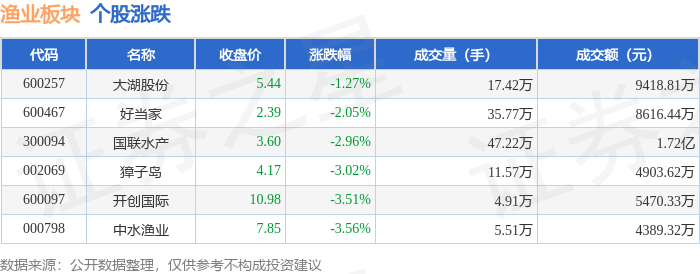
Core Viewpoint - The fishery sector experienced a decline of 2.74% on September 3, with major stocks like Zhongshui Fisheries leading the drop, while the Shanghai Composite Index fell by 1.16% and the Shenzhen Component Index decreased by 0.65% [1] Group 1: Market Performance - The fishery sector's decline was reflected in individual stock performances, with Dahu Co. closing at 5.44, down 1.27%, and other notable declines including Guolian Aquatic Products down 2.96% and Zhongshui Fisheries down 3.56% [1] - The total trading volume for the fishery sector was significant, with Guolian Aquatic Products recording a trading volume of 472,200 shares and a transaction value of 172 million yuan [1] Group 2: Capital Flow - The fishery sector saw a net outflow of 20.33 million yuan from main funds, while retail investors contributed a net inflow of 9.71 million yuan [1] - Individual stock capital flows showed that Dahu Co. had a main fund net inflow of 1.36 million yuan, while Zhongshui Fisheries experienced a net outflow of 777,600 yuan [2]


南农晨读 | 锦绣山河
Nan Fang Nong Cun Bao· 2025-09-03 04:05
Group 1 - The article highlights the transformation of the marine economy in Guangdong, showcasing the integration of traditional fishing markets with digital platforms, allowing new farmers to thrive in the ocean economy [9][10][22] - The bustling activity at the Maoming Bohe Port is emphasized, where fresh seafood is quickly delivered to consumers, illustrating the efficiency and vibrancy of the local seafood market [11][12][16] - The article notes the role of live streaming in promoting seafood sales, indicating a shift towards modern marketing strategies in the fishing industry [16][20] Group 2 - The article discusses the efforts in rural revitalization, with Shantou focusing on resource allocation to strengthen various sectors, including the "Hundred Thousand Project" [24][26][28] - It mentions the collaboration between Shenzhen and Baise, where educators are being sent to assist in teaching, reflecting a commitment to improving education in rural areas [29][33] - The "Xinjiang products southbound, Guangdong products northbound" initiative is introduced, aiming to connect economic and cultural ties between regions through a month-long promotional event [36][43] Group 3 - The article outlines the launch of a training program aimed at enhancing the quality of the livestock industry in Guangdong, involving various industry leaders and associations [46][50] - It highlights the participation of key figures from different agricultural associations, indicating a collaborative approach to improving the livestock sector [48][49] Group 4 - The weather forecast for Guangdong indicates high temperatures and scattered thunderstorms, which may impact agricultural activities and local economies [52][56]
黑龙江现代化大农业跑出“加速度”
Xin Hua She· 2025-09-03 00:24
Group 1 - The core viewpoint is that Heilongjiang Province is leveraging technology to modernize agriculture, aiming for a record grain output of over 160 billion jin in 2024 [1][2] - The contribution rate of agricultural technology progress in Heilongjiang Province exceeds 70%, with comprehensive mechanization rates for crops remaining above 99% [1] - The province is implementing the "Five Goods" integration strategy to enhance the quality and yield of grain production [1] Group 2 - The Dabeichuan Cooperative has improved soybean planting density, increasing the expected yield from 6,000 jin per hectare to over 7,000 jin this year [2] - Heilongjiang Province is promoting the initial and deep processing of agricultural products, exemplified by a company processing 1 million fresh corn cobs daily [2] - The province is also diversifying agricultural products and enhancing value through initiatives like cold-water fishery revitalization [2][3] Group 3 - Heilongjiang Province has over 10 million mu of certified organic food area, promoting the "Heilongjiang Quality Agricultural Brand" to enhance the market value of its products [3] - The province aims to strengthen its agricultural sector by building modern agricultural bases, large enterprises, and industries, ensuring national food security [3]
金融“鱼群”游进蓝色牧场:青岛海洋经济新养殖记
Zhong Guo Zheng Quan Bao· 2025-09-02 22:43
Core Viewpoint - The development of marine economy in Qingdao is significantly supported by financial services, enabling companies like Luhai Feng to establish advanced marine ranches and logistics systems, thereby enhancing the overall marine industry in the region [1][2][3]. Group 1: Marine Ranch Development - Luhai Feng has invested 1.2 billion yuan to build over 300 intelligent deep-water net cages, capable of harvesting 40 tons of fish each [1]. - The marine ranch covers over 50,000 acres and includes a recreational fishing area of 1,534 hectares, making it the largest marine ranch in Qingdao [2]. - The company has spent over ten years restoring marine ecology by deploying artificial reefs and cultivating seaweed, which has improved fish yield [2]. Group 2: Financial Support - Financial institutions, particularly the Bank of Communications Qingdao Branch, have provided various financial services, including bank loans and cross-border settlements, to support Luhai Feng's operations [1][3]. - The bank has facilitated a syndicate loan for the construction of Luhai Feng's cold chain logistics base, which includes a total cold storage capacity of 600,000 tons [3]. - As of June 2025, the Bank of Communications Qingdao Branch reported a credit balance of 23.771 billion yuan for marine enterprises, an increase of 2.858 billion yuan from the beginning of the year [4]. Group 3: Insurance and Risk Management - Insurance plays a crucial role in supporting the sustainable development of the marine economy, providing essential risk coverage for deep-sea operations [5][6]. - A strategic cooperation agreement was signed between China Pacific Insurance and the National Deep Sea Base Management Center, covering risks up to 1.5 billion yuan for deep-sea equipment and research personnel [6]. - The insurance sector in Qingdao has seen a 25% year-on-year increase in premium income from marine-related insurance, amounting to 310 million yuan [6]. Group 4: Diverse Financial Products - Qingdao has developed a comprehensive marine financial product manual, featuring 177 specialized products from 33 financial institutions, addressing the diverse needs of marine enterprises [7]. - The financial services include specialized loans, blue bonds, project financing, and various types of marine insurance [7]. - As of June 2025, the marine loan balance in Qingdao reached 144.905 billion yuan, reflecting a year-on-year growth of 15.47% [8]. Group 5: Government and Regulatory Support - The Qingdao Financial Regulatory Bureau is actively guiding financial institutions to support high-quality development in the marine economy, including the deployment of financial service specialists to key enterprises [8]. - A financial service expert team has been established to provide comprehensive support, including policy consultation and risk management [8]. - The regulatory body aims to enhance financial policies and explore innovative marine financial products to better serve the marine industry [8].