核电

Search documents
中美贸易阶段性缓和,关注通胀及降息进展:海外科技周报(25/10/27-25/10/31)-20251103
Hua Yuan Zheng Quan· 2025-11-03 10:29
Market Overview - The Hang Seng Tech Index closed at 5908.1, down 2.5%, underperforming the Hang Seng Index by 1.5 percentage points[7] - The Philadelphia Semiconductor Index closed at 7228.7, up 3.6%, outperforming both the Nasdaq 100 and S&P 500 indices[7] Key Events - Cameco and Brookfield announced a transformative strategic partnership with the U.S. government to promote the large-scale deployment of Westinghouse nuclear reactor technology, with over $80 billion in financing and project approvals coordinated by the U.S. government[4][16] - The U.S. government will receive a 20% dividend right after distributing over $17.5 billion in profits from Westinghouse[4][16] Cryptocurrency Market - The total market capitalization of cryptocurrencies decreased to $3.64 trillion as of October 31, 2025, down from $3.70 trillion the previous week[19] - The total trading volume for cryptocurrencies was $186.43 billion, accounting for 5.12% of the total market capitalization[19] Investment Insights - The recent easing of U.S.-China trade tensions has led to a reduction in tariffs from 57% to 47%, boosting market confidence, although many measures are only effective for one year[4] - The expectation of further interest rate cuts has been tempered, with the Federal Reserve lowering the federal funds rate target range by 25 basis points to 3.75%-4.00%[4][31] Sector Performance - The AI energy sector showed strong performance, with top gainers including NUSCALE POWER (+19%) and Cameco (+16%), while the consumer electronics sector in Hong Kong declined[9][9] - The overall sentiment in the cryptocurrency market is currently in a state of fear, with a Fear and Greed Index reading of 31[21]
每日收评三大指数探底回升全线收红,钍基熔盐概念异军突起,存储芯片午后探底回升
Sou Hu Cai Jing· 2025-11-03 09:59
Market Overview - The market showed signs of recovery with all three major indices closing in the green, with the Shanghai Composite Index up by 0.55%, the Shenzhen Component Index up by 0.19%, and the ChiNext Index up by 0.29% [1][8] - The total trading volume in the Shanghai and Shenzhen markets was 2.11 trillion yuan, a decrease of 210.7 billion yuan compared to the previous trading day [1] Sector Performance - Thorium-based molten salt concept stocks performed strongly, with companies like Baose Co., Ltd. and Hailu Heavy Industry hitting the daily limit [2][7] - The AI application sector was active, with stocks such as Jishi Media and 37 Interactive Entertainment also reaching the daily limit [1][3] - The coal sector saw renewed strength, with Antai Group achieving 7 limit-ups in 13 trading days [1] - The Hainan Free Trade Zone stocks continued to perform well, with companies like Luoniushan hitting the daily limit following the implementation of new duty-free policies [2][7] - Storage chip concept stocks rebounded, with Puran Co., Ltd. rising over 14% [1] Key Developments - The thorium-based molten salt reactor, led by the Shanghai Institute of Applied Physics, achieved a significant milestone by converting thorium-uranium nuclear fuel, marking the first time such data has been obtained globally [2][7] - The new duty-free policy in Hainan, effective from November 1, showed initial positive effects, with sales reaching 78.549 million yuan on the first day, a 6.1% increase compared to the previous day [2][7] Individual Stock Highlights - In the technology sector, storage chip stocks like Shannong Chip and Puran Co., Ltd. saw significant gains, with Shannong Chip rising over 8% and Puran Co., Ltd. over 10% [6] - Other notable performers included Industrial Fulian, which rose over 4%, and several other core stocks in the computing hardware sector [6] Market Sentiment and Future Outlook - The market is currently experiencing a rotation of hotspots, with a focus on identifying core stocks that can lead the next rally [3][8] - The overall market sentiment has improved, but trading volume remains low, indicating that a strong upward trend may still be uncertain [8]

【焦点复盘】指数缩量反弹迎11月开门红,传媒等AI应用端延续强势,海南自贸概念异军突起
Xin Lang Cai Jing· 2025-11-03 09:32
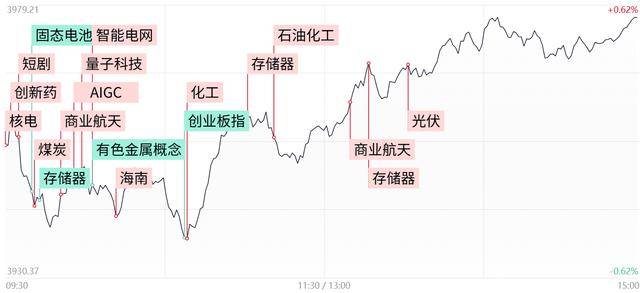
Market Overview - A total of 66 stocks hit the daily limit, while 21 stocks faced limit down, resulting in a sealing rate of 76%. The market showed signs of recovery with all three major indices closing in the green. The Shanghai and Shenzhen stock exchanges recorded a trading volume of 2.11 trillion yuan, a decrease of 210.7 billion yuan from the previous trading day. Over 3,500 stocks rose across the market, with sectors like Hainan, gaming, and film showing significant gains, while battery, non-ferrous metals, and rare earth permanent magnet sectors faced declines. The Shanghai Composite Index rose by 0.55%, the Shenzhen Component Index by 0.19%, and the ChiNext Index by 0.29% [1]. Stock Performance Analysis - The advancement rate for consecutive limit-up stocks dropped to 11.11%, with HeFu China being the only stock to achieve more than two consecutive limit-ups, reaching five. The previously high-flying stock, Time Space Technology, hit a limit down after eight consecutive limit-ups. Other notable stocks include PingTan Development with nine limit-ups in 12 days and Yingxin Development with eight limit-ups in 11 days [3][4]. Key Sector Highlights - The short drama concept continued to gain momentum, with Douyin's short drama copyright center releasing new cooperation guidelines. Tencent's advertising also announced favorable revenue-sharing policies for short drama content. Stocks like Yue Media and Huanrui Century achieved consecutive limit-ups, indicating strong market interest in this sector [5]. - The thorium molten salt nuclear power concept saw a surge following successful fuel conversion tests by the Shanghai Institute of Applied Physics. Stocks such as Baose Co., Ltd. and Lanshi Heavy Industry hit limit-ups, reflecting investor enthusiasm despite concerns over the commercial viability of this technology [6][13]. - The storage chip sector rebounded as major companies like Samsung and SK Hynix announced pauses in contract pricing for DDR5 DRAM, leading to significant stock price increases for companies like Purun Co. and Xiangnan Chip [7][26]. Emerging Trends - The commercial aerospace sector continued to perform well, buoyed by successful launches and upcoming missions planned for next year. Stocks like Aerospace Technology and Aerospace Intelligence saw notable gains [21]. - The Hainan Free Trade Port is nearing its operational launch, expected to officially start on December 18, which has positively impacted related stocks such as Haima Automobile and Pingtan Development [23][24]. - The innovative drug sector is gaining traction, with Pfizer initiating clinical trials for a new drug, positively influencing stocks like Asia-Pacific Pharmaceutical and Bai Cheng Pharmaceutical [40]. Conclusion - The market is experiencing a recovery phase with significant trading activity and a diverse range of sectors showing potential for growth. Investors are advised to keep an eye on emerging trends and sectors that are gaining momentum, such as short dramas, nuclear power, and innovative pharmaceuticals [9].
中国核电:累计回购股份数量约为3126万股
Mei Ri Jing Ji Xin Wen· 2025-11-03 09:28
(记者 王晓波) 每经AI快讯,中国核电11月3日晚间发布公告称,截至2025年10月31日,公司累计回购股份数量约为 3126万股,占公司目前总股本的比例为0.15%,购买的最高价为9.65元/股,购买的最低价为8.4元/股, 已支付的总金额约为2.85亿元。 每经头条(nbdtoutiao)——"为了孩子吃上饭,自己只能靠喝水撑着"!美政府停摆危机逼近"临界 点",4200万人吃饭成问题 ...

A股三大股指尾盘悉数翻红,煤炭、石油股飙升,核电概念爆发
Zheng Quan Shi Bao· 2025-11-03 09:28
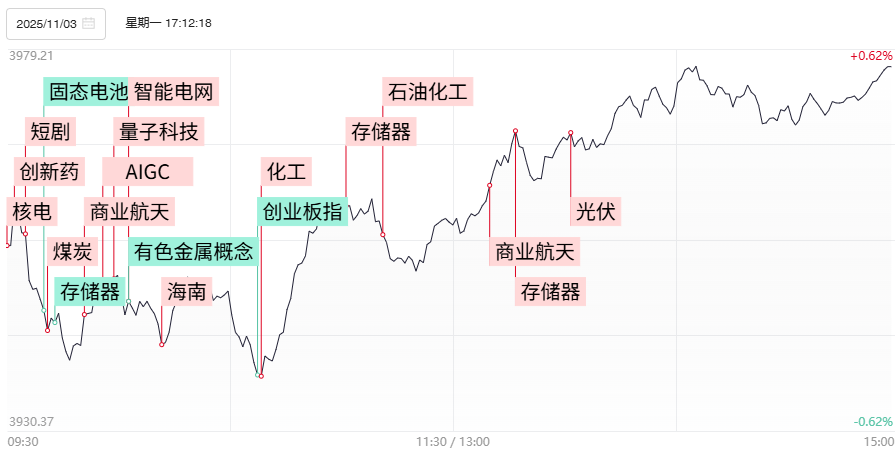
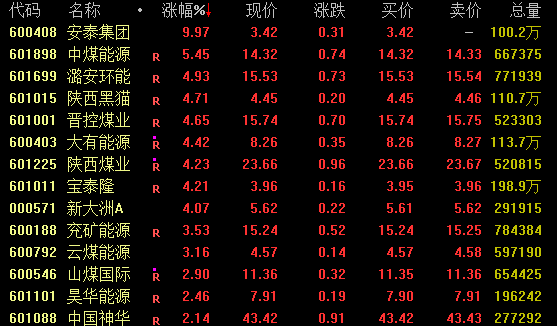
Market Overview - A-shares rebounded in the afternoon on November 3, with all three major indices turning positive by the close; the Shanghai Composite Index rose by 0.55% to 3976.52 points, the Shenzhen Component Index increased by 0.19% to 13404.06 points, and the ChiNext Index gained 0.29% to 3196.87 points [1] - The total trading volume in the Shanghai, Shenzhen, and Beijing markets was 21.33 billion yuan, a decrease of 2.17 billion yuan from the previous day [1] Coal Sector - The coal sector saw significant gains, with companies like Antai Group and Zhongmei Energy hitting the daily limit, and Shanxi Black Cat and Jinkong Coal rising over 4% [3][4] - Analysts noted that the current prices of thermal coal and coking coal are at historical lows, providing room for a rebound due to supply-side policies and seasonal demand increases [3][5] Oil Sector - The oil sector also experienced upward movement, with Huibo Group and Intercontinental Oil hitting the daily limit, and China National Offshore Oil Corporation and China Petroleum rising over 4% [5] - The "Big Three" oil companies (China National Petroleum, Sinopec, and CNOOC) are expected to increase their oil and gas equivalent production by 1.6%, 1.5%, and 5.9% respectively by the third quarter of 2025 [5][6] Nuclear Power Sector - The nuclear power sector surged, with companies like Aerospace Intelligent Equipment and Guorui Technology seeing significant gains [8] - A recent breakthrough in thorium-based molten salt reactor technology by the Chinese Academy of Sciences has positioned this technology as a viable option for nuclear energy development in China, leveraging the country's abundant thorium resources [10] AI Application Sector - The AI application sector was notably active, with companies like Fushi Holdings and Xinghuan Technology seeing substantial increases [12] - The market for AI-generated content, particularly in the animation and drama sectors, is projected to grow significantly, with an expected market size exceeding 20 billion yuan in 2025 [12]
中国核电(601985.SH):累计回购3126.13万股公司股份
Ge Long Hui A P P· 2025-11-03 09:21
格隆汇11月3日丨中国核电(601985.SH)公布,截至2025年10月31日,公司累计回购股份数量为3126.13万 股,占公司目前总股本的比例为0.15%,购买的最高价为9.65元/股,购买的最低价为8.40元/股,已支付 的总金额为2.85亿元(不含佣金等交易费用)。 ...
中国核电累计回购3126.13万股 耗资2.85亿元
Zhi Tong Cai Jing· 2025-11-03 09:16
中国核电(601985)(601985.SH)发布公告,截至2025年10月31日,公司累计回购股份数量为3126.13万 股,占公司目前总股本的比例为0.15%,购买的最高价为9.65元/股,购买的最低价为8.40元/股,已支付 的总金额为2.85亿元(不含佣金等交易费用)。 ...
中国核电(601985.SH)累计回购3126.13万股 耗资2.85亿元
智通财经网· 2025-11-03 09:16
Core Points - China Nuclear Power (601985.SH) announced a share buyback program, with a total of 31.26 million shares repurchased as of October 31, 2025, representing 0.15% of the company's total share capital [1] - The maximum purchase price for the shares was 9.65 CNY per share, while the minimum purchase price was 8.40 CNY per share [1] - The total amount spent on the buyback reached 285 million CNY, excluding commissions and other transaction costs [1]
尾盘,突然拉升!
Zheng Quan Shi Bao· 2025-11-03 09:04
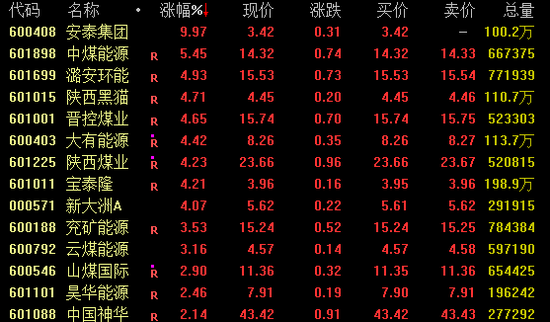
Market Overview - A-shares rebounded in the afternoon on November 3, with all three major indices turning positive by the close; the Shanghai Composite Index rose by 0.55% to 3976.52 points, the Shenzhen Component Index increased by 0.19% to 13404.06 points, and the ChiNext Index gained 0.29% to 3196.87 points [1] - The total trading volume in the Shanghai and Shenzhen markets was 21.33 billion yuan, a decrease of 2.17 billion yuan from the previous day [1] Coal and Oil Sector Performance - The coal sector saw significant gains, with companies like Antai Group and China Coal Energy hitting the daily limit, and several others rising by approximately 5% [3][4] - The oil sector also performed well, with Huibo Group and Zhongjie Oil hitting the daily limit, and China National Offshore Oil Corporation and China Petroleum rising over 4% [5][6] Nuclear Power Sector Surge - The nuclear power sector experienced a substantial increase, with companies like Aerospace Intelligent Equipment and Guorui Technology seeing significant gains, some hitting the daily limit [7][8] - Recent advancements in thorium-based molten salt reactor technology were confirmed by the Chinese Academy of Sciences, marking a significant milestone in nuclear energy development [9] AI Application Sector Activity - The AI application sector was notably active, with companies such as Fushi Holdings and Xinghuan Technology seeing substantial increases, with several stocks hitting the daily limit [10][11] - The market for AI-generated content is expected to grow significantly, with projections indicating over 3000 new works in the first half of 2025 and a market size exceeding 20 billion yuan for the year [10]
尾盘,突然拉升!
证券时报· 2025-11-03 09:00
Market Overview - A-shares rebounded in the afternoon on November 3, with all three major indices turning positive by the close; the Shanghai Composite Index rose by 0.55% to 3976.52 points, the Shenzhen Component increased by 0.19% to 13404.06 points, and the ChiNext Index gained 0.29% to 3196.87 points [1] - The total trading volume in the Shanghai and Shenzhen markets was 21.33 billion yuan, a decrease of 2.17 billion yuan from the previous day [1] Sector Performance Coal and Oil - The coal sector saw significant gains, with companies like Antai Group and Zhongmei Energy hitting the daily limit, and others like Shanxi Black Cat and Jin控煤业 rising over 4% [4][6] - The oil sector also performed well, with Huibo Group and Intercontinental Oil hitting the daily limit, and China National Offshore Oil Corporation and China Petroleum rising over 4% [7] AI Applications - The AI application sector was notably active, with stocks like Fushi Holdings and Xinghuan Technology rising over 10%, and several others hitting the daily limit [12][14] Nuclear Power - The nuclear power concept experienced a surge, with significant advancements in thorium-based molten salt reactor technology reported by the Chinese Academy of Sciences, marking a key development in nuclear energy [10] Key Insights - The current prices of thermal coal and coking coal remain at historical lows, providing room for a rebound due to supply-side policies and seasonal demand increases [6] - The "three barrels of oil" (China National Petroleum, Sinopec, and CNOOC) are expected to continue increasing their oil and gas equivalent production, with respective growth rates of 2.6%, 2.2%, and 6.7% projected for the first three quarters of 2025 [7] - The AI-driven content creation market is projected to grow significantly, with over 3000 new works expected in the first half of 2025, indicating a robust demand for AI applications in media [14]