
光伏

Search documents
TOPCon电池板块活跃 协鑫集成涨停
Xin Lang Cai Jing· 2026-02-09 02:14
Core Viewpoint - The TOPCon battery sector is experiencing significant activity, with several companies seeing substantial stock price increases, indicating a positive market sentiment towards this segment [1] Group 1: Company Performance - Companies such as GCL-Poly Energy, Aiko Solar, and others have reached their daily price limit, reflecting strong investor interest and confidence in the TOPCon technology [1] - Other notable companies in the sector, including Shijin Technology, Saiwu Technology, Linyang Energy, Huamin Co., Dongfang Risheng, Zhonglai Co., Jiejia Weichuang, and JA Solar, have also shown considerable stock price increases [1]


晶澳科技股价涨5.22%,广发基金旗下1只基金位居十大流通股东,持有3668.11万股浮盈赚取2347.59万元
Xin Lang Cai Jing· 2026-02-09 02:14
Group 1 - The core point of the news is that JA Solar Technology Co., Ltd. experienced a stock price increase of 5.22%, reaching 12.91 CNY per share, with a trading volume of 515 million CNY and a turnover rate of 1.23%, resulting in a total market capitalization of 42.728 billion CNY [1] - JA Solar's main business includes the research, production, and sales of silicon wafers, solar cells, and solar modules, as well as the development, construction, and operation of solar photovoltaic power plants. The revenue composition is as follows: photovoltaic modules 91.10%, others 5.85%, and photovoltaic power plant operation 3.05% [1] Group 2 - From the perspective of major circulating shareholders, GF Fund's Guangfa High-end Manufacturing Stock A (004997) increased its holdings by 10.4214 million shares in the third quarter, holding a total of 36.6811 million shares, which accounts for 1.11% of the circulating shares. The estimated floating profit today is approximately 23.4759 million CNY [2] - Guangfa High-end Manufacturing Stock A (004997) was established on September 1, 2017, with a current scale of 4.067 billion CNY. Year-to-date, it has a loss of 0.97%, ranking 5007 out of 5579 in its category; over the past year, it has a return of 15.67%, ranking 3429 out of 4289; and since inception, it has a return of 44.87% [2] Group 3 - The fund manager of Guangfa High-end Manufacturing Stock A (004997) is Zheng Chengran, who has a cumulative tenure of 5 years and 267 days. The total asset scale of the fund is 14.168 billion CNY, with the best fund return during his tenure being 74.83% and the worst being -50.53% [3]

大规模部署要克服不少挑战 太空光伏离“落地”还很远
Ke Ji Ri Bao· 2026-02-09 02:14
近期,有传闻称,马斯克团队围绕太空光伏概念对中国光伏产业进行考察。2月4日,受相关消息影响, A股部分光伏上市公司股价上涨。随后,多家上市公司发布公告回应,表示目前并未与马斯克团队达成 实质性合作,并提示投资者理性看待"太空光伏"相关概念。 事实上,进入2026年以来,太空光伏概念持续受到国内外金融界与产业界关注,被认为是光伏产业新的 增长蓝海。为什么要发展太空光伏?其建设面临哪些困难?距离"上天"还有多远?国际航天专家雨广、 中国光伏行业协会副秘书长江华围绕相关问题进行了解答。 江华也认为,短期内太空光伏的主要应用场景仍然是给卫星供电,至于其他更加宏伟的发展目标,还处 在技术探索和验证阶段,需要待商业航天、电力微波传输等配套产业和技术成熟后才具有现实可行性。 太空的特殊环境虽然有利于光伏板最大化吸收太阳能,但也会给光伏设备正常运行带来严峻挑战。例 如,太空环境中的高能粒子可能会轰击光伏板晶格,造成发电效率降低和运行故障;太空环境的极端温 差也可能对设备安全、寿命造成影响;大规模部署也极大增加了光伏板遭受空间碎片撞击的可能性。江 华介绍,目前太空中应用的光伏板主要为砷化镓材料制成,虽然性能更佳,但成本昂贵,短 ...
马斯克太空光伏计划火速推进!光伏ETF(159857)标的指数飙涨近5%,盘中获申购1700万份
Ge Long Hui A P P· 2026-02-09 02:13
Core Viewpoint - The solar photovoltaic sector is experiencing significant growth, with multiple stocks reaching their upper trading limits and a notable increase in the solar ETF index, indicating strong investor interest and market momentum [1][2]. Group 1: Market Performance - The solar concept stocks have shown strong performance, with companies like GCL-Poly Energy achieving four consecutive trading limits, and others like Hangzhou Electric and Shanshan achieving two consecutive limits [1] - The solar ETF (159857) saw a substantial increase of 4.88%, with 17 million units being subscribed during the trading session and over 200 million yuan flowing in over the past ten days [1] Group 2: Industry Dynamics - The solar industry index reflects the overall performance of upstream and downstream companies involved in the solar supply chain, including silicon materials, wafers, cells, modules, and solar power station operations [1] - The solar industry index is characterized by significant growth potential and volatility, effectively capturing the development dynamics of the solar industry chain [1] Group 3: Future Prospects - Elon Musk's recent comments suggest that space photovoltaic demand is expected to grow exponentially, with Tesla planning to manufacture solar cells and aiming for an annual production of 100 gigawatts [2] - Chinese leading photovoltaic equipment manufacturers are well-positioned to enter the supply chains of Tesla and SpaceX, potentially securing high-value orders and opening new growth opportunities [2]

特斯拉下注光伏电池制造,光伏ETF嘉实(159123)一键布局光伏全产业链投资机遇
Xin Lang Cai Jing· 2026-02-09 02:13
消息方面,特斯拉正评估美国多个选址,计划扩大太阳能电池制造业务,目标在未来三年内实现每年 100吉瓦的太阳能制造能力。中信证券研报称,太空光伏需求有望迎来指数级增长。马斯克下注光伏制 造,为轨道算力和AI供电铺路。中国头部光伏设备厂商具备极强的高效迭代和快速响应能力,有望跻 身特斯拉和SpaceX等相关设备供应链,并收获高额订单,打开全新成长空间。此外,太空光伏设备或 具备明显通胀效应,价值量或将实现跃迁式提升。重点推荐具备技术、产品和份额优势的光伏各环节设 备龙头厂商。 光伏ETF嘉实(159123)跟踪中证光伏产业指数,是布局光伏全产业链的便捷工具。 场外投资者还可以通过光伏ETF场外联接(014605)布局光伏产业链投资机遇。 2026年2月9日早盘,光伏、太空光伏板块拉涨,截至09:50,中证光伏产业指数强势上涨3.85%,成分股 聚和材料上涨20CM涨停,晶科能源上涨12.36%,协鑫集成上涨10.04%,爱旭股份,晶科科技等个股跟 涨。 从全球光伏产业链来看,中国处于绝对优势地位,如果马斯克要推动大规模、低成本的太空光伏路线, 无论是否在美国本地化部署,都将不可避免地依赖中国。中国银河证券认为,随 ...
HJT电池板块活跃 雅博股份涨停
Xin Lang Cai Jing· 2026-02-09 02:12
Group 1 - The HJT battery sector is experiencing significant activity, with stocks such as Yabo Co., Hangxiao Steel Structure, GCL-Poly Energy, and Tuori New Energy reaching their daily limit up [1] - Other notable stocks with substantial gains include Zhongli Group, Saiwu Technology, Huamin Co., Dongfang Risen, TCL Zhonghuan, and Mingyang Smart Energy [1]


光伏概念持续拉升 亚玛顿、TCL中环等多股涨停
Xin Lang Cai Jing· 2026-02-09 02:11
Core Viewpoint - The photovoltaic sector is experiencing a significant surge, with multiple stocks reaching their daily limit up, indicating strong investor interest and market momentum [1] Group 1: Stock Performance - Over ten component stocks in the photovoltaic sector have hit their daily limit up [1] - TCL Zhonghuan has achieved a four-day limit up streak, while GCL-Poly has seen a four-day limit up as well [1] - Shuangliang Energy has recorded three limit ups in five days, and several other companies, including Yamaton, Saiwu Technology, Tuojin New Energy, Juhe Materials, and Zhongli Group, have also reached their daily limit up [1] Group 2: Notable Stock Movements - JinkoSolar, Zhonglai Co., and Optec have all seen their stock prices increase by over 12% [1]


中来股份股价涨5.27%,南方基金旗下1只基金位居十大流通股东,持有796.39万股浮盈赚取422.09万元
Xin Lang Cai Jing· 2026-02-09 02:10
Group 1 - The core viewpoint of the news is that Zhonglai Co., Ltd. experienced a stock price increase of 5.27%, reaching 10.58 yuan per share, with a trading volume of 634 million yuan and a turnover rate of 6.42%, resulting in a total market capitalization of 11.528 billion yuan [1] - Zhonglai Co., Ltd. is located in Changshu, Jiangsu Province, and was established on March 7, 2008, with its listing date on September 12, 2014. The company specializes in the research, production, and sales of solar cell back sheets [1] - The main business revenue composition of Zhonglai Co., Ltd. includes photovoltaic application systems (55.36%), components (24.10%), photovoltaic auxiliary materials (12.81%), others (5.46%), and batteries (2.27%) [1] Group 2 - From the perspective of major circulating shareholders, a fund under Southern Fund ranks among the top shareholders of Zhonglai Co., Ltd. The Southern CSI 1000 ETF (512100) reduced its holdings by 99,300 shares in the third quarter, holding a total of 7.9639 million shares, which accounts for 0.83% of the circulating shares [2] - The Southern CSI 1000 ETF (512100) was established on September 29, 2016, with a latest scale of 78.996 billion yuan. It has achieved a 6% return this year, ranking 1533 out of 5579 in its category; over the past year, it has returned 35.04%, ranking 1803 out of 4289; and since inception, it has returned 21.23% [2] - The fund manager of Southern CSI 1000 ETF (512100) is Cui Lei, who has been in the position for 7 years and 96 days, managing a total fund asset size of 137.02 billion yuan, with the best fund return during the tenure being 279.97% and the worst being -15.93% [2]

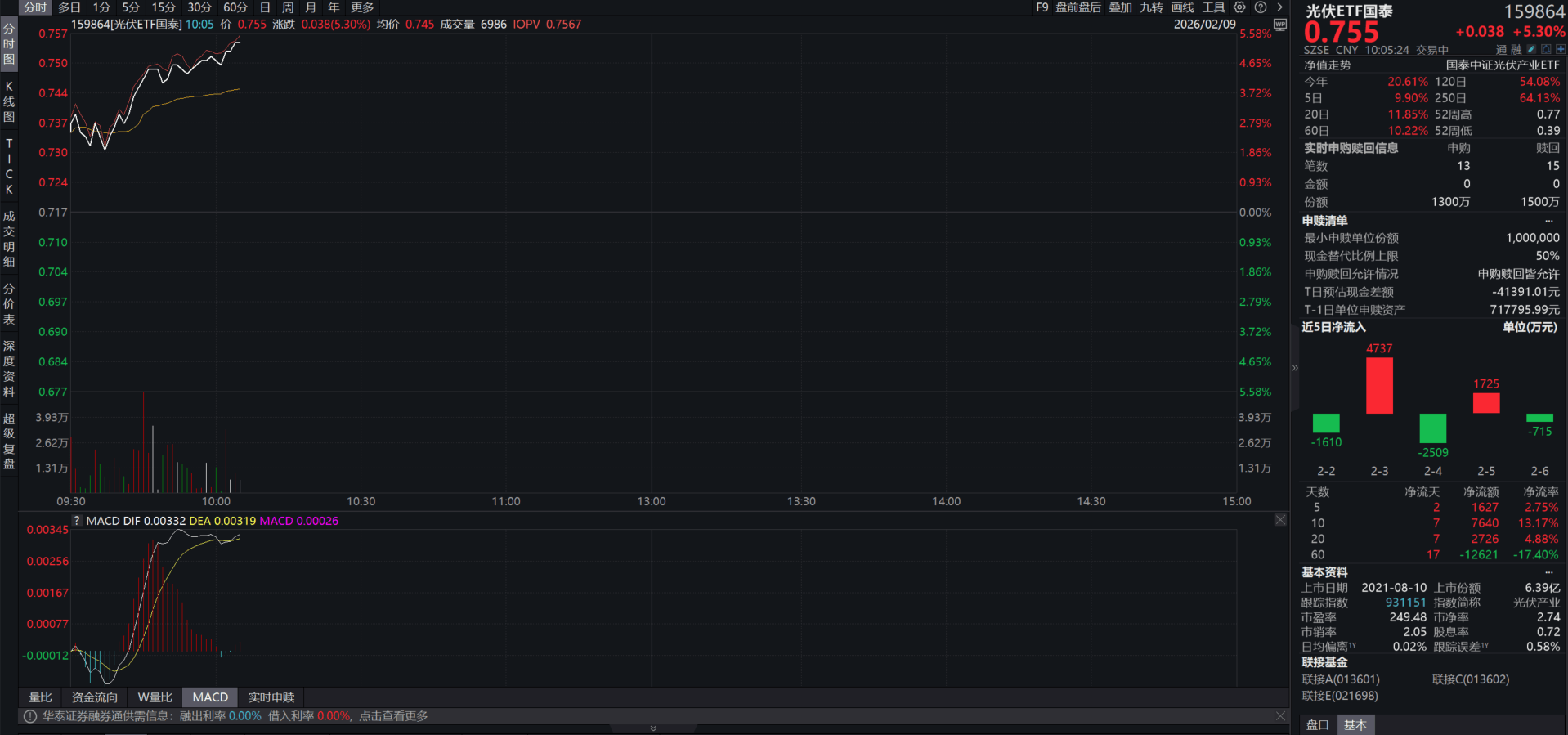
太空光伏概念再度活跃,光伏ETF国泰(159864)强势上涨超5%
Sou Hu Cai Jing· 2026-02-09 02:10
Core Viewpoint - The space photovoltaic sector is experiencing a significant surge, with the Guotai Photovoltaic ETF (159864) rising over 5%, indicating a market recognition of the industry's transition from a cyclical bottom to high-quality development supported by fundamental changes in supply and demand [1] Industry Overview - The commercialization of space photovoltaics is accelerating, opening up a trillion-level new market, with core investment opportunities concentrated in three areas: efficient battery technology iteration, equipment upgrades, and lightweight materials [1] - The demand for space photovoltaics is expected to grow exponentially, with global demand projected to exceed 100 GW by 2035, driven by low-orbit satellite networks [1] - The HJT battery is identified as a short-term core focus due to its ultra-thin and lightweight characteristics, suitable for low-orbit satellite needs, while perovskite/tandem batteries represent a long-term direction with domestic efficiency surpassing 34% [1] Supply and Demand Dynamics - The photovoltaic industry has passed its most challenging cycle, with a key window for supply-demand improvement and profit recovery expected in 2026 [2] - Supply-side dynamics are improving as the previous price war is alleviated through the exit of outdated capacities, with the CR5 in the silicon material segment exceeding 85%, leading to a price recovery from 40,000 CNY/ton to a range of 55,000-75,000 CNY/ton [2] - The cancellation of the export VAT rebate for photovoltaic products on April 1, 2026, is expected to accelerate the exit of small capacities and shift the industry focus from scale competition to technology and brand competition [2] Demand Trends - Global photovoltaic installations remain high at 580-620 GW, with domestic adjustments leading to an increase in distributed energy's share to over 60% [3] - Emerging markets in Africa, Latin America, and the Middle East are experiencing growth rates exceeding 30%, supported by policies like the US IRA and EU REPowerEU [3] - The integration of energy storage with photovoltaic systems is becoming standard, with mandatory storage ratios driving demand for inverters and storage solutions [3] Technological Advancements - Technological iteration is identified as the core growth driver for the photovoltaic industry in 2026, with N-type batteries fully replacing P-type, and market share reaching 96.9% [4] - The adoption of 210mm large-size silicon wafers and TOPCon technology, with over 25% mass production efficiency, is becoming mainstream [4] - The rise of perovskite/silicon tandem batteries, with efficiencies exceeding 30%, is expected to enter small-scale production by 2026, indicating significant long-term potential [4] Investment Opportunities - Future investment opportunities in the photovoltaic industry will focus on three main lines: profit recovery post-supply clearance, benefits from technological iterations, and growth driven by space photovoltaics [5] - For investors, utilizing index investment tools like the Guotai Photovoltaic ETF (159864) is recommended for efficient exposure to the photovoltaic sector, covering key segments across the entire industry chain [5][6]

太空光伏概念股全线走高 特斯拉正加速推进太阳能制造 太空光伏需求有望迎来指数级增长
Zhi Tong Cai Jing· 2026-02-09 02:08
Core Viewpoint - The space photovoltaic concept stocks have seen a significant rise, driven by Tesla's acceleration in solar manufacturing and the anticipated exponential growth in space photovoltaic demand [1] Group 1: Stock Performance - JunDa Co., Ltd. (002865) surged by 167.14%, reaching HKD 43.5 [1] - GCL-Poly Energy (03800) increased by 9.01%, trading at HKD 1.21 [1] - Xinte Energy (01799) rose by 6.81%, priced at HKD 7.69 [1] - Flat Glass Group (601865) gained 6.15%, with a price of HKD 11.56 [1] Group 2: Tesla's Solar Manufacturing Plans - Tesla is evaluating multiple options to expand solar production capacity, including increasing the capacity of its Buffalo, New York factory to 10 GW [1] - Additional factories are being considered in New York, Arizona, or Idaho [1] - Elon Musk stated that Tesla aims to produce 100 GW of solar cells annually to power data centers on Earth and in space [1] Group 3: Market Outlook - CITIC Securities reports that the demand for space photovoltaics is expected to experience exponential growth [1] - Musk's investment in photovoltaic manufacturing is paving the way for powering orbital computing and AI [1] - Leading Chinese photovoltaic equipment manufacturers possess strong capabilities for efficient iteration and rapid response, positioning them to enter the supply chains of Tesla and SpaceX, potentially leading to high-value orders and new growth opportunities [1] - Space photovoltaic equipment may exhibit significant inflation effects, with a potential leap in value [1]
