
高等教育

Search documents
辰林教育就银行授信向公司附属公司应科院提供担保
Zhi Tong Cai Jing· 2025-09-22 11:22
Core Viewpoint - Chenlin Education (01593) has provided a guarantee of up to RMB 300 million to CITIC Bank Nanchang Branch to support its wholly-owned subsidiary, Jiangxi Applied Science Institute, in fulfilling its obligations under a bank financing agreement [1] Group 1 - The guarantee aims to provide favorable financing resources for the operational activities of Jiangxi Applied Science Institute [1] - The board of directors believes that signing the financing agreement and providing the guarantee will enhance cash flow management for the subsidiary [1]
辰林教育(01593.HK)向附属公司江西应用科技学院提供不超过3亿元担保
Ge Long Hui· 2025-09-22 10:20
Core Viewpoint - Chenlin Education (01593.HK) has provided a guarantee of up to RMB 300 million to CITIC Bank Nanchang Branch to support its wholly-owned subsidiary, Jiangxi Applied Technology College, in fulfilling its obligations under a bank financing agreement [1] Group 1 - The guarantee aims to provide favorable financing resources for the operational activities of the college, enhancing its cash flow management [1] - The board of directors believes that the financing agreement and the guarantee terms were determined through fair negotiations among the parties involved, and are reasonable and in the overall interest of the company and its shareholders [1]
辰林教育(01593) - 自愿公告就银行授信向本公司一间附属公司提供担保
2025-09-22 10:09
香 港 交 易 及 結 算 所 有 限 公 司 及 香 港 聯 合 交 易 所 有 限 公 司 對 本 公 告 的 內 容 概 不 負 責,對其準確性或完整性亦不發表任何聲明,並明確表示,概不就因本公告全部 或任何部分內容而產生或因依賴該等內容而引致的任何損失承擔任何責任。 Chen Lin Education Group Holdings Limited 辰 林 教 育 集 團 控 股 有 限 公 司 (於開曼群島註冊成立的有限公司) 承董事會命 本公告乃由辰林教育集團控股有限公司(「本公司」,連同其附屬公司統稱為「本集 團」)自願作出。 本公司之董事(「董事」)會(「董事會」)欣然宣佈,本公司已向中信銀行股份有限公 司 南 昌 分 行(「 該 銀 行 」)提 供 一 筆 最 多 金 額 為 人 民 幣 3 0 0, 0 0 0, 0 0 0 元 之 擔 保(「 擔 保」)。 此 項 擔 保 旨 在 保 證 本 公 司 全 資 附 屬 公 司 江 西 應 用 科 技 學 院(「應 科 院」)( 作 為 借 款 人 ), 按 其 與 該 銀 行( 作 為 貸 款 人 )簽 訂 之 銀 行 融 資 協 議(「 ...
近3亿大单!上海交通大学公布10月大批采购意向
仪器信息网· 2025-09-22 08:55
Core Insights - Shanghai Jiao Tong University has announced multiple procurement intentions for scientific instruments with a total budget of 270 million yuan, expected to be procured by October 2025 [2][3]. Procurement Details - The procurement includes various advanced scientific instruments such as: - Liquid Chromatography-Triple Quadrupole Mass Spectrometer - Scanning Electron Microscope - Targeted Quantitative Detection System for Metabolites - Trace Heavy Metal and Its Speciation Detection Analysis Instrument - Quantitative Analysis Detection Equipment for Volatile and Semi-volatile New Pollutants [2][3]. Budget Breakdown - The budget allocation for specific items includes: - High-purity Liquid Nitrogen: 549.99 million yuan - Ultra-low Temperature Intelligent Workstation: 195 million yuan - Low Noise Low Temperature Constant Temperature System: 530 million yuan - Vacuum Multi-chamber Magnetron Sputtering System: 390 million yuan - Reaction Ion Etching Equipment: 540 million yuan - Laser Floating Zone Furnace: 510 million yuan - Low Temperature SQUID Measurement System: 300 million yuan - Wet Dilution Refrigeration Scanning Probe Microscope System: 1 billion yuan - Ultra-high Vacuum Evaporation Coating System: 655 million yuan - Ultra-low Temperature Multi-field Quantum Measurement and Control System: 516 million yuan - UV Laser Direct Writing Graphic System: 710 million yuan - Electronic Universal Material Testing Machine Upgrade: 425 million yuan [4][5].


江苏34所高校,拟新增建设59个省重点实验室!
仪器信息网· 2025-09-22 08:55
摘要 : 江苏省拟新增建设江苏高校重点实验室59个,包括3个国家级重点实验室培育建设点、39个省高校重点实验室和17个省高校重点(建设)实验室。东南 大学、苏州大学并列第一,江苏大学拟培育"国字号"重点实验室! 特别提示 微信机制调整,点击顶部"仪器信息网" → 右上方"…" → 设为 ★ 星标,否则很可能无法看到我们的推送。 9月18日,江苏省教育厅发布 《江苏高校重点实验室拟新增建设名单公 示》 ,根据《省教育厅关于组织开展江苏高校重点实验室申报建设工 作的通知》(苏教科函〔2025〕2号)要求,经学校遴选推荐,省教育厅组织专家进行评议,拟 新增建设江苏高校重 点 实验室59个 , 包 括 3个国家级重点实验室培育建设点、39个省高校重点实验室和17个省高校重点(建设)实验室。 其中,3个国家级重点实验室培育建设点分别为 中国药科大学 的心血管病临床代谢组学实验室、 南京林业大学 的智慧林业实验室,以及 江 苏大学 的高端海洋流体装备与智能技术实验室。 从拟新增建设数量来看, 东南大学、江苏科技大学、南京师范大学、南京医科大学、苏州大学 均 拟新增建设3个实验室。 | 依托单位 | 实验室名称 | 申报类 ...

教育信息化时代高校英语教师专业发展路径探析
Yang Shi Wang· 2025-09-22 04:14
Core Viewpoint - The article emphasizes the necessity for higher education English teachers to enhance their professional competencies in the context of educational informationization, driven by advancements in information technology such as cloud computing, artificial intelligence, and big data. Group 1: Professional Competencies Required for English Teachers - Information Technology Application Ability: Teachers must not only use basic IT tools but also integrate various digital resources into the teaching process to enhance educational outcomes [1][2] - Information Technology Teaching Design and Implementation Ability: Teachers should design high-quality teaching activities that connect technology with educational goals, utilizing tools like micro-videos and online collaboration platforms to improve classroom interaction [2][3] - Educational Data Analysis and Evaluation Ability: Teachers need to analyze educational data to assess learning progress and individual student needs, enabling more tailored teaching strategies [3][4] - Cross-Cultural Communication and Digital Interaction Ability: Teachers must guide students in cross-cultural communication, understanding cultural nuances, and using digital media effectively [4][5] - Continuous Learning and Innovative Development Awareness: Teachers should adopt a mindset of lifelong learning and innovation to keep pace with rapidly evolving technologies [5][6] Group 2: Development Pathways for English Teachers - Establishing a Multi-Layered Information Technology Training System: A systematic training framework is essential to help teachers master IT skills and move beyond basic applications to more integrated uses [6][7] - Building a Professional Development Learning Community: Creating a collaborative environment for teachers to share experiences and resources can enhance professional growth [7] - Promoting Deep Integration of Information Technology and English Teaching: Classrooms should serve as practice grounds for integrating technology into teaching processes, enhancing the quality of education [6][7] - Strengthening School-Enterprise Cooperation and Industry-Academia Integration: Collaborations with enterprises can provide teachers with access to cutting-edge resources and practical training opportunities [6][7] - Improving Teacher Professional Development Evaluation and Incentive Mechanisms: A revised evaluation system should focus on the effectiveness and innovation of technology use in teaching, alongside traditional metrics [7]
杭州有多吸引“青”? 高校新生在钱塘江边上思政课!
Hang Zhou Ri Bao· 2025-09-22 02:11
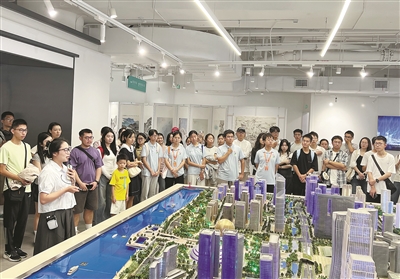
Core Viewpoint - The "Walking Hangzhou" series of ideological and political education activities aims to enhance students' understanding of the city's development and cultural heritage through practical experiences outside the classroom [3][4]. Group 1: Event Overview - Over 100 freshmen from nine municipal universities in Hangzhou participated in the first event of the "Walking Hangzhou" series, which took place along the Qiantang River [3]. - The event included visits to urban balconies, community service centers, and urban planning exhibition halls, providing a hands-on learning experience [3]. Group 2: Student Engagement - Students expressed excitement and surprise at gaining a deep understanding of Hangzhou, with many visiting the city for the first time [3]. - A graduate student in archaeology noted that the experience helped bridge the past and future of Hangzhou, motivating them to contribute to the city's historical narrative [3]. Group 3: Educational Impact - The initiative is part of a broader effort to integrate ideological education across all levels of education in Hangzhou, emphasizing the importance of practical learning [4]. - The program aims to instill a sense of belonging and commitment to the city among young people, encouraging them to stay and contribute to its development [4].
“教育强国:特色高校改革发展论坛”举行
Ren Min Ri Bao· 2025-09-22 01:50
与会者表示,特色高校特别是外语外事类院校正处于转型升级的关键时期,要立足自身办学传统与优 势,紧密对接国家重大战略需求,明晰发展定位,强化特色引领,深化综合改革,在学科建设、人才培 养、国际交流合作等方面不断改革创新,在中国式现代化和教育强国建设的宏伟征程中找准方位、彰显 价值。(凌胜利 赵昊) 人民日报北京9月21日电 "教育强国:特色高校改革发展论坛"日前在外交学院举行,来自上海外国语大 学、北京语言大学、广东外语外贸大学等全国20余所外语院校的专家学者参加。外交学院院长王帆、中 国国际问题研究院院长陈波出席开幕式并致辞。围绕新时代外语院校的使命与挑战、学科建设、人才培 养、服务国家重大战略等议题,与会者展开深入讨论。 ...
优胜劣汰通道开启 民办高校加速洗牌
Zhong Guo Qing Nian Bao· 2025-09-21 22:45
今年高校招生季,民办本科高校招生经历了"冰火两重天"。一方面,少数新建"新型研究性大学"招生分 数奇高,甚至超过一些"双一流"建设高校和专业;另一方面,不少传统民办本科高校招生遇冷,引起人 们对民办高校发展前景的担忧。据报道,少部分省份民办本科高校在第一轮招生后缺额严重,有的高校 经过多次征集补录仍难以完成招生计划,有的甚至被迫取消了文化课分数限制。 目前,我国本科教育体量巨大,出现以上两种情况的高校均为少数,各种夸大其词的议论并不完全可 信。然而,从历史、现实和未来的维度认识,这两种情况都体现了我国本科教育发展的新趋势,对民办 乃至公办本科高校发展前景的担忧并不多余。面对来自人口、技术、政策、产业等方面的重大变化,民 办本科高校进入优胜劣汰的发展通道,转型升级成为必然选择。 本科高校生源供给面临多重挑战 我国民办本科教育从20世纪90年代中期开始出现,2000年以后进入快速发展轨道。2024年全国教育事业 发展统计公报显示,全国共有民办高校803所,占全国高校总数比例的25.75%。民办高校在普及高等教 育、探索办学和管理体制改革、创新人才培养模式等方面发挥了重要作用。近年来,随着新出生人口减 少和政策规范 ...
边城求学记:南亚东南亚学子眼中的云南机遇
Zhong Guo Xin Wen Wang· 2025-09-21 20:22
Group 1 - The article highlights the unique appeal of Yunnan as a study destination for students from South Asia and Southeast Asia, driven by geographical proximity, cultural connections, and quality educational resources [3][4] - In 2024, the number of universities in Yunnan recruiting foreign students has increased to 58, with over 13,000 students from South Asia and Southeast Asia studying in the region [3] - Yunnan has established government scholarships, simplified visa procedures, and provided employment support to create a favorable environment for international students [4] Group 2 - Yunnan University has formed the South Asia and Southeast Asia University Alliance, which has become an important platform for regional higher education exchange, with 126 member institutions [3] - The collaboration between Kunming University of Science and Technology and Malaysian universities has opened new pathways for international cooperation in engineering education [4] - The article emphasizes the potential for further educational internationalization in Yunnan with the completion of the China-ASEAN Free Trade Area negotiations and the implementation of RCEP [4]