Semiconductors

Search documents
这项技术,助力突破NAND瓶颈
半导体芯闻· 2026-03-24 10:53
Core Viewpoint - A new technology developed by a research team from KAIST aims to overcome the limitations of NAND flash memory by utilizing a novel material, boron nitride oxide (BON), to enhance data processing speed and storage stability [2][3]. Group 1: Technology Development - The research team has created an asymmetric tunneling layer technology that selectively controls electron movement using BON, addressing performance degradation and reliability issues associated with the shrinking size and increasing complexity of 3D V-NAND structures [2][3]. - NAND flash memory is a non-volatile storage medium that retains data even without power, but as storage unit sizes decrease, challenges such as slower erase speeds and increased data leakage arise, particularly in the next-generation five-level cell (PLC) technology [2]. Group 2: Performance Improvements - By incorporating BON into the tunneling layer, the new design reportedly improves data erase speed by 23 times compared to traditional designs while maintaining high durability with minimal performance degradation during repeated operations [3]. - The research team successfully distinguished 32 finely divided voltage states in a PLC environment, allowing for over three times higher precision in controlling data distribution between devices, which significantly reduces data interference and lowers read error rates [3]. Group 3: Commercial Viability - The technology has progressed beyond the laboratory stage and is applicable to large-scale semiconductor production processes, marking a significant breakthrough for the commercialization of next-generation ultra-high-capacity storage [3].

Wall Street Breakfast Podcast: Router Ban Plugs Into Gains
Seeking Alpha· 2026-03-24 10:51
Group 1: U.S. Regulatory Changes - The Federal Communications Commission (FCC) has added foreign-made Wi-Fi routers to its "Covered List," effectively banning the import of new models due to national security concerns [3] - The FCC stated that these foreign-made routers pose a severe cybersecurity risk and could disrupt the U.S. economy and critical infrastructure [3] - Existing inventory and installed routers will remain in use, but future devices will be affected by this ban [3] Group 2: Impact on Companies - The ban will impact not only Chinese manufacturers like TP-Link but also U.S.-headquartered firms such as Netgear (NTGR), Eero (AMZN), and Google (GOOG) Nest, which rely on Asian manufacturing [4] - Netgear's shares surged by 14% following the FCC's announcement [2] Group 3: SK Hynix Acquisition - SK Hynix (HXSCL) is acquiring advanced production equipment valued at 12 trillion won ($7.9 billion) from ASML to meet rising demand for memory chips [4] - The equipment, including extreme ultraviolet scanners, is expected to be delivered by December 2027 for next-generation production processes [5] - SK Hynix is also seeking to raise 10 trillion won to 15 trillion won ($10 billion) through a potential U.S. listing [6] Group 4: Puig and Estée Lauder Merger Talks - Shares of Puig (PUIGF) rose by 15% after Estée Lauder (EL) confirmed it is in talks about a merger [7] - Puig has a market capitalization of €8.8 billion ($10.3 billion), while Estée Lauder's market value is $31 billion [7]




Wall Street Breakfast Podcast: FCC Router Ban Plugs Into Gains
Seeking Alpha· 2026-03-24 10:51
Group 1: U.S. Regulatory Changes - The Federal Communications Commission (FCC) has added foreign-made Wi-Fi routers to its "Covered List," effectively banning the import of new models due to national security concerns [3] - The FCC stated that these routers pose a severe cybersecurity risk and could disrupt the U.S. economy and critical infrastructure [3] - Existing inventory and installed routers will remain in use, but future devices will be affected [3] Group 2: Impact on Companies - The ban will impact not only Chinese manufacturers like TP-Link but also U.S.-headquartered firms such as Netgear (NTGR), Eero (AMZN), and Google (GOOG) Nest, which rely on Asian manufacturing [4] - Netgear's shares surged by 14% following the FCC's announcement [2] Group 3: SK Hynix Acquisition - SK Hynix (HXSCL) is acquiring advanced production equipment valued at 12 trillion won ($7.9 billion) from ASML to meet rising demand for memory chips [4] - The equipment, including extreme ultraviolet scanners, is expected to be delivered by December 2027 [5] - This acquisition aligns with SK Hynix's strategy to expand memory chip production, particularly high bandwidth memory, driven by demand from the AI industry [5] Group 4: Puig and Estée Lauder Merger Talks - Shares of Puig (PUIGF) rose by 15% after Estée Lauder (EL) confirmed it is in talks about a potential merger [6][7] - Puig has a market capitalization of €8.8 billion ($10.3 billion), while Estée Lauder's market value is $31 billion [7]

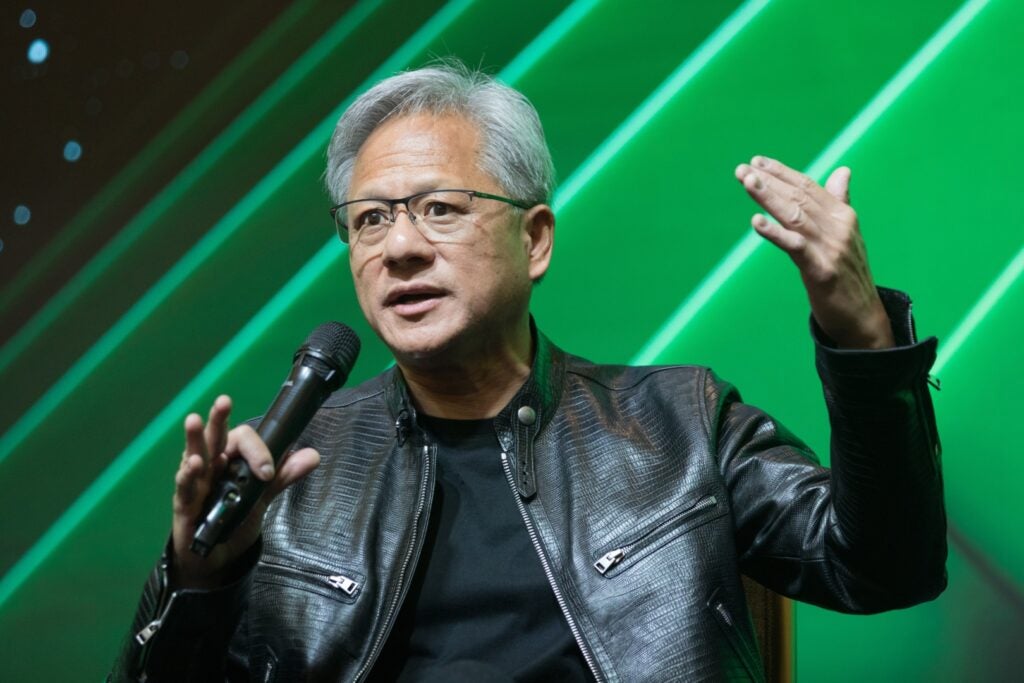
Nvidia CEO claims AGI has been achieved; Is NVDA stock about to soar?
Finbold· 2026-03-24 10:49
Core Viewpoint - Jensen Huang, CEO of Nvidia, claimed that artificial general intelligence (AGI) has already been achieved, suggesting it could run companies or create widely used applications [1][2]. Group 1: AGI and Its Implications - AGI is described as artificial intelligence that has reached or surpassed human intelligence, with references to fictional representations like Data from Star Trek [3]. - The achievement of AGI is seen as a pivotal factor behind significant investments in AI, potentially transforming the global economy and society [4]. Group 2: Nvidia Stock Reaction - Despite the AGI claims, Nvidia's stock showed minimal movement, with a slight increase of 1.59% on March 23, attributed more to market trends than Huang's comments [5]. - The stock's limited response can be linked to Huang's subsequent statement that AGI has a "0%" chance of running a company like Nvidia, which undermines his earlier assertion [8]. Group 3: Industry Context and Challenges - Huang's earlier comments suggested Nvidia would have more employees in the future, contrasting with the narrative that AI will replace human workers [9]. - The AI industry's potential to enhance productivity and improve quality of life is noted, but this outcome has not been consistent with historical trends [10]. - Concerns about the AI sector's profitability and high valuations are growing, with surveys indicating AI adoption has not significantly improved productivity [15][16]. - Ongoing challenges such as the private credit crisis and supply chain disruptions, particularly related to helium and energy shortages, pose risks to the semiconductor and AI industries [16][17].


Puig stock soars 15%, but why market sees risk in Estée Lauder deal?
Invezz· 2026-03-24 10:25
Core Viewpoint - Puig's stock surged over 15% following Estée Lauder's confirmation of merger talks, indicating investor excitement about a potential reshaping of the global prestige cosmetics market [1][6]. Financial Performance - Estée Lauder's fiscal Q2 2026 sales were $4.229 billion with an adjusted operating margin of 14.4%, returning to positive operating income after a loss the previous year [4]. - Puig reported record revenue of €5.042 billion for FY2025, with adjusted EBITDA of €1.045 billion (20.7% margin), a net profit of approximately €594 million, and free cash flow of €664 million [4][5]. Strategic Fit - The merger could create a beauty group with approximately $20 billion in annual sales and an implied valuation exceeding $40 billion, combining Estée Lauder's scale with Puig's growth and profitability [3][5]. Market Reaction and Analyst Sentiment - Analysts are divided on the merger's potential, with some expressing skepticism about large transformational deals due to past negative reactions in similar transactions [7]. - Concerns include integration complexity and execution challenges, although potential synergies of about 5% of the target's sales could provide significant long-term benefits [8][9]. - Optimistic analysts suggest the merger could lead to double-digit earnings-per-share growth in the first year, while others caution that Estée Lauder's share price reflects investor unease regarding the deal [9].

电子行业年度策略:AI开启新一轮硬件通胀,国产算力加速突围
Shanxi Securities· 2026-03-24 10:21
Group 1: Semiconductor Industry - The semiconductor industry is experiencing an upturn driven by AI demand and domestic substitution, with significant capital expenditure expected from major cloud service providers (CSPs) [12][13] - Storage is entering a super cycle due to the massive parameter requirements of AI training, leading to increased demand for high-capacity, high-bandwidth storage solutions like HBM and eSSD [1][15] - The market for DRAM is expected to face shortages as HBM demand grows, with predictions indicating a decline in non-HBM wafer capacity from 81% to 76% among the top five DRAM manufacturers [22][24] Group 2: Storage Market - The storage market is projected to see a significant price increase, with memory prices expected to rise by 80%-90% in Q1 2026, and the global memory market value anticipated to reach $551.6 billion [15][19] - HBM supply is expected to remain tight, with a projected supply gap increasing from 5% in 2025 to 9% in 2027, driven by high demand from leading AI companies [17][18] - NAND production capacity is under pressure, with supply constraints expected to persist due to cautious expansion and a shift towards high-value products [25][28] Group 3: Chip Market - The domestic AI chip market is rapidly expanding, with the accelerated server market projected to exceed $140 billion by 2029, driven by strong demand and the need for domestic production capabilities [29][30] - The power device market is experiencing price increases due to rising costs and heightened demand from sectors like data centers and electric vehicles [33][35] - The analog chip market is expected to grow significantly, with a projected market size of $245.1 billion by 2026, driven by recovery in traditional industries and the rise of AI applications [37][38] Group 4: Electronic Components - The PCB industry is undergoing a transformation towards high-layer, high-speed, and new material standards, driven by the demands of AI servers and high-density interconnects [58][60] - The demand for advanced materials in PCB manufacturing is increasing, with a shift towards low Dk and low Df materials to ensure signal integrity and reliability [63][72] - The market for high-end copper foil is evolving to meet the needs of high-frequency and high-density applications, with significant growth expected in the carrier copper foil segment [67][69]
Tech Momentum and Economic Data Drive Premarket Gains as Investors Eye Fed Policy
Stock Market News· 2026-03-24 10:07
Market Overview - U.S. stock futures are trending higher, indicating a positive start for Wall Street as investors assess the impact of the recent Federal Reserve policy meeting and upcoming economic data [1] - The S&P 500 remains close to all-time highs, supported by strong corporate earnings and a resilient labor market, while the 10-year Treasury yield stabilizes around 4.15% [3] Premarket Activity and Index Performance - Nasdaq Composite (IXIC) futures are leading with a 0.54% increase, driven by growth-oriented sectors, particularly semiconductor and software companies [2] - S&P 500 (SPX) futures are up 0.32%, and Dow Jones Industrial Average (DJI) futures are slightly higher by 0.15% [2] Economic Data Releases - Durable Goods Orders for February increased by 1.2%, surpassing analyst expectations, indicating steady business investment despite higher borrowing costs [4] - The Consumer Confidence Index is anticipated to be 106.5, with a stronger reading potentially supporting the "soft landing" narrative while giving the Federal Reserve more leeway to maintain elevated interest rates [5] Major Stock News and Corporate Developments - Nvidia (NVDA) shares rose 1.8% due to a new supply agreement for AI infrastructure chips, positively impacting peers like Advanced Micro Devices (AMD) and Broadcom (AVGO) [6] - Apple (AAPL) shares increased by 0.7% following a strategic partnership to enhance its operating system with generative AI features [7] - Tesla (TSLA) shares fell 1.2% after an analyst downgrade related to Q1 delivery volumes in Europe, while Alphabet (GOOGL) shares gained after overcoming a regulatory hurdle in the EU [8] Other Notable Movers - Amazon (AMZN) is experiencing positive sentiment in the retail sector, and Meta Platforms (META) continues to see strong engagement metrics [9] - In the banking sector, JPMorgan Chase (JPM) and Goldman Sachs (GS) are trading slightly higher as the yield curve steepens, benefiting traditional lending margins [9]






Broadcom Launches Symantec CBX: Bringing Elite AI Security To Small Business Budgets
Yahoo Finance· 2026-03-24 10:01
Core Insights - Broadcom Inc is enhancing its growth strategy by focusing on cybersecurity and AI infrastructure capabilities [1] - The semiconductor sector experienced a rebound due to easing geopolitical tensions, particularly related to U.S.-Iran relations [1][2] Cybersecurity Developments - Broadcom introduced Symantec CBX, a cloud-based security platform that integrates Symantec and Carbon Black technologies, aimed at organizations with limited security resources [3] - CBX consolidates multiple security functions, enabling users to monitor activities across devices and networks, thereby improving threat detection and response [4] - The platform provides advanced protection to smaller organizations, making it easier for them to defend against complex cyberattacks [5] AI Infrastructure Expansion - Broadcom is advancing its AI initiatives by launching new networking products that enhance data center efficiency for AI operations [6] - The company has begun shipping the Tomahawk 6 chip, which processes twice the data of its predecessor, facilitating larger AI operations [7] - Broadcom is collaborating with partners to optimize AI data center operations and is developing cooling solutions to address increasing computing demands [7]

Semtech SurgeSwitch® Tackles the USB-PD VBus Protection Gap at 53 V
Businesswire· 2026-03-24 10:00
Core Viewpoint - Semtech Corporation has announced the TDS5311P, the first circuit protection device designed for USB Power Delivery Extended Power Range applications at 48 V, enhancing the SurgeSwitch® family of products [1] Company Summary - Semtech Corporation is a leading provider of high-performance semiconductors that support data center networking, Internet of Things (IoT) connectivity, and cellular infrastructure solutions [1] Product Summary - The TDS5311P is positioned as the industry's first device to provide near-constant clamping voltage specifically for USB PD EPR applications at 48 V, indicating a significant advancement in circuit protection technology [1]


Nvidia CEO Jensen Huang Drops A Bombshell— 'I Think We've Achieved AGI'
Benzinga· 2026-03-24 09:40
Core Viewpoint - NVIDIA CEO Jensen Huang believes that Artificial General Intelligence (AGI) has already been achieved, suggesting that an AI capable of building and running a billion-dollar tech company qualifies as AGI [1]. Group 1: AGI Definition and Achievement - Huang defines AGI as an AI that can create a successful product, even if it is not permanent, comparing it to short-lived companies from the dot-com era [1]. - He asserts that the achievement of AGI is not a distant future event, but rather a current reality [1]. Group 2: Industry Perspectives - Huang acknowledges that while AGI could eventually design chips similar to those produced by NVIDIA, current AI technologies have not yet surpassed complex human intelligence [3]. - In contrast, former Tesla AI Chief Andrej Karpathy argues that AGI is still a decade away, emphasizing that the industry is overestimating its current capabilities and that existing models require significant improvement [4].