人工智能

Search documents
突发|华为诺亚方舟实验室主任王云鹤离职
机器之心· 2026-03-28 04:45
Core Viewpoint - The departure of Wang Yunhe, the director of Huawei's Noah's Ark Lab, marks a significant shift in the AI industry, indicating a profound structural transformation within the sector since 2026 [3][25]. Group 1: Wang Yunhe's Background - Wang Yunhe, born in 1991, graduated with a Bachelor's degree in Mathematics from Xi'an University of Electronic Science and Technology and obtained his PhD in Intelligent Science from Peking University in 2018, focusing on deep learning, model compression, machine learning, and computer vision [5][8]. - He has over 8 years of experience at Huawei, starting as an intern at Noah's Ark Lab and progressing to roles such as Senior Engineer, Chief Engineer, and eventually the director of the lab [8][25]. Group 2: Contributions and Achievements - Wang has a notable academic record with over 33,000 citations on Google Scholar, highlighting his influence in the field of AI [13]. - His research includes the development of GhostNet, a lightweight neural network architecture that achieved a Top-1 accuracy of 75.7% on the ImageNet classification task, surpassing MobileNetV3 [15][16]. - He has contributed significantly to the Vision Transformer research, with his survey article receiving 5,528 citations, establishing it as a key reference in the field [18]. Group 3: Insights on AI Models - Wang has provided unique insights into the mainstream technology routes in the era of large models, discussing the potential impact of diffusion models on autoregressive models and emphasizing the need for structural thinking in model design [21]. - His recent work on the DLLM Agent explores how different generative paradigms affect agent planning and decision-making, demonstrating the efficiency of the proposed model in global planning and interaction [22][24]. Group 4: Industry Impact - Wang's departure from Huawei is a focal point for the industry, as he has led several internationally influential algorithm innovations during his tenure [25]. - His future career path, particularly regarding his thoughts on unifying architectures for diffusion language models and general artificial intelligence, remains a topic of interest for the industry [26].


AI三年后取代外科医生?马斯克暴论被证伪
第一财经· 2026-03-28 04:42
Core Viewpoint - The development of surgical robots is currently at a stage comparable to the levels of automotive autonomous driving, primarily between L1 basic assistance and L2 advanced assistance, with only a few standardized procedures exploring L3 conditional autonomy, indicating that surgical robots can assist but not replace the decision-making capabilities of surgeons [3][12]. Group 1: Surgical Robot Development - The "SurgMotion" surgical video model was recently launched by the Chinese Academy of Sciences Hong Kong Innovation Research Institute, aiming to serve as a reliable teaching tool and to enhance the development of intelligent surgical robots [4][11]. - Surgical procedures in China have increased significantly, from 69.3 million in 2019 to 104 million in 2023, highlighting the growing demand for surgical services [4]. - The distribution of surgical physicians in China is uneven, with a severe shortage in grassroots areas, necessitating extensive training for new surgeons [4]. Group 2: AI Integration in Surgery - AI models can integrate vast clinical data and expert experiences, enhancing surgeons' decision-making capabilities and addressing the limitations of traditional training methods [5]. - The "SurgMotion" model is the largest of its kind, trained on a dataset of approximately 15 million frames and over 3,658 hours of real surgical videos, covering 13 anatomical areas and over 100 common clinical procedures [6][11]. - The model aims to improve the visual perception and situational understanding of surgical robots, transitioning surgery from reliance on individual experience to standardized, quantifiable practices [5][6]. Group 3: Levels of Surgical Robot Intelligence - Surgical robots are categorized into five levels of intelligence, with L1 providing basic assistance and L2 offering advanced automated support for specific tasks, while L3 is still in early experimental stages [8][9]. - L1 robots assist surgeons by enhancing precision in operations, while L2 robots automate certain repetitive tasks, improving efficiency without fully taking over decision-making [9]. - L3 robots can perform specific steps autonomously in controlled environments but require human intervention in unexpected situations, indicating the current limitations of AI in complex surgical scenarios [9][10]. Group 4: Challenges and Future Outlook - The transition to fully autonomous surgical robots (L4-L5) remains theoretical due to the complexity and unpredictability of surgical environments, which AI currently cannot fully navigate [10][12]. - The integration of AI in surgery is expected to enhance the role of surgeons, who will increasingly act as conductors of human-machine collaboration rather than being replaced by robots [12][14]. - The medical field's unique challenges, including ethical considerations and regulatory requirements, will slow the adoption of AI technologies in clinical settings, making the complete replacement of human surgeons unlikely in the near future [12][16].

ChatGPT 让所有人变成了超级个体,却没让你的公司成为超级组织
Founder Park· 2026-03-28 03:34
Core Insights - The article discusses the limitations of AI in enhancing organizational productivity despite individual efficiency gains, highlighting a disconnect between personal productivity and overall company performance [3][5][13]. Group 1: AI's Impact on Productivity - AI tools usage increased by 65% in 400 companies over 16 months, but code delivery only rose by less than 10% [3]. - Over 80% of surveyed executives reported no measurable impact of AI on productivity [3]. - The article compares the current situation to the late 19th century when factories adopted electric motors without redesigning workflows, leading to minimal productivity gains [4][13]. Group 2: Systemic Challenges - Four systemic challenges hinder productivity improvements: coordination collapse, noise amplification, productivity illusion, and AI's counterproductive effects [5][8][10]. - Coordination issues arise as employees use AI tools differently, leading to fragmented outputs [5]. - Noise amplification results from the low cost of generating content, making it harder to discern valuable insights [7]. - A study found that developers using AI tools were actually 19% slower, despite believing they were 20% faster, indicating a significant perception-reality gap [8]. Group 3: Organizational Design and AI Integration - Organizations need to redesign processes to integrate AI effectively, moving from viewing AI as a tool to treating it as a team member [15][16]. - New roles such as AI Agent Manager and Intent Engineer are emerging to manage AI's integration into workflows [16]. - The article emphasizes that organizations must focus on outcomes rather than just efficiency, as merely speeding up existing tasks does not lead to transformative results [13][14]. Group 4: Case Studies and Solutions - The article presents examples of companies like Goldman Sachs and Palantir that are successfully integrating AI into their operations by rethinking workflows and decision-making processes [20][21]. - Tezign's Generative Enterprise Agent (GEA) is highlighted as a system that understands context and drives business results, moving beyond traditional AI tools [23][28]. - GEA's Context System allows for better utilization of non-structured data, significantly increasing the efficiency of content usage [29]. Group 5: Future Directions - The article concludes that organizations must evolve from simply adopting AI tools to creating systems that leverage AI's capabilities for strategic decision-making and operational efficiency [56]. - The need for a shift in mindset is emphasized, where companies must ask if their processes are designed for AI rather than just implementing AI tools [56].

走出网页和 App 后,消费级 AI 应用的实力该如何衡量?
机器之心· 2026-03-28 02:30
Group 1 - The traditional metrics based on traffic, such as web visits and mobile MAU, are increasingly inadequate to capture the real growth of consumer AI applications as they become embedded in existing products and workflows [4][6][7] - The a16z "Top 100" series has evolved to include generative AI capabilities integrated into existing products, reflecting a shift in how consumer AI growth is measured [5][6] - Data from Similarweb indicates that by June 2025, platforms like ChatGPT and others generated over 1.1 billion referral visits, marking a 357% year-on-year increase, highlighting the growing impact of AI on user engagement and decision-making [8] Group 2 - The emergence of generative AI in browsers, desktop applications, and productivity tools signifies a shift in the primary environments where AI functionalities are utilized, moving beyond standalone apps [9] - The traditional last-click attribution model is becoming less effective in capturing the user decision-making process, as AI-driven search and in-platform answers compress the stages of information discovery and brand comparison [6][7] - Similarweb's analysis shows that while AI platform visits grew by 28.6% from January 2025 to January 2026, external referrals remained stable, indicating that increased usage of AI platforms does not necessarily translate into external traffic [8]

广深豪宅成交增速超100%,Anthropic最早于10月上市 | 财经日日评
吴晓波频道· 2026-03-28 00:21
Group 1: Industrial Profit Growth - In the first two months of the year, China's industrial enterprises above designated size achieved a total profit of 10,245.6 billion yuan, a year-on-year increase of 15.2% [2] - State-owned enterprises reported a profit of 3,665.6 billion yuan, up 5.3%, while private enterprises saw a significant increase of 37.2% to 2,844.5 billion yuan [2] - The computer, communication, and other electronic equipment manufacturing industries experienced a profit growth of 200%, while the automotive manufacturing sector faced a decline of 30.2% [2][3] Group 2: Real Estate Market Trends - High-end residential transactions in first-tier cities increased by 14% year-on-year, with Guangzhou and Shenzhen seeing transaction growth exceeding 100% [4] - The luxury market in Guangzhou recorded a new high with a unit price of 28,000 yuan per square meter, reflecting strong demand despite overall market challenges [4][5] - The disparity between the luxury and mid-range markets indicates a divide in buyer purchasing power, with luxury properties maintaining strong demand [5] Group 3: Instant Delivery Market Growth - The instant delivery market is projected to exceed 600 billion orders by 2025, with a market size approaching one trillion yuan [6] - Instant retail is expanding beyond food delivery to include supermarkets, fresh produce, and pharmaceuticals, indicating a diversification of services [6] - Despite the challenges in profitability, major platforms are investing in instant delivery as a key growth area due to its high-frequency demand [6] Group 4: Financial Sector Developments - A Beijing-based private equity firm has relaxed its hiring requirements to attract younger talent, emphasizing skills over formal education [7][8] - The firm plans to leverage AI in its investment strategies, indicating a shift towards technology-driven investment approaches [7][8] Group 5: Company Financial Performance - Meituan reported a significant net loss of 186 billion yuan for 2025, despite a revenue increase of 8.1% to 364.9 billion yuan [9] - The company's core local business segment saw a revenue growth of 4.2%, but operating profit turned to a loss of 69 billion yuan, highlighting intense competition and increased marketing expenses [9][10] - Nayuki Tea reported a revenue decline of 12% to 4.33 billion yuan, but managed to narrow its net loss by 73.8% through strategic store closures and optimizations [11][12] Group 6: Upcoming IPOs in AI Sector - Anthropic is planning to go public as early as October, aiming to raise over 60 billion dollars, following a significant funding round that valued the company at 380 billion dollars [13][14] - The company has experienced rapid revenue growth, driven by strong demand for automation tools, and is expected to narrow the gap with competitors like OpenAI [13][14]

中聚投资(01959) - 自愿公告 - 战略合作备忘录
2026-03-27 14:56
香港交易及結算所有限公司及香港聯合交易所有限公司對本公告的內容概不負責,對其準確 性或完整性亦不發表任何聲明,並明確表示概不就因本公告全部或任何部分內容而產生或因 倚賴該等內容而引致的任何損失承擔任何責任。 ZHONG JU INVESTMENT GROUP LIMITED 中聚投資集團有限公司 (前稱世紀聯合控股有限公司) (於開曼群島註冊成立的有限公司) (股份代號:1959) 自願公告 戰略合作備忘錄 本公告乃由中聚投資集團有限公司(「本公司」,連同其附屬公司統稱「本集團」) 自願作出,旨在知會本公司股東及潛在投資者有關本集團之最新業務發展。 戰略合作備忘錄 本公司董事(「董事」)會(「董事會」)欣然宣佈,於二零二六年三月二十七日,本 公司與中美國際控股集團有限公司(「中美」)訂立一份不具法律效力及約束力 的戰略合作備忘錄(「戰略合作備忘錄」),據此,雙方同意就健康管理、人工智 能(「AI」)應用、平台生態建設及其他相關領域(「合作業務」)進行合作。 本公司為一家投資控股公司。其附屬公司主要在中華人民共和國(「中國」)從 事機動車銷售及提供服務。 中美為一間於香港註冊成立的有限公司,其為一個全球性人工智 ...
3 天前突然禁止 873 家中国机构投稿,NeurIPS 顶不住压力火速道歉
程序员的那些事· 2026-03-27 14:40
Core Viewpoint - The NeurIPS 2026 conference faced significant backlash due to newly introduced restrictive submission guidelines that excluded entities on the OFAC sanctions list, impacting 873 Chinese institutions and researchers, leading to a rapid public relations reversal and apology from the conference organizers [1][5]. Group 1 - NeurIPS is a leading international conference in machine learning and computational neuroscience, considered one of the top three conferences alongside ICML and ICLR, and is crucial for academic achievements such as PhD graduation and faculty applications [1]. - On March 24, NeurIPS announced new submission guidelines that prohibited submissions from entities on the OFAC sanctions list, which affected numerous Chinese universities and research institutions [1]. - The announcement sparked immediate outrage, prompting the Chinese Computer Federation to condemn the politicization of academic exchanges and call for a collective boycott from domestic scholars [2][4]. Group 2 - On March 27, the Chinese Association for Science and Technology publicly stated it would suspend funding for scholars participating in the conference and would not recognize related papers as project outcomes [2]. - In response to the collective pressure from the academic community, many researchers announced their refusal to submit papers, review, or even participate in the organizing committee, leading to a crisis in the conference's credibility [4]. - Following the backlash, NeurIPS issued a public apology on March 27, clarifying that the restrictive terms were a miscommunication and that the submission guidelines would revert to align with previous standards, eliminating discriminatory barriers [5].

刚刚,一口气连发3个王炸模型、亮出2026年AGI战略,昆仑万维夯爆了
机器之心· 2026-03-27 13:38
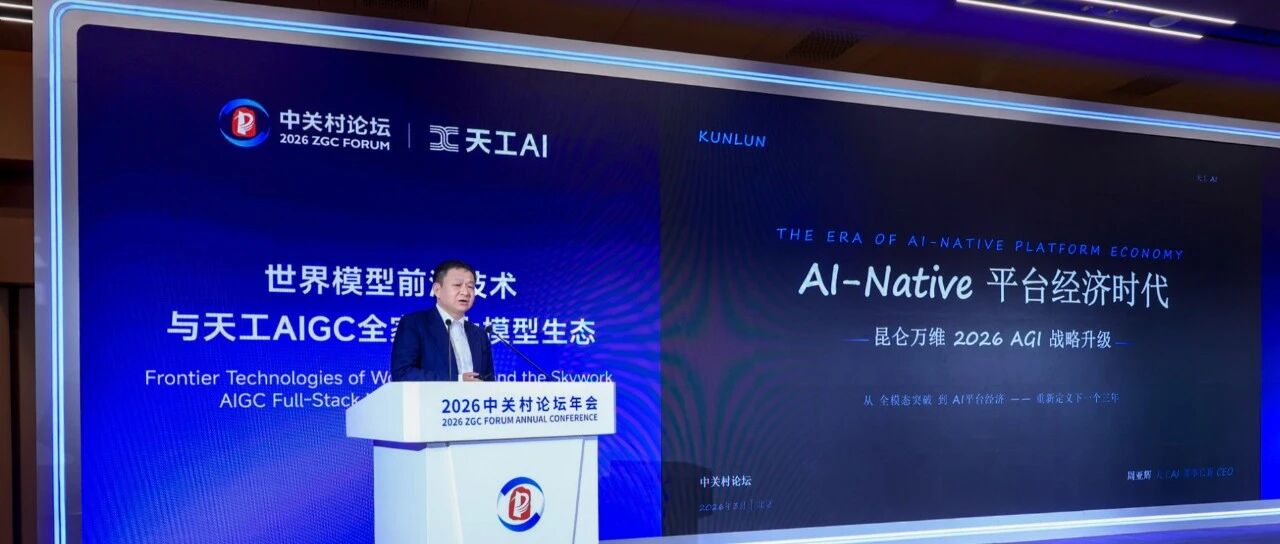
Core Viewpoint - Kunlun Wanwei showcased its latest advancements in artificial general intelligence (AGI) and AI-generated content (AIGC) at the 2026 Zhongguancun Forum, emphasizing its commitment to achieving the ultimate goal of general AI [1][3]. Group 1: New AI Models Released - Kunlun Wanwei's TianGong AI launched three major models: Matrix-Game 3.0, SkyReels V4, and Mureka V9, which enhance AIGC capabilities and advance AI modeling and simulation of the physical world [3][4]. - SkyReels V4 achieved global first place in the "Text to Video with Audio" and "Text to Video without Audio" categories, and second place in the "Image to Video without Audio" category in the Artificial Analysis benchmark [4][6]. Group 2: Matrix-Game 3.0 Features - Matrix-Game 3.0 addresses three critical shortcomings of previous world models: memory retention, long-term operation, and real-time performance, enabling a transition from generating fragments to running entire worlds [17][19]. - The model incorporates a dual pipeline system for data production, utilizing both Unreal Engine synthetic data and real 3A game captures, ensuring comprehensive data acquisition [19][20]. - It employs a collaborative mechanism between computational efficiency and memory capability, achieving real-time generation at 720p resolution while maintaining long-term stability [21][28]. Group 3: SkyReels V4 Enhancements - SkyReels V4 integrates audio and video generation into a unified model, allowing for coherent narrative capabilities similar to human storytelling [33][34]. - The model supports detailed editing and repair capabilities, enabling creators to manage video content more effectively, including element addition, style transfer, and watermark processing [37][39]. - It utilizes a multi-modal semantic reward system to enhance the logical coherence and aesthetic quality of generated content, balancing quality and computational cost [38][39]. Group 4: Mureka V9 Developments - Mureka V9 surpasses its predecessor by organizing music generation closer to real creative processes, focusing on structure, emotional alignment, and iterative refinement [45][46]. - The model transforms music creation into a repeatable and adjustable process, allowing creators to explore multiple versions and make adjustments, thus enhancing the overall creative workflow [46][47]. - Mureka V9 aims to establish a platform for music creation that connects creators and consumers, potentially revolutionizing the music generation landscape [47][55]. Group 5: AGI Strategy and Future Outlook - Kunlun Wanwei's 2026 AGI strategy outlines a clear path towards achieving general AI, focusing on three major models (game, video, and music) and a superintelligent agent for unified task execution [48][51]. - The strategy emphasizes the importance of an open ecosystem that facilitates collaboration between developers and creators, aiming to translate AI capabilities into practical applications across various industries [55][56].

AI竞赛的终局不是技术,而是现金流:Anthropic的隐藏优势
美股研究社· 2026-03-27 11:29
Core Viewpoint - The investment landscape in the AI sector is shifting from a focus on technological capabilities to a more pragmatic evaluation of cash flow and profitability, indicating a transition from "tech narrative" to "business narrative" [1][2][4]. Group 1: Investment Trends - Major tech companies like Google and Amazon are investing billions into Anthropic, signaling a shift in survival logic away from OpenAI's model [2]. - The current market resembles the pre-burst internet bubble, where the focus is on sustainable business models rather than just technological prowess [2][5]. Group 2: Competitive Landscape - The AI industry has been dominated by a "arms race" mentality, but by 2026, the focus will shift from technical superiority to commercial viability [5]. - OpenAI, despite its prominence, faces challenges with high operational costs and dependency on Microsoft, which complicates its revenue model [5][6]. Group 3: Anthropic's Positioning - Anthropic has strategically focused on enterprise AI, avoiding the pitfalls of consumer applications that lead to high user acquisition costs [9]. - The partnership with Amazon provides Anthropic with structural advantages in cost control and distribution, enhancing its competitive edge [9][10]. - Anthropic emphasizes "controllable and safe" AI models, which are essential for enterprise clients, particularly in high-stakes industries [10]. Group 4: Future Outlook - For Anthropic to enter the top tier of global companies by 2030, it must establish itself as a foundational infrastructure in enterprise AI, create dependency in key industries, and reduce operational costs significantly [11][12]. - The AI industry is expected to follow a trajectory similar to early cloud computing, moving from high investment and low profit to explosive revenue growth and profit release [12]. Group 5: Conclusion - The narrative around AI is evolving from a magical solution to a focus on practical business applications, where cash flow and profitability will determine the leaders in the industry [15][16].
AI日报丨中国已是全球AI专利最大拥有国,特斯拉再度出手管理市场预期,降低电动车销量回升期待
美股研究社· 2026-03-27 11:29
Group 1 - Apple has issued rare bonuses to iPhone hardware designers to prevent them from leaving for AI startups like OpenAI, with bonuses worth hundreds of thousands of dollars in stock units, vesting over four years [5] - Meituan's CEO Wang Xing emphasized the importance of proactive strategies in the AI revolution, stating that general AI cannot reliably manage real-world service experiences, and introduced an AI assistant named "Xiaoguan" to enhance user-centered local services [6] - China's Ministry of Foreign Affairs announced that China has become the largest holder of AI patents globally, with a core industry scale exceeding 1.2 trillion RMB and over 6,200 companies, marking it as a key player in global intelligent transformation [7] Group 2 - Meta Platforms has increased its investment in a Texas data center project to $10 billion, a sixfold increase from the initial $1.5 billion, aiming to support AI model training and inference workloads by 2028 [9] - Tesla has lowered market expectations for electric vehicle sales, with analysts now projecting 1.689 million deliveries for 2026, down from previous estimates of 1.75 million [11] - Apple is preparing to open Siri to external AI assistants in its upcoming iOS 27 update, allowing integration with competitors like ChatGPT, as part of its strategy to catch up in the AI field [12] - Google has released the Gemini 3.1 Flash Live audio model, designed for real-time audio and voice interactions, achieving a score of 90.8% in the ComplexFuncBench Audio benchmark [13] - Microsoft has frozen hiring in its Azure cloud business and North American sales departments, reflecting a trend of cost control amid increased investments in AI infrastructure [14]