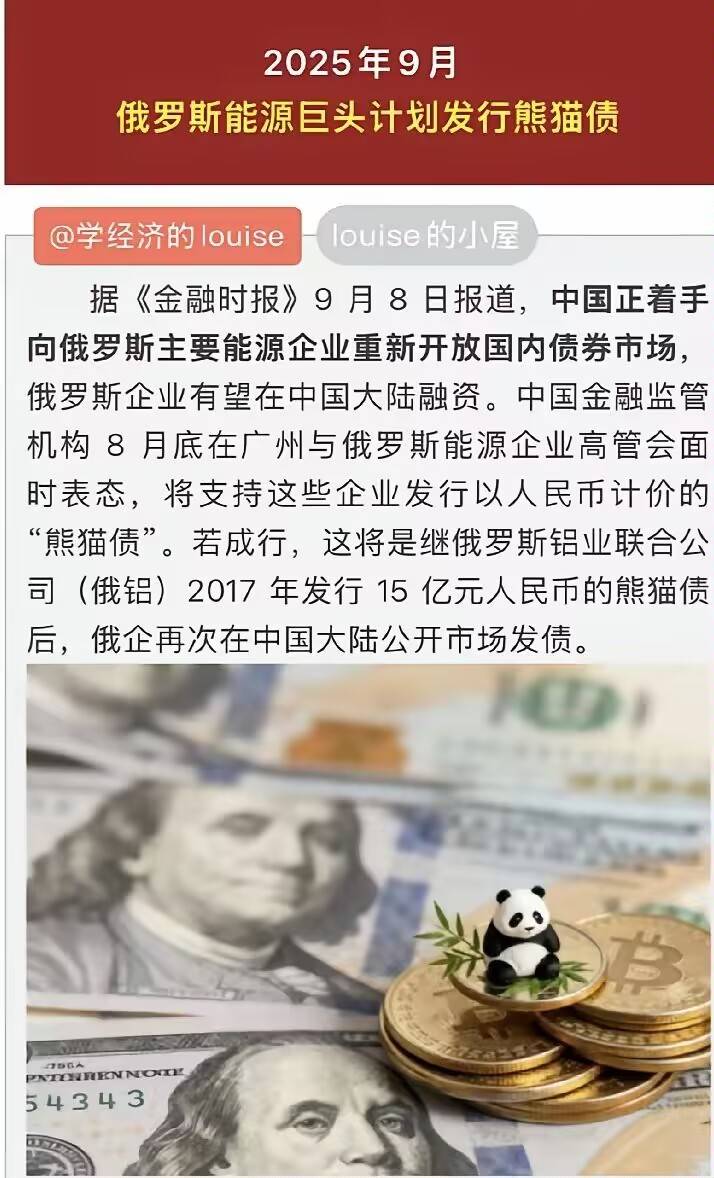
债券发行

Search documents
香港40亿美债引1182亿疯抢!全球资本“弃美投中”,美元霸权瓦解
Sou Hu Cai Jing· 2025-11-07 10:55
Core Viewpoint - The issuance of $4 billion in sovereign bonds by China in Hong Kong on November 3 has shifted the dynamics of global finance, indicating a potential decline in confidence in the dollar's dominance [1][4]. Group 1: Dollar Dominance and Market Reaction - The confidence in the dollar's supremacy is beginning to waver, as evidenced by the quietness in the Federal Reserve trading floor [3]. - China's 3-year and 5-year dollar bond yields of 3.646% and 3.787% respectively are lower than those of comparable U.S. Treasury bonds, suggesting that Chinese credit is perceived as more secure [4]. - The $4 billion bond attracted $118.2 billion in subscriptions, a 30-fold oversubscription, indicating a significant shift in capital preferences towards Chinese assets [6]. Group 2: Strategic Implications of China's Bond Issuance - The issuance is part of a broader strategy to establish China as a key player in global finance, leveraging its $3 trillion in foreign reserves and trade surpluses to enhance the credibility of the yuan [8][10]. - Hong Kong's role as an international financial hub facilitates the rapid influx of global capital into China, a competitive advantage over other emerging markets [10]. - The geopolitical landscape has shifted, with China's military capabilities providing a counterbalance to U.S. influence, reducing the effectiveness of U.S. military power in maintaining dollar hegemony [12]. Group 3: Threefold Strategic Approach - The first strategy involves creating an "Eastern safe haven" for capital, offering stability through sovereign bonds while providing financial assistance to struggling nations, thereby altering the traditional capital flow dynamics [15]. - The second strategy aims to promote the internationalization of the yuan by using dollar bonds as a bridge, allowing investors to convert dollars into yuan, which could enhance the yuan's global circulation [17]. - The third strategy seeks to constrain U.S. monetary policy by attracting global dollars to China, potentially increasing inflationary pressures in the U.S. and complicating its economic management [19]. Group 4: Future Financial Landscape - The $4 billion bond issuance is a small yet significant step towards reshaping global financial rules, moving from U.S.-centric dominance to a more collaborative financial governance model [20]. - The erosion of dollar hegemony could force the U.S. to raise Treasury yields to retain capital, exacerbating its fiscal pressures given its existing $30 trillion debt [22]. - The emergence of a multi-currency credit system will provide investors with alternatives to dollar assets, reducing reliance on the dollar for safe-haven investments [24].

财政部在香港发行40亿美元主权债券 总认购金额1182亿美元
2 1 Shi Ji Jing Ji Bao Dao· 2025-11-06 14:16
Core Points - The Ministry of Finance of the People's Republic of China successfully issued $4 billion in sovereign bonds in Hong Kong on November 5, with a strong market response [1] - The bonds included $2 billion with a 3-year maturity at an interest rate of 3.646% and $2 billion with a 5-year maturity at an interest rate of 3.787% [1] - The total subscription amount reached $118.2 billion, indicating a subscription rate 30 times the issuance amount, with the 5-year bonds having a subscription rate of 33 times [1] Investor Composition - The investor base was diverse, with geographical distribution as follows: 53% from Asia, 25% from Europe, 16% from the United States, and 6% from the Middle East [1] - The types of investors included sovereign entities (42%), banks and insurance companies (24%), fund management (32%), and dealers (2%) [1] - All issued bonds will be listed on the Hong Kong Stock Exchange [1]
30倍认购!财政部成功在港发行40亿美元主权债券
Sou Hu Cai Jing· 2025-11-06 04:48
Core Points - The Ministry of Finance successfully issued $4 billion in sovereign bonds on November 5 in the Hong Kong Special Administrative Region [1] - The bonds included $2 billion with a 3-year maturity at an interest rate of 3.646% and $2 billion with a 5-year maturity at an interest rate of 3.787% [1] - The issuance was highly welcomed by the market, with total subscriptions reaching $118.2 billion, which is 30 times the issuance amount [1] - The 5-year bonds had a subscription multiple of 33 times [1] Investor Composition - The investor base was diverse, with geographical distribution as follows: 53% from Asia, 25% from Europe, 16% from the United States, and 6% from the Middle East [1] - The types of investors included: 42% sovereign entities, 24% banks and insurance companies, 32% fund management, and 2% trading firms [1] - All issued bonds will be listed on the Hong Kong Stock Exchange [1]
伯克希尔(BRK.A.US)再启日元债发行,为全球6万亿美元火热债市“火上浇油”
智通财经网· 2025-11-06 04:28
Core Viewpoint - Berkshire Hathaway is preparing to issue yen-denominated bonds for the second time this year, reflecting a record high in global bond issuance in 2023 [1] Group 1: Company Actions - Berkshire Hathaway has hired banks to arrange a potential yen bond issuance, indicating its active participation in the Japanese bond market [1] - The company is one of the largest issuers in the yen bond market, with significant stakes in major Japanese trading companies [1] Group 2: Market Context - The global bond issuance has surged to approximately $6 trillion in 2023, driven by favorable market conditions for various financing activities, including AI projects and mergers [1] - The recent rebound in yen bond trading has seen other issuers, such as Renault and Slovenia, preparing to price their bonds [1] Group 3: Investment Implications - The issuance of yen-denominated bonds by Berkshire Hathaway suggests that the company sees investment opportunities in Japan, particularly in trading companies [1] - The company's AA rating and the potential for higher spreads compared to local firms with similar credit ratings make its bond offerings significant in the yen market [1]
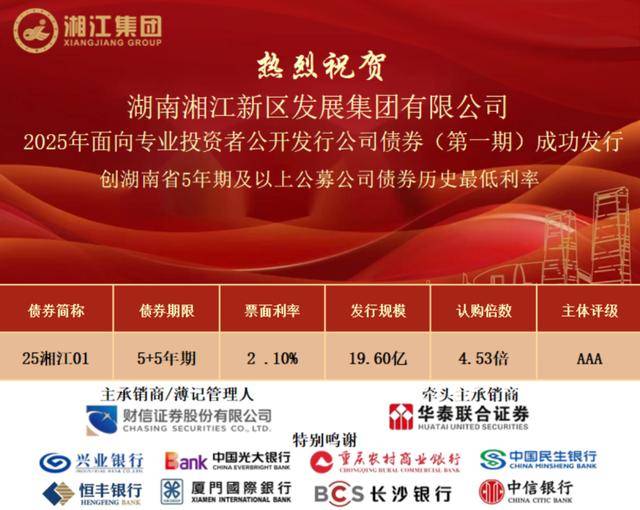
利率创全省新低!湘江集团成功发行19.6亿元小公募公司债
Sou Hu Cai Jing· 2025-11-05 13:22
Group 1 - The core point of the article is that Xiangjiang Group successfully issued its first phase of corporate bonds for 2025, achieving a record low interest rate, which has been widely recognized by the capital market [1][3] - The bond issuance amount is 1.96 billion yuan, with a term of 5+5 years and a coupon rate of 2.1%, marking the lowest historical rate for public corporate bonds in Hunan Province with a subscription multiple of 4.53 times [3] - This bond issuance is seen as a significant achievement in the group's deepening state-owned enterprise reform and reflects the market's recognition of Xiangjiang Group's overall strength, credit level, and development prospects [3] Group 2 - As an AAA-rated entity, Xiangjiang Group has been actively enhancing its debt risk management while expanding funding sources, ensuring smooth repayment of maturing debts to maintain sustainable development [3] - The successful bond issuance will further optimize the financing structure of Xiangjiang Group and enhance its financing capabilities [3] - The company plans to focus on four major business sectors: regional development, urban operations, industrial investment, and financial services, while exploring diversified financing to enhance the competitiveness and value creation of state-owned capital [3]
担心钱跑中国?晚了!香港40亿债券遭疯抢,美国禁令成了一纸空文
Sou Hu Cai Jing· 2025-11-05 10:07
Core Viewpoint - The article discusses China's strategic move to issue $4 billion in bonds in Hong Kong as a countermeasure to the U.S. financial dominance and its debt issues, showcasing a shift in global financial dynamics [1][20]. Group 1: U.S. Debt Situation - The U.S. is facing a significant debt crisis, with high interest rates making it difficult to manage repayments, leading to a reluctance from the Federal Reserve to lower interest rates [3][5]. - The fear of acknowledging economic weakness and losing international capital to faster-growing economies like China is driving U.S. policymakers' decisions [5][7]. Group 2: China's Strategic Response - China aims to proactively attract international capital by issuing bonds, rather than waiting for investments to come, effectively "collecting" dollars from the global market [10][14]. - The successful issuance of $2 billion in dollar bonds in the Middle East last year, which saw demand exceed $40 billion, indicates strong global confidence in China's economic prospects [10][12]. Group 3: Long-term Implications - This strategy allows China to assist countries in need of dollars, thereby undermining the U.S.'s historical financial dominance and creating a win-win situation for both China and its partners [14][18]. - If this bond issuance becomes a regular practice, it could lead to a significant shift in the flow of global dollars, enhancing China's leverage in U.S.-China strategic competition [22].
中国香港发债40亿美元:这不是借钱,是在重塑美元流动规则
Sou Hu Cai Jing· 2025-11-04 16:45
Core Insights - China plans to issue up to $4 billion in U.S. dollar sovereign bonds in Hong Kong, a move that is seen as a strategic maneuver amid the current challenges faced by the U.S. Federal Reserve [1][3] - The issuance is not merely a routine financing effort but a calculated response to the U.S. economic situation, particularly high interest rates and the potential for capital outflow [1][6] Group 1: Economic Context - The U.S. economy is under pressure from high interest rates, prompting discussions about potential interest rate cuts by the Federal Reserve, which are complicated by fears of capital flight [3][6] - The Federal Reserve's previous rate cut in September 2022 led to a surge in capital flowing into Chinese assets, highlighting the interconnectedness of global markets [3][6] Group 2: China's Strategic Positioning - The issuance of dollar bonds is part of China's strategy to redistribute dollars globally, countering the Federal Reserve's tightening measures and maintaining liquidity in the market [6][8] - China's approach offers an alternative to countries in need of dollars, allowing them to avoid reliance on the International Monetary Fund (IMF) and its stringent conditions [8][11] Group 3: Market Dynamics - The bond issuance in Hong Kong serves as a bridge between global capital and China's financial system, showcasing China's commitment to financial openness while facilitating coexistence of the yuan and the dollar [9][11] - China's sovereign bonds have a default rate of 0%, significantly lower than that of the U.S. and Europe, which enhances their attractiveness to global investors [9][11] Group 4: Future Implications - Regular issuance of U.S. dollar sovereign bonds by China could lead to systemic changes in global dollar liquidity, diminishing the Federal Reserve's control over global monetary policy [11] - This strategy reflects a shift in the balance of power in international finance, as China provides alternative liquidity channels without directly challenging the dollar's dominance [11]
美元霸权要完?中国发行美元美债,美国以后别想收割世界了!
Sou Hu Cai Jing· 2025-11-04 10:43
Core Viewpoint - The issuance of up to $4 billion in U.S. dollar sovereign bonds by China in Hong Kong aims to reshape the global financial credit landscape through international capital voting, rather than addressing liquidity needs [1][3]. Summary by Relevant Sections Sovereign Debt Value - The core value of sovereign debt lies in the market-based pricing of national credit, with interest rates reflecting market recognition of a country's creditworthiness [3]. - China's dollar sovereign bond interest rates are expected to be lower than those of U.S. Treasury bonds, potentially approaching the Federal Reserve's 3.75%-4% federal funds rate range in October 2025, indicating high global market recognition of China's sovereign credit [3]. Global Financial System Dynamics - Historically, the U.S. has relied on two main paths for capital extraction: creating regional conflicts to attract safe-haven capital and establishing "debt traps" through institutions like the IMF and World Bank [5][6]. - China's bond issuance fundamentally disrupts this model, providing a new avenue for debt relief to developing countries, thus avoiding asset acquisition by Western capital at low prices [6][11]. Stability and Capital Flow - China is positioned as a "new safe haven" for global capital, with a stable economic foundation, the largest foreign exchange reserves, and a growing trade surplus, contrasting with the U.S.'s rising debt and inflation pressures [8][10]. - A shift of even one-third of capital that would have remained in the U.S. to China could significantly weaken the U.S.'s capital extraction capabilities [10]. Internationalization of Renminbi - The bond issuance includes a repayment mechanism with an option for renminbi settlement, promoting the internationalization of the currency and reducing reliance on the dollar [13]. - As the use of the dollar contracts, idle capital may return to the U.S., exacerbating domestic inflation, while China's regular issuance of dollar sovereign bonds opens a new channel for dollar allocation, altering the existing dollar dominance [15]. Restructuring Global Credit System - This initiative is not a challenge to existing rules but a market-driven approach to reconstruct the global capital credit system, offering a more stable asset allocation choice globally [17][18]. - The gradual replacement of a unipolar hegemony with a diversified credit system could lead to a fairer and more reasonable global financial order [18].
一觉醒来,中国发行美元美债!美国以后别想收割世界了
Sou Hu Cai Jing· 2025-11-04 08:09
Core Viewpoint - China is set to issue up to $4 billion in U.S. dollar sovereign bonds in early November, signaling a strategic move to enhance its credit standing in comparison to the U.S. [1][4] Group 1: Sovereign Bond Issuance - The issuance of sovereign bonds typically utilizes domestic currency, raising questions about China's decision to issue in dollars despite having substantial foreign reserves [3][4] - China's foreign exchange reserves exceed $3 trillion, and the $4 billion bond issuance is minimal compared to its overall financial strength [4] - The key factor in this issuance is not the amount raised but the willingness of investors to buy the bonds and the conditions under which they are purchased [6][7] Group 2: Credit Comparison with the U.S. - The issuance aims to compare China's creditworthiness with that of the U.S.; if China's bond rates are lower than U.S. Treasury rates, it indicates stronger credit [7][9] - International capital views China's sovereign credit as more reliable and promising than that of the U.S., which could shift capital flows away from the U.S. [9][11] Group 3: Strategic Operations Against Dollar Dominance - China’s issuance of dollar bonds is a strategic move to counter U.S. dollar hegemony, allowing it to lend to countries in need, thereby preventing U.S. financial exploitation [13][16] - By providing financial assistance to countries like Egypt and Congo, China aims to disrupt U.S. influence in these regions [16][17] - The operation also promotes the internationalization of the Renminbi, as repayments can be made in Renminbi rather than dollars [17][19] Group 4: Impact on Global Financial Landscape - The issuance is part of a broader trend of de-dollarization, with many countries moving away from dollar transactions towards local currencies [24][26] - China's ability to issue dollar bonds without needing to address a dollar shortage is unique and reflects its strong economic fundamentals [26][28] - The global financial order is shifting towards a multipolar system, with China's actions contributing to the decline of U.S. dollar dominance [28][30]

俄罗斯急抱中国大腿!首次发49亿人民币债
Sou Hu Cai Jing· 2025-11-03 07:10
Core Insights - Russia is set to issue domestic bonds denominated in Chinese yuan, marking a significant shift in its financial strategy amid ongoing Western sanctions [1][6] - The bond issuance, with a maximum scale of 400 billion rubles (approximately 4.9 billion USD), is aimed at alleviating financial pressure on the Russian economy [6] Group 1: Bond Issuance Details - The bond issuance will have maturities ranging from 3 to 10 years, with the first trades expected to start in December [6] - The decision to issue yuan-denominated bonds is seen as a response to the economic challenges posed by the prolonged Ukraine conflict and Western sanctions [6] Group 2: Economic Context - Russia's budget deficit is projected to soar to 5.7 trillion rubles (about 630 million USD) by 2025, significantly higher than initial forecasts [6] - The reliance on Chinese financial systems is highlighted as a necessity due to blocked access to dollar and euro channels, indicating a strategic pivot towards China [6] Group 3: Implications for Currency - This move is expected to enhance the international standing of the yuan, creating a mutually beneficial scenario for both Russia and China [6]