
美元主权债券

Search documents
中国人寿海外公司总资产超4500亿元,参与Minimax上市
Xin Lang Cai Jing· 2026-01-21 14:11
Group 1 - The core viewpoint of the article highlights that by December 31, 2025, China Life Overseas Company's total assets will exceed 452.8 billion HKD [1] - China Life Overseas Company participated in the Hong Kong government's issuance of multi-currency digital green bonds in November 2025, subscribing to approximately 2.4 billion HKD equivalent in four currencies: USD, offshore RMB, HKD, and EUR, making it the largest subscriber among Chinese insurance companies [1] - Concurrently, the Chinese Ministry of Finance issued 4 billion USD in 3-year and 5-year USD sovereign bonds in Hong Kong, with China Life Overseas Company subscribing to about 600 million USD [1] Group 2 - In terms of equity investments, China Life Overseas Company participated in multiple Hong Kong H-share IPO projects in 2025, covering sectors such as semiconductors, artificial intelligence, and biomedicine [1] - Companies like Hesai Technology, MiniMax, and Weisheng Pharmaceutical have successfully listed on the Hong Kong Stock Exchange [1]

财政部在卢森堡首次发行欧元主权债券
Zheng Quan Ri Bao· 2025-11-20 16:09
Core Points - The Ministry of Finance of the People's Republic of China successfully issued €4 billion in sovereign bonds in Luxembourg, marking the first issuance of euro-denominated sovereign bonds by China in this market [1] - The issuance included €2 billion in 4-year bonds at an interest rate of 2.401% and €2 billion in 7-year bonds at an interest rate of 2.702% [1] - The total subscription amount reached €100.1 billion, 25 times the issuance amount, with the 7-year bonds having a subscription multiple of 26.5 times [1] Group 1 - The issuance was well-received by international investors, indicating strong confidence in China's sovereign credit and economic outlook [2] - The diverse investor base included 51% from Europe, 35% from Asia, 8% from the Middle East, and 6% from offshore investors in the United States [1] - Investor types included sovereign entities (26%), fund management (39%), banks and insurance (32%), and dealers (3%) [1] Group 2 - HSBC acted as a joint lead underwriter and bookrunner for the issuance, signaling China's commitment to deeper integration into international financial markets [2] - The issuance is expected to provide a pricing benchmark for more Chinese issuers seeking euro financing, thereby strengthening their overseas financing capabilities [2] - The Ministry of Finance has been regularly issuing sovereign bonds abroad, including euro, dollar, and offshore renminbi bonds, with significant issuance volumes [2][3]
中国银行协助财政部在香港发行40亿美元主权债券
Jin Rong Shi Bao· 2025-11-11 01:16
Group 1 - The core point of the article is that the Bank of China successfully assisted the Ministry of Finance in issuing $4 billion in sovereign bonds in Hong Kong, which received significant attention from both domestic and international markets [1] - The bond issuance consists of two maturities: $2 billion for 3-year bonds with an interest rate of 3.646% and $2 billion for 5-year bonds with an interest rate of 3.787% [1] - The issuance attracted a diverse range of investors, including sovereign and supranational entities, banks, insurance companies, and asset management firms, resulting in a total subscription amount of approximately $118.2 billion, with an overall subscription multiple of about 30 times, the highest in the history of the Ministry of Finance's dollar sovereign bond issuances [1] Group 2 - The geographical distribution of investors was broad, with 53% from Asia, 25% from Europe, 16% from the Middle East, and 6% from the United States, indicating strong international interest in Chinese sovereign credit [1]

融创成首家境外债基本清“零”的大型房企|财富周历 动态前瞻
Sou Hu Cai Jing· 2025-11-10 00:55
A-share Market - In early November, over 35 brokerages have conducted research on companies in the photovoltaic component industry chain, semiconductor material stocks, and leading consumer electronics firms [2] - The 1388 companies listed on the ChiNext board reported a total operating income of 3.25 trillion yuan for the first three quarters of 2025, representing a year-on-year growth of 10.69%, with net profit reaching 244.66 billion yuan, up 18.69% year-on-year [2] - Beijing Bank and Shanghai Bank have signed stock repurchase loan commitment letters with several listed companies, with other banks like Ningbo Bank, Jiangsu Bank, and Nanjing Bank also expected to qualify for this loan business [2] - The Shanghai Stock Exchange reported that 2.3 million new A-share accounts were opened in October 2025, bringing the total new accounts for the first ten months to 22.46 million, a year-on-year increase of 10.57% [3] Financial Market - The Ministry of Finance successfully issued 4 billion USD in sovereign bonds in Hong Kong, with a total subscription amount of 118.2 billion USD, 30 times the issuance amount [4] - The Hong Kong Stock Exchange reported a record high in total revenue and net profit for the first three quarters of the year, with total revenue of 21.85 billion HKD, up 37% year-on-year, and net profit of 13.42 billion HKD, up 45% year-on-year [4][5] - The People's Bank of China conducted a 700 billion yuan reverse repurchase operation with a term of three months, and also conducted a 65.5 billion yuan 7-day reverse repurchase operation at a rate of 1.40% [4][5] Real Estate Sector - Sunac China announced that its approximately 9.6 billion USD offshore debt restructuring plan was approved by the Hong Kong High Court, making it the first large real estate company to achieve a "zero" status on offshore debt [3] - Country Garden's offshore debt restructuring plan was successfully passed with over 75% approval from creditors in both debt groups, indicating a significant milestone for the company [6] - The real estate market in major cities showed a recovery in transaction volume during September, with Shanghai leading in new and second-hand home transactions in October [7] Banking Sector - A total of 42 A-share listed banks reported net commission and fee income of 578.2 billion yuan for the first three quarters of 2025, a year-on-year increase of 4.60% [8]




经济分析与资产展望:整固蓄势,窄幅波动
HUAXI Securities· 2025-11-09 14:24
Global Market Performance - Major global stock indices mostly declined due to multiple factors including the cooling of Fed rate cut expectations and the U.S. government shutdown, with Japan and South Korea leading the drop at 4.07% and 3.74% respectively[1] - The Nasdaq fell 3.04%, marking its worst weekly performance since April, driven by concerns over AI tech stock bubbles and liquidity pressures from the government shutdown[1] - Global bond yields mostly rose, with U.S. Treasury yields experiencing fluctuations amid liquidity tightening and policy expectation dynamics[1] Domestic Market Insights - The A-share market saw a slight increase despite reduced trading volume, with daily transactions falling below 2 trillion yuan, while the Hang Seng Index led major indices with a gain[2] - China's CPI rose year-on-year in October, alleviating deflation concerns, while PPI's decline narrowed, indicating a potential stabilization in prices[2] - The People's Bank of China maintained liquidity easing, contributing to a stable bond market environment[2] Economic Developments - The U.S. government shutdown is entering its sixth week, with potential progress as Democrats soften their stance on funding resolutions[3] - China's exports showed a decline of 0.8% year-on-year in October, influenced by tariff disruptions and high base effects from the previous year[3] - China successfully issued $4 billion in sovereign bonds in Hong Kong, with a subscription rate of 30 times, indicating strong international investor interest[3] Inflation and Price Trends - October's CPI increased by 0.2% year-on-year, driven by holiday consumption and rising food prices, while core CPI rose to 1.2%[3] - The forecast for 2026 suggests a CPI central tendency of 0.6%, with expectations of price recovery driven by stable food prices and improved consumer demand[3] Risk Factors - Potential unexpected changes in macroeconomic conditions and industrial policies pose risks to market stability[5]
新华财经周报:11月3日-11月9日
Xin Hua Cai Jing· 2025-11-09 11:04
Key Points - The Ministry of Commerce responded to issues related to ASML and rare earth exports, emphasizing the dual-use nature of these items and the importance of compliance in export controls to ensure global supply chain stability [1][2] - The Ministry of Commerce announced the approval of export licenses for Chinese exporters related to ASML, aiming to restore supply while urging the Netherlands to adopt a responsible approach in trade relations [2] - The State Council's Tariff Commission decided to suspend additional tariffs on certain imports from the U.S. starting November 10, 2025, as part of trade negotiations [3] - The National Immigration Administration introduced ten innovative measures to support high-quality development and expand open services, effective from November 5, 2025 [3][4] - The Ministry of Industry and Information Technology and the Ministry of Water Resources released a plan for the high-quality development of water-saving equipment, targeting the industrialization of key technologies by 2027 [4] - The National Bureau of Statistics reported a slight increase in the Consumer Price Index (CPI) in October, with a year-on-year rise of 0.2%, while the Producer Price Index (PPI) showed a narrowing decline [4] - The People's Bank of China resumed government bond trading in October, marking a return to market operations after a hiatus [5] - The Ministry of Finance successfully issued $4 billion in sovereign bonds in Hong Kong, with a total subscription amounting to 30 times the issuance, indicating strong international investor interest [5] - The State Administration of Foreign Exchange reported a current account surplus for the third quarter, highlighting a trade surplus in goods [5] - The China Securities Regulatory Commission introduced new regulations for the management of securities settlement risk funds, enhancing risk prevention measures [7] - The Beijing-Tianjin-Hebei region aims to develop a 200 billion yuan industry cluster for the BeiDou satellite navigation system by 2027, promoting the application of new positioning technologies [8]
中资离岸债风控周报(11月3日至7日):一级市场发行平稳 二级市场多数下行
Xin Hua Cai Jing· 2025-11-09 06:39
Primary Market - A total of 26 offshore bonds were issued this week (November 3 - November 7, 2025), including 9 offshore RMB bonds and 17 USD bonds, with issuance scales of 10.3996 billion RMB and 10.58 billion USD respectively [1] - The largest single issuance in the offshore RMB bond market was 3 billion RMB by China Railway Construction Corporation, while the highest coupon rate was 6.6% issued by Shandong High Creation Holdings Group [1] - In the USD bond market, the largest single issuance was 500 million USD by China Cinda (Hong Kong) Holdings, with the highest coupon rate of 5.15% issued by the Asian Development Bank [1] Secondary Market - The yield on Chinese USD bonds mostly declined this week, with the Markit iBoxx Chinese USD Bond Composite Index down 0.02% to 251.02 [2] - The investment-grade USD bond index increased by 0.05% to 243.65, while the high-yield USD bond index decreased by 0.53% to 244.48 [2] - The real estate USD bond index fell by 1.16% to 184.4, while the city investment USD bond index rose by 0.06% to 153 [2] Benchmark Spread - As of November 7, 2025, the spread between the 10-year benchmark government bonds of China and the US narrowed to 228.72 basis points, a decrease of 1.52 basis points from the previous week [3] Rating Changes - On November 3, China Chengxin International Credit Rating Co. withdrew the long-term credit rating of "BBBg-" for Chongqing Fuling Lingang Economic Zone Construction Development Group due to commercial reasons [5] - On November 6, Fitch Ratings withdrew the "A-" rating for Jiangxi Railway Aviation Investment Group Co., Ltd. as the company chose not to participate in the rating process [5] Domestic News - The People's Bank of China resumed open market operations for government bond trading, with a net injection of 20 billion RMB in October [6] - On November 5, the Ministry of Finance successfully issued 4 billion USD in sovereign bonds in Hong Kong, with a total subscription amount of 118.2 billion USD, 30 times the issuance amount [7] - The Deputy Governor of the People's Bank of China, Lu Lei, announced measures to support the development of the offshore RMB market, including regular issuance of RMB central bank bills in Hong Kong [8] Offshore Debt Alerts - On November 5, Sunac China announced that its offshore debt restructuring plan was approved by the High Court [10] - On November 6, Yuexiu Property announced a financing agreement for a term loan of 600 million HKD [11] - On November 6, Country Garden's offshore debt restructuring plan was approved with over 75% of creditor votes in favor [12] - On November 7, Shimao Construction reported a significant lawsuit involving approximately 11.291 billion RMB and issues related to bond defaults and overdue debts [13]

财政部在香港成功发行美元主权债券 认购倍数创新高
Zheng Quan Ri Bao· 2025-11-07 16:04
Core Viewpoint - The issuance of $4 billion sovereign bonds by the Ministry of Finance of the People's Republic of China in Hong Kong was met with strong market demand, reflecting high international investor confidence in China's sovereign credit and long-term economic stability [1][2]. Group 1: Bond Issuance Details - The issuance included $2 billion in 3-year bonds at an interest rate of 3.646% and $2 billion in 5-year bonds at an interest rate of 3.787% [1]. - The total subscription amount reached $118.2 billion, which is 30 times the issuance amount, marking the highest subscription level in previous dollar sovereign bond issuances [1]. - The 5-year bonds had an impressive subscription multiple of 33 times [1]. Group 2: Market Impact and Investor Confidence - The diverse range of investors included 53% from Asia, 25% from Europe, 16% from the Middle East, and 6% from the United States, indicating broad geographical interest [2]. - The types of investors were varied, with sovereign entities, banks and insurance companies, fund management, and dealers making up 42%, 24%, 32%, and 2% respectively [2]. - The high subscription rates demonstrate China's strong appeal in the international financial market, transcending regional boundaries [2]. Group 3: Strategic Importance - The issuance of these bonds helps to optimize China's debt structure and enhances the diversity of its foreign debt currency, making it more rational [3]. - Continuous issuance of dollar sovereign bonds and positive market responses increase China's influence in international financial markets and provide it with greater voice in financial rule-making [3]. - Since 2009, the Ministry of Finance has regularly issued sovereign bonds abroad, including RMB, dollar, and euro-denominated bonds, improving the issuance mechanism [2].

国债月报:债市或延续震荡-20251107
Wu Kuang Qi Huo· 2025-11-07 14:56
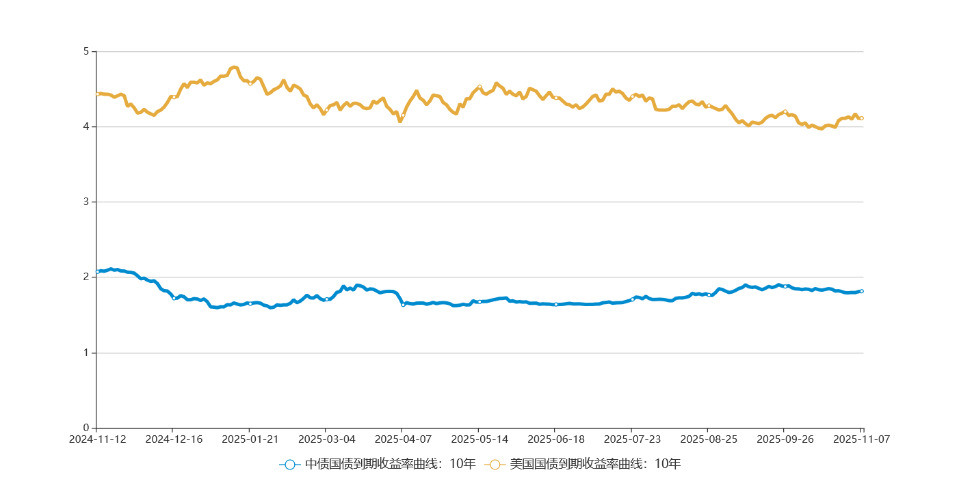
Report Industry Investment Rating No relevant content provided. Core Viewpoints of the Report - The bond market is likely to continue to fluctuate. The central bank's restart of buying and selling government bonds is positive for bond market sentiment in the short - term. In the medium - term, the bond market in the fourth quarter is mainly affected by fundamentals, the implementation time of the new fund fee regulations, and institutional allocation power. Overall, the supply - demand pattern of the bond market in the fourth quarter may improve, and the market may maintain a volatile trend under the background of weak domestic demand recovery and improved inflation expectations. The bond market is expected to recover with fluctuations, and the long - term strategy is to buy on dips [14][15]. Summary by Directory 1. Monthly Assessment and Strategy Recommendation - **Economic and Policy Situation**: In October, the manufacturing PMI was lower than expected, with both supply and demand under pressure. The non - manufacturing PMI met expectations and showed a slight improvement. The "anti - involution" has boosted price expectations, but the coordination between demand and production needs further observation. In terms of exports, October's export data was lower than expected, with exports to the US declining and non - US exports maintaining resilience. The Fourth Plenary Session emphasized achieving the annual economic and social development goals, and as the economic growth rate in the first three quarters was relatively high, the pressure to achieve the goal this year is not large. Policy may focus more on policies for the connection with next year, and there is no strong need for additional measures in the fourth quarter. Overseas, the Fed cut interest rates in October, and subsequent inflation and employment data will indicate whether there will be a rate cut in December [11]. - **Major Events**: The People's Bank of China and the Bank of Korea renewed the bilateral local currency swap agreement with a scale of 400 billion yuan/70 trillion won for five years. On November 5, the Ministry of Finance issued 4 billion US dollars of sovereign bonds in Hong Kong, which were well - received by the market. The State Council Tariff Commission adjusted the tariff measures on US - originated goods. Some Fed officials expressed their views on interest rate cuts, and US financial system liquidity was approaching a dangerous level. China's October export and import data were released, and the foreign exchange reserve scale increased slightly [11][12][13]. - **Liquidity**: This week, the central bank conducted 495.8 billion yuan of reverse repurchase operations, with 2.068 trillion yuan of reverse repurchases maturing, resulting in a net withdrawal of 1.5722 trillion yuan. The DR007 interest rate closed at 1.43% [14]. - **Interest Rates**: The latest 10 - year Treasury yield was 1.81%, up 1.14 BP week - on - week; the 30 - year Treasury yield was 2.16%, up 1.00 BP week - on - week; the latest 10 - year US Treasury yield was 4.11%, unchanged week - on - week [14]. - **Trading Strategy**: The recommended strategy is to buy on dips for a 6 - month period, with a profit - loss ratio of 3:1. The core driving logic is loose monetary policy and the difficulty of credit improvement [16]. 2. Futures and Spot Markets - **Contract Performance**: Presented the closing prices, annualized discounts, settlement prices, and net basis of T, TL, TF, and TS contracts, as well as the closing prices and trading volumes of TS, TF, T, and TL contracts [19][23][26][29][31][36]. 3. Main Economic Data - **Domestic Economy** - **GDP and PMI**: In the third quarter of 2025, the actual GDP growth rate was 4.8%, exceeding market expectations. In October, the manufacturing PMI was 49.0%, down 0.8 percentage points from the previous value, while the service PMI was 50.2%, up 0.1 percentage point [41]. - **Manufacturing PMI Sub - items**: In October, both supply and demand in the manufacturing industry were under pressure. The production index decreased by 2.2 percentage points to 49.5%, and the new order index decreased by 0.9 percentage points. Domestic demand recovery was still insufficient [47]. - **Price Index**: In September, CPI同比 decreased by 0.3%, core CPI同比 increased by 1.0%, and PPI同比 decreased by 2.3%. In terms of month - on - month data, CPI环比 was 0.1%, core CPI环比 was 0.0%, and PPI环比 was 0.0% [50]. - **Export and Import**: In October 2025, China's import and export data were slightly lower than expected. Exports (in US dollars) decreased by 1.1% year - on - year, and imports increased by 1.0% year - on - year. Exports to the US decreased by 25.1% year - on - year, while exports to ASEAN maintained a relatively high growth rate of 10.9% year - on - year [53]. - **Industrial and Consumption Data**: In September, the year - on - year growth rate of industrial added value was 6.4%, and the year - on - year growth rate of social consumer goods retail sales was 3.0%, down 0.4 percentage points from the previous value [56]. - **Investment and Real Estate**: From January to September, the cumulative year - on - year growth rate of fixed - asset investment was - 0.5%, and the cumulative year - on - year growth rate of real estate investment was - 13.9%. In September, the month - on - month growth rate of second - hand housing prices in 70 large and medium - sized cities was - 0.6%, and the year - on - year growth rate was - 5.2% [59]. - **Foreign Economy** - **US Economy**: In the second quarter, the US GDP at current prices on an annualized basis was 3.0331 trillion US dollars, with an actual year - on - year growth rate of 1.99% and a quarter - on - quarter growth rate of 3.0%. In September, the US CPI and core CPI data were released, and the ISM manufacturing and non - manufacturing PMI data were also reported. In August, the order amount of durable goods increased by 7.63% year - on - year, and the number of non - farm payrolls increased by 22,000 [68][71][74]. - **EU and Eurozone Economy**: In the third quarter, the EU GDP increased by 1.5% year - on - year and 0.3% quarter - on - quarter. In September, the eurozone CPI and core CPI data were released, and in October, the manufacturing and service PMI data were reported [74][77]. 4. Liquidity - **Money Supply and Social Financing**: In September, the M1 growth rate was 7.2%, and the M2 growth rate was 8.4%. The M1 - M2 gap continued to narrow. The social financing increment was 3.53 trillion yuan, with a year - on - year decrease of 233.9 billion yuan. The growth of social financing mainly came from government bonds [82]. - **Social Financing Sub - items**: In September, the year - on - year growth rate of government bonds in social financing slowed down, and the financing of the real - economy sector remained stable. The social financing growth rate of the household and enterprise sectors was 5.94%, and the growth rate of government bonds was 20.20% [85]. - **MLF and Reverse Repurchase**: In September, the MLF balance was 5.85 trillion yuan, with a net injection of 300 billion yuan. This week, the central bank conducted 2.068 trillion yuan of reverse repurchase operations, with 867.2 billion yuan of reverse repurchases maturing, resulting in a net injection of 1.2008 trillion yuan. The DR007 interest rate closed at 1.46% [88]. 5. Interest Rates and Exchange Rates - **Interest Rate Changes**: Presented the latest interest rates, daily, weekly, and monthly changes of various types of interest rates, including repurchase rates, Treasury bond yields, and US Treasury bond yields [92]. - **Interest Rate and Exchange Rate Charts**: Presented charts of Treasury bond yields, inter - bank pledged repurchase rates, US Treasury bond yields, Treasury bond yields of the UK, France, Germany, and Italy, the Fed's target interest rate, and exchange rates [95][97][100].
财政部在香港发行40亿美元主权债券 总认购金额1182亿美元
2 1 Shi Ji Jing Ji Bao Dao· 2025-11-06 14:16
Core Points - The Ministry of Finance of the People's Republic of China successfully issued $4 billion in sovereign bonds in Hong Kong on November 5, with a strong market response [1] - The bonds included $2 billion with a 3-year maturity at an interest rate of 3.646% and $2 billion with a 5-year maturity at an interest rate of 3.787% [1] - The total subscription amount reached $118.2 billion, indicating a subscription rate 30 times the issuance amount, with the 5-year bonds having a subscription rate of 33 times [1] Investor Composition - The investor base was diverse, with geographical distribution as follows: 53% from Asia, 25% from Europe, 16% from the United States, and 6% from the Middle East [1] - The types of investors included sovereign entities (42%), banks and insurance companies (24%), fund management (32%), and dealers (2%) [1] - All issued bonds will be listed on the Hong Kong Stock Exchange [1]