
新茶饮

Search documents
跨境出海周度市场观察-20251205
Ai Rui Zi Xun· 2025-12-05 05:45
跨境出海 周度市场观察 行业环境 头部品牌动态 投资运营 产品技术 营销活动 01 行业趋势 Industry Trends 本周看点: 合规与增长两难:出海企业如何突围?业内人士谈破局关键; 文化理解:中国企业出海拉美的必修课; "传统茶"变"时尚味",一杯奶茶融入95后泰国女生日常。 行业环境: 1. 合规与增长两难:出海企业如何突围?业内人士谈破局关键 关键词:合规门槛,资金流动,本土化运营,地缘政治,监管政策 概要:中国企业出海面临合规、资金流动和本土化运营等挑战。在"安客尔全球远航论坛"上, 专家指出,合规与资金压力是关键瓶颈,需通过多元化交易设计和弹性资金储备应对。中信银 行建议前瞻性合规布局和金融服务创新,如全球司库功能和分离式保函。地缘政治加剧了供应 链和ODI备案的复杂性,隐性风险如税务差异和金融规则需提前规划。未来十年,出海趋势将 聚焦合规、协同和本土化,人民币结算和精准布局成为重点。企业需从"单打独斗"转向"协 同作战",合规将成为核心竞争力。 原文链接:http://finance.sina.com.cn/jjxw/2025-11-13/doc-infxhkct2395167.shtm ...
霸王茶姬上市7个月,市值每天蒸发1个亿
Sou Hu Cai Jing· 2025-12-04 12:14
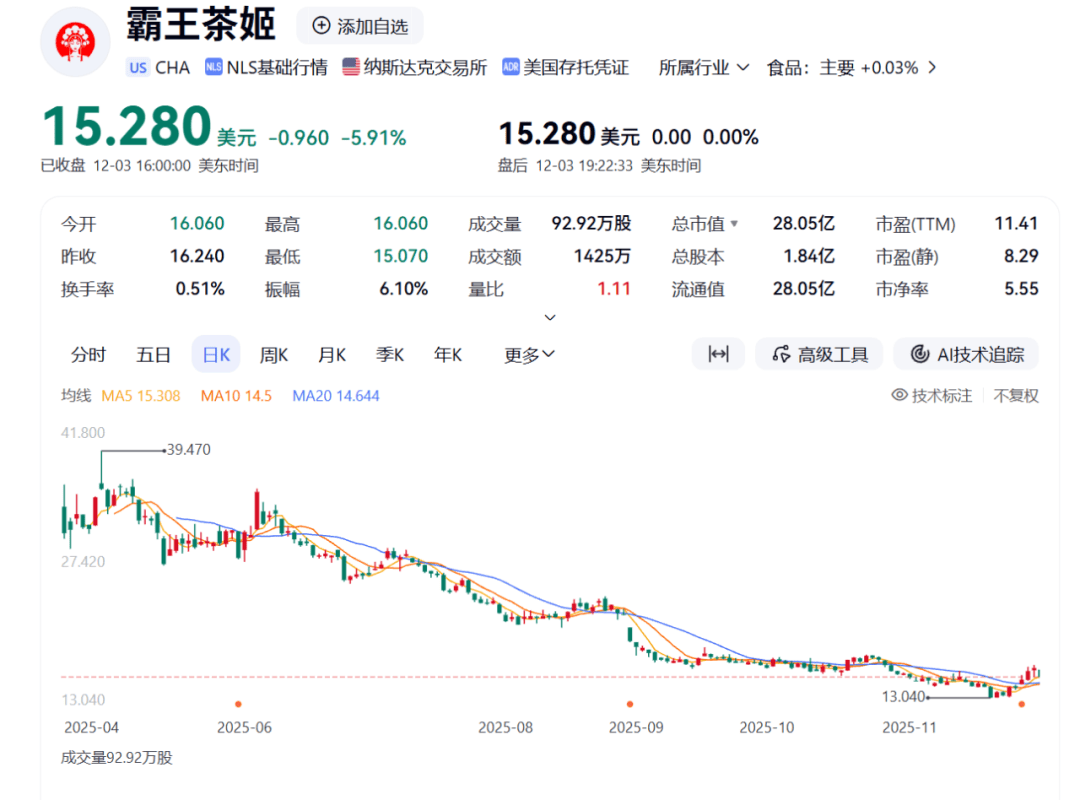
这几天,霸王茶姬的消息有点多。 一是,霸王茶姬创始人张俊杰和天合光能联席董事长高海纯结婚。 一场市值600亿的"双霸总联姻"吸引了不少眼球; 二是,霸王茶姬三季报公布。 11月28日晚,霸王茶姬公布了2025年第三季度财报。 业绩么,依然承压。 但让资本市场兴奋的是,它终于要分红了。 霸王茶姬上市以来进行首次现金分红,总额约1.77亿美元,约12.6亿元人民币;张俊杰持股比例为53.8%,粗略估算将分红0.95亿美元,也就是人民币约 6.7亿元。 果然,创始人结婚,公司是要发大红包的。 01 通常而言,上市分红,是好事。但霸王茶姬这次,有点不一样。 公告里清清楚楚写着,这是"特别现金股息"。 啥意思? 说白了,就是一次性的突击分红,今天分了,明天还有没有,没人给你保证。 所以,市场上有声音说,这本质上就是一次"信心营销"。 效果怎么样?立竿见影。 分红消息一出,霸王茶姬的股价连涨几天,市值也从24亿美元的低谷,短暂地回到了29亿美元。美股的投资者们,似乎很吃这一套。只是还没高兴两天, 12月3日开盘,霸王茶姬股价又低开了,截至当日收盘,市值跌至28亿美元。 但问题是,这钱从哪来?又分给了谁? 还是看两组数据: ...

霸王茶姬:困于“伯牙”?
3 6 Ke· 2025-12-03 13:57
Core Viewpoint - Bawang Chaji, a tea brand focusing on milk tea, has faced declining revenue and profits since its NASDAQ listing in April 2025, with a significant drop in same-store GMV and overall financial performance [1][4][5]. Financial Performance - In Q3 2025, Bawang Chaji reported a net revenue of 3.208 billion yuan, a 9.4% decrease from 3.541 billion yuan in Q3 2024, and a continuous decline from the previous two quarters [1][4]. - The company's operating profit for Q3 2025 was 454.4 million yuan, with an operating profit margin of 14.2%, down from 794.3 million yuan and 22.4% in the same quarter of 2024 [4]. - Adjusted net profit for Q3 2025 was 502.8 million yuan, a 22.23% decrease from 646.6 million yuan in Q3 2024, with a net profit margin of 12.4% [4]. Business Model and Market Strategy - Bawang Chaji's revenue from franchise tea houses in Q3 2025 was 2.8116 billion yuan, down from 3.299 billion yuan in the same quarter of 2024, attributed to price sensitivity among consumers due to delivery platform subsidy wars [1][4]. - The company has maintained a "big single product, high repurchase" strategy, focusing on its flagship product "Boya Juexian," which has generated significant sales but faces challenges in sustaining consumer interest without new product introductions [2][9]. Market Competition - The competitive landscape for new tea drinks has intensified, with brands like Heytea and Nayuki expanding into lower-tier cities and increasing competition [7]. - Bawang Chaji has rapidly opened stores, reaching a total of 7,338 locations by September 30, 2025, with 6,971 being franchise stores, which may dilute per-store revenue [7][20]. Product Development and Innovation - The company has been slow in product innovation, with only eight new products launched in 2025, including variations of its flagship product, which may hinder its ability to attract repeat customers [9][10]. - Bawang Chaji plans to enhance its product matrix and introduce a 4.0 menu to explore new consumption scenarios and improve brand experience [14]. International Expansion - Bawang Chaji has successfully expanded internationally, with 262 overseas stores as of Q3 2025, particularly in Southeast Asia, where it has seen a 75.3% year-over-year increase in overseas GMV [16][17]. - The brand has become popular in Malaysia, leveraging local partnerships and marketing strategies to achieve record sales [17]. Customer Engagement and Retention - The company has achieved 11 consecutive quarters of profitability, with a stable cash flow and no interest-bearing debt, indicating a healthy financial position despite domestic market challenges [20]. - As of September 30, 2025, Bawang Chaji had 222 million registered members, a 36.7% increase year-over-year, and a low store closure rate of 0.3% [20].
“投资古茗账面盈利50亿元,最终可能赚到100亿元”
Zhong Guo Ji Jin Bao· 2025-12-03 11:14
Core Insights - The founder partner of Meituan Longzhu, Zhu Yonghua, predicts that the ready-to-drink beverage industry will see six new listed companies in the next five years, including Heytea and Chayan Yuese [2][4] - The Chinese coffee and tea market is expected to reach a trillion yuan scale in the next 5 to 10 years [4] Industry Overview - The beverage industry is undergoing a transformation into an "M-shaped" ecological structure, where leading brands expand significantly while new brands emerge rapidly [5][7] - The tea market's overall revenue grew by 16.5% year-on-year in Q3, with transaction volume increasing by 39.2%, but the average transaction value decreased by 16.3% [5] - The coffee market's overall revenue increased by 27.3% year-on-year in Q3, with transaction volume rising by 42.6%, while the average transaction value fell by 10.7% [5] Market Dynamics - The number of tea beverage stores decreased by 4% year-on-year to 408,000, while coffee store numbers increased by 12.8% to 193,000 [5] - The coffee market is projected to reach a scale of 600 billion yuan, with expectations for price normalization in the near future [8] Regional Brand Strategies - Local brands are leveraging unique regional flavors and emotional connections to secure their market space amidst fierce competition [9][11] - The example of Mo Mo Nan Lu, a local brand with only 200 stores, illustrates the importance of focusing on local market cultivation and product differentiation through local ingredients [11]

告别烧钱的“疯狂联名” 新茶饮开启轻量化营销
Mei Ri Shang Bao· 2025-12-02 23:35
Core Insights - The new tea beverage industry is experiencing a shift from a "traffic-driven" marketing approach to a "value-driven" one, as exemplified by Heytea's introduction of a "hand-drawn custom cup sticker" feature that allows users to create personalized stickers, enhancing customer engagement and experience [1][2][3] Group 1: Marketing Innovations - Heytea's new feature allows users to upload their designs for cup stickers via a mini-program, which has gained popularity on social media platforms, reflecting a new direction in user-centric marketing [1] - The success of this feature has led to the emergence of related services on second-hand trading platforms, with prices for custom designs ranging from 3 to over 20 yuan, indicating a growing market for personalized products [2] Group 2: Industry Trends - The trend of co-creation between brands and consumers is not unique to Heytea; other brands like Kawan Kawa and Momo Milk Tea have also launched similar initiatives, showing a broader industry movement towards interactive marketing [2] - The frequency of brand collaborations has significantly decreased in 2023, with Heytea's partnerships dropping from 39 last year to just one this year, indicating a cooling off of the previously popular IP collaboration strategy [2][3] Group 3: Financial Implications - The financial reports indicate a significant increase in sales and distribution expenses for new tea brands, with Gu Ming at 480 million yuan (up 42.4%), Cha Bai Dao at nearly 400 million yuan (up 201.6%), and Mi Xue Bing Cheng at nearly 1.6 billion yuan (up 21.3%) [3] - The decline in effective brand collaborations has led to consumer fatigue, reducing the long-term brand recall and effectiveness of these marketing strategies [3]
娃哈哈集团“老臣”潘家杰跳槽古茗;星巴克中国首席增长官杨振谈外卖大战丨消费早参
Mei Ri Jing Ji Xin Wen· 2025-12-02 23:28
Group 1: Starbucks China - Starbucks China emphasizes that the competition in the delivery sector is not a price war but an experience war, aiming to enhance the delivery experience for customers [1] - The strategy aligns with the company's focus on optimizing delivery through membership integration and delivery assurance, moving the coffee sector's competition from price battles to value enhancement [1] Group 2: Wahaha Group and Gu Ming - Former Wahaha Group executive Pan Jiajie has joined Gu Ming as Senior Vice President of Supply Chain, overseeing new business incubation and supply chain management [2] - This transition is expected to inject mature supply chain management experience into Gu Ming, strengthening its cost control and digital capabilities, which will support the company's fundamentals [2] - The movement of high-level executives highlights a shift in the new tea beverage sector from scale expansion to deepening supply chain competition, prompting companies to prioritize core talent retention [2] Group 3: Russia's Visa Policy Impact - Russia's implementation of a temporary visa-free policy for Chinese citizens has led to a significant increase in flight searches and hotel bookings to Russia, with searches surging over 800% within an hour of the announcement [3] - This policy is expected to provide direct business growth for travel platforms, airlines, and cross-border accommodation companies, enhancing their performance outlook and fundamental support [3] - The policy's benefits will drive innovation in cross-border travel products and service upgrades, fostering collaboration across the aviation, cultural tourism, and duty-free industries [3] Group 4: Movie Ticket Resale Market - The high demand for 4D movie tickets for "Zootopia 2" has led to significant price inflation in the resale market, with tickets being sold at nearly double their original price [4] - This phenomenon indicates strong box office appeal and a surge in demand for immersive viewing experiences, which is expected to enhance the performance outlook for distributors, cinemas, and 4D equipment suppliers [4] - The success of such films is pushing the industry to focus on content quality and technological upgrades, accelerating the industrialization of quality intellectual properties [4]
云姨夜话丨2025年资本市场里的新“罐子生意”“盒子生意”
Sou Hu Cai Jing· 2025-12-01 12:37
Group 1: Company Developments - Suzhou Jiangtian Packaging Technology Co., Ltd. successfully passed the IPO review on the Beijing Stock Exchange, with Nongfu Spring as its largest customer, accounting for a significant portion of its revenue [3] - Jiangtian Technology had previously undergone five rounds of guidance from Anxin Securities for a proposed listing on the ChiNext, revealing past financial irregularities such as loan transfers and non-genuine trade background in bill transactions [3] - New Tianli Technology Co., Ltd. has recently passed the review by the Beijing Stock Exchange, producing plastic containers for popular brands like Mixue Ice City and Xiangpiaopiao [4][5] Group 2: Industry Trends - The label printing industry in China has a relatively low entry barrier and low industry concentration, with key materials like high-temperature PET film and anti-counterfeiting holographic materials being heavily reliant on imports [3] - International label giant Avery Dennison plans to increase its smart label chip packaging capacity in China by 800 million pieces per year by 2027, potentially squeezing the market space for domestic manufacturers [3] - The new tea beverage sector has seen a surge in IPOs, with major brands like Gu Ming and Mixue Ice City listing on the Hong Kong Stock Exchange and NASDAQ in early 2025, marking the year as a significant period for new tea drink IPOs [6]


奶茶黑马赚钱快分红狠,古茗一年分红37亿,创始人王云安独揽15亿
3 6 Ke· 2025-12-01 03:46
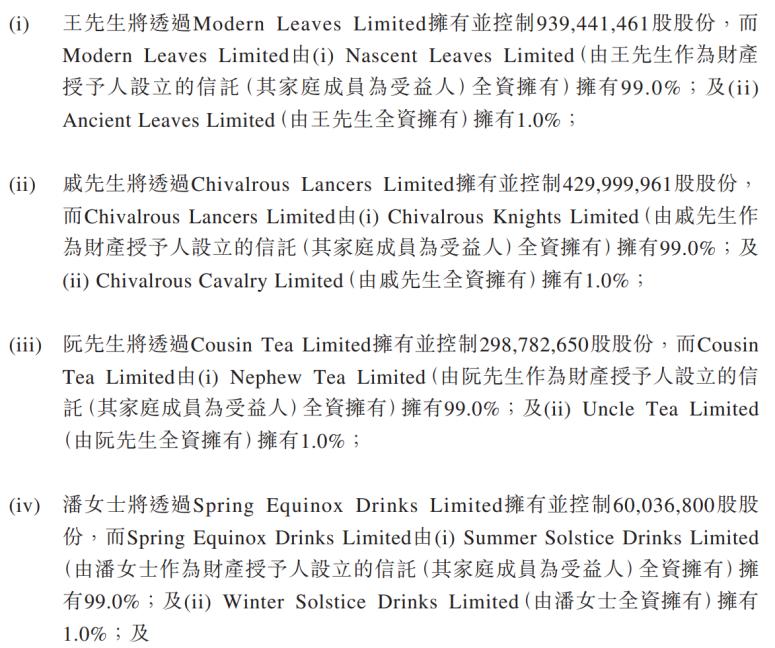
古茗突然宣布大手笔分红,创始人王云安及一众高管成为最大赢家。 古茗(1364.HK)日前发布公告称,公司计划派发特别股息0.93港元/股,以23.78亿总股本计算,合计派发股息22.12亿港元,且无须缴纳预 扣税。 这已是古茗年内第二次宣布派息。今年1月,古茗就宣布分红17.4亿元人民币。截至6月底,这笔股息已派发了8.7亿元,其余部分将于明年 3月前派发完毕。 上市刚9个多月,古茗的分红额已经超过了公司的募资额。今年2月上市时,古茗的募资净额为19.30亿港元,而年内两次分红就分出了超37 亿元。 值得注意的是,由于古茗股权极为集中,上述分红多数流入了古茗创始人、董事长兼CEO王云安及部分高管的海外信托之中。 截至今年6月底,王云安、戚侠、阮修迪、潘萍萍4位控股股东通过家族信托,合计控制公司72.77%的股权。算下来王云安4人从本次派息 中分得约16亿港元,约合14.7亿人民币。若算上年初那次分红,王云安4人共可取得超28亿元分红,其中王云安独揽逾15亿元。 此外,随着古茗市值拔升,王云安等人的身价也水涨船高。以古茗596亿港元的市值计算,四位控股股东的合计持股市值约为433亿港元, 王云安个人的身价为23 ...
港股三大指数高开,六部门联合发文增强消费品供需适配性,港股消费ETF(513230)早盘走强
Mei Ri Jing Ji Xin Wen· 2025-12-01 02:32
Group 1 - The Hong Kong stock market opened positively on the first day of December, with the Hang Seng Index rising by 0.34%, the Hang Seng China Enterprises Index increasing by 0.31%, and the Hang Seng Tech Index up by 0.21% [1] - Major technology stocks mostly saw gains, while copper prices reached a new high, leading to a strong performance in copper stocks. Other sectors such as aluminum, gold, heavy infrastructure, domestic real estate, and automotive stocks were also active, whereas gas, home appliance, and building materials stocks declined [1] - The consumer sector in Hong Kong continued to rise, with the CSI Hong Kong Stock Connect Consumer Theme Index increasing by 1.54% and the Hong Kong Consumer ETF (513230) gaining over 1% [1] Group 2 - Zhongyou Securities expressed a positive outlook on consumer investment opportunities, highlighting two categories: 1) New consumption opportunities in trendy toys, gold jewelry, and new tea drinks, which align with current trends of personalized and self-indulgent consumption, and benefit from the cultural export atmosphere [2] - The second category focuses on cyclical sectors, suggesting that if consumer stimulus policies continue and the economy gradually recovers, companies in the white wine, restaurant, and travel sectors will see favorable market conditions [2] - The Hong Kong Consumer ETF (513230) tracks the CSI Hong Kong Stock Connect Consumer Theme Index, encompassing leading companies in various consumer sectors, including Pop Mart, Lao Pu Gold, and Miniso, as well as e-commerce giants like Tencent, Kuaishou, Alibaba, and Xiaomi, highlighting a strong tech-consumer attribute [2]
蜜雪冰城试点卖早餐,或将复用供应链、拓展消费场景,港股消费ETF(513230)震荡攀升
Mei Ri Jing Ji Xin Wen· 2025-12-01 02:32
Group 1 - The Hong Kong stock consumer sector showed strong fluctuations, with the Hong Kong consumer ETF (513230) rising over 1% [1] - Leading stocks included Lao Pu Huang Jin, which surged nearly 5%, and Tongcheng Travel, which increased by approximately 3.5% [1] - Other notable gainers were Alibaba, Chow Tai Fook, Shenzhou International, Smoore International, and China Resources Beer, while Xiaomi Group, Miniso, Mixue Group, and Li Auto experienced declines [1] Group 2 - Mixue Ice City has introduced a "breakfast series" in select cities, including Dalian, Xi'an, Nanning, and Hangzhou, featuring products priced at 5 yuan [1] - The breakfast initiative is seen as an attempt to leverage the supply chain and expand consumption scenarios, reflecting a trend towards all-day operations in the new tea beverage and restaurant sectors [1] - This move may encourage more brands to explore category extensions and expand their operational scenarios [1] Group 3 - Zhongyou Securities remains optimistic about consumer investment opportunities, highlighting two categories: new consumption opportunities and cyclical recovery plays [2] - New consumption opportunities include sectors like trendy toys, gold and jewelry, and new tea beverages, which align with current consumer trends towards personalization and cultural export [2] - Cyclical recovery plays focus on sectors such as liquor and travel, which may benefit from ongoing consumer stimulus policies and economic recovery [2]