
Artificial Intelligence

Search documents
春节将至,国产大模型再次迎来上新热潮
2 1 Shi Ji Jing Ji Bao Dao· 2026-02-14 23:35
Core Insights - The Chinese AI industry is experiencing a surge in new model launches ahead of the Spring Festival, with major players like MiniMax, Zhiyuan, and ByteDance introducing their latest products in what is referred to as the "AI Battle of the Gods" [1][11]. Group 1: MiniMax M2.5 Launch - MiniMax officially launched its new text model, MiniMax M2.5, on February 13, which has significantly improved performance metrics, achieving scores of 80.2% on SWE-Bench Verified and 51.3% on Multi-SWE-Bench, surpassing previous models [4][14]. - The M2.5 model features a "native Spec capability," allowing it to deconstruct architecture and functional planning proactively, mimicking the work of a real architect [4][14]. - The M2.5-lightning version supports an output speed of over 100 transactions per second (TPS), which is approximately double that of mainstream models, with operational costs estimated at $0.3 per million tokens for input and $2.4 per million tokens for output [6][16]. Group 2: Zhiyuan GLM-5 Launch - Zhiyuan AI launched its flagship model GLM-5 on February 12, which saw its stock price surge by 28.68%, reaching a market capitalization of 179.2 billion HKD, an increase of 40 billion HKD from the previous day [7][17]. - The GLM-5 model has expanded its base from 355 billion parameters (activated 32 billion) to 744 billion parameters (activated 40 billion), and its pre-training data has increased from 23 terabytes to 28.5 terabytes, enhancing its general intelligence capabilities [7][17]. - In programming capabilities, GLM-5 aligns with Claude Opus 4.5 and has achieved the highest scores in industry-standard benchmarks, outperforming Gemini 3 Pro [19]. Group 3: ByteDance Seedance 2.0 - ByteDance's AI video generation model, Seedance 2.0, has gained significant attention for its multimodal input capabilities, generating high-quality videos from text and images, which has attracted global interest [1][11]. - The model's rapid development has been noted by industry figures, including Elon Musk and filmmaker Jia Zhangke, highlighting its potential for creative applications [1][11]. Group 4: Future Developments - The industry anticipates further advancements, with Zhiyuan indicating that models will evolve from merely "writing" to "doing tasks," particularly in completing large-scale tasks end-to-end [19]. - Upcoming releases include ByteDance's Doubao Model 2.0, which is expected to excel in multimodal perception and complex task execution, marking a significant upgrade since its initial launch [19][20].

What Is 1 of the Best AI Stocks to Own for the Next 10 Years?
Yahoo Finance· 2026-02-14 22:17
Core Insights - The significant investment in artificial intelligence (AI) infrastructure is becoming a major economic driver, with most businesses aiming to utilize these tools for revenue growth and cost reduction [1] - Alphabet (NASDAQ: GOOGL) is highlighted as a comprehensive investment opportunity in the AI sector, involved in various aspects of the industry [2] Group 1: Alphabet's AI Initiatives - DeepMind, Alphabet's AI research lab, is developing Tensor Processing Units, enhancing its technological capabilities [3] - Google Cloud reported a 48% year-over-year revenue growth and a 30% operating margin in Q4, driven by strong demand for AI products and services [3] - Alphabet's consumer-facing apps, including the Gemini app with 750 million monthly active users, are being enhanced by AI, improving ad targeting for its customers, which account for 72% of its revenue [4] Group 2: Investment Considerations - Alphabet's shares are trading at a forward price-to-earnings ratio of 28.8, indicating a reasonable valuation with strong earnings growth potential in the coming years [4] - Despite being a leading AI investment opportunity, Alphabet was not included in a recent list of the top 10 stocks recommended by the Motley Fool Stock Advisor, which suggests caution for potential investors [5]

一键生成“换脸”视频作品 真假难辨的AI内容该如何监管?
Yang Shi Xin Wen· 2026-02-14 21:07
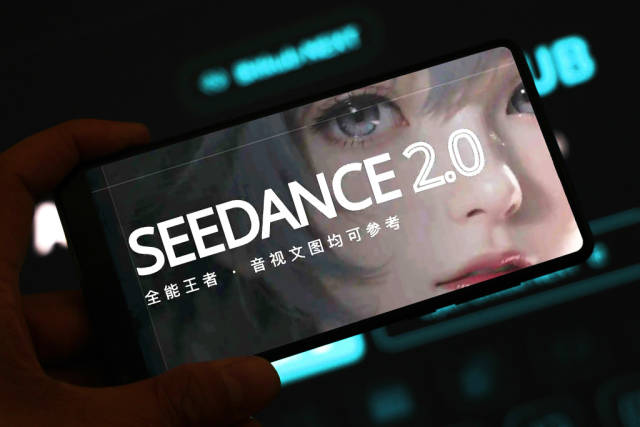
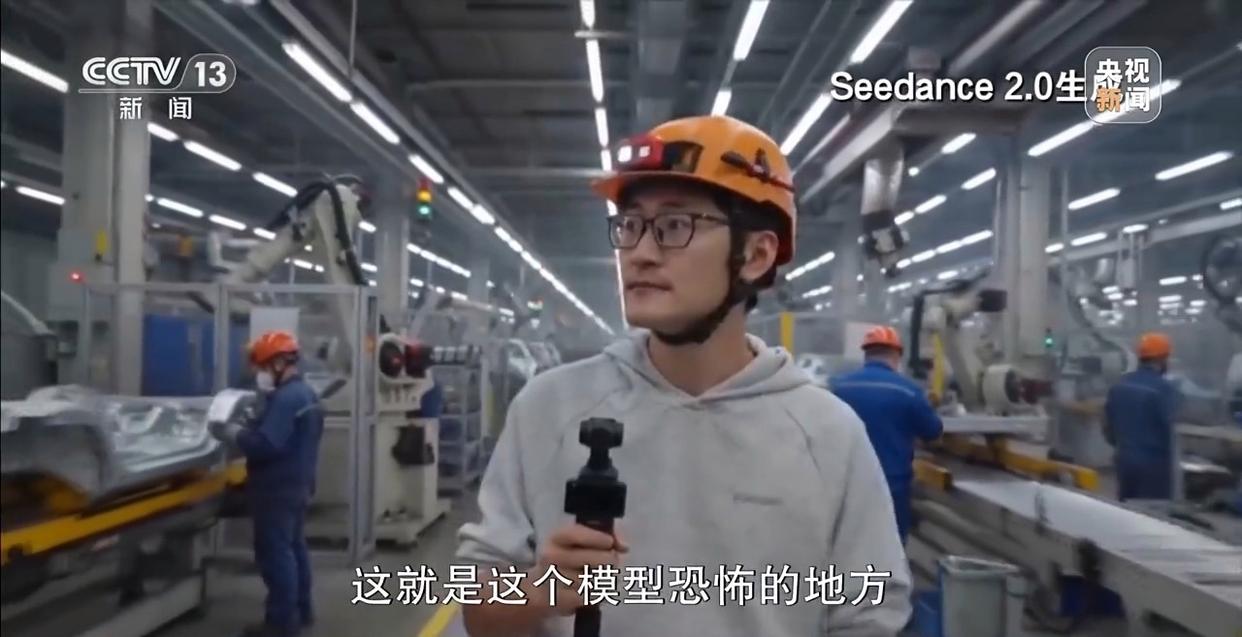
Core Viewpoint - The emergence of advanced AI video generation models, particularly Seedance 2.0, is revolutionizing the video production industry, significantly lowering the barriers to entry and raising concerns about authenticity and copyright issues [1][10][18]. Group 1: Technological Advancements - Domestic AI platforms are rapidly launching new versions of their models, with significant breakthroughs in various technical fields, particularly in video generation [1]. - Seedance 2.0 allows users to generate high-quality videos with multi-camera angles and native sound effects from simple text descriptions, marking it as a versatile tool in video creation [2][4]. - The model has been described as having a "director's consciousness," capable of creating coherent narratives and realistic character portrayals [4][6]. Group 2: Industry Impact - The introduction of Seedance 2.0 is seen as a revolutionary shift in the video industry, with experts claiming it could disrupt traditional filmmaking practices and even threaten established industries like Hollywood [6][8]. - The Chinese online audio-visual market is projected to exceed 1.22 trillion yuan in 2024, with short video users reaching 1.04 billion, indicating a growing demand for AI-driven content creation [8]. Group 3: Ethical and Legal Concerns - The rapid advancement of AI video generation has raised significant concerns regarding privacy, copyright, and the potential for misuse, particularly with the ability to create hyper-realistic videos [10][12]. - The use of real human images as references in AI-generated content has led to immediate backlash, prompting the suspension of this feature in Seedance 2.0 due to infringement risks [10][12]. - Legal frameworks are being scrutinized, with calls for stricter regulations on AI-generated content to prevent the spread of misleading or infringing materials [13][14][16].
The Catch-22 Behind Amazon's Big AI Spending Plans
The Motley Fool· 2026-02-14 18:15
Core Viewpoint - Most investors are not in favor of Amazon's $200 billion capital expenditure plan, primarily aimed at enhancing its Amazon Web Services (AWS) division, but the alternative of not investing could be more detrimental [2][3]. Investment Plans - Amazon plans to allocate $200 billion for capital expenditures, with a significant portion directed towards AWS, which is crucial for its AI business [2]. - In 2025, Amazon generated $717 billion in revenue, resulting in a net income of $77.7 billion, highlighting the scale of its operations [2]. Market Position - AWS is losing market share to competitors like Microsoft and Google, with its share dropping to a multiyear low of 28% [5]. - Despite a year-over-year revenue increase of nearly 24% for AWS, the growth rate is slower than that of its top competitors, and profit margins are decreasing [7]. Investment Justification - Amazon has demonstrated the ability to achieve respectable returns on its AI investments, such as its Trainium and Inferentia AI processing chips, which are competitive with Nvidia's offerings at lower costs [8]. - The introduction of Amazon Bedrock has facilitated the development of generative AI applications for cloud customers, with a reported 60% quarter-over-quarter growth in customer spending [9]. Future Outlook - The capital expenditures are expected to position Amazon favorably in the rapidly growing AI data center market, projected to expand at an average annualized rate of 35.5% through 2034 [9].


港股异动丨MiniMax大涨超17%创上市新高,市值突破2100亿
Ge Long Hui· 2026-02-14 17:50
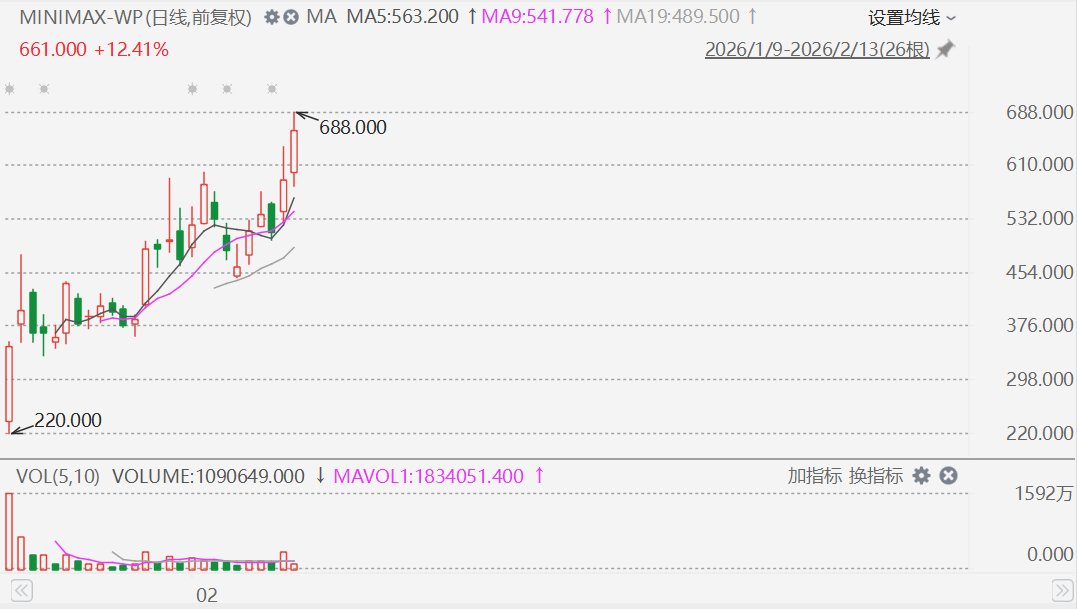
Group 1 - MiniMax-WP (0100.HK) experienced a significant increase of over 15%, reaching 688 HKD, marking a new high since its listing, with a market capitalization surpassing 210 billion HKD [1] - The company officially launched its latest flagship programming model, MiniMax M2.5, which is designed for agent scenarios and is positioned as a production-grade model [1] - The M2.5 model features competitive coding and agentic performance, directly competing with international models like Claude Opus 4.6, and supports full-stack programming development across PC, App, and cross-platform applications [1] Group 2 - The M2.5 model is noted for its industry-leading capabilities in core productivity scenarios such as advanced Excel processing, in-depth research, and PowerPoint applications [1] - The model has an activation parameter count of only 10 billion, providing advantages in memory usage and inference efficiency, supporting over 100 transactions per second (TPS) with inference speed exceeding that of top international models [1]
MINIMAX-WP(00100.HK):全球化多模态大模型公司 高性价比构筑核心竞争力
Ge Long Hui· 2026-02-14 17:50
Core Insights - The open-source project Clawdbot, now renamed openClaw, has gained significant attention in the tech community, with MiniMax providing foundational technical support for developers [1] - MiniMax's agent capabilities are highly regarded for their cost-effectiveness, particularly in comparison to similar products like Claude, leading to increased user satisfaction and a surge in token usage [9] Company Overview - MiniMax, established in late 2021, has served over 200 countries and regions, with more than 200 million individual users and over 100,000 enterprise clients [2] - The company generates 73% of its revenue from overseas markets, with significant contributions from Singapore and the United States [2] Product Performance - MiniMax's AI products, including Talkie (AI companionship) and Hailuo (AI video), contribute significantly to revenue, accounting for 29%, 33%, and 35% respectively [3][6] - The company reported a revenue of $30.52 million in 2024, with a projected increase to $53.44 million in 2025, reflecting a year-on-year growth of 175% [6] Technological Advancements - MiniMax has introduced the OctoCodingBench, enhancing the training of coding agents through process supervision, which has shown competitive success rates compared to established closed-source models [2] - The company is a pioneer in commercializing the MoE (Mixture of Experts) architecture, which improves scalability and efficiency while reducing computational costs [4] Market Position - MiniMax's M2.1 model has demonstrated superior performance in handling non-extreme full-stack tasks efficiently and cost-effectively, leading to a 64% year-on-year increase in token usage following the popularity of Clawdbot [9] - The company is positioned to capitalize on the growing demand for AI applications among small and micro enterprises due to its high cost-performance ratio and comprehensive multi-modal service offerings [8] Future Outlook - MiniMax is expected to see substantial revenue growth, with projections of $80 million, $190 million, and $395 million from 2025 to 2027, reflecting year-on-year growth rates of 173%, 129%, and 107% respectively [7] - The company aims to enhance its open platform's capabilities, which is seen as a core growth driver for future revenue [10]
X @TechCrunch
TechCrunch· 2026-02-14 17:44
Designer Kate Barton teams up with IBM and Fiducia AI for a NYFW presentation https://t.co/66PrsXkhYV ...

AI超级入口争夺及变现开启:一场关乎未来生态的生死博弈
Sou Hu Cai Jing· 2026-02-14 17:28
Core Insights - Major tech companies are investing heavily in AI platforms, with Alibaba, Tencent, and Baidu collectively spending over 45 billion yuan to attract new users during the 2026 Spring Festival [2][8] - The marketing strategies have evolved from simple cash giveaways to more sophisticated methods that include subsidies, scenario binding, and social sharing, reflecting a shift from technical competition to ecosystem development [2][4] Group 1: Investment and Marketing Strategies - Tencent initiated the competition by distributing 10 billion yuan in cash red envelopes, leveraging its social ecosystem with over 1.4 billion monthly active users to enhance user engagement [3] - Baidu followed with 5 billion yuan in red envelope benefits, integrating its AI product with its existing app ecosystem to capture new traffic [3] - Alibaba's strategy involved offering 30 billion yuan in vouchers through its app, which connects various services within its ecosystem, enhancing user experience and engagement [3] Group 2: Evolution of AI Applications - AI applications are transitioning from basic functionalities to becoming integral parts of daily life, evolving into comprehensive digital assistants that can handle various tasks beyond simple queries [4][7] - The competition is moving towards embedding AI deeply into everyday scenarios, making it a necessity rather than an optional feature [7][12] Group 3: Future Implications and Competitive Landscape - The current marketing tactics are seen as a short-term strategy for user acquisition, with the real challenge being user retention post-subsidy [9][12] - The battle for AI dominance is not just about immediate user engagement but about establishing a long-term operational system that can integrate various services seamlessly [9][17] - Companies that can effectively create a reliable and compliant AI ecosystem will likely emerge as leaders in the global market, as the competition extends beyond local user engagement to include technological sovereignty and adaptability [16][17]




字节跳动豆包大模型2.0发布,多数基准达SOTA水平
Sou Hu Cai Jing· 2026-02-14 15:57
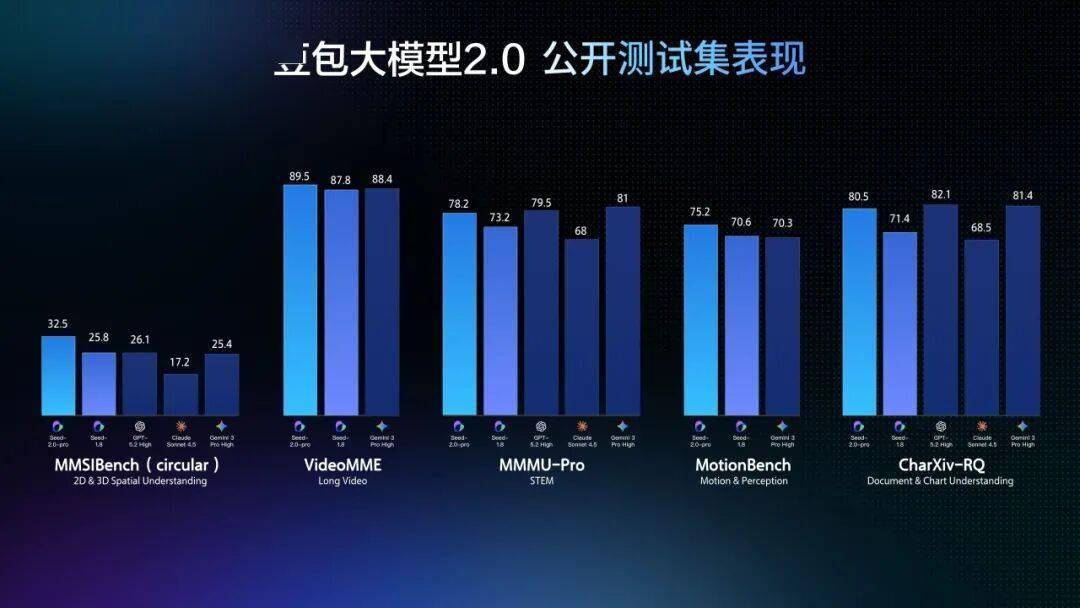
豆包 2.0 全面升级了多模态能力,在各类视觉理解任务上均达到世界顶尖水平,视觉推理、感知能力、空间推理与长上下文理解能力表现尤为突出,豆包 2.0 Pro 在大多数相关基准测试中取得最高分。 面对动态场景,豆包 2.0 强化了对时间序列与运动感知的理解能力,在TVBench等关键测评中处于领先位置,且在 EgoTempo 基准上超过了人类分数,表 明它对"变化、动作、节奏"这类信息的捕捉更为稳定,在工程侧可用性更高。 长视频场景中,豆包 2.0 在大多评测上超越了其他顶尖模型,且在多个流式实时问答视频基准测试中表现优异,能作为 AI 助手完成实时视频流分析、环 境感知、主动纠错与情感陪伴,实现从被动问答到主动指导的交互升级,可应用于健身、穿搭等陪伴场景。 LLM与 Agent 表现大幅强化,长程任务执行能力提升 IT之家 2 月 14 日消息,字节跳动宣布,今天,豆包大模型正式进入 2.0 阶段。豆包 2.0(Doubao-Seed-2.0)围绕大规模生产环境下的使用需求做了系统性 优化,依托高效推理、多模态理解与复杂指令执行能力,更好地完成真实世界复杂任务。 IT之家注意到,豆包 2.0 系列包含 Pro ...
从Gemini到豆包:全球两大AI巨头为何走上同一条路?
Di Yi Cai Jing Zi Xun· 2026-02-14 15:27
Core Insights - ByteDance officially launched Doubao-Seed-2.0, a significant upgrade to its AI model, which has evolved over the past year and a half, enhancing capabilities in text, multimodal understanding, deep reasoning, and agent execution [1][2] Model Features - Doubao-Seed-2.0 offers a full-stack model matrix, multimodal understanding, enterprise-level agent capabilities, and cost efficiency, positioning it among the global leaders in AI [1] - The flagship Doubao-2.0 Pro targets deep reasoning and long-chain task execution, directly competing with models like GPT 5.2 and Gemini 3 Pro [2] Model Variants - The Doubao-2.0 series includes Pro, Lite, and Mini versions, all featuring upgraded multimodal understanding and enhanced LLM and agent capabilities for real-world task execution [3] - The Pro version achieved top scores in various competitions, showcasing its advanced mathematical and reasoning abilities [3] Performance Metrics - Doubao-2.0 Pro excels in instruction following, tool invocation, and search agent evaluations, achieving a score of 54.2 in the HLE-Text test, significantly outperforming other models [4] - The model's pricing structure offers a competitive edge, with input costs at 3.2 yuan per million tokens for inputs under 32k and 16 yuan per million tokens for outputs, making it more cost-effective than competitors [4] Multimodal Understanding - The model's multimodal capabilities have been significantly enhanced, achieving top scores in visual reasoning, spatial perception, and long-context understanding tests [7] - Doubao-2.0's ability to process complex visual inputs and generate interactive content aligns closely with the advancements seen in Gemini 3 Pro [7][8] Strategic Positioning - The development of Doubao-2.0 reflects a broader industry trend towards creating AI that can understand and interact with the physical world, moving beyond mere language processing to executing complex real-world tasks [6][8]
