
豆包2.0

Search documents
2026年春季宏观展望:提质增效,科技突围
KAIYUAN SECURITIES· 2026-03-02 07:12
Group 1: International Technology Development - The global AI industry is rapidly developing, with US tech giants expected to increase AI infrastructure investment to over $650 billion in 2026, a growth of over 60% from 2025[14] - AI product exports from China are projected to grow significantly, with an expected year-on-year increase of 4.8% to 5.6% in 2026, supported by US tech giants' increased capital expenditure[42] - The competition between China and the US in technology and critical minerals is expected to intensify, as the US aims to maintain its economic and technological lead over China[5] Group 2: China's Technology Policy Landscape - The "14th Five-Year Plan" emphasizes technological self-reliance and security, aiming to significantly enhance the level of technological independence and develop key industries[6] - Fiscal policies will leverage various funding sources, including a total of 1.5 trillion yuan in technology-focused funds to support key industries[74] - Monetary policies will focus on precision support for technology, green finance, and small and medium enterprises, with a significant increase in the quota for technology innovation loans to 1.2 trillion yuan[76] Group 3: Economic Transition and New Growth Drivers - New productive forces are expected to take over the "pillar industry" status from real estate, with their share of nominal GDP rising to 11.4% in 2023, while real estate's share is declining[83] - The influence coefficient of new productive forces has increased significantly, indicating a stronger economic pull compared to real estate[83] - The capital market is transitioning ahead of the economic fundamentals, with new growth drivers accounting for approximately 47% of the total market value of A-shares by the end of 2025[9]






中银国际:AI大模型演进路径逐渐清晰 算力或供不应求
Zhi Tong Cai Jing· 2026-02-25 06:17
Group 1 - The core viewpoint is that major AI models both domestically and internationally are set to complete significant upgrades around the Spring Festival in 2026, indicating a robust demand for advanced models and a potential growth in computing power hardware [1][2]. Group 2 - Domestic AI models are undergoing intensive updates, with several releases from companies such as Zhiyuan, ByteDance, and Alibaba between January 27 and February 16, 2026 [2]. - Internationally, major model updates include OpenAI's GPT-5.3-Codex, Anthropic's Claude Opus 4.6, and Google's Gemini 3.1 Pro, all released in February 2026, showcasing enhanced capabilities [2]. Group 3 - The enhancement of model capabilities is leading to the emergence of intelligent agents and multimodal applications, with tools like OpenClaw evolving from simple chatbots to sophisticated office assistants [3]. - ByteDance's SeeDance 2.0 has significantly improved video generation efficiency, increasing the usable rate from 20% to 90%, which may drive the animation and film industries towards large-scale development [3]. Group 4 - The price adjustment by Zhiyuan for its GLM Coding Plan, including a 30% or more increase in subscription prices, reflects a growing market demand and indicates a supply bottleneck in computing power, suggesting ongoing benefits for the computing power industry [4].
东方证券:大厂比拼应用入口 软件将迎“K”型分化
智通财经网· 2026-02-24 09:03
Core Insights - In 2026, major internet companies are expected to invest over 4 billion yuan to transition AI from laboratory technology to practical applications, marking a critical point for widespread AI adoption [1] - The Chinese open-source models are gaining global traction due to their performance and cost advantages, with several models recently achieving significant milestones [2] - Concerns about AI potentially disrupting the software industry are valid, but the industry is likely to experience a "K-shaped" differentiation, where certain software will be more vulnerable to AI than others [3] Investment Opportunities - The computing power industry is anticipated to present clear investment opportunities amid the new wave of model iterations and accelerated application promotion by major internet companies [4] - Key players in the AI computing power sector include Haiguang Information, Cambricon Technologies, and several others listed, which are positioned to benefit from the growing demand for AI applications [4] - In the AI application domain, companies such as Zhaoyi Information and iFLYTEK are highlighted as potential investment targets due to their high barriers to entry and proactive transformation strategies [4]

第二个“DeepSeek时刻”?大模型“春节档”精彩纷呈!科创人工智能ETF(589520)单日吸金843万元!
Xin Lang Cai Jing· 2026-02-24 02:54
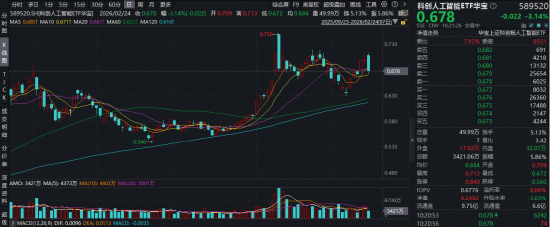
Group 1 - Major tech companies in China and overseas launched new AI models during the Spring Festival, including Alibaba's Qwen3-Max-Thinking and ByteDance's Doubao 2.0 [1][8] - Domestic AI companies initiated a "red envelope war" during the holiday, with Tencent distributing 1 billion yuan in cash and Qianwen launching a 3 billion yuan "Spring Festival treat plan" [1][8] - Guolian Minsheng Securities remains optimistic about AI investment opportunities, citing four dimensions of industry prosperity: increased capital expenditure by tech giants, the transition of AI assistants to executors, ongoing supply-demand tension in computing infrastructure, and accelerated application demand in the AI sector [1][9] Group 2 - On February 24, the first trading day after the Spring Festival, the domestic AI industry-focused ETF (589520) experienced a decline of 3.14% due to overseas market disturbances, despite attracting 8.43 million yuan in investments on February 13 [2][9] - Key stocks within the ETF, such as Lanke Technology and Lingyun Light, saw gains of over 3%, while stocks like Xinghuan Technology and Sikan Technology faced declines exceeding 10% [2][9] - The Huabao AI ETF focuses on the domestic AI industry chain, with nearly half of its holdings in the semiconductor sector and over 30% in software, indicating strong growth potential [4][11] Group 3 - The Huabao AI ETF does not charge a sales service fee, with a maximum commission of 0.5% for subscription and redemption by agents, while the trading fees are determined by the brokerage [6][13] - The Huabao AI ETF's linked funds have specific fee structures, including a subscription fee for amounts over 2 million yuan and a redemption fee based on holding periods [6][13]


中信建投:春节大厂模型频发 云需求有望“通胀”
智通财经网· 2026-02-23 12:51
Core Insights - The report highlights a significant iteration of large models during the Spring Festival, with advancements in multi-agent collaboration and native multi-modal capabilities driving a leap in performance [1] - Major AI companies have released new foundational models, showcasing features such as parallel agent architecture, complex logical reasoning, and support for ultra-long context [1] - The industry trend is shifting from conversational Q&A to fully automated management of complex engineering tasks [1] Company Developments - Google launched its flagship model Gemini 3.1 Pro, achieving a 77.1% accuracy in the ARC-AGI-2 test and supporting a million-token ultra-long context [2] - Anthropic's Claude Sonnet 4.6 has improved its efficiency in code writing and long text reasoning, slightly outperforming its predecessor Opus 4.6 [3] - xAI introduced the Grok 4.2 model with 500 billion parameters, utilizing a multi-agent cluster mechanism for complex task handling [3] - Alibaba's Qwen 3.5 flagship series integrates linear attention and expert mixture architecture, enhancing decoding throughput by 8.6 times [4] - ByteDance's Doubao 2.0 matrix includes various versions optimized for complex instruction execution, achieving gold medal-level performance in competitions [4] - Zhiyuan AI launched the GLM-5 model with 744 billion parameters, marking a significant advancement in automated intelligent engineering [5] - MiniMax's M2.5 model set industry records in productivity benchmarks, achieving an 80.2% accuracy rate [5] - Kimi's K2.5 model employs joint text-visual pre-training technology, significantly reducing end-to-end reasoning latency [6] Industry Trends - The demand for AI reasoning has led to a price increase in cloud services, with Alibaba Cloud reporting a 34% growth in revenue for Q3 2025, driven by AI-related products [7] - The industry is transitioning from a "price-for-volume" model to a "premium monetization" approach in cloud services [7] - The hardware landscape is shifting from a focus on GPU dominance to a collaborative heterogeneous computing model, with increased demand for CPU and memory due to the rise of AI agents [8] - The need for high concurrency reasoning has highlighted the "memory wall" bottleneck, prompting data centers to adopt high-speed interconnect technologies [8]


春节要闻与市场主线:特朗普关税裁决、AI竞赛、中东局势升温
Sou Hu Cai Jing· 2026-02-23 01:46
Core Viewpoint - The travel data during the Spring Festival showed strong performance, while the IEEPA tariff ruling and escalating Middle East tensions disturbed risk appetite. The AI competition accelerated, and the resilience of the US economy led to a decline in interest rate cut expectations [1][2][7] Group 1: Major Events and Market Trends - The US Supreme Court ruled the IEEPA tariffs illegal, prompting Trump to invoke the Trade Act of 1974, resulting in an average tariff rate that may not differ significantly from previous levels [2][8] - The technology sector continues to see a high level of interest with new AI and robotics products emerging [2][14] - The US economy remains resilient, with inflation pressures emerging, leading to a decline in interest rate cut expectations [2][23] Group 2: Asset Class Performance - During the Spring Festival, major asset classes showed divergence, with the Nasdaq, Korean index, and European stocks rising by 1.51%, 5.92%, and 2.44% respectively, while Hong Kong stocks weakened due to liquidity and competitive pressures [3][26] - The bond market showed mixed results, with US Treasury yields slightly rising while Japanese and German long-term bond yields fell [3][26] - Precious metals and oil performed strongly due to safe-haven demand, with gold and silver prices reaching $5104 and $84 per ounce, respectively, and oil prices rising to $71 per barrel [3][26] Group 3: Debt Market Outlook - The post-Spring Festival bond market will largely depend on the fundamentals, policy signals, supply and demand, and stock market performance [4][41] - The bond market is expected to remain in a volatile state, with limited space below 1.8% for the 10-year Treasury yield [4][41] - The demand side of the bond market is primarily driven by insurance and bank allocations, with a focus on the potential for structural opportunities in medium to short-term bonds [4][40] Group 4: Stock Market and Convertible Bonds - The stock market is expected to open slightly lower on the first trading day after the holiday, with a focus on tariff and trade issues, the Fed's interest rate decisions, and geopolitical concerns [5][42] - The overall market sentiment is expected to remain positive, with potential for a quick recovery after a slight dip [5][42] - Investors are advised to optimize their positions during the post-holiday low opening, particularly in sectors like AI applications and humanoid robots that may be undervalued due to market sentiment [5][48]
2026春节期间国内外大事
Sou Hu Cai Jing· 2026-02-23 01:25
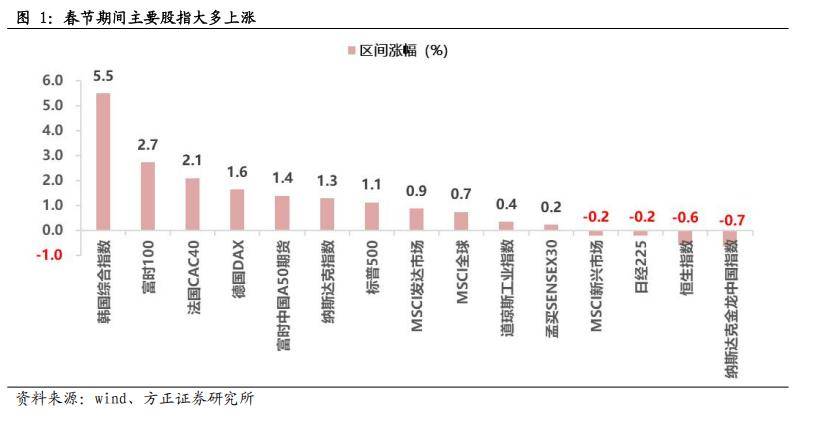
Market Performance During Spring Festival - Major stock indices mostly rose, with South Korea and European markets performing well. The S&P 500 and Nasdaq indices increased by approximately 1% [1] - In the Asia-Pacific region, South Korea's index stood out with a rise of nearly 5.5%, while the Hang Seng Index fell by 0.6% and the A50 index rose by 1.4% [1] - In the Hong Kong market, energy and materials sectors led the gains, both rising over 3%, while industrial, consumer, and technology sectors lagged behind [1] Commodity Market - Commodity performance was mixed, with crude oil and precious metals showing the best results. Silver rose over 10% and oil prices increased by nearly 6% [1][7] - Industrial metals had modest gains, with copper and aluminum slightly up, while natural gas and tin saw significant declines [1] Bond and Currency Markets - U.S. Treasury yields fluctuated, maintaining around 4.1%, while the U.S. dollar index rose significantly by 0.86% [1][5] - The Chinese yuan experienced initial appreciation followed by depreciation, fluctuating around 6.9 [1] Domestic Data and News - The Spring Festival box office revenue was 4.924 billion yuan, down 48.24% year-on-year, with total attendance dropping by 45.5% [12] - Cross-regional personnel flow during the Spring Festival increased by 11.2% compared to the previous year, reaching 5.08 billion trips [14] - The tourism market showed continued growth, with long-distance travel orders accounting for 59.6% of bookings, and inbound tourism also seeing significant increases [21] AI and Technology Developments - Major tech companies launched new AI models during the Spring Festival, indicating a competitive landscape in AI infrastructure [23][24] - Notable releases included Alibaba's Qwen3-Max-Thinking and ByteDance's Protenix-v1, showcasing advancements in AI capabilities [24]
华尔街见闻早餐FM-Radio | 2026年2月16日
Hua Er Jie Jian Wen· 2026-02-15 23:02
Market Overview - US CPI growth slowed to 2.4% year-on-year in January, below expectations, leading to reduced inflation concerns and increased expectations for interest rate cuts, with traders now estimating a 50% chance of three rate cuts this year [10][28] - The S&P 500 index experienced a weekly decline of 1.39%, while the Nasdaq fell 2.1%, marking significant market volatility [17] - In Asia, the Shanghai Composite Index fell below 4100 points, with semiconductor stocks performing well, while the Hang Seng Index dropped by 1% [2] Key Developments in China - The People's Daily published an important article by General Secretary Xi Jinping emphasizing the need to boost domestic demand and implement measures to stimulate consumption and investment [23] - China's social financing in January reached 7.22 trillion yuan, with new RMB loans amounting to 4.71 trillion yuan, and M2 money supply growing by 9.0% year-on-year [24] - The housing market showed mixed signals, with a narrowing month-on-month decline in prices across first, second, and third-tier cities, but an expanding year-on-year decline [4][24] Regulatory Actions - The Financial Regulatory Bureau and the Market Regulatory Bureau held discussions with six travel platform companies regarding compliance issues in their lending practices [5][25] - New antitrust compliance guidelines were issued, highlighting eight new types of monopolistic risks, including "choose one" and "lowest price across the network" practices [25] Company News - Meituan forecasted a significant loss of over 23 billion yuan for 2025, continuing losses into the first quarter [9][25] - DeepSeek is expected to release a new model, V4, around the Spring Festival, which is currently undergoing testing [6][26] - ByteDance launched Doubao 2.0, significantly reducing inference costs and competing directly with GPT-5 and Gemini 3 [7][27] - MiniMax introduced the M2.5 model, which operates at a cost of $1 per hour, significantly cheaper than GPT-5, while maintaining competitive performance [8][26] International Developments - The US is considering partially lifting tariffs on aluminum and steel to alleviate inflationary pressures [13][29] - The US military is preparing to deploy a second aircraft carrier to the Middle East amid rising tensions with Iran [14][41] - Trump confirmed plans to visit Venezuela, with US energy officials noting that Venezuelan oil revenues have exceeded $1 billion [15][30]

Seedance2.0炸场之后,豆包Seed2.0能否再度勇攀高峰?
虎嗅APP· 2026-02-15 02:32
Core Viewpoint - Seedance 2.0 has become a significant name in the AI video sector, showcasing China's AI video model's global leadership in adhering to physical laws. The launch of Doubao Model 2.0 marks ByteDance's entry into the "native multimodal Agent" era, emphasizing a shift from information distribution to task processing [5][6]. Group 1: Doubao Model 2.0 Upgrades - The core upgrade of Doubao 2.0 involves a comprehensive reconstruction of underlying capabilities, enabling AI to transition from information distribution to task processing. This model integrates multimodal understanding, adjustable logical reasoning, and stable tool invocation as inherent capabilities [5][6]. - Doubao 2.0 Pro (32k) is priced at 3.2 yuan per million tokens, significantly cheaper than GPT 5.2 and Gemini 3 Pro, while the Lite version's price is reduced to 0.6 yuan, enhancing its cost-effectiveness [6]. Group 2: Performance and Capabilities - Doubao 2.0 has shown a notable improvement in logical reasoning capabilities, ranking alongside Gemini 3 Pro in key evaluation metrics. Its performance in real tasks is more stable, capable of complex task decomposition, causal chain establishment, multi-step planning, and result verification [8][14]. - The model's multimodal capabilities have been optimized to address high-frequency production environment needs, such as screenshot recognition, chart analysis, and complex document reading, which are essential for real-world enterprise processes [15][16]. Group 3: Agent Restructuring - Doubao 2.0 supports native multi-skill invocation and continuous adherence to multi-turn instructions, enhancing its structured output capabilities. This improvement allows for more reliable task execution in enterprise processes, reducing context breaks and ensuring consistent output formats [20][21]. - The model's enhanced context management alleviates the "fragmentation" issue in complex tasks, maintaining goal consistency over longer execution periods, which is crucial for enterprise-level Agents [21]. Group 4: ByteDance's Strategic Positioning - ByteDance aims to differentiate itself in the AI cloud market by transforming model capabilities into scalable production infrastructure through its Volcano Engine. This approach focuses on providing stable, cost-effective, and smoothly deployable cloud services to enterprise clients [22][24]. - The emphasis on API services, production environment adaptation, and competitive pricing during the Doubao 2.0 launch highlights the importance of cloud platforms in sustaining stable reasoning costs and flexible scalability, which are critical for long-term enterprise adoption [26].
从Gemini到豆包:全球两大AI巨头为何走上同一条路?
Di Yi Cai Jing Zi Xun· 2026-02-14 15:27
Core Insights - ByteDance officially launched Doubao-Seed-2.0, a significant upgrade to its AI model, which has evolved over the past year and a half, enhancing capabilities in text, multimodal understanding, deep reasoning, and agent execution [1][2] Model Features - Doubao-Seed-2.0 offers a full-stack model matrix, multimodal understanding, enterprise-level agent capabilities, and cost efficiency, positioning it among the global leaders in AI [1] - The flagship Doubao-2.0 Pro targets deep reasoning and long-chain task execution, directly competing with models like GPT 5.2 and Gemini 3 Pro [2] Model Variants - The Doubao-2.0 series includes Pro, Lite, and Mini versions, all featuring upgraded multimodal understanding and enhanced LLM and agent capabilities for real-world task execution [3] - The Pro version achieved top scores in various competitions, showcasing its advanced mathematical and reasoning abilities [3] Performance Metrics - Doubao-2.0 Pro excels in instruction following, tool invocation, and search agent evaluations, achieving a score of 54.2 in the HLE-Text test, significantly outperforming other models [4] - The model's pricing structure offers a competitive edge, with input costs at 3.2 yuan per million tokens for inputs under 32k and 16 yuan per million tokens for outputs, making it more cost-effective than competitors [4] Multimodal Understanding - The model's multimodal capabilities have been significantly enhanced, achieving top scores in visual reasoning, spatial perception, and long-context understanding tests [7] - Doubao-2.0's ability to process complex visual inputs and generate interactive content aligns closely with the advancements seen in Gemini 3 Pro [7][8] Strategic Positioning - The development of Doubao-2.0 reflects a broader industry trend towards creating AI that can understand and interact with the physical world, moving beyond mere language processing to executing complex real-world tasks [6][8]