
非银行金融

Search documents
基于一致预期的中观景气度研究
Mai Gao Zheng Quan· 2025-11-18 05:22
Group 1 - The report emphasizes the importance of analyst consensus expectations in predicting future industry performance, particularly in the context of the current A-share market, which is characterized by valuation recovery and liquidity-driven trends [9][11][12] - The report constructs a composite expectation factor to capture marginal changes in industry prosperity, focusing on the strength and magnitude of upward revisions in analyst forecasts [11][12][49] - The analysis categorizes expected indicators into three groups: profitability, asset quality, and cost metrics, which are essential for assessing market expectations regarding industry fundamentals [16][23] Group 2 - The upward strength signal reflects the breadth of upward revisions within an industry, indicating improvements in industry prosperity [30][32] - The upward magnitude signal measures the month-on-month improvement in overall industry forecasts, highlighting the concentration and intensity of industry recovery [40][44] - The report identifies that profitability-related indicators, such as expected net profit and ROE, significantly outperform cash flow and cost indicators in terms of predictive power and return potential [35][44] Group 3 - The composite expectation score combines upward strength and upward magnitude to provide a comprehensive view of industry prosperity, with higher scores correlating with better future performance [53][65] - The backtesting results show that the top-performing industries based on the composite score yield substantial excess returns compared to the benchmark, demonstrating the model's effectiveness in identifying profitable sectors [70][73] - The report highlights that the top five industry strategy achieved an annualized excess return of 12.40%, indicating strong predictive capabilities of the model [70][74]
中信建投:继续看多黄金 港股情绪指数抬升
Zheng Quan Shi Bao Wang· 2025-11-16 12:15
Group 1 - The A-share sentiment index is declining while the Hong Kong stock sentiment index is rising, indicating a shift in market sentiment [1] - The VIX for the Shanghai Stock Exchange 50, CSI 300, CSI 500, and CSI 1000 has decreased, suggesting a more stable market environment [1] - Institutions are currently focusing on sectors such as basic chemicals, defense and military, automotive, textile and apparel, non-bank financials, and media, while interest in the telecommunications sector has decreased [1] Group 2 - There has been an increase in institutional attention towards the "petroleum and petrochemicals," "coal," "steel," "light manufacturing," and "non-bank financial" sectors over the past week [1] - Many industries are approaching the threshold of crowded indicators, indicating potential liquidity and consistency among constituent stocks [1] - For the long term, the company is optimistic about the relative returns of electric power and utilities, basic chemicals, electric equipment and new energy, electronics, and computers by November 2025 [1] Group 3 - The VIX for gold, silver, copper, and crude oil has risen, with a long-term bullish outlook on gold [1]

中信建投:看好电力及公用事业、基础化工、电力设备及新能源、电子和计算机的相对收益
Di Yi Cai Jing· 2025-11-16 12:12
Group 1 - The current institutional focus is on the basic chemical, defense, automotive, textile and apparel, non-bank financial, and media industries, while the telecommunications sector has seen a decline in institutional attention [1] - In the past week, there has been an increase in institutional interest in the "petroleum and petrochemical," "coal," "steel," "light manufacturing," and "non-bank financial" sectors [1] - Many industries are currently at the threshold of triggering congestion indicators (liquidity, consistency of constituent stocks) [1] Group 2 - The relative returns for electric power and utilities, basic chemicals, electric equipment and new energy, electronics, and computers are expected to be favorable by November 2025 [1] - The VIX for gold, silver, copper, and crude oil has risen, and the medium to long-term outlook for gold remains bullish [1]
华泰股份:华泰集团财务公司是经国家金融监管总局批准设立的非银行金融机构
Zheng Quan Ri Bao Wang· 2025-11-14 14:11
Core Viewpoint - Huatai Group's financial company has been approved by the National Financial Regulatory Administration as a non-bank financial institution, with Huatai Group holding 60% and Huatai Co. holding 40% of the shares [1] Group 1 - Huatai Financial Company has been granted access to the central bank's ACS comprehensive front-end subsystem, which is crucial for the digital upgrade of basic financial institution operations [1] - The ACS system is the core system for the People's Bank of China to centrally process financial institutions' accounting data and implement business supervision [1] - The access to the ACS system will enable electronic reconciliation, electronic receipts, and online handling of deposit reserves, optimizing Huatai Financial Company's fund management and risk control efficiency [1]

1.31万亿南向资金扫货港股
Di Yi Cai Jing Zi Xun· 2025-11-13 13:21
Core Insights - The Hong Kong stock market is experiencing a surge in investment, with significant inflows from southbound funds and public funds, indicating strong market interest despite recent volatility [2][4][6] Group 1: Market Performance - The Hang Seng Index has shown a slight increase of 0.81% as of November 13, with a maximum drawdown of -8.17% and a maximum increase of 8.89% in the fourth quarter [3] - The Hang Seng Technology Index has seen a decline of 7.49% with a maximum drawdown exceeding 15% [3] - Both indices have outperformed major global markets with annual gains exceeding 33% [3] Group 2: Fund Inflows - Southbound funds have recorded a net inflow of 1.31 trillion HKD year-to-date, marking a historical high and a 60% increase compared to last year's total inflow of 807.87 billion HKD [4] - Public funds have significantly increased their holdings in Hong Kong stocks, reaching a market value of 1.36 trillion HKD by the end of Q3, a more than 40% increase from the previous quarter and a doubling from the same period last year [4][5] - Over half of the active equity funds have increased their allocation to Hong Kong stocks, with some funds raising their positions by over 20% in a single quarter [4] Group 3: ETF Trends - The trend of investing in Hong Kong stocks through ETFs has intensified, with 79 Hong Kong Stock Connect-themed ETFs seeing a net inflow of nearly 300 million HKD in the fourth quarter, totaling 2.184 billion HKD for the year [5] - The total size of these ETFs has surged to 352.87 billion HKD, a 3.4-fold increase from the end of last year [5] Group 4: Investment Preferences - Dividend-paying assets are gaining popularity, with significant net subscriptions to various dividend-focused ETFs [5] - There is a noticeable shift in capital flows, with previous high-growth sectors like technology and innovative pharmaceuticals experiencing a slowdown in inflows [5][9] Group 5: Market Dynamics - The alternating activity between A-shares and Hong Kong stocks is attributed to industry cycle rotations rather than significant capital shifts between the two markets [6] - The Hong Kong market is seen as attractive due to its valuation advantages, structural benefits, and the ongoing appeal of Chinese assets [6][7] Group 6: Growth and Value Considerations - The Hong Kong market offers a dual appeal for defensive and growth-oriented investments, with blue-chip stocks providing stable dividends and innovative sectors presenting growth opportunities [7][8] - Concerns about potential bubbles in growth assets are countered by the argument that recent price increases are corrections of previous undervaluations rather than speculative bubbles [8]


“18罗汉”突然异动!背后有何逻辑
Zheng Quan Shi Bao Wang· 2025-11-12 07:07
Group 1 - The A-share market saw a significant rally among the top 18 stocks by market capitalization, with Agricultural Bank reaching a historical high and the total market value of these stocks exceeding 20 trillion yuan [2] - Despite the overall market showing some recovery, the number of declining stocks remained high, indicating a mixed performance with over 3,800 stocks falling [2] - Southbound capital experienced a substantial net inflow of 12.748 billion yuan last week, with banks, non-bank financials, and the oil and petrochemical sectors being the main beneficiaries [3] Group 2 - Analysts suggest that the recent shift towards large-cap stocks may be driven by changes in market risk appetite, with macro leverage around 12.46 times and high valuations in the technology sector [4] - The market is experiencing increased valuation and sentiment risks, with a decrease in liquidity for sell orders, indicating heightened selling pressure [4] - Recommendations for asset allocation include increasing exposure to domestic stocks and commodities, with a focus on large-cap stocks and sectors such as coal, photovoltaics, telecommunications, and agriculture showing good investment value [4]






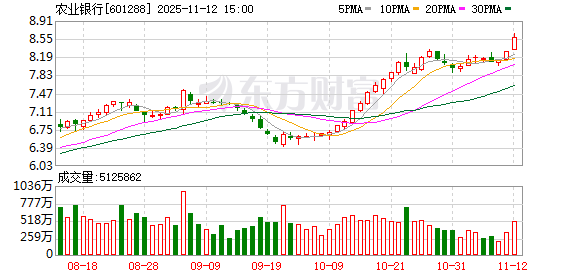
“18罗汉”突然异动!农业银行总市值盘中突破3万亿,背后有何逻辑?
Zheng Quan Shi Bao Wang· 2025-11-12 05:20
Core Viewpoint - The A-share market experienced a significant shift with large-cap stocks showing strong performance, particularly the top 18 stocks, which collectively exceeded a market capitalization of 20 trillion yuan, indicating a potential change in market dynamics and investor sentiment [1][2]. Group 1: Market Performance - On November 12, the A-share market saw a collective rise in the top 18 stocks, with Agricultural Bank reaching a new historical high, while the overall market showed mixed results with over 3,800 stocks declining [1]. - The major indices initially faced declines, with the Shenzhen Component and ChiNext Index dropping over 1%, but later rebounded due to the strong performance of large-cap stocks [1]. Group 2: Fund Flows - Southbound capital saw a significant net inflow of 12.748 billion yuan during the week of November 3 to November 7, with the banking, non-banking financial, and oil and petrochemical sectors being the primary beneficiaries [2]. - The net inflow amounts for these sectors were 8.27 billion yuan for banking, 5.35 billion yuan for non-banking financials, and 4.81 billion yuan for oil and petrochemicals, totaling approximately 18.4 billion yuan [2]. Group 3: Market Logic - Analysts suggest that the shift towards large-cap stocks may be driven by changes in market risk appetite, with current macro leverage at approximately 12.46 times and high valuations in the technology sector [3]. - The market is experiencing increased valuation and sentiment risks, with a decrease in liquidity for sell orders, indicating heightened selling pressure [3]. - Recommendations for asset allocation include increasing exposure to domestic stocks and commodities, with a focus on large-cap stocks and balanced growth-value strategies, particularly in sectors like coal, photovoltaics, telecommunications, and agriculture [3].

刚刚!“18罗汉”,突然异动!
券商中国· 2025-11-12 03:39
Core Viewpoint - The A-share market has shown a significant shift with large-cap stocks gaining momentum, particularly the top 18 stocks, which collectively exceeded a market capitalization of 20 trillion yuan. This change is attributed to a shift in market risk appetite and a preference for traditional large-cap stocks, especially in the banking and energy sectors [1][2][4]. Market Performance - On November 12, the A-share market initially saw a decline, with major indices like the Shenzhen Component and ChiNext Index dropping over 1%. However, large-cap stocks later rallied, with the Agricultural Bank of China hitting a new historical high, rising by 3%. Other notable performers included Midea Group, China Petroleum, and China Bank, each increasing by around 2% [2][4]. - Despite the overall index recovery, the number of declining stocks remained high, with over 3,800 stocks falling, indicating a mixed market sentiment [2]. Capital Flow - Southbound capital saw a significant net inflow of 12.748 billion yuan during the week of November 3 to November 7, with major inflows directed towards the banking, non-banking financial, and oil and petrochemical sectors, amounting to approximately 184 million yuan [2][4]. Underlying Logic - Analysts suggest that the recent performance of large-cap stocks is likely due to a change in market risk preferences, with a current macro leverage ratio of about 12.46 times. The technology sector is perceived to have high valuations, while the broader market indices exhibit structural risks [4]. - The strengthening of the US dollar, which has surpassed the 99 mark, is expected to influence market dynamics, with traditional sectors showing resilience during market downturns. Analysts predict that sectors previously underweighted, such as coal, photovoltaic, banking, and chemicals, will benefit as the market recovers [4]. - Looking ahead to November 2025, there is a recommendation to increase allocations in domestic stocks and commodities, favoring large-cap stocks and a balanced growth-value approach, particularly in sectors like coal, photovoltaic, telecommunications, and agriculture [4].

上市公司三季报超预期全景解析
量化藏经阁· 2025-11-11 00:08
Core Viewpoint - The article focuses on the analysis of companies that reported better-than-expected earnings in their Q3 2025 financial disclosures, highlighting the importance of analyst reports that indicate "earnings exceed expectations" as a comprehensive judgment based on both objective earnings data and subjective research tracking [1][33]. Q3 Financial Disclosure Situation - As of October 31, 2025, a total of 5,401 A-share companies listed before July 1, 2025, disclosed their Q3 2025 financial reports [2][34]. - Among different indices, the median year-on-year net profit growth rate for the CSI 500 index constituents was the highest at 10.27% [7]. - The financial sector reported a median year-on-year net profit growth rate of 10.97%, which is relatively high, while the consumer sector reported a decline of 4.27% [8][34]. - In terms of industry performance, non-bank financial, steel, and non-ferrous metals sectors showed higher median year-on-year net profit growth rates [11][34]. - Hot concept indices with high public fund holdings, such as the NVIDIA industry chain index and semiconductor selection index, reported median year-on-year net profit growth rates exceeding 40% [13][34]. - Representative industry-themed ETFs tracking indices like securities companies and CSI 300 non-bank also showed high median year-on-year net profit growth rates [16][34]. Q3 Earnings Exceeding Expectations - The proportion of companies exceeding expectations in the CSI 300 index was the highest at 21.65% [3][22]. - The financial sector had the highest proportion of companies exceeding expectations, reaching 13.11% [22][34]. - Non-bank financial and food and beverage industries had a higher proportion of companies exceeding expectations [25][34]. - Among hot concepts with high public fund holdings, the Moutai index and cyclical index had a higher number of companies exceeding expectations [35]. - The representative ETF indices with a high number of companies exceeding expectations included CSI 300 non-bank and securities companies [28][35]. Selected Companies - Based on the analysis of Q3 earnings reports and analyst comments, companies such as Sunshine Power and Shengyi Technology were identified as exceeding expectations for Q3 2025 [36][36].

2026年A股市场风格可能更趋于均衡,建议关注三条主线
Mei Ri Jing Ji Xin Wen· 2025-11-10 01:21
Group 1 - CITIC Securities maintains a bullish outlook on gold stocks, indicating a decrease in volatility for commodities and stock indices [1] - The sentiment index for A-shares and Hong Kong stocks has declined, with a notable drop in the VIX for major indices [1] - Institutional focus is shifting towards defense, military, and non-bank financial sectors, while interest in the telecommunications sector is decreasing [1] Group 2 - CICC forecasts a more balanced market style for A-shares by 2026, driven by the restructuring of the international monetary order and the AI revolution [2] - The report emphasizes the importance of fundamentals and the movement of global and domestic funds in shaping market dynamics [2] - Three main investment themes are suggested: growth in prosperous sectors, breakthroughs in external demand, and cyclical reversals [2] Group 3 - China Galaxy Securities highlights the ongoing adjustment in the technology sector, with a focus on the rotation of market themes [3] - The report notes that the market is expected to maintain rapid rotation, with sectors like electric grid equipment, lithium batteries, and chemicals showing upward trends [3] - Key investment themes include anti-involution, new productive forces, consumer sectors, and "dual heavy" areas benefiting from project construction [3]