信贷

Search documents
新鸿基公司发布年度业绩,股东应占溢利15.93亿港元 同比增加321.79%
Zhi Tong Cai Jing· 2026-03-20 03:15
Group 1 - The core viewpoint of the article highlights the successful completion of the strategic transformation of the company, leading to seamless cooperation among its three major business platforms: "Alternative Investment Solutions," "Investment Management," and "Credit" [2] - The integration model has enhanced recurring revenue, profitability, and capital efficiency, solidifying the company's position as a leading alternative investment platform [2] - The company reported a significant increase in shareholder profit, with a year-on-year growth of over three times, despite a low base [2] Group 2 - For the fiscal year 2025, the company achieved total revenue of HKD 37.05 billion, a slight decrease of 0.3% year-on-year [3] - Total income rose to HKD 54.74 billion, reflecting a substantial increase of 28.42% year-on-year [3] - The company's net profit attributable to shareholders reached HKD 15.93 billion, marking a remarkable increase of 321.79% year-on-year, with basic earnings per share at HKD 0.814 and a proposed second interim dividend of HKD 0.15 per share [3]

新鸿基公司(00086.HK)年度股东应占溢利达15.93亿港元 同比增长321.79%
Ge Long Hui· 2026-03-19 12:29
Core Viewpoint - New Horizon Company (00086.HK) reported its annual performance for the year ending December 31, 2025, showing a total revenue of RMB 3.7052 billion, a slight decrease of 0.29% year-on-year, while the profit attributable to shareholders surged by 321.79% to HKD 1.5931 billion, indicating a significant turnaround in profitability [1] Financial Performance - Total revenue for 2025 was RMB 3.7052 billion, down 0.29% year-on-year [1] - Profit attributable to shareholders reached HKD 1.5931 billion, up 321.79% year-on-year [1] - Basic earnings per share were HKD 0.814 [1] - Proposed second interim dividend of HKD 0.15 per share [1] Strategic Developments - 2025 marks a clear turning point in the company's development, with the completion of its strategic transformation [1] - The integration of three major business platforms—"Alternative Investment Solutions" (formerly "Fund Management"), "Investment Management," and "Credit"—has achieved seamless cooperation and full synergy [1] - This integrated model has enhanced recurring income, profitability, and capital efficiency, solidifying the company's position as a leading alternative investment platform [1] Operational Efficiency - Cost control remains a key advantage for the company, with a cost-to-income ratio of approximately 30% in 2025 [1] - The EBITDA margin was around 50%, showcasing the operational model's strengths [1] Capital Management - The company actively managed its balance sheet, optimizing its capital structure by repurchasing a total of USD 26.2 million in medium-term notes during the year [1] - Cumulatively, since 2022, the total amount of repurchased and redeemed medium-term notes reached USD 460.3 million, reducing the net debt-to-equity ratio to 25.8% [1]
M2余额增速达9%创近两年新高
Shang Hai Zheng Quan Bao· 2026-02-13 17:04
Core Viewpoint - The article highlights the significant recovery in credit demand and the positive impact of monetary policy on credit supply, indicating a favorable environment for investment and economic growth. Group 1: Credit Supply and Demand - Credit supply has shown stable growth, driven by a notable recovery in demand, with major projects being launched early in the year, leading to increased project loans [2] - In January, corporate loans increased by 4.45 trillion yuan, with medium to long-term loans rising by 3.18 trillion yuan, providing strong financial support for key sectors like manufacturing and emerging industries [2] - The release of consumer demand before the Spring Festival has also supported steady growth in personal loans, with various consumption needs driving this increase [2] Group 2: Financing Costs and Loan Structure - The average interest rate for newly issued corporate loans was approximately 3.2% in January, down about 20 basis points from the previous year, while personal housing loans remained stable at 3.1% [3] - The sustained low financing costs reflect the effectiveness of the moderately loose monetary policy, helping to reduce the financial burden on enterprises and stimulate their operational vitality [3] - The structure of credit is continuously optimizing, with financial resources increasingly directed towards high-quality development areas, as evidenced by the growth rates of inclusive small and micro loans and medium to long-term loans in the service sector [3][4] Group 3: Financial Support for Economic Transition - The shift in credit resources from traditional sectors to emerging fields is a natural result of economic structural transformation and an essential reflection of improved financial support for the real economy [4] - Financial institutions are increasingly motivated to optimize the structure of capital supply through market-driven incentives, enhancing their service capabilities [4]
四大证券报精华摘要:2月10日
Zhong Guo Jin Rong Xin Xi Wang· 2026-02-10 00:04
Group 1: Tungsten Market and Related Industries - Tungsten prices have been rising, with ammonium paratungstate (APT) price reaching over 1 million yuan per ton, attracting significant attention from the capital market [1] - Affected by the price increase of tungsten-related products, listed companies in the industry are expected to report strong performance in their 2025 earnings forecasts, with noticeable growth in product sales [1] - The price surge in the MLCC (multi-layer ceramic capacitors) market, driven by AI trends, has seen a nearly 20% increase in spot prices in South Korea, with expectations for continued growth [1] Group 2: Sodium Battery Development - Changan Automobile and CATL have launched the world's first mass-produced sodium battery passenger vehicle, marking a significant step towards large-scale application of sodium batteries in the automotive sector [2] - Sodium batteries are gaining traction due to their abundant resource availability, wide temperature range, long cycle life, and high safety, transitioning from laboratory to large-scale applications [2] Group 3: A-Share ETF Market Trends - The A-share ETF market is experiencing a shift, with traditional broad-based ETFs seeing outflows while ETFs in high-growth sectors like chemicals, telecommunications, and non-ferrous metals are attracting inflows [3] - Recent earnings forecasts from listed companies indicate a positive market sentiment, with a focus on AI, price increase chains, and overseas expansion as key investment themes [3] - Over the past month, 148 brokerages have conducted research on over 560 listed companies, a 26% increase compared to the same period last year, highlighting a growing interest in sectors such as electronics and machinery [3] Group 4: Solar Energy and Space Initiatives - Tesla is ramping up hiring for solar panel manufacturing, aiming to become the largest solar component manufacturer in the U.S., while SpaceX has acquired xAI to build a space-based data center [4] - The A-share photovoltaic sector responded positively to these developments, with a 4.53% increase in stock prices and a net inflow of 4.058 billion yuan in the photovoltaic equipment sector [4] Group 5: Banking Sector Insights - Since the beginning of 2026, listed banks have seen a surge in institutional research, particularly among small and medium-sized banks in coastal economic regions, with 54 institutional visits recorded [5] - Key topics of interest include the performance of credit in the new year, the "14th Five-Year Plan," and wealth management strategies [5] Group 6: Dye Industry Price Increases - The dye industry is experiencing a price increase trend, with companies like Fulaient notifying customers of price adjustments for various disperse dye products due to rising raw material costs [6] - The current price surge in the dye industry is driven by multiple factors, primarily the increase in prices of key upstream intermediates [6] Group 7: Fund Issuance and Foreign Investment - As of February 9, 29 new funds are set to be issued in the coming weeks, with a focus on mixed equity funds and passive index funds [7] - A total of 224 foreign institutions have conducted 569 research visits to A-share listed companies, with firms like Goldman Sachs maintaining a "overweight" rating on Chinese stocks [7] Group 8: Night Economy Initiatives - Various local governments are incorporating night economy strategies into their work reports to stimulate consumption, with initiatives in cities like Shanghai and Fujian focusing on expanding service consumption [8] - The night economy is recognized as a key driver for activating consumer potential and enhancing service consumption quality [8]
美股再迎6只新股上市 今晚还将有3只
Sou Hu Cai Jing· 2026-01-30 06:46
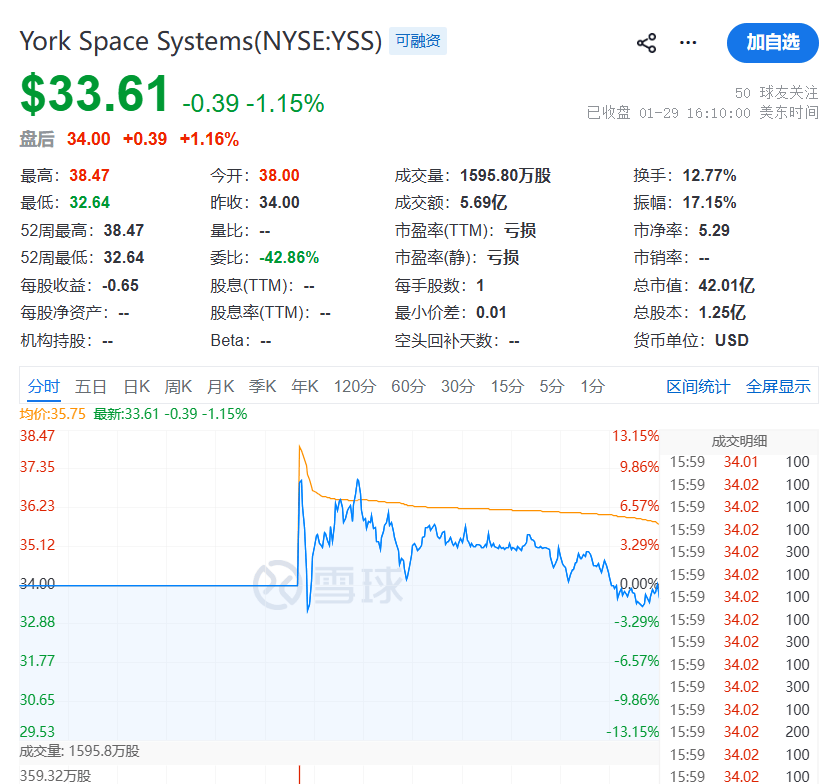
Summary of Key Points Core Viewpoint - Six new stocks entered the US capital market on January 29, 2026, raising approximately $1.783 billion, with three additional companies set to list that evening, all of which are SPACs [1]. Group 1: Newly Listed Stocks - **York Space System (YSS)**: - Opened at $38 per share, up 11.76% from the offering price, but closed at $33.61, down 1.15%, with a total market capitalization of $4.201 billion [2]. - Issued 18.5 million shares at $34 each, raising $629 million. The company provides end-to-end critical solutions for space missions in the aerospace and defense sectors, reporting $281 million in revenue and a net loss of $56.04 million for the first nine months of 2025 [4]. - **Ethos Technologies (LIFE)**: - Opened at $19 per share, unchanged from the offering price, and closed at $16.85, down 11.32%, with a total market capitalization of $1.061 billion [5]. - Issued 10.53 million shares at $19 each, raising $200 million. The company operates a technology platform connecting consumers, agents, and insurance companies, reporting $277 million in revenue and a net profit of $46.59 million for the first nine months of 2025 [7]. - **Picpay (PICS)**: - Opened at $19.5 per share, a slight increase of 2.63%, and closed at $19, with a total market capitalization of $2.462 billion [7]. - Issued 22.86 million shares at $19 each, raising $434 million. The company serves the Brazilian market across various sectors, reporting $1.122 billion in revenue and a net profit of $59 million for the first nine months of 2025 [10]. Group 2: SPACs - Three SPACs listed: - **Xsolla SPAC 1 (XSLLU)** raised $200 million, targeting the video game industry and related sectors [10]. - **United Acquisition I (UACU)** raised $100 million, with no specific acquisition target yet identified, focusing on companies with strong management and competitive advantages [10]. - **K2 Capital Acquisition (KTWOU)** raised $120 million, concentrating on humanoid robotics, physical AI, and advanced energy sectors, particularly small modular nuclear reactors [10].


Picpay NV(PICS.US)登陆美股市场 开盘股价波动不大
Zhi Tong Cai Jing· 2026-01-29 23:26
Core Viewpoint - Picpay NV has successfully launched on the US stock market with an opening price of $19.02, slightly above its IPO price of $19, indicating positive market reception [1] Company Overview - Picpay NV is a digital banking and payment technology platform headquartered in São Paulo, Brazil, originally starting as a mobile payment wallet [1] - The company has evolved into a comprehensive digital banking and payment ecosystem, offering a variety of financial services [1] Services Offered - Picpay provides multiple services including personal wallets, QR code payments, credit, insurance, investments, and merchant acquiring services [1] - The platform serves over 66 million users, showcasing its extensive reach in the digital finance sector [1]
美股异动 | Picpay NV(PICS.US)登陆美股市场 开盘股价波动不大
智通财经网· 2026-01-29 17:25
Core Viewpoint - Picpay NV has successfully launched on the US stock market with an opening price of $19.02, slightly above its IPO price of $19, indicating positive market reception [1] Company Overview - Picpay NV is a digital banking and payment technology platform headquartered in São Paulo, Brazil, originally starting as a mobile payment wallet [1] - The company has evolved into a comprehensive digital banking and payment ecosystem, offering a variety of financial services [1] Services Offered - Picpay provides multiple services including personal wallets, QR code payments, credit, insurance, investments, and merchant acquiring services [1] - The platform serves over 66 million users, showcasing its significant market presence and user base [1]
IPO动态丨本周美股预告:Ethos Technologies等4家公司即将上市
Sou Hu Cai Jing· 2026-01-26 06:03
Summary of Key Points Core Viewpoint - The article discusses recent IPO activities, highlighting eight new stocks that went public, including six SPACs, and outlines upcoming IPO plans for four companies in early 2026. Group 1: Recent IPOs - Eight new stocks were listed last week, with six being SPACs [1] - BitGo (BTGO) raised $223 million by issuing 11.82 million shares at $18 per share [1] - EquipmentShare (EQPT) raised $747 million by issuing 30.5 million shares at $24.5 per share [1] - Other SPACs raised amounts ranging from $150 million to $261 million [1] - Ten companies submitted IPO applications, including two from China [1] Group 2: Upcoming IPOs - Four companies plan to go public in January 2026 [1] - Public Policy Holding Company, Inc. plans to list on NASDAQ under the ticker PPHC, aiming to raise $55.82 million by issuing 4.15 million shares at $13.45 each [2][3] - Picpay Holdings Netherlands B.V. plans to list on NASDAQ under the ticker PICS, with a target of raising approximately $434 million by issuing 22.86 million shares at $16 to $19 each [4][6] - Yellowstone Midco Holdings II/York Space Systems Inc. plans to list on NYSE under the ticker YSS, aiming to raise about $544 million by issuing 16 million shares at $30 to $34 each [7][9] - Ethos Technologies Inc. plans to list on NASDAQ under the ticker LIFE, targeting approximately $211 million by issuing 10.53 million shares at $18 to $20 each [13]

苏州银行:2026年信贷投放实现“开门红”,将继续推进规模稳健增长
2 1 Shi Ji Jing Ji Bao Dao· 2026-01-20 10:07
Core Viewpoint - Suzhou Bank has reported a strong start to the credit issuance for the peak season, indicating a positive outlook for the bank's performance in 2026 [1] Group 1: Credit Issuance - As of early 2026, Suzhou Bank's credit issuance during the peak season is performing well, achieving a good start [1] - The bank has proactively initiated preparations for the peak season to ensure efficient approval and implementation of project reserves [1] - Suzhou Bank aims to continue promoting credit issuance and actively expand its market share to support stable growth in annual credit scale [1]

银行业 2026 年经营展望:资产负债篇:到期存款流向是资负格局的关键
Guoxin Securities Hongkong· 2026-01-13 05:12
Investment Rating - The report maintains an "Outperform" rating for the banking sector [6] Core Insights - The expected M2 growth rate for 2026 is approximately 7.5%, with credit growth around 6.0% and social financing growth at about 8.0%. This aligns with the goal of stabilizing economic growth and ensuring reasonable price recovery [2][18][19] - The banking sector is expected to see a structural differentiation in retail credit, with corporate lending remaining the primary contributor to new loans, accounting for approximately 80% to 85% of new loans [33][37] - The report highlights the importance of deposit flows, particularly the trend of deposits moving from large banks to smaller banks, which will influence the asset-liability gap for large banks in 2026 [3][41] Summary by Sections M2 and Credit Growth - The M2 increment for 2026 is estimated at about 25.4 trillion yuan, with fiscal net injection contributing approximately 12.0 trillion yuan and bank credit (including write-offs and ABS) contributing around 16.8 trillion yuan [2][29][24] - The anticipated new social financing for 2026 is about 35.3 trillion yuan, reflecting a growth rate of approximately 8.0% [30][32] Credit Allocation - Corporate lending is expected to remain strong, while retail lending will show structural improvements, contributing about 10% to 15% of new loans [33][37] - The report notes that retail credit is likely to experience a slight positive growth, particularly in quality consumption scenarios and personal operating loans [33][37] Asset-Liability Dynamics - The asset-liability gap for large banks is projected to continue, with marginal changes primarily driven by the liability side, influenced by deposit flows [3][41] - The report estimates that the maturity of fixed-term deposits for the six major banks in 2026 will be around 57 trillion yuan, with 2-year and longer-term deposits accounting for 27 to 32 trillion yuan [49][52] Investment Recommendations - The report recommends focusing on high-quality stocks with improving fundamentals, specifically highlighting Ningbo Bank and Changshu Bank, while also suggesting attention to Changsha Bank and Chongqing Rural Commercial Bank for potential excess returns [4] - Additionally, it emphasizes the value of stable, high-dividend stocks, recommending China Merchants Bank, Industrial and Commercial Bank of China, and Jiangsu Bank [4]