Semiconductor

Search documents
Elon Musk unveils chip manufacturing plans for SpaceX and Tesla
TechCrunch· 2026-03-22 16:20
Core Insights - Elon Musk has announced plans for a chip-building collaboration between Tesla and SpaceX, referred to as the "Terafab" facility, aimed at addressing semiconductor shortages for AI and robotics needs [1] - The facility is proposed to be located near Tesla's Austin headquarters and aims to manufacture chips capable of supporting 100 to 200 gigawatts of computing power annually on Earth, and a terawatt in space [1] - Musk did not provide a specific timeline for the completion of the Terafab project [1] Company Background - Musk lacks a background in semiconductor manufacturing, which raises questions about the feasibility of the ambitious plans [2] - There is a historical context of Musk overpromising on goals and timelines, which may impact the perception of this new initiative [2]



S&P 500 Stocks Lead Five AI Plays Near Buy Points
Investors· 2026-03-21 12:55
Group 1: Market Overview - The S&P 500 index fell 1.5% on Friday, marking a three-session losing streak and a six-month low, influenced by the ongoing Iran conflict and its potential impact on global energy prices [4] - Stocks experienced a jump after comments from Trump regarding the possibility of winding down the Iran war, which may have alleviated some market concerns [5][26] Group 2: Key Stocks and Performance - Texas Pacific Land (TPL) has seen an 81% year-to-date return, making it the second-best performing stock in the S&P 500, driven by its land leasing for oil and gas and new data center opportunities [2][10] - Seagate Technology (STX) ranks No. 11 in the S&P 500 with a 49% return, benefiting from increased demand for storage solutions driven by AI and cloud environments [2][12] - Nova (NVMI) is part of the IBD 50 list, focusing on semiconductor manufacturing and expected to benefit from increased capital spending by major chipmakers [3][15] - BWX Technologies (BWXT), a supplier for the U.S. Navy's nuclear reactors, is positioned to benefit from AI-driven power demand, with a recent analyst rating suggesting a price target of $230 [18][21] - Powell Industries (POWL) provides electrical gear for the oil and gas industry and has seen a significant backlog growth, with data centers contributing 12% to 15% of total revenue [22][23] Group 3: Company Developments - TPL is expanding its business model beyond land leasing, with a recent $50 million investment in a data center startup and plans for more deals in 2026 [9][10] - Seagate is set to launch 40-terabyte drives to meet rising storage demands, particularly from AI applications [13] - BWXT reported a 19% revenue increase and a 17% EPS growth, driven by nuclear components and medical sales, although it anticipates a softer first quarter [20] - Powell Industries reported a backlog of around $1.6 billion, with new orders totaling $439 million, indicating strong demand in the market [23]



NVIDIA Corporation (NVDA) Unveils Agent Toolkit For Creating Specialized AI Agents
Yahoo Finance· 2026-03-21 12:43
Core Insights - NVIDIA Corporation is recognized as a top AI stock pick by Harvard University, highlighting its strong position in the AI sector [1] - The company launched the Agent Toolkit, an open-source platform designed for creating autonomous enterprise agents, which includes OpenShell for enhanced security and privacy controls [1][3] - CEO Jensen Huang emphasized NVIDIA's strategy to expand AI capabilities and partnerships, aiming to leverage a computing demand projected to exceed $1 trillion by 2027 [4] Group 1: Product Development - The Agent Toolkit features open-source models and software that enable enterprises and developers to create specialized AI agents, enhancing productivity [3] - NVIDIA AI-Q, part of the toolkit, allows developers to build custom AI agents capable of perceiving, reasoning, and acting on enterprise knowledge [3] Group 2: Market Position - NVIDIA is the leading player in AI computing, transitioning from a GPU manufacturer to an AI infrastructure company, providing a comprehensive platform for AI development, training, and inference [5] - The company's technology is pivotal in advancing generative AI, large language models, and robotics, solidifying its market dominance [5] Group 3: Strategic Partnerships - NVIDIA is actively forming partnerships with major automotive and cloud service companies to broaden its market reach and capitalize on growing AI demand [4]

Ray Dalio says AI investors think they’re betting on technology but 'that’s not true.' Why most stocks may not survive
Yahoo Finance· 2026-03-21 12:17
Core Insights - The article discusses the risks associated with high investor enthusiasm in the tech sector, particularly regarding generative AI and related technologies, which may lead to overvaluation of companies [2][6][25] - It highlights the historical context of tech bubbles, such as the dot-com era, where many companies failed despite the underlying technology's success [3][4][8] - The article emphasizes the importance of distinguishing between the success of technology and the survival of companies, suggesting that many investors may misunderstand their investments [5][25] Group 1: Technology and Market Dynamics - Investor enthusiasm has driven up valuations in the tech sector, especially for companies involved in chips, cloud infrastructure, and generative AI, with Goldman Sachs estimating a potential 7% boost to global GDP from generative AI over the next decade [2][3] - The dot-com bubble serves as a historical example where many internet companies collapsed despite the internet's transformative impact on the economy, illustrating the disconnect between technology success and company viability [3][4][8] - The International Monetary Fund warns that AI is reshaping financial markets, potentially increasing the speed and scale of price movements, which can lead to mispricing of assets [9] Group 2: Investment Strategies and Challenges - Investors face the challenge of not only identifying successful technologies but also determining which companies will translate that success into sustainable profits [10][25] - The article notes that even professional investors struggle to consistently identify long-term winners in emerging sectors, particularly early in a technology's lifecycle [11] - Diversification is emphasized as a key strategy for managing risk in uncertain environments, especially in rapidly evolving sectors like AI [19][26]
2 Artificial Intelligence (AI) Stocks That Are Quietly Outperforming Micron Technology in 2026 With 76% and 82% Gains
The Motley Fool· 2026-03-21 09:12
分组1: Micron Technology - Micron Technology's shares have risen 62% in 2026, driven by significant increases in revenue and earnings [1] - Despite its strong performance, Micron has been outperformed by Lumentum and Western Digital, which have seen gains of 90% and 77% respectively [1] 分组2: Lumentum - Lumentum is positioned in a fast-growing AI niche, providing essential connectivity for AI data centers [3] - The company offers optical and photonic products that enhance network bandwidth and enable high-speed data transfers, leading to high demand from hyperscalers [4] - Lumentum's revenue for the first half of fiscal 2026 increased by 62% to $1.2 billion, with non-GAAP earnings jumping 367% year over year to $2.80 per share [7][8] - The company anticipates an 85% year-over-year revenue increase in the current quarter, with earnings guidance at $2.25 per share, nearly quadrupling from the previous year [9] - Analysts expect Lumentum's growth momentum to continue as AI data center build-outs remain strong [10] 分组3: Western Digital - Western Digital has benefited from a storage boom driven by AI data centers, with demand for hard-disk drives (HDDs) surging [14] - The company reported a 26% year-over-year revenue increase to $5.83 billion in the first half of fiscal 2026, with earnings doubling to $3.92 per share [16] - Western Digital has sold out its HDD capacity for 2026 and is entering long-term agreements with customers for future capacity [17][18] - The AI-centric storage market is projected to grow at a 25% compound annual growth rate through 2032, indicating continued revenue growth for Western Digital [18][19]



United Microelectronics Corporation (UMC) Teams With HyperLight, Jabil to Accelerate TFLN Photonics for Hyperscale AI
Insider Monkey· 2026-03-21 01:39
Core Insights - Generative AI is viewed as a transformative technology by Amazon's CEO Andy Jassy, indicating its potential to significantly enhance customer experiences across the company [1] - Elon Musk predicts that by 2040, humanoid robots could create a market worth $250 trillion, representing a major shift in the global economy driven by AI innovation [2][3] - Major firms like PwC and McKinsey acknowledge the potential of AI to unlock multi-trillion-dollar opportunities, reinforcing the optimistic outlook on AI's economic impact [3] Company and Industry Analysis - A breakthrough in AI technology is seen as a catalyst for redefining work, learning, and creativity, leading to increased interest from hedge funds and top investors [4] - There is speculation about an under-owned company that may play a crucial role in the AI revolution, suggesting that it could be a significant investment opportunity [4][6] - Prominent figures in technology and finance, including Bill Gates and Warren Buffett, recognize AI as a major technological advancement with the potential for substantial social benefits [8]
Market Stumbles Toward Correction as Middle East Conflict and Interest Rate Fears Weigh on Wall Street
Stock Market News· 2026-03-20 21:07
Market Performance - U.S. equity markets are experiencing significant weakness, with the S&P 500 (SPX) falling approximately 1.5% to 6,506, marking its first drop below the 200-day moving average in over 200 days, raising concerns about a deeper trend reversal [2] - The Nasdaq Composite (IXIC) dropped 2% to 21,647, heavily impacted by a spike in the 10-year Treasury yield, which reached 4.32% [2] - The Dow Jones Industrial Average (DJI) decreased by 443 points, or roughly 1%, trading near 45,577, with both the Dow and Nasdaq nearing formal correction territory [3] - The Russell 2000 (RUT) index fell 2.3%, reflecting the pressure on smaller companies due to higher borrowing costs [3] Corporate News and Earnings Highlights - Super Micro Computer (SMCI) shares plummeted following reports of a co-founder being charged for diverting Nvidia (NVDA) chips to China, negatively affecting the broader AI sector [4] - Micron Technology (MU) saw a 3.9% decline in stock price after its third-quarter fiscal 2026 guidance fell short of market expectations [5] - FedEx (FDX) shares rose 2.8% after exceeding analyst estimates in quarterly earnings and providing a strong outlook for the year [5] - Other notable movers included CrowdStrike (CRWD) down 4% and Salesforce (CRM) down 1.7%, impacting the Dow [6] Macroeconomic Outlook - The ongoing conflict between the U.S.-Israel alliance and Iran is contributing to market volatility, with crude oil prices around $108 per barrel, raising concerns about sustained energy-driven inflation [7] - Federal Reserve Chair Jerome Powell indicated that while inflation progress is being made, the implications of Middle East developments remain uncertain [7] - Upcoming economic indicators, including Construction Spending data and the S&P Global "flash" Purchasing Managers Index (PMI), will be closely monitored for insights into the U.S. economy's resilience amid geopolitical tensions and high-interest rates [7]

Jeff Bezos wants to buy manufacturers for a disturbing reason
Yahoo Finance· 2026-03-20 19:37
Core Insights - Jeff Bezos is in early discussions to establish a $100 billion fund aimed at acquiring manufacturing companies and leveraging artificial intelligence for operational automation [1][2] - This fund could become one of the largest of its kind, comparable to SoftBank's Vision Fund [1] - The initiative represents a significant shift in Bezos' focus towards industrial AI since he stepped down as CEO of Amazon in 2021 [2] Fund Objectives - The fund is described as a "manufacturing transformation vehicle," targeting companies facing challenges such as high labor costs, production backlogs, and the need for capital to adopt new technologies [3] Target Sectors - The fund is expected to focus on sectors including chipmaking, defense, and aerospace, where there are existing pressures and opportunities for modernization through AI [8] Project Prometheus - The strategy is linked to Project Prometheus, an AI startup co-founded by Bezos, which aims to develop AI models for understanding and simulating physical operations in manufacturing [5][6] - Project Prometheus has launched with $6.2 billion in funding and is seeking an additional $6 billion [5] Market Conditions - Current U.S. manufacturing conditions, including labor shortages and production bottlenecks, present an opportunity for Bezos to intervene and modernize the industrial sector [7]
Wall Street Stumbles on Quadruple Witching Friday as Iran Conflict and Energy Shocks Fuel Stagflation Fears
Stock Market News· 2026-03-20 18:07
Market Overview - U.S. equity markets are experiencing significant declines, with major indexes on track for their fourth consecutive weekly drop, marking the longest losing streak in over a year [1] - The S&P 500 is down 0.84% at approximately 6,551 points, while the Nasdaq Composite has fallen 1.16% toward the 22,000 level, and the Dow Jones Industrial Average is down 0.4%, roughly 200 points, near 46,021 [2] Selling Pressure and Market Drivers - Small-cap stocks are particularly affected, with the Russell 2000 tumbling 1.37%, attributed to the "quadruple witching" event, which involves the simultaneous expiration of stock options and futures [3] - Trading volume is elevated, aligning with the 20-session average of 20 billion shares, indicating increased market activity [3] Sector Performance - The Energy sector is the only sector showing gains, up 1.52%, driven by Brent Crude oil prices surpassing $110 per barrel due to drone attacks on Persian Gulf energy infrastructure [4] - Other sectors, particularly Real Estate and Technology, are lagging, with Real Estate down 1.99% and Technology down 1.42%. Consumer Discretionary stocks have fallen 2.6% due to concerns over household purchasing power being impacted by rising energy costs [5] Corporate Developments - Nvidia reported a revenue of $68.13 billion for its fiscal fourth quarter, a 73% year-over-year increase, yet its stock is down 1.5% as investors are cautious in the growth sector [6] - Super Micro Computer shares plummeted over 25% after its co-founder was charged with smuggling $2.5 billion worth of AI servers to China, negatively impacting the semiconductor industry, including Micron Technology, which fell 3.9% [7] - Adobe is facing uncertainty as CEO Shantanu Narayen announced his resignation after 18 years, despite a strong Q1 earnings report [8] - Tesla is down 1.1% amid a new investigation into its Full Self-Driving software related to its stance against LiDAR technology [8] - Amazon is down 0.8% as it plans to re-enter the smartphone market, while Americas Gold and Silver is seeing increased trading volume after joining the GDXJ junior gold miners index [9] Economic Outlook - The Federal Reserve has maintained the federal funds rate in the 3.5% to 3.75% range, with Chair Jerome Powell acknowledging economic uncertainty and a softening labor market, as initial jobless claims reached 205,000 this week [10] - Investors are monitoring the situation in the Middle East and upcoming consumer sentiment readings, with the CBOE Volatility Index (VIX) near 24, indicating heightened market volatility [11]
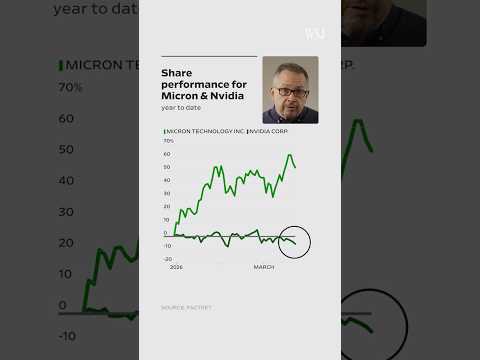
Why Investors Are Wary of Nvidia and Micron Despite Strong AI Demand
The Wall Street Journal· 2026-03-20 17:16
- Demand for AI systems is booming, but investors aren't in a mood to celebrate it. Take Nvidia, for example. The AI superstar's price-to-earnings ratio, which measures a stock's price against its projected earnings, is actually now below that of the S&P 500 for the first time in more than a decade.And here's why. Memory chip maker Micron has seen its own business triple in size as the AI systems made by companies like Nvidia require loads of memory in order to function. That demand is actually overwhelming ...