动态随机存取存储器(DRAM)

Search documents
从四次到两次:SEC 酝酿财报改革,美股信任机制面临大考
美股研究社· 2026-03-17 11:22
Core Viewpoint - The core of the capital market is not profit, but information. A reduction in information disclosure will lead to a re-pricing of risk in the market [1]. Group 1: Potential Changes in Disclosure Regulations - The U.S. capital market is at a potential crossroads, with the SEC considering a reform that would allow companies to choose to disclose earnings only twice a year instead of quarterly [2][4]. - This change is not merely a regulatory adjustment but could fundamentally alter the operational logic of the U.S. stock market [5]. Group 2: Historical Context and Current Trends - For the past fifty years, U.S. public companies have adhered to a quarterly disclosure system, which has been a symbol of transparency in the market [7]. - The number of publicly listed companies in the U.S. has decreased from nearly 8,000 in 1996 to about 4,300 today, indicating a trend towards privatization partly due to the costs associated with information disclosure [8][9]. Group 3: Implications of Reduced Disclosure Frequency - Proponents of reducing disclosure frequency argue that quarterly earnings reports lead to "short-termism," pressuring management to prioritize short-term profits over long-term strategy [9]. - However, reducing the frequency of disclosures may lead to decreased transparency, making it harder for investors to access critical operational data [10]. Group 4: Market Dynamics and Investor Behavior - The discussion around disclosure frequency represents a re-negotiation of the balance between corporate management rights and investor information rights [11]. - If earnings reports are reduced, the "transparency premium" that U.S. stocks enjoy may be reassessed, potentially leading to a decline in overall market valuations [12][14]. Group 5: Comparative Analysis with Other Markets - The article draws parallels with the South Korean market, where companies like Samsung and SK Hynix face valuation discounts due to governance and transparency issues, suggesting that reduced transparency in the U.S. could lead to similar outcomes [15][16]. Group 6: Long-term Consequences and Investor Sentiment - Historical experience shows that trust in capital markets takes decades to build but can be destroyed quickly through regulatory setbacks [17]. - The long-term foundation of capital markets is trust, which relies on timely and comprehensive information disclosure. A decline in transparency could erode the global appeal of U.S. markets [19][20].


“春风”送暖,创业板新增上市标准,风口在哪?
IPO日报· 2026-03-13 00:32
Core Viewpoint - A new set of listing standards for the ChiNext board is about to be introduced, aimed at enhancing the inclusiveness and adaptability of the capital market to better serve technological innovation and the development of new productive forces [1][2]. Group 1: Reform Directions - The reform will focus on three main directions: expanding the inclusiveness and coverage of the listing system, replicating successful experiences from the Sci-Tech Innovation Board (STAR Market), and comprehensively improving the quality of listed companies on the ChiNext board [4][5][6][7]. - The new listing standards will support the development of new industries, new business formats, and new technologies, particularly in emerging sectors such as new consumption and modern services [5][6]. Group 2: Evolution of Listing Standards - The ChiNext board has evolved through three sets of listing standards since its inception in 2009, with the first standard focusing on profitability, requiring companies to have a net profit of at least 60 million yuan in the most recent year and a cumulative profit of at least 100 million yuan over the last two years [15]. - The second standard, introduced in 2020, emphasizes a balance of market capitalization, revenue, and profitability, requiring a minimum market value of 1.5 billion yuan and revenue of at least 400 million yuan in the most recent year [17]. - The third standard, set to be implemented in 2025, will allow unprofitable companies to list, requiring a minimum market value of 5 billion yuan and revenue of at least 300 million yuan [19]. Group 3: Upcoming Fourth Standard - The upcoming fourth set of listing standards is expected to be more precise and inclusive, supporting high-growth companies in new consumption and modern services, and will further relax profitability and revenue requirements [23][25]. - This new standard aims to complement the STAR Market's standards and will focus on supporting companies with innovative business models and technologies [22][23]. Group 4: Implementation of Supporting Policies - The reform will also introduce a series of supporting measures, including pre-IPO reviews, allowing companies under review to raise funds from existing shareholders, and optimizing new stock pricing mechanisms [25][26]. - These measures have already been successfully implemented on the STAR Market, benefiting several companies and enhancing the efficiency of the capital market [27][30]. Group 5: Market Reactions and Expectations - Industry representatives have expressed optimism about the reforms, highlighting the importance of supporting technological innovation and the potential for increased listings from high-growth sectors such as new consumption and modern services [32][33]. - Analysts predict that the new standards will attract more companies back to the A-share market, particularly those in emerging sectors that have previously considered listing abroad [34].
债券“科技板”他山之石:海外科技巨头债券融资路径演变案例复盘之半导体行业
Soochow Securities· 2026-02-25 10:08
1. Report Industry Investment Rating - The document doesn't provide the industry investment rating. 2. Core Viewpoints of the Report - The semiconductor industry is of strategic importance, but its financing system faces challenges. The report analyzes the bond financing strategies of three overseas semiconductor companies to provide reference for Chinese semiconductor companies and the domestic bond market [9][10][11]. 3. Summary According to the Directory 3.1 Asia: SK Hynix Inc - **Company Overview**: A global leading semiconductor storage solutions provider, focusing on memory chips with products like DRAM, NAND flash, and CIS. In 2025, it became the world's largest DRAM manufacturer and had a strong position in other markets [12][14][15]. - **Development Path**: It went through four stages: "start - up and foundation - building (1983 - 1998)", "scale expansion (1999 - 2011)", "strategic transformation (2012 - 2020)", and "AI - enabled (2021 - 2025)". It achieved strategic upgrades through technology iteration and capacity expansion [16][17][20]. - **Bond Issuance History and Changes**: The bond - issuing mode evolved from "point - like exploratory financing" to "normalized, large - scale, diversified strategic financing". The financing strategy changed in different stages, with the bond financing frequency, term, and coupon rate showing corresponding characteristics [24][31][34]. 3.2 Europe: ASML Holding NV - **Company Overview**: The global leader in semiconductor lithography equipment, with a monopoly in the EUV market. Its products include EUV, DUV lithography equipment, and related services. In 2025, it further consolidated its monopoly position [46][47][48]. - **Development Path**: It went through three stages: "breaking through difficulties (1984 - 2007)", "technological monopoly (2007 - 2013)", and "ecosystem binding (2013 - present)". It achieved a leading position through technological focus and strategic choices [49][50][54]. - **Bond Issuance History and Changes**: The bond - issuing mode evolved from "supplementary financing" to "strategic supporting financing". The financing strategy was adjusted according to different development stages, with the bond financing frequency, term, and coupon rate changing accordingly [57][62][65]. 3.3 United States: Broadcom Inc - **Company Overview**: A global leading provider of semiconductor chips and infrastructure software solutions, with a dual - business pattern of "semiconductor chips + infrastructure software". It ranked 7th in the global semiconductor companies in 2025 [77][79]. - **Development Path**: It went through three stages: "merger and acquisition expansion (1991 - 2013)", "technology integration (2013 - 2018)", and "chip + software ecosystem closed - loop (2018 - present)". It reshaped its business through mergers and acquisitions [81][82][85]. - **Bond Issuance History and Changes**: The bond - issuing mode evolved from "supplementary R & D financing" to "merger - driven large - scale financing". The financing strategy was closely related to the merger and acquisition process, with the bond financing frequency, term, and coupon rate showing different characteristics in different stages [86][93][94].


SK海力士:存储价格将继续上涨
半导体行业观察· 2026-02-22 01:33
Core Viewpoint - SK Hynix anticipates a continued upward trend in memory prices throughout the year due to strong demand driven by AI services and limited supply [4][5] Group 1: Memory Price Trends - The current upward trend in memory prices is expected to persist throughout the year, primarily driven by strong demand from AI customers [4] - Despite potential "despeccing" from PC and mobile users, limited supply growth is likely to keep prices rising [5] - A shortage of cleanroom space across the industry is contributing to supply constraints and a favorable pricing environment [5] Group 2: Inventory and Supplier Negotiation - Healthy inventory levels and enhanced supplier bargaining power are leading to increased discussions around long-term contracts [5] - SK Hynix notes that no customer can fully meet their memory needs this year, resulting in low demand fulfillment rates across all end markets [5] - The company is engaging in discussions for multi-year contracts with major clients, aiming to maximize future demand stability [6] Group 3: HBM Business Outlook - Current supply-demand tightness in traditional DRAM may lead to more favorable terms for the HBM business in 2027 [6] - Although there is potential for demand growth, significant changes to production plans for HBM and traditional DRAM in 2026 are deemed challenging [6] Group 4: Production Capacity and Technology Upgrades - SK Hynix will focus on increasing 1b nm DRAM capacity this year, primarily to support HBM3E and HBM4 supply [7] - The company plans to utilize 1c nm technology for HBM starting in 2027, with a significant portion of traditional DRAM expected to adopt this node by year-end [7] Group 5: Capital Expenditure Guidance - SK Hynix expects an increase in capital expenditures this year compared to last year, while maintaining capital expenditure discipline [8] - The company anticipates that the composition of wafer fab equipment (WFE) spending will remain similar to last year, with a focus on HBM and traditional DRAM [8]
一文看懂存储芯片
半导体行业观察· 2026-02-20 03:46
Core Viewpoint - The article emphasizes the importance of understanding various types of computer memory, including ROM, DRAM, SRAM, and flash memory, and their unique trade-offs in speed, cost, power consumption, and data persistence [2][3]. Group 1: Memory Types Overview - Computer memory is categorized into volatile and non-volatile types, with volatile memory requiring power to maintain data and non-volatile memory retaining data without power [6][7]. - Volatile memory includes DRAM and SRAM, while non-volatile memory includes ROM and flash memory [6][7]. Group 2: Memory Hierarchy - Modern computing systems utilize a hierarchical structure of memory types to balance speed, capacity, cost, and data persistence, with SRAM and DRAM serving as fast, temporary storage, and ROM and flash memory providing long-term storage [9][70]. - The memory hierarchy includes registers, cache, main memory (DRAM), and non-volatile storage, addressing the speed disparity between processors and memory [9]. Group 3: Key Memory Attributes - Key attributes defining memory technology include speed, latency, bandwidth, capacity, cost per bit, persistence, and energy consumption [10]. - No single memory type excels in all attributes, necessitating a combination of different memory technologies in modern systems [10]. Group 4: ROM Characteristics - ROM is a non-volatile memory type used to store firmware and essential data, with various subtypes like Mask ROM, PROM, EPROM, and EEPROM, each having distinct advantages and disadvantages [12][26]. - ROM is primarily used for firmware storage, with applications in embedded systems and early gaming cartridges [15][25]. Group 5: DRAM Characteristics - DRAM is the dominant form of main memory in computing systems, requiring periodic refreshing to maintain data, making it cost-effective for large capacity storage [27][28]. - DRAM is widely used in desktops, laptops, and servers, balancing performance and cost [31]. Group 6: SRAM Characteristics - SRAM is known for its speed and low latency, making it suitable for cache memory in CPUs and GPUs, despite its higher cost and lower density compared to DRAM [55][59]. - SRAM is utilized in performance-critical applications where speed is paramount [61]. Group 7: Flash Memory Characteristics - Flash memory is a non-volatile storage technology that retains data without power, with two main types: NOR and NAND, each suited for different applications [63][64]. - NAND flash is commonly used in SSDs and other storage devices due to its high density and cost-effectiveness, while NOR flash is used for firmware storage [66][68]. Group 8: Future Trends in Memory Technology - The semiconductor industry is exploring next-generation memory technologies, such as Z-axis memory, MRAM, ReRAM, and PCM, to address the limitations of current memory types and enhance performance, efficiency, and capacity [72][73][74][76].
未知机构:美光目标价立涨100美元-20260213
未知机构· 2026-02-13 02:15
Summary of Conference Call Notes Company and Industry Involved - **Company**: Micron Technology (美光科技) - **Industry**: Semiconductor, specifically focusing on memory storage solutions Core Points and Arguments 1. **Target Price Increase**: Morgan Stanley raised Micron's target price from $350 to $450, maintaining an "overweight" rating due to strong AI storage demand [4][5][10] 2. **AI Demand Impact**: The report emphasizes that the explosive growth in AI demand is a primary driver for the semiconductor market, particularly for memory chips [5][7] 3. **Supply Shortages**: There is a significant supply shortage in the DRAM market, with prices expected to continue rising due to limited supply growth projected until 2026 [5][6] 4. **Price Increases**: DRAM prices have surged, with DDR5 spot prices increasing by 30% year-to-date and 130% compared to January contract prices [5] 5. **Earnings Projections**: Micron's earnings per share (EPS) is projected to soar to $52.53 in the calendar year 2026, driven by rising average selling prices (ASP) [9] 6. **Cash Flow Strength**: Micron is expected to generate approximately $10 billion in cash flow per quarter, significantly enhancing its balance sheet [10] 7. **Market Sentiment**: Despite concerns regarding competition from Chinese memory chip companies and HBM4 supply issues, Morgan Stanley believes these fears are overstated [10][11] 8. **Valuation Methodology**: Morgan Stanley employs a "through cycle" valuation method, suggesting that traditional cyclical assessments of Micron are flawed [12][13] 9. **Scenario Analysis**: Three potential market scenarios were outlined: - Bull Case: $600 based on a 30x multiple of "through cycle EPS" - Base Case: $450 based on a 25x multiple of "through cycle EPS" - Bear Case: $216 based on a 16x multiple of "through cycle EPS" [13][14] Other Important but Possibly Overlooked Content 1. **Investment Recommendations**: The report recommends investing in Shannon Microelectronics (香农芯创), which is positioned to benefit from the rising storage prices and is expected to see significant revenue growth [1][15] 2. **Market Dynamics**: The ongoing supply-demand imbalance is expected to sustain price increases, with AI demand further exacerbating the situation [5][6] 3. **Long-term Growth Potential**: The semiconductor market is projected to support an annual revenue increase of nearly $200 billion over the next 12 months, surpassing the entire logic semiconductor market size in 2020 [7] 4. **MSCI Index Inclusion**: Shannon Microelectronics' inclusion in the MSCI index is anticipated to attract passive and institutional investment, enhancing liquidity and valuation [15]

承认存储涨价影响盈利能力,任天堂Switch 2价格走向成谜
Guo Ji Jin Rong Bao· 2026-02-05 13:42
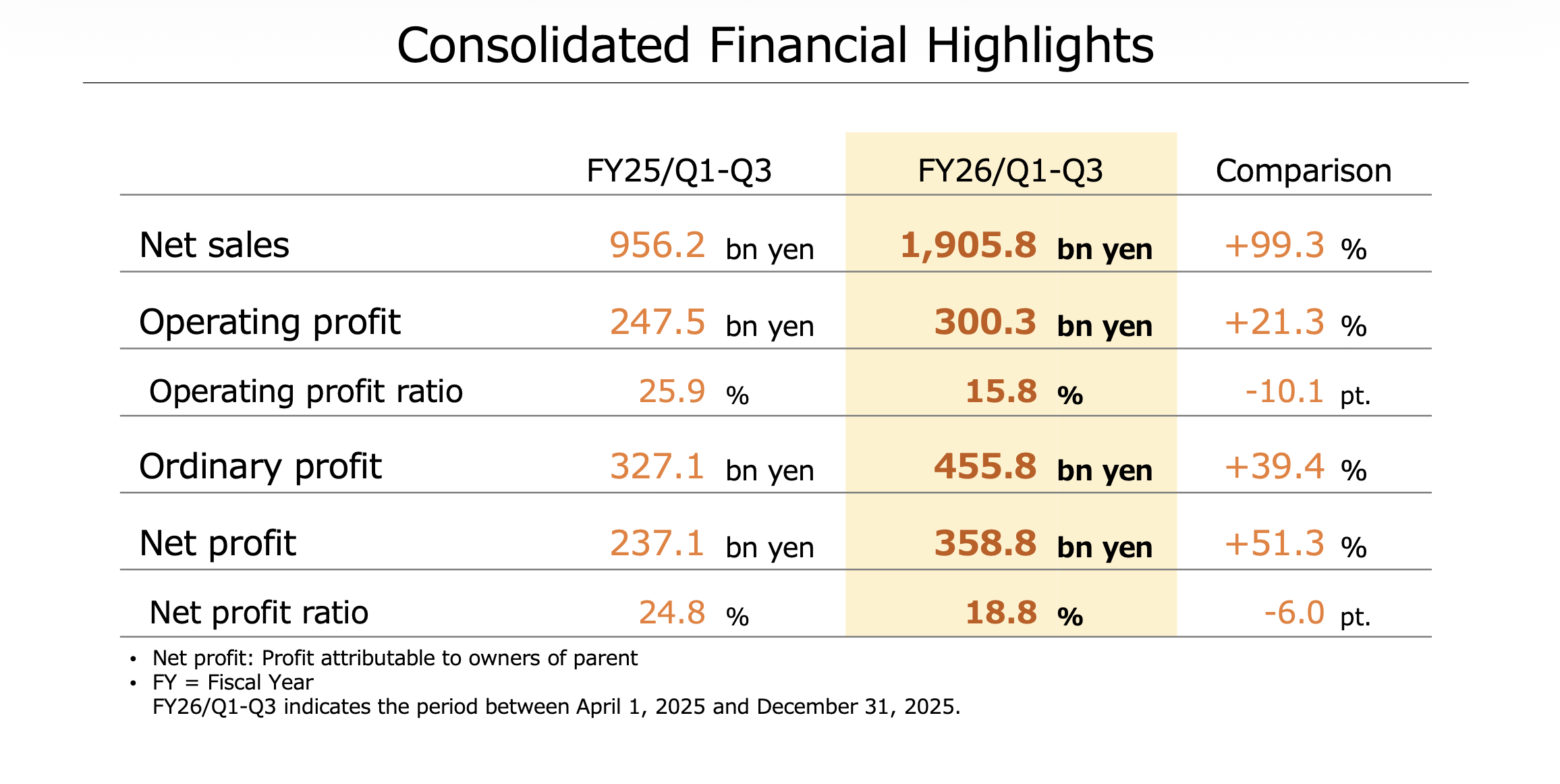
Core Viewpoint - Nintendo's recent financial report fell short of market expectations, raising concerns about future profitability due to rising component costs and conservative sales forecasts [1][3]. Financial Performance - For the first three quarters of fiscal year 2026, Nintendo reported net sales of 1,905.8 billion yen, a year-on-year increase of 99.3%; operating profit was 300.3 billion yen, up 21.3%; and net profit reached 358.8 billion yen, a 51.3% increase. However, the net profit margin decreased by 6 percentage points to 18.8% [1]. - In the third quarter of fiscal year 2026, Nintendo achieved revenue of 806.3 billion yen, an 86% year-on-year increase, but below the market expectation of 847.7 billion yen. Operating profit was 155.2 billion yen, up 23.1%, also below the expected 180.7 billion yen [1]. Hardware and Software Sales - In the first three quarters, the Switch 2 console sold 17.37 million units, making it the fastest console to reach 15 million sales. However, sales of the original Switch console decreased by 66% to 3.25 million units. Software sales for Switch 2 reached 37.93 million copies, while sales for the original Switch declined by 12.1% to 109 million copies [2]. Future Outlook - Nintendo maintained its full-year forecast for fiscal year 2026, projecting Switch 2 sales of 19 million units, with nearly 17.4 million units sold by the end of December 2025. The company also expects a net profit of 350 billion yen for the fiscal year [3]. - Concerns about profit margins are heightened due to ongoing U.S. tariffs and rising storage chip prices, which could pressure future profitability [3]. Component Cost Impact - Nintendo's president stated that the recent rise in memory prices has not significantly impacted hardware profits for the first three quarters, but ongoing price increases could pose risks. The company is monitoring the situation closely [5]. - The global storage chip market is experiencing a "super cycle" driven by AI demand, leading to rising prices that could affect the profitability of consumer electronics [5]. Pricing Strategy - Analysts suggest that raising the price of the Switch 2 may be necessary to maintain profitability amid rising memory costs, with estimates indicating a potential price increase of about 15% [6]. - However, some analysts believe that concerns regarding the profitability of the Switch 2 may be overstated, as Nintendo traditionally adheres to a strategy of not selling hardware at a loss [7].
存储巨头,发2964%绩效奖金
半导体芯闻· 2026-02-04 10:17
Core Viewpoint - SK Hynix achieved its highest-ever performance last year, leading to a record performance bonus of 2964% of the basic salary for employees, marking the highest bonus in the company's history [1]. Group 1: Performance and Financials - SK Hynix's operating profit for 2025 is expected to double, driven by a shortage of AI-related storage chips that has increased prices, surpassing market expectations [3]. - The company reported record revenue and profit for the December quarter, with revenue reaching 32.827 trillion KRW (approximately 230 billion USD), exceeding the expected 32.132 trillion KRW [3]. - Operating profit for the same quarter was 19.17 trillion KRW, higher than the anticipated 17.729 trillion KRW, with a year-on-year revenue growth of about 66% and a staggering 137% increase in operating profit [3]. Group 2: Business Strategy and Market Position - SK Hynix is a key supplier of High Bandwidth Memory (HBM), benefiting from the booming AI sector, as HBM is used in AI data center chipsets [4]. - The company's HBM business revenue is projected to more than double in 2025, contributing to a record annual revenue of 97.147 trillion KRW, nearly a 50% increase from 2024 [4]. - The annual operating profit is expected to reach 47.206 trillion KRW, more than double that of the previous year [4]. Group 3: Market Dynamics and Future Outlook - The demand for HBM far exceeds supply, leading to a shortage in the memory industry, which is expected to persist into the next year due to companies like SK Hynix awaiting further capacity expansion [5]. - The company plans to cancel treasury stock worth 12.24 trillion KRW to enhance shareholder value, following reports that it has become the exclusive supplier of advanced memory chips for Microsoft's new AI processors [6].

HBM爆发重塑半导体行业格局,SK海力士年度利润首超三星
Hua Er Jie Jian Wen· 2026-01-29 06:43
Group 1 - SK Hynix is set to surpass Samsung Electronics in operating profit for the first time in 2025, with profits reaching 47.2 trillion KRW compared to Samsung's 43.6 trillion KRW, marking a significant shift in the global memory chip market [1] - The primary driver of this performance reversal is the high bandwidth memory (HBM) market, where SK Hynix has solidified its global leadership, securing substantial orders from clients like Nvidia [1][2] - Counterpoint Research estimates that SK Hynix will hold a 57% revenue share in the HBM market by Q3 2025, while Samsung's share will be only 22% [1] Group 2 - SK Hynix's success is attributed to its leading position in HBM technology, which is crucial for AI processors and servers produced by companies like Nvidia [2] - The company has secured over two-thirds of the HBM supply orders for Nvidia's next-generation Vera Rubin products, indicating its strong foothold in the market [2] - Despite Samsung's plans to deliver the sixth generation HBM4 products this year, analysts expect SK Hynix to maintain a high market share and dominant position in the HBM4 segment [3][4] Group 3 - The competition in the HBM sector is intensifying, with Samsung and Micron making strides in the field [3] - Analysts predict that Samsung will achieve significant improvements in HBM4 supply for Nvidia's new products, overcoming previous quality issues [3][4] - The outcome of this technological race will directly impact the global AI chip supply chain and determine the future market share distribution between the two South Korean semiconductor giants [4]
跌超19%,拖累道指,黄金、原油齐涨
Zhong Guo Ji Jin Bao· 2026-01-28 00:31
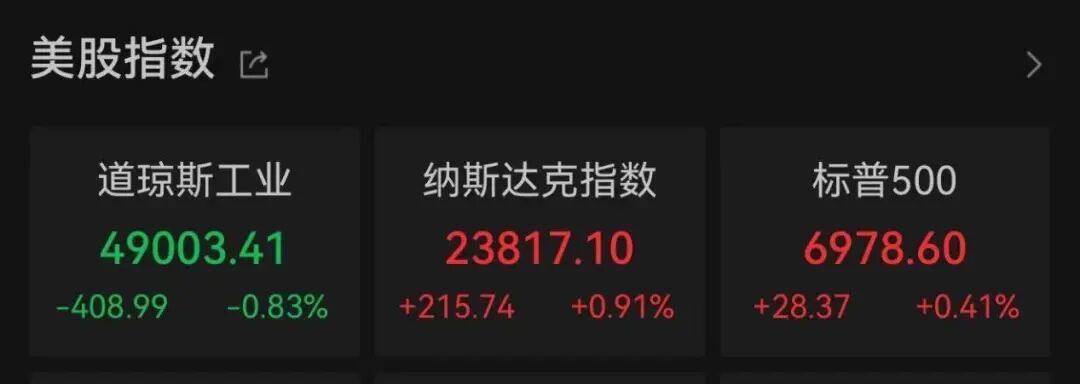
Market Overview - The U.S. stock market showed mixed results, with technology and semiconductor stocks rising, while the Dow Jones Industrial Average was dragged down by a significant drop in UnitedHealth Group, which fell over 19% [3] - The S&P 500 index increased by 0.41% to 6978.60 points, and the Nasdaq Composite rose by 0.91% to 23817.10 points, while the Dow Jones index decreased by 0.83% to 49003.41 points [3] Currency and Trade Policy - The U.S. dollar index has been declining, with President Trump signaling that he is not concerned about the dollar's depreciation [4] - The U.S. continues to adjust its trade policies, maintaining a 50% tariff rate on Indian goods and threatening to raise tariffs on certain South Korean products to 25% [4] Semiconductor Sector - The Philadelphia Semiconductor Index reached a new high, increasing by 2.40% [8] - Micron Technology announced a $24 billion investment plan to build a new memory chip manufacturing facility in Singapore, aimed at increasing production amid a global shortage [9] - This investment is expected to create synergies between NAND flash memory and DRAM production, driven by the rising demand from AI and data-centric applications [9] Technology Giants - Among the "Big Seven" tech companies, only Tesla saw a decline of 0.99%, while Amazon and Microsoft rose over 2% [12] - Google announced a price adjustment for data transmission methods in North America, set to double by May 1, 2026 [12] - Microsoft introduced the MAIA 200 chip, an AI inference accelerator based on TSMC's 3nm process, which will support various AI models, including OpenAI's latest GPT-5.2 [12] Commodity Prices - Gold prices continued to rise, reaching $5160 per ounce, driven by geopolitical tensions and central banks accumulating gold as a fundamental currency [14] - International oil prices also increased, with NYMEX WTI crude oil futures closing above $60 per barrel [14]