电池

Search documents
半年翻倍涨 逼近15万元/吨!锂价疯涨背后 电池行业变了
Nan Fang Du Shi Bao· 2026-01-09 15:58
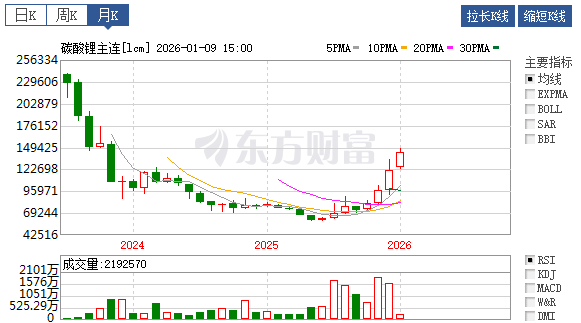
Core Insights - Lithium carbonate futures prices have surged, closing at 143,420 yuan per ton on January 9, 2026, marking an increase of over 120% from the low of 59,900 yuan per ton on June 5, 2025, and reaching a new high since November 2023 [1][3] Supply and Demand Dynamics - Demand for lithium has significantly increased, with new energy vehicle sales growing over 30% year-on-year and battery installation volumes rising over 40% [3] - The supply side is facing constraints due to government policies limiting new mining projects and key expansion projects being in the ramp-up phase, leading to a short-term supply tightness [3] - Recent government initiatives have added cost pressures on the industry, further driving up operational costs for companies [3] Raw Material Price Trends - Major battery companies are responding to rising raw material costs by increasing product prices, with some companies raising prices by 15% [4] - A shift towards long-term agreements in the supply chain is occurring, with leading companies locking in costs through dynamic pricing mechanisms that allow for price fluctuations [4] Market Consolidation - The competitive landscape is shifting, with smaller battery companies being pushed out of the core supply chain as leading firms secure resources through binding agreements [5] - The market share of the top ten battery companies is expected to increase from 65% to 75% by 2025, indicating a trend towards consolidation [7] Technological Developments - The high lithium prices are catalyzing the development of alternative battery technologies, such as sodium batteries, which are becoming viable substitutes in certain applications [8] - Solid-state battery technology is advancing, but it remains heavily reliant on lithium, with significant lithium consumption per GWh compared to other battery types [9][13] Investment Trends - Investment in sodium battery projects has surged, with a total of approximately 61.5 billion yuan allocated across 28 projects, indicating a shift in focus within the battery industry [8] - The capital market is increasingly favoring mature technologies with established production capabilities, leading to a pronounced "Matthew Effect" in the industry [13]

两部门:今年4月1日起取消光伏等产品增值税出口退税
Zheng Quan Shi Bao Wang· 2026-01-09 14:41
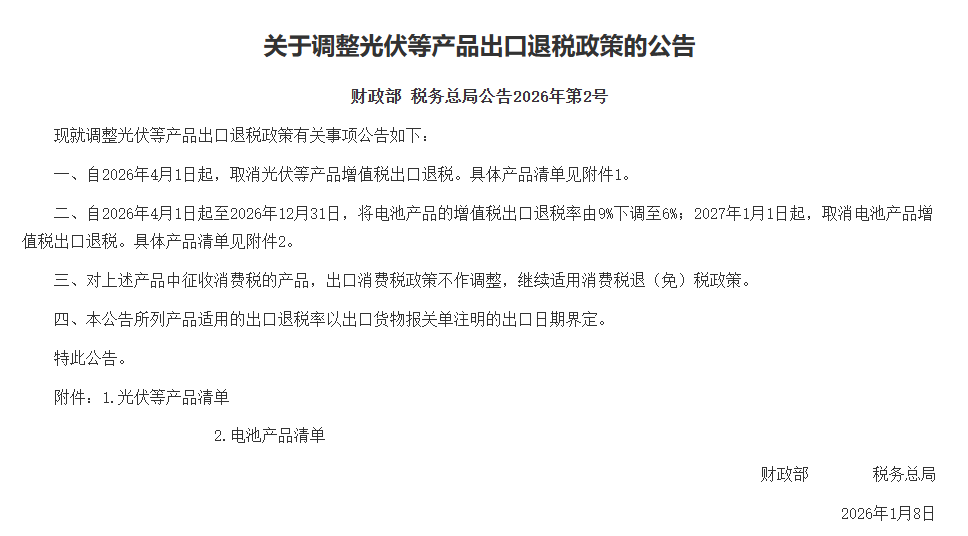
1月9日,财政部、税务总局发布《关于调整光伏等产品出口退税政策的公告》,明确自2026年4月1日 起,取消光伏等产品增值税出口退税。自2026年4月1日起至2026年12月31日,将电池产品的增值税出口 退税率由9%下调至6%;2027年1月1日起,取消电池产品增值税出口退税。出口消费税政策不作调整, 相关产品继续适用消费税退(免)税政策。 早在2024年11月,两部门就曾将部分光伏、电池产品出口退税率由13%下调至9%,彼时曾引发外贸企 业短期加急出货。浙商证券(601878)研报曾指出,随着相关出口产品出口退税的取消或退税率的下 调,或使得相关出口导向行业供给侧优化。 ...
4月起,光伏产品出口退税归零,千亿产业,谁在窃喜?
Mei Ri Jing Ji Xin Wen· 2026-01-09 14:20
Group 1 - The Ministry of Finance and the State Taxation Administration announced the cancellation of the export VAT rebate for photovoltaic products starting April 1, 2026, reducing the rebate rate from 9% to 0% [1] - In the first ten months of 2025, photovoltaic exports reached $24.42 billion, which would result in a loss of approximately $2.2 billion (around 15.3 billion RMB) in rebates for large exporting companies [1] - If companies cannot raise prices to offset the impact of the export tax policy adjustment, their performance may be adversely affected [1] Group 2 - JinkoSolar's overseas business accounted for over 60% of its total shipments in the first half of 2025, maintaining a leading position in various international markets [2] - Trina Solar reported overseas revenue of 14.767 billion RMB, making up about 48% of its total revenue in the same period [2] - JA Solar's overseas business revenue was approximately 11.842 billion RMB, accounting for about 49.54% of its total revenue [2] Group 3 - Among the four major photovoltaic manufacturers, JinkoSolar has the highest proportion of overseas business, followed by Trina Solar and JA Solar, with LONGi Green Energy having the lowest [3] - Trina Solar's energy storage segment has made significant progress in expanding overseas markets, with a successful shipment of a 1.2 GWh energy storage system to Chile in July 2025 [3] - The export VAT rebate for battery products will be reduced from 9% to 6% starting April 1, 2026, and will be completely eliminated by January 1, 2027, providing a longer buffer period compared to photovoltaic products [3] Group 4 - The cancellation of export rebates may benefit manufacturers with a higher proportion of overseas production capacity [3] - Companies are increasingly establishing overseas production facilities, with JinkoSolar actively promoting global production and sales, including setting up factories in Southeast Asia and the U.S. [5]


骆驼股份:公司在建主要项目包括新能源低碳产业园一期等
Zheng Quan Ri Bao· 2026-01-09 14:17
Core Viewpoint - The company is focusing on its main business and has made significant progress in strategic transformation and new business development, particularly in the low-pressure lithium battery sector and overseas markets [2] Group 1: Business Development - The company is currently constructing major projects, including the first phase of the new energy low-carbon industrial park, with more details to be disclosed in the 2025 semi-annual report [2] - The low-pressure lithium battery business is experiencing rapid growth, having secured project designations from several mainstream automotive companies [2] - The company is actively expanding its overseas business, demonstrating significant synergy effects [2] Group 2: Product Innovation - The company has systematically laid out new power products, completing technical reserves for power supplies for low-altitude flying vehicles, low-pressure sodium batteries, small power sources, and small energy storage systems [2] - The company is extending its product applications to new scenarios in a timely manner [2] Group 3: Strategic Focus - The management is driving enterprise value enhancement through stable operational performance, aiming to create long-term and sustainable value returns for all shareholders [2] - The company is promoting industrial upgrades through strategic focus and is actively leveraging new technologies to accelerate its transformation into a comprehensive energy solution provider [2] - The company is committed to practicing a green, sustainable, and high-quality development approach [2]

骆驼股份:截至2025年三季度末公司应收账款约为22.41亿元
Zheng Quan Ri Bao Wang· 2026-01-09 14:15
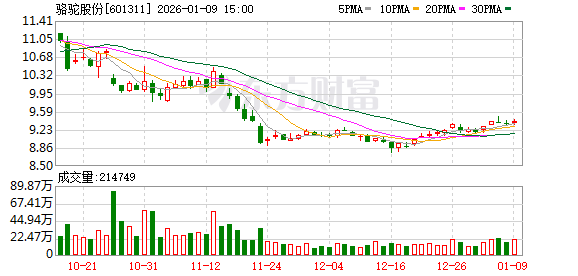
Core Viewpoint - The company, Camel Group (601311), emphasizes its commitment to adhering to relevant policies and regulations regarding information disclosure, and it will provide financial data for the second half of 2025 in its annual report [1] Group 1: Financial Performance - As of the end of Q3 2025, the company's accounts receivable stood at approximately 2.241 billion, reflecting a year-on-year increase of 5.19% from 2.131 billion in the same period last year [1] - The growth rate of accounts receivable is lower than the year-on-year growth rate of operating revenue, which is 7.14% [1] - The proportion of accounts receivable to operating revenue has slightly decreased year-on-year, indicating improved efficiency in revenue collection [1] Group 2: Production and Sales - The company reports that its production and sales conditions are good, with capacity utilization remaining at a high level [1]
国家为何取消光伏、电池等出口退税?
Di Yi Cai Jing· 2026-01-09 13:45
国家整治光伏产业低价无序竞争,取消出口退税支持 光伏、电池等产品取消出口退税"靴子落地"。 继2024年底中国将光伏、电池出口退税率由13%下调至9%后,1月9日财政部税务总局发布《关于调整 光伏等产品出口退税政策的公告》(下称《公告》),决定自2026年4月1日起,取消光伏等产品增值税 出口退税。自2026年4月1日起至2026年12月31日,将电池产品的增值税出口退税率由9%下调至6%; 2027年1月1日起,取消电池产品增值税出口退税。 上海国家会计学院副教授葛玉御对第一财经分析称,国家将陆续取消光伏等产品和电池产品增值税出口 退税,反映了不再通过出口退税的方式来支持这两类行业。经过多年出口退税支持,我国光伏和电池产 业在国际上已经具备竞争优势,但也存在一些问题,比如出现内卷式竞争以及其他一些国家反补贴调查 等。 对此,中国光伏行业协会名誉理事长王勃华认为,这一变化与企业主动调整经营策略密切相关,越来越 多的企业开始响应"不低于成本价销售"的行业共识,减少低价、低利润订单,推动盈利能力边际改善。 此外,自2024年第三季度以来,主要产业链企业固定资产和在建工程规模逐步下降,新建产能扩张节奏 明显放缓,行 ...
电池出口补贴再退坡,分析师:政策直指“反内卷”
Di Yi Cai Jing· 2026-01-09 13:16
对上述产品中征收消费税的产品,出口消费税政策不作调整,继续适用消费税退(免)税政策。 表面上减少了税费补贴,但实际上直指"反内卷"。 与客户自提模式相比,电池厂自送海外的模式下,电池厂商需要承担更高的税收成本。因为他们不仅要 承担国内的增值税,还需要处理出口过程中的各类税务问题。这意味着电池厂商将面临直接的成本压 力,可能影响其利润率和市场定价策略。 1月9日,财政部、税务总局发布关于调整光伏等产品出口退税政策的公告。公告显示,2026年4月1日起 至2026年12月31日,将电池产品的增值税出口退税率由9%下调至6%;2027年1月1日起,取消电池产品 增值税出口退税。 杨玏认为,这项政策的出台,表面上看减少了对电池行业的出口补贴,事实上却对解决电池产业"内 卷"问题有着更深远的意义。中国电池产业,尤其是动力电池和储能电池领域,经历了多年的过度竞 争。低价竞争、技术模仿叠加过度依赖政策补贴,导致许多中小企业难以脱颖而出,技术创新动力不 足。在此背景下,相关政策希望通过下调退税率,进一步推动行业淘汰低端产能,转向研发技术含量更 高、附加值更强的产品。 中国出口退税制度自1985年4月1日起正式实施,电池类产品 ...
电池出口退税政策调整:2026年4月起出口退税率降至6%,2027年取消
中关村储能产业技术联盟· 2026-01-09 13:15
Core Viewpoint - The adjustment of export tax rebate policies for photovoltaic and battery products is expected to increase export costs for battery companies, potentially leading to a short-term "rush to export" and promoting long-term industrial upgrades towards high-quality development [4][5]. Summary by Sections Export Tax Rebate Policy Changes - From April 1, 2026, the export VAT rebate for photovoltaic products will be canceled. For battery products, the export VAT rebate rate will be reduced from 9% to 6% from April 1, 2026, to December 31, 2026, and will be completely canceled starting January 1, 2027 [5][6]. Affected Products - The battery product list includes lithium primary batteries and battery packs, lithium-ion batteries, and all-vanadium flow batteries [3]. Implications for Battery Companies - The changes in export tax rebate policies may increase export costs for battery companies, which could lead to a surge in exports in the short term. In the long term, this may drive the industry towards upgrades and high-quality development [4].

财政部、税务总局:2026年4月1日起,取消光伏等产品增值税出口退税
Bei Jing Shang Bao· 2026-01-09 12:48
此外,公告还列出了涉及产品的具体清单,其中光伏等产品包括249项,电池产品包括22项。 北京商报讯(记者 马换换 李佳雪)1月9日晚间,财政部官网显示,财政部、税务总局发布《关于调整 光伏等产品出口退税政策的公告》。 公告显示,自2026年4月1日起,取消光伏等产品增值税出口退税。自2026年4月1日起至2026年12月31 日,将电池产品的增值税出口退税率由9%下调至6%;2027年1月1日起,取消电池产品增值税出口退 税。对上述产品中征收消费税的产品,出口消费税政策不作调整,继续适用消费税退(免)税政策。公 告所列产品适用的出口退税率以出口货物报关单注明的出口日期界定。 ...
【金融街发布】财政部、税务总局:4月1日起取消光伏等产品增值税出口退税
Xin Hua Cai Jing· 2026-01-09 12:40
Core Viewpoint - The Ministry of Finance and the State Taxation Administration announced adjustments to the export tax rebate policy for photovoltaic products, effective from April 1, 2026, which includes the cancellation of VAT export rebates for these products [1]. Summary by Categories Policy Changes - From April 1, 2026, the VAT export rebate for photovoltaic products will be canceled [1]. - The VAT export rebate rate for battery products will be reduced from 9% to 6% from April 1, 2026, until December 31, 2026 [1]. - Starting January 1, 2027, the VAT export rebate for battery products will also be canceled [1]. Consumption Tax - The announcement specifies that the export consumption tax policy for products subject to consumption tax will remain unchanged, continuing to apply the consumption tax rebate (or exemption) policy [1]. Export Date Definition - The applicable export rebate rates for the products listed will be determined based on the export date indicated on the customs declaration [1].