
基金

Search documents
9个小将干出700亿!永赢基金高收益背后,是梭哈还是实力?
市值风云· 2026-02-10 10:13
Core Viewpoint - The article discusses the rapid growth and performance of Yongying Fund in 2025, highlighting the significant increase in assets under management and the impressive returns of its equity funds during a bullish market. It raises questions about the sustainability of such high returns and the risks associated with concentrated investment strategies [1][3][8]. Group 1: Fund Performance and Growth - Yongying Fund's total assets under management grew from 528.3 billion to 652.4 billion in 2025, marking a 23.5% increase [4]. - The combined scale of equity and mixed funds surged from 32.6 billion at the beginning of 2025 to 175.2 billion by year-end, while passive products like ETFs expanded tenfold from 4.7 billion to nearly 50 billion [6]. - In 2025, four equity funds doubled their net value, and 18 funds achieved returns exceeding 50% [6]. Group 2: "Smart Selection" Series - The "Smart Selection" series contributed significantly to Yongying Fund's growth, with 16 products attracting 74.1 billion in new investments [10]. - Among the ten funds with complete performance data, only three had returns below 50% [11]. - The "Smart Selection" series is characterized by high concentration in top holdings, with many funds having over 70% of their assets in the top ten stocks [18]. Group 3: Investment Strategy and Risks - The high returns of the "Smart Selection" series are attributed to concentrated positions in sectors like AI and semiconductors, but this strategy also entails significant volatility and risk, with some funds experiencing drawdowns exceeding 50% [27]. - The management team is relatively young, with most fund managers having less than five years of experience, raising concerns about their ability to navigate market cycles [30][31]. - The article emphasizes the need for investors to manage positions carefully and consider profit-taking strategies in light of the inherent risks of concentrated investments [27][30]. Group 4: ETF Expansion - Yongying Fund expanded its ETF offerings from 4 to 15 in 2025, with notable performance in satellite ETFs, which grew to 16.6 billion [32]. - The fund's strategy includes a mix of high-growth and stable income products, aiming to balance risk and return [35].

“固收一姐”姜晓丽告别天弘:从未休过长假的基金经理选择停下
Xin Lang Cai Jing· 2026-02-10 10:06
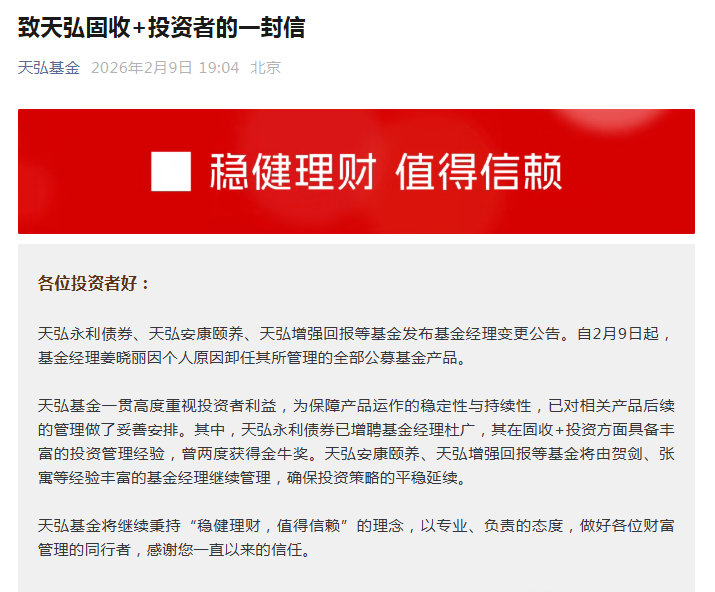
Core Viewpoint - The departure of Jiang Xiaoli, a senior fund manager at Tianhong Fund, has raised market attention due to her extensive experience and management of over 350 billion yuan in assets across 70 funds [1][13]. Company Overview - Tianhong Fund announced Jiang Xiaoli's resignation due to personal reasons, emphasizing respect for her decision and gratitude for her contributions [3][15]. - The company has a robust research and investment system, ensuring the continued stable operation of its products [3][15]. - Tianhong Fund currently has 59 fund managers, significantly higher than the industry average of 24.8, but the average tenure of 4.46 years is slightly below the industry average of 5.02 years [4][16]. Fund Management Transition - Jiang Xiaoli's responsibilities for ten funds have been taken over by ten other fund managers, with Zhang Yu managing the most funds (four) [10][21]. - The new management team consists of experienced fund managers who have worked with Jiang for many years, ensuring continuity in the investment strategy [11][23]. Performance Metrics - Under Jiang Xiaoli's management, the Tianhong Tongli A fund achieved a one-year return of 24.87% and a two-year return of 48.22% [8][19]. - Other funds managed by Jiang also showed solid performance, with Tianhong Enhanced Return A achieving a one-year return of 7.72% and a two-year return of 16.70% [8][19]. Personal Insights from Jiang Xiaoli - In her farewell letter, Jiang expressed the heavy responsibility of managing funds that include retirement savings and salaries of working individuals [7][17]. - She highlighted the need for fund managers to expand their perspectives and update their cognitive models in the face of significant changes in the macroeconomic environment [18].
20亿,重庆落地一只低空经济产业基金
FOFWEEKLY· 2026-02-10 10:00
Core Insights - The event "Ecological Empowerment, Smart Low Altitude" marked the official launch of the Chongqing Low Altitude Economic Development Company and the establishment of a 2 billion yuan aerospace investment fund focused on low altitude economic industries [1] Group 1: Fund Details - The Aerospace Investment (Chongqing) Low Altitude Economic Industry Fund is co-funded by ICBC Financial Asset Investment Co., Aerospace Investment Holdings Co., Chongqing Industrial Mother Fund, and Liangjiang Fund [1] - The fund adopts a "government guidance + market operation" model, aiming to invest in aerospace information and low altitude economic sectors [1] Group 2: Objectives and Impact - The fund is designed to attract leading enterprises to Chongqing, accelerate breakthroughs in core technologies, and support high-end equipment manufacturing [1] - It aims to inject capital momentum into the high-quality development of the industrial chain and promote the construction of a low altitude economic ecosystem and the accelerated formation of industrial clusters in the city [1]
江苏LP持续领跑,700亿基金落地
FOFWEEKLY· 2026-02-10 10:00
Core Viewpoint - The article highlights the significant investment activity in Nanjing, with over 70 billion yuan in funds being mobilized to invigorate the primary market, marking a strong start to the year for the investment landscape in Jiangsu province [2][3][5]. Group 1: Investment Initiatives in Nanjing - The 2026 Zijin Mountain Venture Capital Conference in Nanjing announced a total fund scale exceeding 700 billion yuan, making it one of the most substantial funding events at the beginning of the year [5]. - A 100 billion yuan market-oriented mother fund was introduced, designed for a long-term investment period of 20 years, aimed at fostering sustainable industrial development [5]. - Additional funds launched include the Jiangsu Modern Service Industry Innovation Development Fund and the Jiangsu Science and Technology Innovation Relay Fund, each with a scale of 100 billion yuan, targeting the growth of modern services and technology innovation [5][6]. Group 2: Broader Context in Jiangsu - Nanjing's recent actions are part of a larger strategy, with a policy introduced on January 26 to create an industry fund cluster exceeding 200 billion yuan, known as the "4+N" model [7]. - By January 2026, this fund cluster had already established 52 funds with a total scale exceeding 130 billion yuan, indicating a robust investment ecosystem [8]. - The establishment of the Zijin Mountain International Science and Technology Innovation Fund District aims to enhance collaboration and attract leading institutions, aligning with Jiangsu's industrial framework [8][9]. Group 3: Overall Investment Climate in Jiangsu - The article notes a clear recovery signal in the primary market, driven by the rising interest in sectors such as AI, robotics, low-altitude economy, and semiconductors, alongside active funding initiatives from various local LPs [11]. - Jiangsu has positioned itself as one of the most active regions for LP investments, with a focus on nurturing patient capital and supporting hard technology and the real economy [11][12]. - The province's investment strategy includes the establishment of a 100 billion yuan investment fund in collaboration with China Chengtong, marking a significant partnership in the venture capital landscape [11][12]. Group 4: Recent Developments and Future Outlook - In early 2026, Jiangsu launched the fourth batch of special funds under the provincial mother fund, totaling 67.1 billion yuan, aimed at enhancing new productive forces [12]. - Various cities within Jiangsu are also launching their own funds, such as the 6 billion yuan Wuxi Shengshi Xichuang Yingrui Fund and the 20 billion yuan China Electronics Technology Group Fund, indicating a coordinated effort across the province [13][14]. - The article concludes that Jiangsu's proactive funding approach is not merely about financial disbursement but is aimed at establishing a clear, efficient industrial fund ecosystem that supports long-term growth [14][16].

“工作以后,从没休过长假”,300亿美女基金经理辞职
Shen Zhen Shang Bao· 2026-02-10 09:50
Core Viewpoint - Tianhong Fund announced the resignation of fund manager Jiang Xiaoli due to personal reasons, emphasizing the company's commitment to maintaining stable operations of its products through a robust research and investment system [4]. Group 1: Resignation Announcement - Jiang Xiaoli has resigned from all public fund products she managed, citing a desire for a break and to focus more on family [4]. - The company respects her decision and expresses gratitude for her long-term professional contributions [4]. - Jiang Xiaoli has 16 years of experience in the securities industry, managing a total of 10 funds with an aggregate scale of 35 billion yuan as of her resignation date [4]. Group 2: Impact on Funds - Tianhong Fund stated that the "fixed income+" business operates under a multi-manager model, ensuring product strategy stability [5]. - The incoming fund manager will continue to execute established investment goals and processes, with no significant changes to the investment scope [5]. - The research and investment team will provide comprehensive support to ensure continuity [5].
申万金工ETF组合202602
Shenwan Hongyuan Securities· 2026-02-10 09:43
1. Report Industry Investment Rating - Not provided in the given content 2. Core Viewpoints of the Report - The report focuses on constructing multiple ETF portfolios, including macro industry, macro + momentum industry, core - satellite, and trinity style rotation portfolios, aiming to find better investment opportunities by combining macro factors, momentum factors, and style rotation [4][5]. - Different industries have different sensitivities to economic, liquidity, and credit factors. For example, traditional cycle industries are sensitive to the economy, TMT is sensitive to liquidity, and consumption is sensitive to credit [4]. 3. Summary According to Relevant Catalogs 3.1 ETF Portfolio Construction Methods 3.1.1 Based on Macro Method - Calculate macro - sensitivities of broad - based, industry - themed, and Smart Beta ETFs based on economic, liquidity, and credit variables. Combine with momentum indicators for complementary analysis [4]. - Traditional cycle industries are suitable for economic up - periods, TMT for weak - economy but loose - liquidity periods, and consumption for credit - expansion periods. State - owned enterprises and ESG - related themes have low sensitivities to liquidity and credit [4]. - Construct three ETF portfolios (macro industry, macro + momentum industry, and core - satellite) and adjust positions monthly [4]. 3.1.2 Trinity Style Rotation ETF Portfolio Construction - Build a medium - to - long - term style rotation model centered on macro - liquidity, and compare it with the CSI 300 index [5]. - Construct three types of models (growth/value rotation, market - cap, and quality models) by screening macro, fundamental, and market - sentiment factors. The model has 8 style - preference results [5]. - Select ETFs with high exposure to the target style, control industry exposure, and set allocation limits to get the final ETF allocation model [5]. 3.2 Macro Industry Portfolio - Select industry - themed ETFs with over 1 - year establishment and over 200 million current scale. Calculate sensitivity scores of economic, liquidity, and credit factors monthly, adjust scores according to the latest indicators, and sum them up. If liquidity and credit deviate significantly, remove the liquidity score. Select the top 6 industry - themed indices and corresponding largest - scale ETFs for equal - weight allocation [6][7]. - Currently, with falling economic leading indicators, loose liquidity, and tightened credit, the portfolio is biased towards TMT and consumption. The February positions are shown in Table 1 [8]. - The portfolio has large fluctuations and outperformed the benchmark significantly in January [11]. 3.3 Macro + Momentum Industry Portfolio - Combine macro and momentum methods to address the left - side nature of macro - based strategies (low win - rate but high odds). Use clustering to group industry - themed indices and select the highest - rising product in each group in the past 6 months for equal - weight allocation [12]. - The momentum - selected industries still have a high proportion of cyclical industries. The February positions are shown in Table 3 [16]. - The portfolio has performed well this year and outperformed the CSI 300 significantly in January [17]. 3.4 Core - Satellite Portfolio - Design a "core - satellite" portfolio with the CSI 300 as the core to address the high volatility and rapid industry rotation of industry - themed ETFs [19]. - Calculate macro - sensitivities for broad - based, industry - themed, and Smart Beta ETFs, construct three stock portfolios, and weight them at 50%, 30%, and 20% respectively [19]. - The current allocation of broad - based ETFs is biased towards the Sci - tech Innovation Board and the ChiNext. The portfolio has performed stably, outperforming the benchmark in most months except December, and had significant excess returns in January 2026 [23][24]. 3.5 Trinity Style Rotation ETF Portfolio - The model currently favors the small - cap growth - high - quality segment. The factor exposures and historical performance are shown in Table 7 [26]. - The February positions are shown in Table 9 [31]. - The portfolio has achieved certain excess returns, especially in some months such as August 2025 and January 2026 [29].
中信证券(06030.HK):华夏基金2025年实现净利润23.96亿元
Ge Long Hui· 2026-02-10 09:25
格隆汇2月10日丨中信证券(06030.HK)公布控股子公司华夏基金2025年度业绩快报,截至2025年12月31 日,华夏基金总资产人民币222.46亿元,总负债人民币71.51亿元;2025年实现营业收入人民币96.26亿 元,净利润人民币23.96亿元,综合收益总额人民币23.68亿元。截至2025年12月31日,华夏基金母公司 管理资产规模为人民币30,144.84亿元。 ...

这支长三角母基金招GP了 | 科促会母基金分会参会机构一周资讯(2.4-2.10)
母基金研究中心· 2026-02-10 09:06
Core Viewpoint - The establishment of the "China International Science and Technology Promotion Association Mother Fund Branch" aims to enhance the role of mother funds in China's capital market, promoting the flow of social capital towards innovative and entrepreneurial enterprises, thereby fostering the healthy development of the investment industry, particularly the mother fund sector [1][25]. Group 1: Long Triangle Mother Fund - The Long Triangle Mother Fund is currently recruiting General Partners (GPs) to select sub-fund management institutions in a standardized and efficient manner, adhering to principles of openness, fairness, and justice [2][3]. - The fund is a cross-regional investment fund established by the finance departments of Shanghai, Jiangsu, and Zhejiang, aimed at promoting high-quality industrial development in the demonstration area [5]. Group 2: Sub-Fund Requirements - Sub-funds must focus on the core investment directions of the mother fund and cannot engage in prohibited activities such as credit, guarantees, or real estate investments [6]. - The cumulative investment from the mother fund in a single sub-fund should not exceed 20% of the total subscribed capital, with a maximum of 30% allowed under certain conditions [6]. Group 3: Recent Investments - The Yuexiu Industrial Fund has invested in Suzhou Lilai Intelligent Manufacturing Co., focusing on upgrading the supply chain of the new energy vehicle parts industry [12][13]. - The Guoshou Science and Technology Innovation Fund has co-led a strategic financing round for Shanghai Xihua Testing Technology Co., enhancing the resilience and innovation of the biopharmaceutical industry [19][20]. - Anhui High-tech Investment led a financing round exceeding 100 million RMB for Hongmo Biological, a company specializing in the research and industrialization of human milk oligosaccharides [21][24].

天弘基金“固收+”名将姜晓丽离职,坦言工作后从未休过长假
Nan Fang Du Shi Bao· 2026-02-10 09:04
Core Viewpoint - Jiang Xiaoli, a prominent fund manager at Tianhong Fund, has officially resigned from managing all 10 public fund products due to personal reasons, including a desire for rest and family time after years of high-intensity work [2][5][7]. Group 1: Fund Management and Performance - Jiang Xiaoli managed a total of 350.24 billion yuan across various funds, including "Fixed Income+" and pure bond categories [2][4]. - Under her management, the Tianhong Yongli Bond Fund achieved a cumulative return of 167.12% over nearly 18 years, surpassing its benchmark by 60.85% [4]. - The Tianhong Yongli Bond A fund, managed by Jiang, reported a return of 114.35% and an annualized return of 5.80%, ranking 40th among 101 similar products [4]. Group 2: Transition and Continuity - Tianhong Fund has implemented a "multi-fund manager co-management" model to ensure continuity in product operations following Jiang's departure [9]. - Experienced fund managers, including Du Guang and He Jian, will take over the management of Jiang's funds to maintain investment strategy stability [9]. - The company has a robust talent pool and research system to support its "Fixed Income+" business, ensuring effective management continuity [9]. Group 3: Company Background and Growth - Tianhong Fund, established in November 2004, has a registered capital of 5.143 billion yuan and is primarily owned by Ant Group [8]. - As of the end of 2025, the company's total public fund management scale reached 1.25 trillion yuan, with non-monetary fund management growing over 42% in two years [8].

景顺长城基金农冰立:对2026年权益市场保持乐观
Zheng Quan Ri Bao Wang· 2026-02-10 09:01
Group 1 - The core viewpoint is that despite recent adjustments in the technology sector due to external sentiment, internal structural differentiation, and high valuation digestion, the AI-driven technological revolution continues to deepen [1] - The upcoming fund, Invesco Great Wall Xin You Growth, will focus on a wide range of technology sectors, emphasizing the importance of selecting "big technology" fund managers with strong investment capabilities [1] - Fund manager Nong Bingli emphasizes the technology sector as a long-term core theme in the market, with a focus on diversified investments across low-correlation industries to manage portfolio risk and reduce drawdowns [1] Group 2 - The fund will allocate 60%-95% of its assets to stock investments, covering A-shares and Hong Kong stocks, with a maximum of 50% in Hong Kong Stock Connect stocks [2] - A floating management fee mechanism linked to fund performance is set to encourage the fund manager and team to enhance their ability to generate excess returns and promote long-term holding by investors [2] - Nong Bingli maintains an optimistic outlook for the equity market through 2026, focusing on sectors such as computing power, semiconductors, the internet, innovative pharmaceuticals, and consumer electronics [2]