
渔业

Search documents
欧盟将提议限制鳗鱼国际交易,日本要联手中韩反对
日经中文网· 2025-06-26 02:47
Core Viewpoint - The European Union has proposed to list eels, including Japanese eels, under the Convention on International Trade in Endangered Species (CITES), which could significantly hinder the circulation of eels in Japan if approved at the upcoming conference [1][2]. Group 1: Proposal and Implications - The EU's proposal aims to include 18 species of eels, including Japanese eels, in CITES Appendix II, which would require export permits for trade [2]. - If the proposal passes, it could create major obstacles for Japan's eel supply, which is heavily reliant on imports from China, accounting for 70% of the 63,000 tons expected in 2024 [2]. - Japan plans to collaborate with China and South Korea to lobby against the proposal, arguing that eel resources are abundant and not at risk of extinction [2]. Group 2: Market Impact - The average wholesale price of grilled eel in Tokyo's Toyosu market for 2024 is projected to be around 4,500 yen per kilogram, remaining stable compared to the previous year [3]. - Concerns are rising among producers in Kyushu about potential declines in retail sales due to increasing public scrutiny over consuming endangered species [3]. Group 3: Resource Assessment - The EU claims that the resource levels of Japanese eels have "significantly decreased," while Japan counters that the resources are sufficient [4]. - Japanese eels are born in the Mariana Trench and migrate to East Asia, where they are caught and raised for consumption [4]. - Due to overfishing and environmental degradation, the catch of juvenile eels has remained low since the late 1970s, leading to their classification as "critically endangered" by the International Union for Conservation of Nature (IUCN) in 2014 [4].

中水渔业:收到政府补助2.69亿元
news flash· 2025-06-25 13:35
Group 1 - The company received a government subsidy of 269.65 million yuan on June 24, 2025 [1] - The subsidy consists of 251.75 million yuan related to income and 16.90 million yuan related to assets [1] - The subsidy is expected to have a positive impact on the company's profits for the fiscal year 2025 [1]

饶平县全力推进“木改塑”构建现代化海洋牧场发展新格局
Zhong Guo Fa Zhan Wang· 2025-06-25 10:49
Core Viewpoint - The modernization of marine ranching and the "wood-to-plastic" initiative are key measures for promoting high-quality development in Qianzhou Town [2] Group 1: Policy Implementation - The "wood-to-plastic" subsidy implementation plan was detailed, including beneficiaries, funding sources, and subsidy standards [1] - The town leadership emphasized the importance of policy execution and provided clear guidance for participants [1][2] - A commitment was made to offer "nanny-style" services to ensure effective policy implementation [1] Group 2: Community Engagement - Community party organization leaders are tasked with responsibility breakdown and ensuring zero barriers for participation in the "wood-to-plastic" initiative [2] - The town aims to create a collaborative effort to promote the "wood-to-plastic" work, encouraging fishermen to participate [2] Group 3: Data Collection and Analysis - A scientific database was established through drone surveys to document existing fish farms, facilitating the "wood-to-plastic" initiative and future development [3] - Abandoned fish farms were prioritized for removal to clear obstacles for the renovation project [3] Group 4: Transformation Incentives - A combination of site visits, policy explanations, and household mobilization was used to shift fish farmers from passive to active participation in the transformation [4] - New plastic fish farms and deep-water net cages were constructed, showing initial success in the transformation [4] Group 5: Economic Development - The "wood-to-plastic" initiative has led to the issuance of sea use rights and aquaculture permits, addressing long-standing illegal sea usage issues [5] - The removal of wooden fish farms has improved navigation safety and released quality coastal resources for future tourism projects, contributing to a new "blue economy" vision [5]
太湖水之变磨砺三十年,水质从Ⅴ类提升到全湖Ⅲ类,恢复到良好标准
Zhong Guo Huan Jing Bao· 2025-06-25 02:46
Core Viewpoint - The article discusses the long-term efforts and challenges in the ecological restoration and pollution control of Taihu Lake, highlighting the transition from severe pollution to improved water quality over 30 years, with a focus on collaborative governance and innovative solutions to address the complex pollution issues [1][4][19]. Group 1: Water Quality Improvement - Taihu Lake's water quality has improved from Class V to Class III over 30 years, establishing itself as a benchmark for large lake nutrient management internationally [1]. - The average depth of Taihu Lake is 1.9 meters, making it a shallow lake with limited self-purification capacity, which complicates pollution management [2][3]. - In 2022, the population in the Taihu basin accounted for 4.8% of the national total, and the regional GDP represented 9.8% of the national GDP, indicating significant economic activity in the area [3]. Group 2: Pollution Sources and Challenges - The shallow nature of Taihu Lake allows sunlight to reach the bottom, promoting blue-green algae growth, which is exacerbated by industrial pollution and urbanization in the surrounding areas [2][3]. - The 2007 blue-green algae outbreak highlighted the complexity of pollution sources, leading to a shift in focus from ecological restoration to source control and pollution interception [4][6]. - The Taihu basin has faced severe pollution, with 67% of monitored points classified as inferior Class V water quality, indicating a critical need for effective pollution control measures [3]. Group 3: Governance and Collaborative Efforts - The governance of Taihu Lake has evolved from fragmented management to a more coordinated approach, with the establishment of inter-agency collaboration and joint initiatives among cities [15][16]. - The introduction of the Taihu Lake water pollution prevention office in 2009 marked a significant step towards unified management of water quality across different jurisdictions [16]. - Recent initiatives include the establishment of cross-regional cooperation mechanisms and joint law enforcement efforts to tackle pollution effectively [17][18]. Group 4: Economic Transformation and Sustainable Development - The shift from high-pollution industries to green, low-carbon economic models is crucial for the sustainable development of the Taihu region, with significant reductions in polluting industries [12][13]. - The transformation of Zhou Tie Town from a chemical industry hub to an eco-friendly area demonstrates the potential for economic growth while prioritizing environmental protection [12][13]. - By 2024, the region has seen a stable GDP growth rate while improving water quality, showcasing a successful model of balancing economic development with ecological sustainability [14].
中共辽宁省委辽宁省人民政府关于<br/>进一步深化农村改革扎实推进乡村全面振兴的实施意见
Liao Ning Ri Bao· 2025-06-25 01:29
Core Viewpoint - The article emphasizes the importance of implementing comprehensive strategies for rural revitalization and agricultural development in the province, guided by Xi Jinping's thoughts and the resolutions from the 20th National Congress of the Communist Party of China [1] Group 1: Agricultural Production and Supply - Ensure stable production and supply of key agricultural products, with grain planting area maintained at over 53.3 million acres and grain output around 50 billion pounds [2] - Stabilize livestock production, maintaining a breeding sow population of over 1.3 million heads and supporting the development of meat and dairy industries [2] - Strengthen farmland protection and construction, ensuring dynamic balance in annual farmland area and promoting high-standard farmland construction of 4.76 million acres [3] Group 2: Agricultural Technology and Disaster Resilience - Enhance agricultural technology and equipment levels, promoting biotechnology and smart agriculture [4] - Improve disaster prevention and reduction capabilities, including strengthening meteorological services and flood control projects [4] Group 3: Food Security and Trade - Implement food production support policies, including minimum purchase prices for rice and subsidies for land fertility protection [5] - Establish a diversified food supply system, expanding modern facility agriculture and supporting deep-sea fisheries [6] Group 4: Poverty Alleviation and Employment - Ensure no large-scale return to poverty, with stable employment for over 156,000 individuals from impoverished backgrounds [8] - Maintain overall stability in support policies and funding for rural revitalization, with at least 60% of funds directed towards industrial development [8] Group 5: Rural Infrastructure and Public Services - Advance rural infrastructure construction, including building 300 rural water supply projects and improving rural road conditions [13] - Enhance basic public service levels in rural areas, ensuring 90% of counties have established integrated medical service systems [14] Group 6: Environmental Protection and Governance - Strengthen rural ecological environment construction, including adding 14,000 garbage collection facilities and improving rural sewage treatment [15] - Build strong rural grassroots party organizations to enhance governance effectiveness and address corruption [16] Group 7: Talent Development and Investment - Cultivate rural talent through various training programs, aiming to train over 10,000 practical talents [24] - Improve the multi-source investment mechanism for rural revitalization, encouraging financial institutions to increase funding for agricultural sectors [27]
南农晨读 | 共护良田
Nan Fang Nong Cun Bao· 2025-06-25 01:01
Group 1 - The 35th National Land Day in Guangdong focuses on the theme of "saving and intensive land use, strictly adhering to the red line of arable land" to raise awareness about the responsibility of protecting agricultural land [4][5] - Guangdong province, covering 1.9% of the national land area, supports 8.9% of the population and contributes 10.9% to the national economy, highlighting its significance in China's agricultural landscape [6] - Guangdong has achieved a balance in arable land use for 25 consecutive years and has seen a net increase in arable land for four consecutive years, showcasing its commitment to sustainable agricultural practices [7][8] Group 2 - Guangdong has initiated a core technology project for modern marine ranching, which has already produced a large number of high-quality seedlings, with 30% being provided free of charge to support marine ranching efforts [12][13] - This initiative aims to enhance agricultural productivity and contribute to the high-quality development of the fishing industry in Guangdong [14] Group 3 - The "Strong Support Team" for lychee farmers in Dajing Town actively assists in harvesting, sorting, and promoting lychee sales through various measures, enhancing the quality and marketability of the fruit [19][22] - The team plays a crucial role in addressing sales bottlenecks and providing support to local farmers, thereby boosting the lychee industry [21][22] Group 4 - The 2025 National and Beautiful Countryside Basketball Competition (Village BA) will take place in Zhongshan City, featuring local agricultural products and promoting regional culture [25][27] - The event aims to engage the community and support local businesses through the promotion of quality agricultural products [26][27] Group 5 - The Huai Ji agricultural system has mobilized over ten member enterprises to provide essential supplies to flood-affected residents, demonstrating community solidarity and support during recent severe weather events [60][62] - This initiative reflects the spirit of mutual aid and community resilience in the face of challenges [61][63]

157万余尾鱼虾放流珠江,番禺生态环境建设工作亮点多多
Nan Fang Nong Cun Bao· 2025-06-24 15:31
Core Viewpoint - The Panyu District is actively engaged in ecological restoration efforts through the release of aquatic species, with a focus on enhancing biodiversity in the Pearl River system [4][6]. Group 1: Aquatic Species Release Activities - On June 24, the Panyu District held its 2025 aquatic species release event, where over 1.57 million fish and shrimp were released, including species such as grass carp, yellowfin seabream, and white eel [2][3]. - The district has conducted these release activities for 44 consecutive years, emphasizing their importance in ecological restoration and the maintenance of aquatic resources [6]. Group 2: Biodiversity and Ecological Improvement - In the past five years, Panyu District has released over 5.5 million aquatic species, optimizing the variety and quantity of species to enhance local biodiversity [7][8]. - Local species such as yellowfin seabream and shrimp have shown a recovery in population, contributing to the ecological vitality of the Pearl River [8][9]. Group 3: Sustainable Fisheries Development - Panyu District is committed to consolidating and expanding its fisheries development achievements, which include ongoing release activities and initiatives for river protection and water environment management [10][11]. - The district promotes a green and circular development model for its fisheries, aiming for high-quality industry growth [12][13]. Group 4: Innovative Aquaculture Practices - The district has established benchmark models for fishery governance, including various water treatment methods and ecological breeding practices to reduce wastewater discharge [14][15][19]. - Panyu District encourages the adoption of premium aquaculture species and ecological mixed farming to enhance the quality of its fisheries, contributing to the public brand "Panyu Fresh" [18][19].
广州新船海上“牧鱼”
Guang Zhou Ri Bao· 2025-06-24 01:47
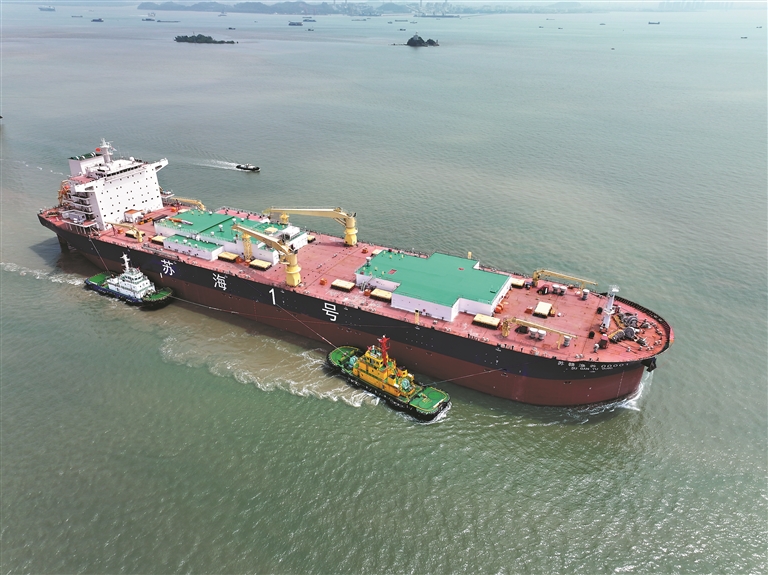
Core Insights - The delivery of the world's first self-propelled closed salmon farming vessel, "Suhai No. 1," marks a new phase in China's deep-sea salmon farming and opens new opportunities in the blue food supply chain [2][5]. Group 1: Vessel Specifications and Capabilities - "Suhai No. 1" is designed as a giant offshore salmon farming and processing factory, capable of producing 8,000 tons of salmon annually, equivalent to approximately 1.5 million fish [5]. - The vessel features an automated processing workshop for salmon, allowing for both ice-fresh and frozen processing, with the ability to deliver products to major domestic markets within 24 hours [6]. - The total construction cost of "Suhai No. 1" is nearly 600 million yuan, and it is operated by Jiangsu Lian Deep Ocean Technology Co., Ltd. [5]. Group 2: Operational Advantages - The vessel can perform 16 water exchanges with natural seawater within 24 hours, ensuring the freshness and cleanliness of the farming water [5]. - Unlike traditional fixed deep-water intelligent net cages, "Suhai No. 1" has a mobile production capability, allowing it to quickly relocate to safe waters in adverse conditions such as typhoons or red tides, enhancing farming safety and stability [5]. - The vessel's continuous farming capability allows for staggered market releases, which can help stabilize supply and potentially lower prices for salmon in the domestic market [6].
中水集团远洋股份有限公司 2024年年度股东会决议公告
Zhong Guo Zheng Quan Bao - Zhong Zheng Wang· 2025-06-23 23:12
登录新浪财经APP 搜索【信披】查看更多考评等级 证券代码:000798 证券简称:中水渔业 公告编号:2025-020 中水集团远洋股份有限公司 2024年年度股东会决议公告 本公司及董事会全体成员保证信息披露的内容真实、准确、完整,没有虚假记载、误导性陈述或重大遗 漏。 重要内容提示: 1.本次股东会召开期间不存在增加、变更或否决议案的情形; 2.本次股东会不涉及变更以往股东会已通过的决议。 一、会议召开和出席情况 (一)股东会召开情况 1.会议召开时间 现场会议召开日期和时间:2025年6月23日(星期一)14:00。 网络投票时间: (1)通过深圳证券交易所交易系统进行网络投票的具体时间为:2025年6月23日9:15-9:25,9:30- 11:30和13:00-15:00; (2)通过深圳证券交易所互联网投票系统投票的具体时间为:2025年6月23日9:15一15:00期间的任意 时间。 2.现场会议召开地点:北京市总部基地中国水产有限公司大楼11层会议室。 3.会议召开方式:采用现场表决与网络投票相结合的方式召开。 4.会议召集人:公司董事会。 5.会议主持人:董事总经理叶少华先生。 本次股东会 ...
逛古荔贡园,探烟火城墟,来茂南畅游一“夏”!
Nan Fang Nong Cun Bao· 2025-06-23 10:06
Core Points - The article highlights the revitalization of Maonan District through tourism and local specialties, particularly focusing on the ancient lychee garden and the oil city market [3][4][5][6][8]. Group 1: Tourism Development - The ancient lychee garden in Maonan is a key attraction, showcasing the historical significance and vibrant life of the region [3][4]. - The "Oil City Market" is part of the "Hundred Markets and Thousand Villages Revitalization Plan," leveraging ecological restoration to enhance tourism [9][10]. - A scenic steam train route connects various villages, creating a cultural and historical experience for visitors [12][13]. Group 2: Local Specialties - The ancient lychee, with a history dating back to 1938, is a highlight of local cuisine, known for its rich flavor and sweetness [17][18]. - The local tilapia, branded as "Maonan Crisp Tilapia," is recognized for its high nutritional value and market appeal, contributing to the region's culinary reputation [20][21][23]. - Traditional snacks and desserts, such as "cat poop candy" and steamed rice cakes, reflect the local culture and culinary heritage [25][27].